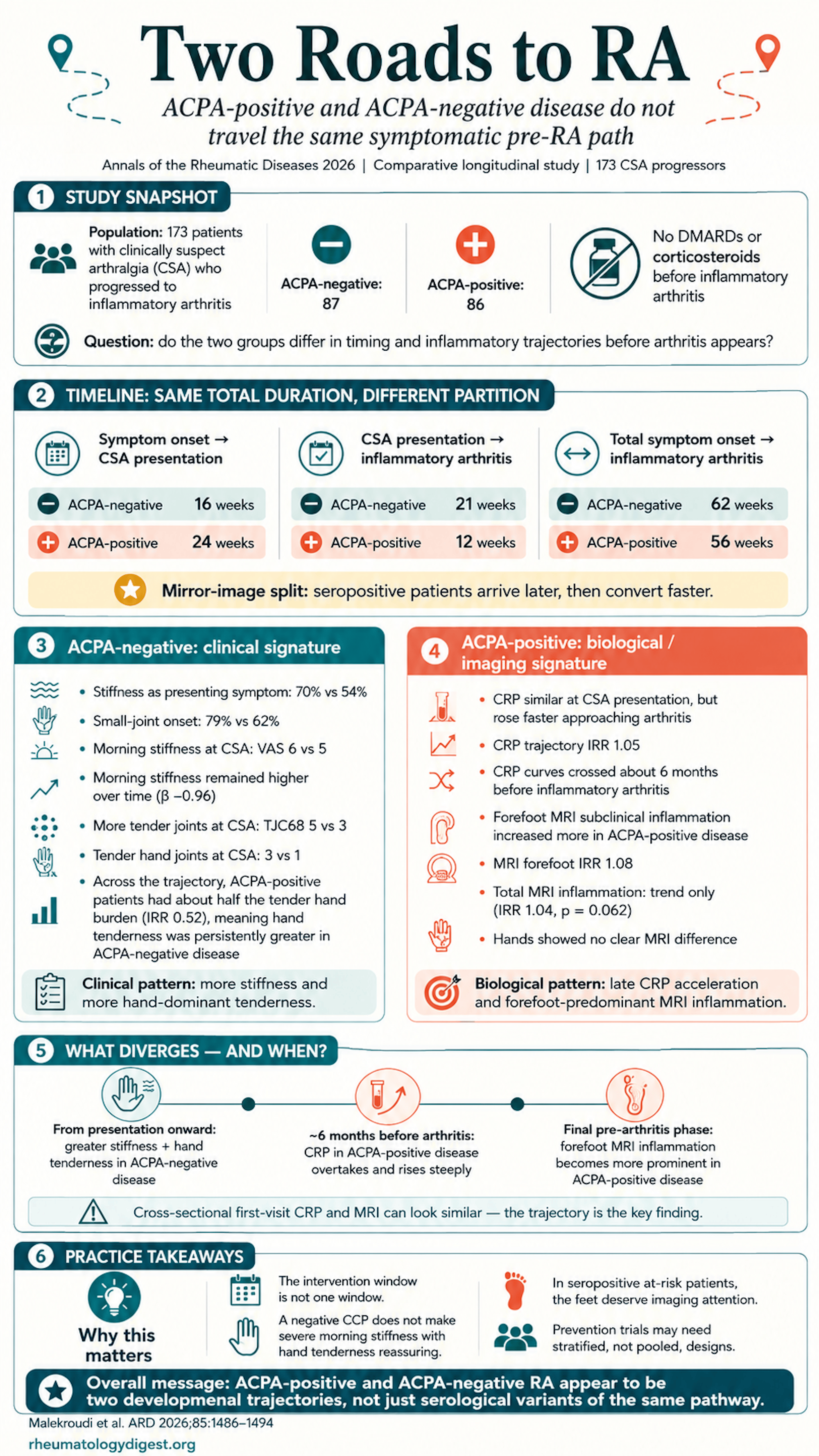
TL;DR: ACPA-positive and ACPA-negative RA take the same total time to travel from first symptom to arthritis, but split it in mirror image — seropositive patients reach the rheumatologist later and convert faster, leaving roughly half the actionable window once they arrive.
Two entities, one window?
The pre-RA window is well mapped in seropositive disease: autoantibodies about a decade before diagnosis, ACPA maturation around five years out, a cytokine rise, and symptoms arriving late. For ACPA-negative RA the map is close to blank. That matters because the symptomatic at-risk phase — clinically suspect arthralgia (CSA) — is the presumed window for interception, and trials are being run in exactly that stage.
The two entities already diverge in risk factors, radiographic progression, DMARD-free remission and treatment response, and imaging at diagnosis shows more forefoot involvement in ACPA-positive RA. The open question was whether they also differ before arthritis exists.
The design
173 CSA patients who all went on to develop clinically apparent arthritis — 87 ACPA-negative, 86 ACPA-positive — from the Leiden CSA cohort and the placebo arm of TREAT EARLIER. Morning stiffness, tender joint counts, CRP and contrast-enhanced MRI of hand and foot (RAMRIS) were tracked serially. No DMARDs or corticosteroids were given before arthritis developed, so these are untreated natural trajectories.
One feature makes the timeline comparison interpretable: referral was effectively blind to ACPA status. Dutch primary care guidelines discourage GPs from ordering autoantibodies, a regional campaign had asked them to refer on clinical suspicion alone, and CSA was designated at the first visit before labs returned. Serology could not have driven who arrived when — precisely the confounder that would otherwise manufacture these findings. Hard to replicate where a GP-ordered CCP routinely precedes referral.
The timelines mirror each other
| Interval | ACPA-negative | ACPA-positive | p |
|---|---|---|---|
| Symptom onset → CSA presentation | 16 weeks | 24 weeks | 0.006 |
| CSA presentation → arthritis | 21 weeks | 12 weeks | 0.014 |
| Total, onset → arthritis | 62 weeks | 56 weeks | 0.77 |
The total symptomatic pre-RA period is essentially identical, but apportioned in opposite directions: seropositive patients spend longer in the community and convert quickly once seen, seronegative patients arrive sooner and then linger.
The actionable window — the part after the patient is in front of you — is roughly twice as long in ACPA-negative CSA, in the entity we tend to regard as the less certain one.
Each entity has its own signature
| Marker | Higher in | Detail |
|---|---|---|
| Morning stiffness | ACPA-negative | Presenting symptom in 70% vs 54%; more severe throughout (β −0.96, 95% CI −1.76 to −0.17) |
| Small-joint onset | ACPA-negative | 79% vs 62% |
| Tender joint count | ACPA-negative | TJC68 5 vs 3 at presentation; ACPA-positive carried about half the tender hand joint burden throughout (IRR 0.52, 0.37–0.72) |
| CRP | ACPA-positive | Faster rise approaching arthritis (IRR 1.05, 1.01–1.08); trajectories cross around 6 months out |
| MRI forefoot inflammation | ACPA-positive | IRR 1.08 (1.00–1.16); hands showed no difference (1.03, ns) |
CRP and total MRI inflammation were indistinguishable at CSA presentation — 3 vs 4 mg/L and 5 vs 6 — and diverged only over time, so a cross-sectional look at the first visit misses this entirely. The imaging signal was confined to the forefoot, pushing back to the pre-arthritis phase a compartmental preference already described at diagnosis.
Tender joints and MRI dissociate
An internal tension: ACPA-positive patients had more forefoot inflammation on MRI but no more tender foot joints. MRI is more sensitive than palpation there, but the authors go further — tender joint count is not a pure inflammation measure, and comorbid pain or central sensitisation may already be operating in the pre-RA phase. If those mechanisms are commoner in ACPA-negative feet, they would mask the difference. TJC is a noisy proxy for inflammation in at-risk populations, and the discrepancy is itself a finding.
A related clarification: the higher joint count in ACPA-negative RA has often been dismissed as an artefact of the 2010 criteria, which need more involved joints to reach six points. These data undercut that — the excess is present throughout the pre-disease phase, where no criteria were applied.
How much to believe
Effect sizes are modest and several confidence intervals sit on unity — the MRI findings above, and a stiffness difference of about one VAS point. Many comparisons across four marker domains, uncorrected — the borderline findings are the vulnerable ones. Analysed by any autoantibody rather than ACPA alone, the CRP signal lost significance while total MRI gained it, so CRP looks tied specifically to ACPA.
Symptom onset dates were patient-reported, and the 8-week onset-to-CSA difference is most exposed to recall. CRP was the only systemic marker, so mechanism is inferred rather than shown. And because only patients who progressed were studied, this describes how converters travel — it cannot say who will convert. Single Dutch region, and the serology-naïve referral pathway that makes it interpretable is itself a local feature.
One objection the authors do pre-empt persuasively is the perennial charge that ACPA-negative RA is a wastebasket. They point to exclusion of likely alternative diagnoses at inclusion, a sensitivity analysis restricted to those meeting classification criteria, ACPA status remaining stable across the entire trajectory, and the rarity of anti-CarP and anti-acetylated antibodies in ACPA- and RF-negative at-risk individuals.
What this changes
- The intervention window is not one window. Prevention trials that recruit at CSA presentation and treat for a fixed duration are intervening at different points in the course for the two groups.
- Do not let a negative CCP downgrade suspicion in a patient with severe morning stiffness and prominent hand tenderness — that is the characteristic ACPA-negative pre-RA phenotype, not a reassuring one.
- Image the feet in seropositive at-risk patients. Forefoot subclinical inflammation accelerates specifically in ACPA-positive disease and will not be found on examination, because tenderness does not track it.
- A rising CRP in seropositive CSA is a late signal — the curves cross about six months before conversion. A marker of imminence rather than of risk.
- The seropositive delay is pre-referral. Roughly 24 weeks pass between symptom onset and rheumatology presentation — a health-systems target, not a biological inevitability.
Long-term TREAT EARLIER data already showed the most durable methotrexate effect in the ACPA-negative group. Set alongside two distinct developmental trajectories, the case for stratified rather than pooled prevention trials becomes difficult to dismiss.