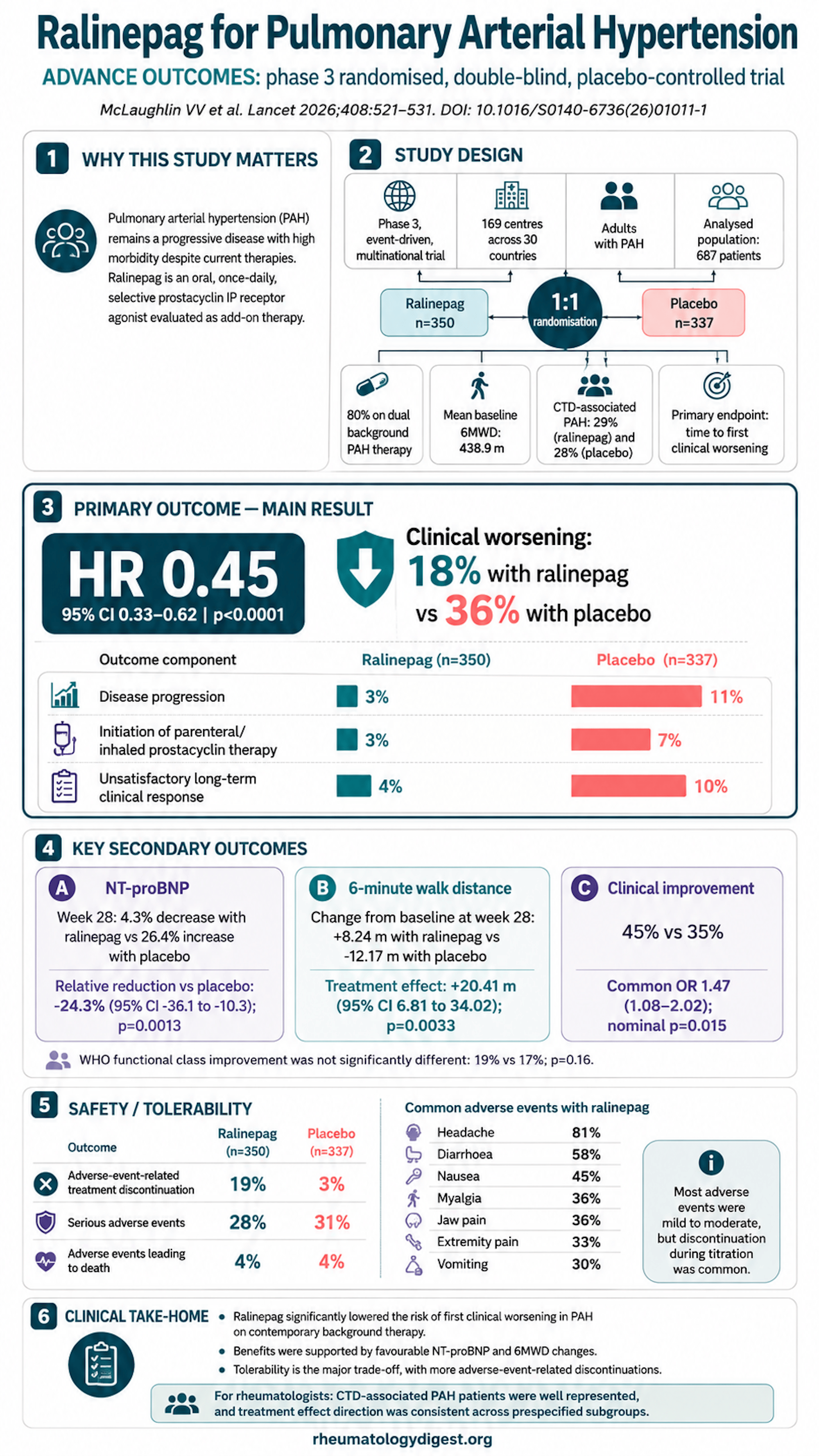
TL;DR: Once-daily oral ralinepag cut first clinical worsening by 55% (HR 0.45) in a largely low-risk, dual-therapy PAH population — but the effect was carried entirely by the softer composite components, with death (3% vs 3%) and hospitalisation (5% vs 6%) unchanged, the secondary hierarchy stopping at WHO functional class, and 19% discontinuing for adverse events. The most useful clinical signal may be the placebo arm: 36% of apparently stable patients still deteriorated.
The Clinical Problem
Pulmonary arterial hypertension remains one of the most lethal complications encountered in rheumatology practice, and connective tissue disease-associated PAH carries a particularly poor prognosis. Despite three decades of drug development, outcomes remain sobering — five-year survival in the French registry cohort was only 52%.
Sixteen agents are now approved across four pathways (nitric oxide, endothelin, prostacyclin, activin signalling). The prostacyclin pathway is the most potent but the most difficult to deploy in practice, for practical rather than pharmacological reasons: parenteral routes require indwelling catheters or pumps, inhaled formulations demand multiple daily administrations, and the available oral agent (selexipag) requires twice-daily dosing with an intensive titration schedule and substantial class side effects.
The therapeutic gap is therefore specific: a prostacyclin-pathway agent that is oral, once-daily, and tolerable enough for use as third-line add-on therapy in patients already on dual background treatment, before escalation to parenteral prostacyclins becomes necessary.
Ralinepag is an oral, highly selective, non-prostanoid prostacyclin IP receptor agonist. In preclinical work it was more potent than selexipag’s active metabolite at raising intracellular cAMP, with a longer half-life permitting once-daily dosing. Phase 2 showed reduced pulmonary vascular resistance versus placebo, and an open-label extension showed sustained haemodynamic, functional-class and exercise-capacity gains over 24 months.
The Research Question
In adults with PAH — the majority already receiving contemporary dual oral background therapy — does adding once-daily oral ralinepag, titrated to the highest individually tolerated dose, delay the time to first clinical worsening event compared with placebo, and is it tolerable enough to sustain?
How the Study Was Designed
Design: Multinational, randomised, double-blind, placebo-controlled, event-driven phase 3 trial across 169 pulmonary hypertension centres in 30 countries.
Key eligibility:
- Age ≥18 years
- PAH by the 2022 ESC/ERS haemodynamic definition, confirmed by right heart catheterisation: mPAP >20 mm Hg, PAWP ≤15 mm Hg, PVR >2 Wood units
- WHO functional class II–IV
- Stable oral background PAH regimen for ≥30 days
- Excluded: FEV1 <60% or TLC <60% predicted; pregnancy or breastfeeding
A design detail worth noting: this is the first PAH outcome trial to use the lowered 2022 haemodynamic thresholds (PVR >2 WU rather than the historical ≥3 WU). This admits a milder-haemodynamic population than any prior pivotal PAH trial and materially affects how the results should be generalised.
Randomisation and masking: 1:1, block size four within each stratum. Stratified by baseline 6MWD (<400 vs ≥400 m), CTD-associated PAH versus other aetiologies, and background therapy (two agents vs one or none). Sponsor, patients, investigators, care providers and outcome assessors all masked; identical tablets and packaging.
Intervention: Ralinepag or placebo from 50 µg once daily, titrated weekly in 50 µg increments to the highest tolerated individualised dose. Critically, no upper dose ceiling was specified. Titration ran 16 weeks; visits at weeks 4, 8, 12, 16, then every 12 weeks.
Primary outcome — time to first clinical worsening event, a composite of:
- Death from any cause
- Hospitalisation for worsening PAH, right heart failure, or both
- Initiation of parenteral or inhaled prostacyclin-pathway therapy
- Disease progression — ≥15% fall in 6MWD (confirmed on a second test on a different day) plus either worsening WHO functional class or the need for additional PAH therapy
- Unsatisfactory long-term clinical response — all three of: receipt of trial drug for ≥28 weeks, a confirmed decrease in 6MWD at or after week 28, and sustained WHO FC III/IV for ≥28 consecutive weeks
All events were adjudicated by an independent, blinded clinical endpoint committee.
Secondary outcomes (hierarchical, fixed-sequence, two-sided α 0.05, testing stopped at the first non-significant result): NT-proBNP change to week 28 → 6MWD change to week 28 → WHO FC improvement at week 28 → clinical improvement at week 28 → time to first all-cause non-elective hospitalisation → time to death → attainment of all three non-invasive low-risk criteria → REVEAL Lite 2, SF-36 PCS/MCS, heart rate recovery.
Statistical framework:
- Power: ~180 events for ≥80% power to detect HR 0.65 at two-sided α 0.05, assuming a placebo annual event rate of 15% — corresponding to roughly 700–1000 patients.
- Cox proportional hazards with treatment, aetiology (CTD vs other) and background therapy as factors, baseline 6MWD continuous. Proportional hazards assumption checked (log-log plot, Schoenfeld residuals, treatment × log(time) interaction) — no violation.
- Estimand strategy: a treatment policy strategy for the primary outcome — all intercurrent events (discontinuation, background therapy changes, rescue or prohibited medications) ignored, all post-event observations retained. The ITT-analogous, conservative choice.
- For NT-proBNP and 6MWD a composite strategy: values missing due to death or clinical worsening, and 6MWD missing due to inability to walk, imputed with the worst observed change from baseline plus a random error term, then MMRM. FC and clinical improvement used non-responder imputation.
- Post-hoc inverse probability of censoring weighting (IPCW) analyses were added to address informative censoring — a direct acknowledgement that differential dropout was anticipated.
The Results
Patient flow and exposure
- Enrolment Jan 2019 – June 2025; last visit 31 Dec 2025.
- 1037 screened → 728 randomised and dosed → 687 in the full analysis and safety sets (350 ralinepag, 337 placebo).
- 41 randomised, treated patients from Chinese sites were excluded from primary analyses because of regulatory challenges and data integrity concerns (14 ralinepag, 27 placebo). A prespecified sensitivity analysis including them was consistent.
- Median follow-up: 85.0 weeks vs 78.4 weeks. Total exposure 699.3 vs 642.3 patient-years.
- Median achieved dose: 250 µg at week 28, 300 µg at week 52 — well above the 50 µg start, confirming meaningful uptitration.
Baseline — a notably well-treated, low-risk cohort
- Median age 53; 76% female; median time since diagnosis 2.1–2.6 years.
- Aetiology: idiopathic ~57%; connective tissue disease 100 (29%) vs 94 (28%); heritable 4–6%; drug/toxin ~3%; HIV ~3%.
- Mean 6MWD 438.9 m (SD 104.8) — high for a PAH trial. Median NT-proBNP 233.5 vs 192.0 pg/mL — low. Mean mPAP 45.5 mm Hg.
- 548 (80%) on dual therapy (ERA + PDE5i in ~73%); only 2% untreated.
- REVEAL Lite 2 low risk 71%/73%. COMPERA 2.0 low risk 54% vs 48%.
- A baseline imbalance worth flagging: WHO FC II in 261 (75%) ralinepag vs 223 (66%) placebo; FC III in 89 (25%) vs 113 (34%). The placebo arm was modestly sicker by functional class.
Primary outcome
- 185 adjudicated first clinical worsening events: 64 (18%) of 350 ralinepag vs 121 (36%) of 337 placebo.
- HR 0.45 (95% CI 0.33–0.62); p<0.0001 — a 55% relative risk reduction, comfortably exceeding the 0.65 the trial was powered to detect.
- Kaplan–Meier curves separated by week 8 and remained separated to 208 weeks (4 years).
- Direction of effect consistent across all prespecified subgroups, including CTD-PAH.
Composition of the composite — the most important table in the paper
| Component | Ralinepag (n=350) | Placebo (n=337) |
|---|---|---|
| Death from any cause | 11 (3%) | 10 (3%) |
| Hospitalisation for worsening PAH / RHF | 19 (5%) | 20 (6%) |
| Initiation of parenteral or inhaled prostacyclin | 10 (3%) | 22 (7%) |
| Disease progression | 10 (3%) | 36 (11%) |
| Unsatisfactory long-term clinical response | 14 (4%) | 33 (10%) |
The entire treatment effect is carried by the three “softer” components. Death and hospitalisation were essentially superimposable. The authors are transparent about this and argue, citing REVEAL and prior morbidity data, that in a predominantly low-risk pretreated population morbidity events precede mortality events and few hard events would be expected as first events over this follow-up.
Sensitivity analyses
- Investigator-reported (rather than adjudicated) worsening: consistent.
- Inclusion of Chinese sites: consistent.
- Post-hoc analysis treating unsatisfactory long-term clinical response as censoring rather than an event: consistent.
- IPCW analyses: HR attenuated modestly to 0.50–0.52 versus 0.45 in the primary analysis.
Secondary outcomes — where the hierarchy broke
- NT-proBNP (week 28): −4.3% ralinepag vs +26.4% placebo → 24.3% lower (95% CI −36.1 to −10.3); p=0.0013. Note the placebo arm rose; much of the “benefit” is prevention of deterioration rather than active reduction.
- 6MWD (week 28): LS mean +8.24 m vs −12.17 m → treatment effect 20.41 m (6.81 to 34.02); p=0.0033. Statistically robust but modest, and near or below most estimates of the minimal important difference — in a cohort already walking ~439 m (a likely ceiling effect).
- WHO functional class improvement (week 28): 67 (19%) vs 57 (17%); common OR 1.34 (0.89–2.01); p=0.16 — NOT SIGNIFICANT. The fixed-sequence hierarchy stopped here. Everything below is nominal and formally exploratory.
- Clinical improvement (composite responder): 154/346 (45%) vs 116/335 (35%); common OR 1.47 (1.08–2.02); nominal p=0.015.
- Observed-case FC shift analysis (less conservative missingness handling): improved 24% vs 19%, deteriorated 2% vs 3%; nominal p=0.013 — illustrating how sensitive the FC result is to imputation assumptions.
- Shift in attainment of all three low-risk criteria: improvement 71/254 (28%) vs 61/286 (21%); deterioration 21 (8%) vs 33 (12%).
- No nominal differences for: time to first all-cause non-elective hospitalisation, time to death, attainment of all three low-risk criteria at week 28, REVEAL Lite 2, SF-36 PCS and MCS, or heart rate recovery.
- SF-36 domains (exploratory): physical functioning favoured ralinepag (+1.42, 0.45 to 2.40), but bodily pain favoured placebo (−4.19, −5.58 to −2.80) — a quantified reflection of the prostacyclin pain burden.
Safety and tolerability — the cost side of the ledger
- Total adverse events: 6574 with ralinepag vs 3512 with placebo (nearly double).
- ≥1 AE: 346 (99%) vs 320 (95%).
- Serious AEs: 98 (28%) vs 104 (31%) — numerically fewer with ralinepag.
- AEs leading to death: 15 (4%) vs 14 (4%) — no signal.
- AE as primary reason for discontinuation: 65 (19%) vs 10 (3%).
- Discontinued study drug before completion without an investigator-reported worsening event: 104 (30%) vs 39 (12%).
- Most ralinepag discontinuations (n=57) occurred during the 16-week titration window.
| Adverse event | Ralinepag | Placebo |
|---|---|---|
| Headache | 284 (81%) | 140 (42%) |
| Diarrhoea | 204 (58%) | 95 (28%) |
| Nausea | 158 (45%) | 86 (26%) |
| Myalgia | 126 (36%) | 36 (11%) |
| Jaw pain | 125 (36%) | 30 (9%) |
| Extremity pain | 114 (33%) | 27 (8%) |
| Vomiting | 104 (30%) | 38 (11%) |
| Flushing | 76 (22%) | 22 (7%) |
| Arthralgia | 68 (19%) | 38 (11%) |
| Decreased appetite | 37 (11%) | 5 (1%) |
Headache was severe in 56 (16%) of ralinepag patients versus 8 (2%) on placebo, and was the single commonest AE leading to discontinuation. Conversely, some events were less frequent with ralinepag — worsening of PAH 5% vs 8%, syncope 4% vs 8%, dizziness 15% vs 19% — consistent with genuine disease modification. No new safety signals.
Study Limitations
- Functional unblinding is the central methodological vulnerability. Headache 81% vs 42%, jaw pain 36% vs 9% — patients and investigators could plausibly infer allocation. This matters enormously because the composite was driven by disease progression and unsatisfactory long-term clinical response, both of which depend on 6MWD effort and investigator judgement about the need for additional therapy. Blinded adjudication protects against misclassification of reported events but cannot protect against biased event generation upstream. The authors acknowledge this directly.
- Differential discontinuation and informative censoring. 30% vs 12% stopped drug without a worsening event. Under a treatment policy strategy patients remain in the analysis, but those lost to follow-up cannot contribute events. The IPCW attenuation from 0.45 to 0.50–0.52 quantifies this — reassuring but not dispositive.
- A subtle definitional asymmetry. “Unsatisfactory long-term clinical response” required receipt of trial drug for ≥28 weeks. Patients who discontinued during the 16-week titration — disproportionately ralinepag — were structurally ineligible to accrue this component. The post-hoc censoring analysis addresses this and was consistent, but it is worth raising.
- No mortality or hospitalisation benefit. The trial does not demonstrate an effect on hard outcomes.
- The hierarchy stopped at WHO functional class. Every subsequent secondary outcome, including the clinical improvement composite that reads well, is nominal.
- Placebo, not active, comparator. No inference about ralinepag versus selexipag, inhaled treprostinil, or parenteral prostacyclins — nor about relative tolerability, the clinically decisive question when choosing among prostacyclin agents.
- Restricted generalisability. Pretreated, 80% dual therapy, largely FC II, walking 439 m, NT-proBNP ~200 pg/mL, >70% low-risk. Applicability to newly diagnosed, high-risk, or FC IV patients is unproven (only one FC IV patient enrolled).
- Design-imposed constraint on recurrent events — patients who worsened entered an open-label extension, so recurrent-event analysis was impossible (ethically appropriate, but a limitation).
- Excluded Chinese sites (n=41); COVID-19 and armed conflict affecting sites in Ukraine and Israel impaired recruitment and retention.
- Sponsor involvement. United Therapeutics designed the trial, collected and analysed the data — mitigated by external statistical review of the SAP, an independent DMC, blinded adjudication, and full author data access.
How This Study Adds to Practice
A genuinely new therapeutic option with a favourable administration profile. ADVANCE OUTCOMES is only the second randomised controlled trial of an oral prostacyclin IP receptor agonist in PAH, and the first PAH outcome trial conducted under the 2022 ESC/ERS haemodynamic definition. It establishes once-daily oral ralinepag, with no fixed dose ceiling, as an effective option for prostacyclin-pathway intensification.
It validates escalation in “well-controlled” patients — arguably the most practice-changing message. The cohort was largely low-risk, FC II, on dual therapy, walking 439 m — precisely the patients in whom clinicians are tempted to hold at two drugs. Yet 36% of placebo patients experienced clinical worsening. Comfortable haemodynamic and functional numbers are not a licence for therapeutic complacency.
It reframes the comparison with GRIPHON. Against the selexipag pivotal trial, ADVANCE OUTCOMES enrolled a far better-treated population: dual background therapy 80% vs 33%, baseline 6MWD 439 m vs 353 m, NT-proBNP 213 vs 515 pg/mL. Demonstrating benefit in this healthier cohort is a higher bar — though it also means the two trials are not directly comparable.
Direct relevance to rheumatology. CTD-PAH comprised 29% of the cohort — 194 patients, one of the larger CTD-PAH populations in any randomised PAH trial — and was a prespecified randomisation stratum. The direction of effect was consistent in this subgroup, historically the one with the worst outcomes. This supports early triple-pathway escalation in systemic sclerosis-associated PAH.
But the tolerability arithmetic must be discussed honestly with patients. 19% stopped for adverse events, mostly during titration, with headache in 81% and severe headache in 16%. The number needed to treat to prevent one clinical worsening event is roughly 6 — while the number needed to harm for AE-driven discontinuation is around 6 as well. The trial does not tell us whether the benefit outweighs the burden for an individual patient — it tells us the trade-off exists and must be navigated. Structured counselling before initiation, slow titration, and prophylactic symptom management during the first 16 weeks are where the clinical work lies.
Specific cautions when prescribing in systemic sclerosis:
- Gastrointestinal overlap: diarrhoea 58%, nausea 45%, vomiting 30%, decreased appetite 11%. In SSc with established GI involvement — dysmotility, SIBO, malabsorption — these events will be harder to attribute and harder to tolerate. Baseline GI phenotyping before initiation is prudent.
- Musculoskeletal overlap: myalgia 36%, arthralgia 19%, extremity pain 33%. In inflammatory myopathy, overlap syndromes, or SSc with tendon friction rubs, distinguishing drug-related prostacyclin pain from disease activity will be a recurring diagnostic problem. Document baseline pain scores.
- Jaw pain in 36% deserves particular thought in SSc patients with microstomia or reduced oral aperture.
- The SF-36 bodily pain domain moved against ralinepag, quantifying what these numbers mean for patient experience.
Final Take-Aways
- Ralinepag reduced first clinical worsening by 55% (HR 0.45, 95% CI 0.33–0.62; p<0.0001) in 687 patients, 80% already on dual oral background therapy. Kaplan–Meier separation appeared by week 8 and persisted for four years.
- The effect was carried entirely by softer composite components — disease progression (3% vs 11%), initiation of parenteral or inhaled prostacyclin (3% vs 7%), and unsatisfactory long-term clinical response (4% vs 10%). Death (3% vs 3%) and hospitalisation (5% vs 6%) were unchanged.
- The secondary hierarchy stopped at WHO functional class. NT-proBNP (24.3% lower, p=0.0013) and 6MWD (+20.41 m, p=0.0033) were formally positive; WHO FC improvement was not (OR 1.34, p=0.16). Everything beyond that — including the appealing clinical improvement composite (45% vs 35%) — is nominal.
- Tolerability is the limiting factor, not efficacy. Headache 81% (severe in 16%), diarrhoea 58%, myalgia 36%, jaw pain 36%; 19% discontinued for adverse events versus 3%, most within the 16-week titration. Serious adverse events and deaths, however, were no higher than placebo.
- The most useful clinical insight is the placebo arm. More than one in three patients who looked stable on dual therapy — FC II, walking 439 m, low-risk by REVEAL Lite 2 — deteriorated. Risk stratification identifies who is low-risk today, not who will remain so.
- For CTD-PAH specifically, a stratified subgroup of 194 patients showed a consistent direction of benefit, supporting timely triple-pathway escalation in a phenotype with historically poor outcomes.
- Unanswered questions: how ralinepag compares directly with selexipag or inhaled prostacyclins; whether the titration burden can be reduced without losing efficacy; whether the morbidity benefit eventually translates into mortality benefit; and how it should be sequenced relative to sotatercept in the modern four-pathway landscape.