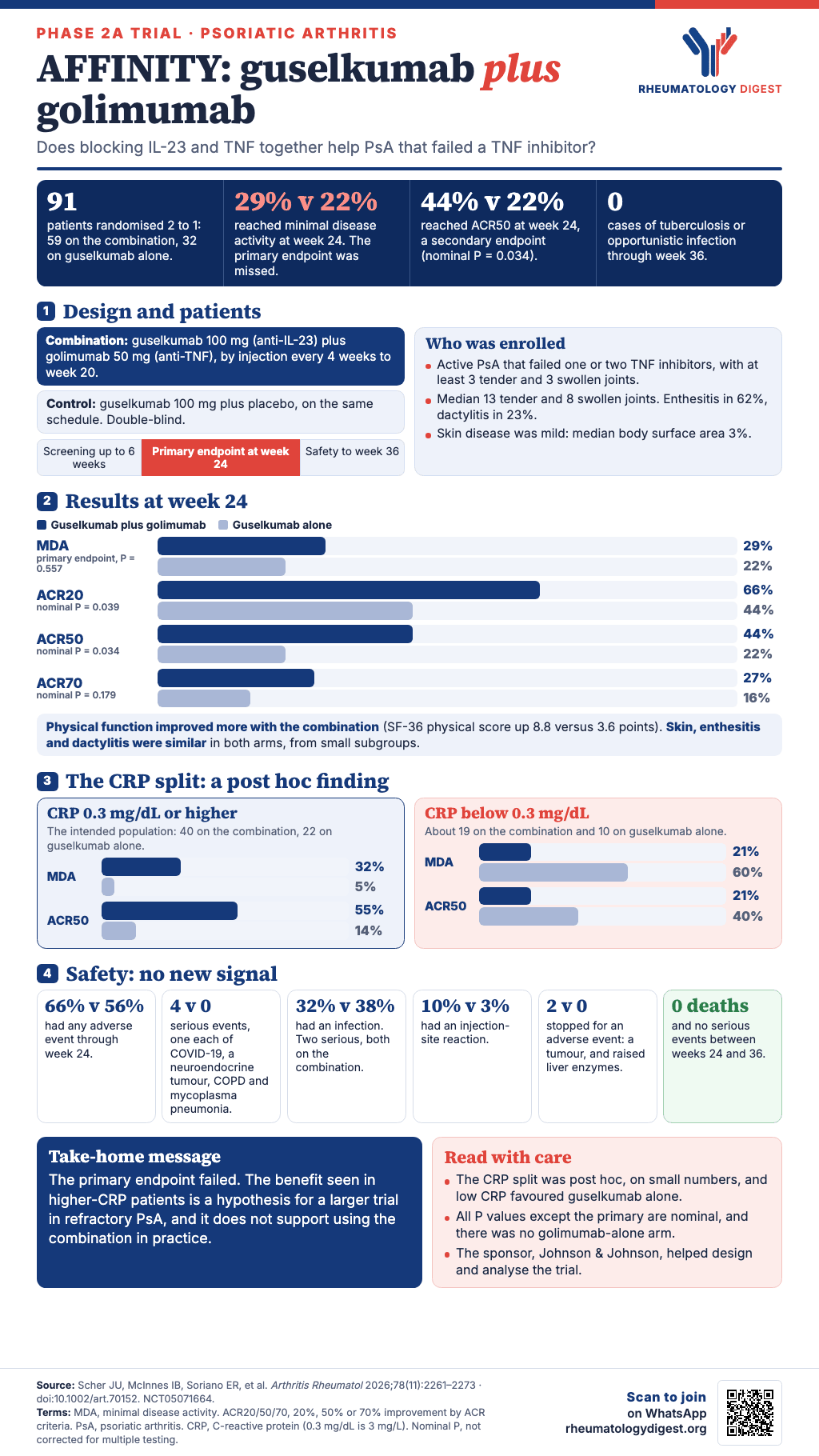
TL;DR: In AFFINITY, adding golimumab (anti-TNF) to guselkumab (anti-IL-23) in TNF-inhibitor-refractory psoriatic arthritis did not meet its primary endpoint (minimal disease activity at week 24: 29% vs 22%), but ACR50 and physical function favoured the combination, mainly in patients with CRP of 0.3 mg/dL or more (a post hoc finding, with the opposite direction in low-CRP patients), and no new safety signal emerged, so this is a hypothesis for a larger trial and not a treatment option.
Psoriatic arthritis (PsA) that fails a TNF inhibitor (TNFi) is a recognised problem. The authors cite data that more than 40% of patients on a TNFi do not reach ACR20 at six months, that efficacy tends to fall with each successive TNFi, that drug persistence is lower with later biologics even when the mechanism differs, and that most patients on advanced therapy do not reach sustained remission. This trial asks whether blocking two pathways at once, IL-23 and TNF, can raise the ceiling in these patients.
Why combine an IL-23 and a TNF inhibitor?
- Different jobs. IL-23 promotes Th17 cell differentiation and is a major driver of skin and enthesial inflammation. TNF drives synovial inflammation and activates osteoclasts and synovial fibroblasts, which leads to bone destruction. The authors suggest that joint disease involves more mechanisms than IL-23 alone, so adding anti-TNF could matter most for joints.
- Guselkumab is a fully human antibody against the p19 subunit of IL-23 that also binds CD64 on IL-23-producing monocytes. It is approved for plaque psoriasis, PsA, ulcerative colitis and Crohn’s disease. Golimumab is a fully human anti-TNF antibody approved for PsA, ankylosing spondylitis, juvenile idiopathic arthritis and ulcerative colitis.
- Earlier signals. A mouse colitis model suggested synergy. In the phase 2 VEGA study in TNFi-naïve ulcerative colitis, guselkumab plus golimumab induction followed by guselkumab maintenance gave higher clinical and histological remission, endoscopic improvement and CRP reduction than either drug alone, with similar adverse event rates.
- Cautions the authors acknowledge. Biologic combinations in rheumatoid arthritis showed limited efficacy and safety concerns, and the IL-17/TNF bispecific antibody ABT-122 showed no clear benefit beyond a TNFi in rheumatoid arthritis or PsA.
Trial design
AFFINITY (NCT05071664) was a phase 2a, multicentre, randomised, double-blind, active-controlled proof-of-concept study sponsored by Johnson & Johnson.
- Arms (2:1): subcutaneous guselkumab 100 mg plus golimumab 50 mg (n = 59) versus guselkumab 100 mg plus placebo (n = 32), at week 0 and every 4 weeks through week 20, in identical prefilled syringes.
- Phases: screening up to 6 weeks, a 24-week double-blind period, and a week 36 safety follow-up during which a switch to standard care was allowed.
- Who was eligible: adults aged 18–65 with PsA for at least 6 months who met CASPAR criteria, with at least three tender and three swollen joints, active plaque psoriasis (a plaque of at least 2 cm or nail changes), and inadequate response to one or two TNFi (at least 12 weeks of etanercept, adalimumab or certolizumab, or at least 14 weeks of infliximab, with the last dose more than five half-lives earlier). Prior guselkumab or golimumab, more than two TNFi, and any prior non-TNFi biologic were exclusions.
- Primary endpoint: minimal disease activity (MDA) at week 24, defined as meeting at least five of seven criteria: tender joints ≤1, swollen joints ≤1, PASI ≤1 or psoriatic body surface area ≤3%, patient pain ≤1.5, patient global ≤2.0, HAQ-DI ≤0.5 and Leeds Enthesitis Index ≤1.
- Secondary endpoints: MDA at week 16; ACR20, ACR50 and ACR70; resolution of enthesitis and dactylitis; PASI90 and PASI100; IGA 0/1; SF-36 physical component summary and HAQ-DI; safety.
- Statistics: the sample size assumed MDA rates of 45% versus 20% (60 and 30 patients; over 80% power, one-sided α = 0.1). Estimates carry 90% confidence intervals. Non-responder imputation was used for binary endpoints, and anyone who started a prohibited drug, started or raised a csDMARD or oral steroid, or stopped treatment was counted as a non-responder. Apart from the primary endpoint, all P values are nominal, with no correction for multiple testing.
A protocol change that matters. Screening hs-CRP of 0.3 mg/dL or more (3 mg/L) was originally required. A protocol amendment, made to offset the effect of the Ukraine–Russia conflict on recruitment, removed the minimum, and allowed up to 10% of participants with CRP under 0.1 mg/dL. The authors therefore describe CRP of 0.3 mg/dL or more as the “intended enrolment population”, and the CRP subgroup analyses were done post hoc after the amendment.
Who was enrolled
Between November 2021 and November 2023, 155 people were screened in nine countries (Denmark, France, Hungary, Italy, Poland, Russia, Spain, Ukraine and the United States) and 91 were randomised. At week 24, 92% of the combination group and 88% of the monotherapy group were still on treatment.
- Disease: mean PsA duration 7.8 years, median 13 tender and 8 swollen joints, enthesitis in 62%, dactylitis in 23%. Skin disease was mild to moderate (median body surface area 3.0%). Mean HAQ-DI was 1.2 and mean SF-36 physical score 32.1, which the authors read as moderate-to-severe disability.
- Prior treatment: all had a TNFi (one in 85%, two in 14%; one participant had three and was enrolled in error). About 45% were on a csDMARD at baseline, and 9% on oral steroids.
- Imbalances: the combination group had longer psoriasis (13.4 vs 10.0 years), more nail disease (67% vs 59%), more people with baseline CRP of 0.3 mg/dL or more (71% vs 66%) and fewer with baseline CRP under 0.1 mg/dL (8% vs 25%).
- Screening CRP ≥0.3 mg/dL (the intended population) made up 62 patients (40 combination, 22 monotherapy). These patients were more often female (64% vs 55%), more often had dactylitis (29% vs 10%), had higher BMI (31.7 vs 29.8), longer PsA (8.9 vs 5.5 years) and more severe psoriasis (median PASI 5.6 vs 2.7).
Results at week 24
Primary endpoint missed. MDA was reached by 29% with the combination and 22% with guselkumab alone (odds ratio 1.4, 90% CI 0.6–3.3; P = 0.557). At week 16 the figures were 32% and 12% (nominal P = 0.056). The participant-level data showed more patients in the combination arm meeting the joint, pain, global and function components of MDA earlier, while the skin (PASI ≤1 or BSA ≤3%) and enthesitis components were met about equally in both arms. The authors suggest this pattern may explain why the composite did not separate.
Secondary joint outcomes favoured the combination (nominal P values):
| Week 24 | Combination | Guselkumab alone | Nominal P |
|---|---|---|---|
| ACR20 | 66% | 44% | 0.039 |
| ACR50 | 44% | 22% | 0.034 |
| ACR70 | 27% | 16% | 0.179 |
Function. The SF-36 physical component score rose by a least-squares mean of 8.84 with the combination against 3.59 with monotherapy (nominal P = 0.010), crossing the clinically meaningful threshold (5 points) by week 8 on average. The HAQ-DI fell by 0.39 versus 0.26 (nominal P = 0.263), also passing its meaningful threshold (0.35) by week 8 with the combination.
Skin, entheses and dactylitis were similar, and numbers were small.
- Enthesitis resolved in 17 of 35 (49%) versus 11 of 21 (52%).
- Dactylitis resolved in 8 of 13 (62%) versus 7 of 8 (88%).
- Among patients with at least 3% body surface area and IGA of 2 or more (22 and 13 patients), PASI90 was 54% versus 38% and PASI100 was 32% versus 31%. IGA 0/1 with a two-grade fall was 54% versus 62%.
The CRP split
A post hoc analysis divided patients by screening CRP. The interaction between treatment arm and CRP level was significant (P = 0.002 for MDA and P = 0.007 for ACR50).
| Week 24 | CRP ≥0.3 mg/dL (combination n = 40, monotherapy n = 22) | CRP <0.3 mg/dL |
|---|---|---|
| MDA | 32% vs 5%, OR 12.3 (90% CI 2.0–77.8), nominal P = 0.025 | 21% vs 60%, OR 0.1 (90% CI 0.0–0.6), nominal P = 0.037 |
| ACR50 | 55% vs 14%, OR 9.6 (90% CI 2.7–33.7), nominal P = 0.003 | 21% vs 40%, OR 0.4 (90% CI 0.1–2.0), nominal P = 0.364 |
Two things deserve emphasis. First, the wide confidence intervals show how few patients drive these ratios. By subtraction, the low-CRP group held about 19 patients on the combination and 10 on monotherapy, so the “60%” in that group is about six of ten. Second, the low-CRP signal runs against the combination, a result the authors do not explain beyond saying that patients with higher inflammatory burden may benefit more from the additive effect. The authors say the CRP hypothesis, and the possible role of other inflammation markers, needs testing in a larger cohort.
Safety through week 36
- Adverse events through week 24: 66% with the combination and 56% with monotherapy. Commonest with the combination: diarrhoea (10%), COVID-19 (8%) and headache (8%). Commonest with monotherapy: nasopharyngitis (9%), upper respiratory infection (6%) and influenza (6%).
- Serious adverse events: four (7%) in the combination arm and none with monotherapy: one each of COVID-19, a neuroendocrine tumour, COPD and mycoplasma pneumonia. The mycoplasma pneumonia was the only serious event the investigators judged treatment-related, and it resolved.
- Infections: 32% versus 38%. Two serious infections (COVID-19 and mycoplasma pneumonia) in the combination arm. No tuberculosis and no opportunistic infections.
- Injection-site reactions: 10% versus 3%.
- Discontinuation for adverse events: two, both on the combination: the neuroendocrine tumour (reported early in treatment) and raised liver enzymes.
- Weeks 24 to 36: no deaths, serious adverse events, serious infections, tuberculosis or opportunistic infections.
The authors conclude there were no new or unexpected safety findings compared with the known profiles of either drug. A trial of 91 patients followed for 36 weeks cannot rule out rarer events.
How the authors interpret it
- Joints more than skin. IL-23 is a major cytokine for skin and entheses, which guselkumab already treats well, whereas joint disease involves additional mechanisms. Neutralising TNF as well may therefore have a more marked effect on joints, and the authors suggest a faster onset (separation in SF-36 from week 16, in MDA at week 16), though they say larger studies are needed to check.
- Monotherapy performance was as expected. Guselkumab alone performed in line with the phase 3 data in TNFi-inadequate responders. The authors point to the phase 3 SOLSTICE trial, which showed significant benefit for both guselkumab regimens against placebo in this population.
- Biological rationale. In ulcerative colitis biopsies from VEGA, combination therapy reduced inflammatory gene modules by week 4, and the authors read guselkumab as the main driver of tissue healing with golimumab adding anti-innate inflammatory activity.
- A place in difficult-to-treat PsA. They link the result to the GRAPPA definition of difficult-to-treat PsA (persistent inflammation despite multiple treatments) and suggest the strategy might lay a foundation for care in refractory disease with persistent inflammation.
Limitations the authors state
- Small, proof-of-concept sample, which limits generalisability and power for secondary endpoints. The trial was adequately powered for the primary endpoint under its assumptions, and the observed rates (29% vs 22%) were well below the 45% vs 20% assumed.
- The CRP amendment probably affected the findings, and fewer participants with the intended characteristics were enrolled than planned.
- Subgroups with psoriasis, enthesitis or dactylitis were small, so those results should be interpreted with caution. Low baseline skin burden makes PASI changes harder to detect.
- A single comparator. There was no golimumab-alone arm, which is why the authors say future designs should assess both monotherapy arms.
- Sponsor involvement. The study was supported by Johnson & Johnson. Employees took part in the design and in data collection, analysis and interpretation, and publication was contingent on the company’s approval.
For next steps they suggest ACR50 as the primary endpoint, both monotherapy arms, a broader range of PsA patients regardless of prior treatment, ongoing biomarker analyses, and the phase 2b DUET-UC and DUET-CD trials of the same combination in ulcerative colitis and Crohn’s disease for further safety and efficacy data.
What it adds up to
AFFINITY did not show that dual IL-23 and TNF blockade works in TNFi-refractory PsA. Its prespecified primary endpoint failed, its supportive findings are secondary or post hoc, and its most interesting signal (a large benefit in higher-CRP patients) comes with an opposite signal in lower-CRP patients, on small numbers. What it does offer is a testable hypothesis, namely that persistently inflamed, refractory patients are the ones to study, a safety profile that raised no new concerns over 36 weeks, and a template for a better-designed trial.