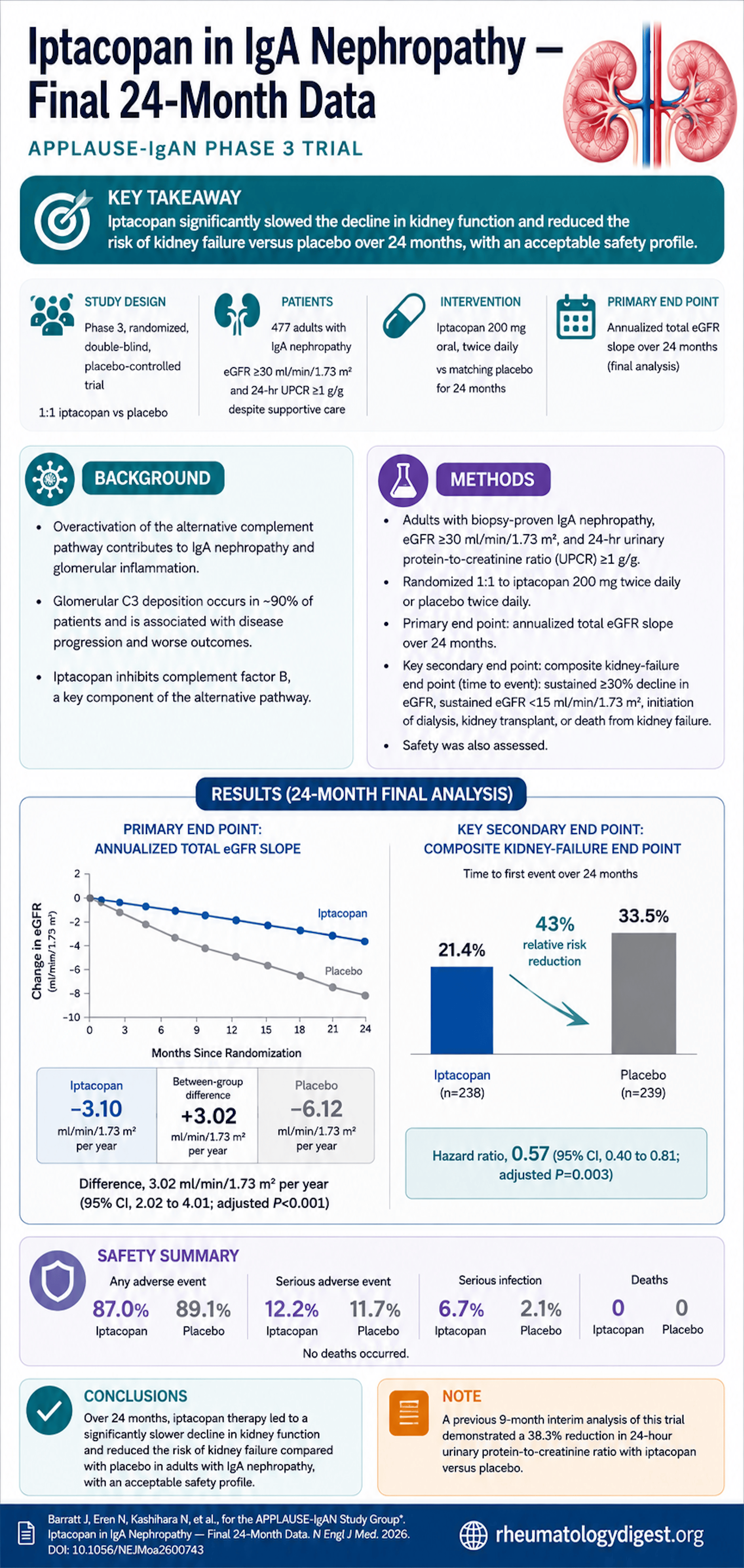
TL;DR: The oral factor B inhibitor iptacopan roughly halved the rate of eGFR decline in high-risk IgA nephropathy (−3.10 vs −6.12 ml/min/1.73 m²/year) and cut the composite kidney-failure endpoint from 33.5% to 21.4% (HR 0.57) over 24 months — converting an accelerated approval based on proteinuria into evidence on preserved kidney function; the trade-off is a three-fold higher rate of serious infection, making meningococcal and pneumococcal vaccination mandatory.
The Clinical Problem
IgA nephropathy is the commonest primary glomerulonephritis worldwide, and despite decades of “supportive care” orthodoxy the natural history remains poor — up to 50% of patients progress to kidney failure within 10 to 20 years of diagnosis. Traditional management targeted haemodynamics rather than mechanism: blood-pressure control, RAS blockade, lifestyle measures, all aimed at reducing glomerular hyperfiltration.
The mechanistic case for complement is now strong. Glomerular C3 deposition occurs in roughly 90% of patients with IgAN and predicts progression and worse outcomes; intrarenal complement activation beyond the glomerulus may drive tubulointerstitial inflammation and fibrosis; and greater complement activity correlates with faster eGFR decline. Critically, activation in IgAN is driven through the alternative pathway, making factor B a rational target.
The updated KDIGO 2025 guideline reframes the therapeutic goal explicitly: address both fundamental drivers of nephron loss — the IgAN-specific immunological process and the generic CKD process — simultaneously. That creates space for a mechanism-directed agent layered on top of optimised supportive care.
Iptacopan is an oral, potent factor B inhibitor. Blocking factor B prevents alternative-pathway C3 cleavage and shuts down the amplification loop, preventing downstream membrane attack complex generation. It already has proven efficacy in two archetypal alternative-pathway diseases — C3 glomerulopathy and paroxysmal nocturnal haemoglobinuria.
The regulatory context matters for how this paper should be read. The 9-month interim analysis of this same trial showed a 38.3% reduction in 24-hour urinary protein-to-creatinine ratio versus placebo, and on that basis iptacopan received accelerated FDA approval for primary IgAN. This publication is the confirmatory piece: does the surrogate translate into preserved kidney function?
The Research Question
In adults with IgA nephropathy at high risk of progression despite maximal supportive care, does oral iptacopan 200 mg twice daily, added to standard therapy, slow the rate of eGFR decline over 24 months — and does it reduce hard kidney-failure events?
How the Study Was Designed
Framework
- Phase 3, international, double-blind, randomised, placebo-controlled. Conducted 25 January 2021 to 19 September 2025; database lock 6 October 2025.
- Screening, run-in of up to 90 days, then a 24-month treatment period. Randomisation 1:1 to iptacopan 200 mg twice daily or matching placebo, both on top of supportive care.
- Stratified by geographic region (Asia vs other), baseline proteinuria (24-h UPCR <2 vs ≥2), and eGFR (30 to <45 vs ≥45 ml/min/1.73 m²).
Participants
- Adults ≥18 years with biopsy-confirmed IgAN, eGFR ≥30 ml/min/1.73 m², and 24-h UPCR ≥1 g/g despite a maximum tolerated and stable dose of ACE inhibitor or ARB for ≥90 days, with or without SGLT2 inhibitor.
- Biopsy recency requirements scaled to renal function: if eGFR ≥45, biopsy within 5 years; if eGFR 30 to <45, biopsy within 2 years and showing <50% tubulointerstitial fibrosis — a sensible guard against enrolling patients whose kidneys were already scarred beyond rescue.
- Vaccination against N. meningitidis and S. pneumoniae was mandatory; H. influenzae type B vaccination recommended per local availability. Non-negotiable with complement blockade.
- A separate low-eGFR cohort (20 to <30 ml/min/1.73 m²) was enrolled but is not reported here.
Endpoints
- Primary (final analysis): annualised total eGFR slope over 24 months.
- Secondary, in prespecified hierarchical order:
- 24-h UPCR <1 at 9 months, without rescue/alternative medication or kidney-replacement therapy
- Composite kidney-failure endpoint (time-to-event): sustained eGFR decline ≥30% from baseline for ≥4 weeks, sustained eGFR <15 for ≥4 weeks, initiation of maintenance dialysis (≥4 weeks), kidney transplant, or death from kidney failure
- Change in FACIT-Fatigue score from baseline to 9 months
- Exploratory: UPCR <1 at 24 months; log-transformed UPCR ratios at 9 and 24 months; alternative-pathway complement biomarkers; haematuria.
Statistics — worth attention
- ~430 patients gave 89–90% power at two-sided α 0.05.
- Primary endpoint by longitudinal mixed-effects model using all eGFR values to month 24 or to initiation of rescue/alternative medication or KRT.
- The intercurrent-event handling is the methodological crux: data collected after rescue medication or KRT were discarded and imputed on the assumption that starting such therapy indicates disease worsening. Missing data after discontinuation due to adverse events, physician decision or failure to meet continuation criteria were likewise imputed to indicate worsening. In the figures, values after glucocorticoids/immunosuppressants/KRT were imputed under “jump to reference” for iptacopan and as missing at random for placebo — a deliberately conservative asymmetry against the active drug.
- Supplementary analyses used a treatment-policy strategy including all values regardless of rescue medication, plus an alternative endpoint of change in eGFR at 24 months.
- Sequentially rejective hierarchical testing controlled familywise error at one-sided 2.5%. Exploratory analyses are reported with unadjusted CIs and should not be read as hypothesis tests.
The Results
Flow and baseline
- 1185 screened → 478 randomised → 477 in the final analysis (238 iptacopan, 239 placebo).
- Discontinuation was markedly asymmetric: 18.9% on iptacopan versus 36.8% on placebo. The commonest reason in both arms was a prespecified one — eGFR reduction of ≥30%. This is itself an efficacy signal, but it also complicates the analysis and is why the imputation strategy matters.
- Rescue or alternative medication for disease progression: 4.6% vs 13.4%.
- Baseline: mean age ~39 years; ~52% Asian, ~46% White; mean eGFR 63.4 vs 65.6; median 24-h UPCR 1.7 vs 1.8; ~27% in each arm had eGFR 30 to <45. MEST-C: M1 ~61%, E1 ~30%, S1 ~71%, T1/T2 ~39–41%, C1/C2 ~21–27%.
- Background therapy: ACEi/ARB in 100% and 98.3%; SGLT2 inhibitor in only 19.3% overall — a genuine limitation for contemporary practice, reflecting enrolment beginning in 2021.
- Haematuria at baseline ~75% in both arms. Prior glucocorticoids ~29% vs ~26%.
Primary endpoint — the headline
- Annualised total eGFR slope: −3.10 (95% CI −3.80 to −2.40) with iptacopan versus −6.12 (−6.83 to −5.41) with placebo.
- Difference 3.02 ml/min/1.73 m²/year (95% CI 2.02 to 4.01), adjusted P<0.001.
- In plain terms: iptacopan approximately halved the rate of chronic eGFR loss.
- Supplementary analysis (mean change in eGFR baseline to 24 months): −5.62 vs −10.64, difference 5.02 (2.80 to 7.25).
Secondary endpoints
- UPCR <1 at 9 months: 43.9% vs 17.5%; difference 26.4 percentage points (18.7 to 34.0); odds ratio 4.45 (2.79 to 7.09); adjusted P<0.001. The authors deserve credit for presenting the percentage-point difference alongside the OR, explicitly noting that the odds ratio may inflate the apparent magnitude of effect.
- Composite kidney-failure endpoint: 21.4% vs 33.5%; hazard ratio 0.57 (95% CI 0.40 to 0.81), adjusted P=0.003.
- FACIT-Fatigue: mean change 1.07 vs 0.31; difference 0.76 (−0.43 to 1.95) — not significant, and the hierarchy therefore terminated here. The authors’ explanation is plausible: baseline scores (~42.6 in both arms) were already comparable to healthy general-population norms, leaving no room to improve.
Exploratory
- UPCR <1 at 24 months: 40.7% vs 23.7%; difference 17.0 percentage points — consistent with the 9-month result, i.e. the antiproteinuric effect was maintained, not transient.
- Adjusted geometric mean ratio to baseline in 24-h UPCR: 0.61 at 9 months, 0.63 at 24 months (first-morning UPCR: 0.62 and 0.61) — a durable ~38–40% relative reduction.
- Apparent sustained reduction in haematuria, hypothesised to reflect reduced glomerular inflammation.
- Alternative-pathway biomarker changes (serum C3, Wieslab functional AP assay, urinary soluble C5b-9) were sustained to month 24 — confirming on-target, durable pathway inhibition.
Subgroups
The effect was consistent across all prespecified subgroups: age, sex, region, proteinuria category, eGFR category, haematuria, SGLT2 inhibitor use, and MEST-C score. Two observations worth flagging:
- SGLT2 inhibitor users had a numerically larger effect (difference 3.97, 95% CI 1.82–6.12) than non-users (2.71, 1.60–3.83). Not formally tested; the authors suggest combination therapy might offer additive benefit. Treat as hypothesis-generating.
- The US/Canada subgroup crossed unity (1.11, −2.32 to 4.53), but with only 21 vs 20 patients this is a sample-size artefact, not a signal.
Safety
- Overall adverse events: 87.0% vs 89.1% — essentially identical, most mild or moderate.
- Serious adverse events: 12.2% vs 11.7%. Discontinuation for adverse events: 4.6% in each arm. No deaths in either group.
- Infections and infestations overall: 62.2% vs 56.9%.
- Serious infections: 16 patients (6.7%) on iptacopan vs 5 (2.1%) on placebo — the clearest safety signal, and the one to counsel on. Four pneumonias in the iptacopan arm; all other serious infections were single occurrences.
- Encapsulated-organism infections were similar between arms: 4.2% vs 3.3%. Two iptacopan patients had confirmed S. pneumoniae disease (one pneumonia with sepsis, one epiglottitis); both recovered completely with antibiotics and supportive care but discontinued per protocol.
- No N. meningitidis or H. influenzae infections occurred — and the authors note no meningitis or meningococcal sepsis has occurred in this or other completed iptacopan trials.
- Renal/urinary serious adverse events 2.1% vs 1.7%; neoplasms 1.7% vs 1.3%.
- A notable imbalance the other way: hypertension as an adverse event occurred in 2.5% on iptacopan vs 10.0% on placebo (difference −7.5 percentage points); hyperkalaemia 4.2% vs 7.5%. Both plausibly reflect better preserved renal function rather than a direct drug effect.
Study Limitations
- Enriched high-risk population only. Entry required UPCR ≥1 g/g despite maximal RAS blockade. The effect in lower-risk, less proteinuric patients is unknown — the authors say so explicitly. The separately enrolled eGFR 20–<30 cohort is not reported here either, so both ends of the severity spectrum are missing.
- Contemporary background therapy was thin. Only 19.3% were on an SGLT2 inhibitor. Against today’s standard of care, the placebo arm’s decline of −6.12 may overstate the achievable margin, and the absolute benefit could be smaller when layered on fully optimised therapy.
- Differential discontinuation (18.9% vs 36.8%) is substantial and informative. Although the commonest reason was a prespecified ≥30% eGFR fall — itself part of the composite outcome — the resulting missingness is not random, and conclusions depend on the imputation model. Mitigated by conservative “jump to reference” imputation for iptacopan and concordant treatment-policy analyses, but this remains the principal internal-validity question.
- Structural overlap between the primary and composite endpoints. A sustained ≥30% eGFR decline is both a component of the composite kidney-failure endpoint and a prespecified reason for discontinuation. The two results are therefore not independent confirmations of each other.
- Sequencing and patient selection are unanswered. How iptacopan fits alongside budesonide, sparsentan, endothelin blockade or emerging B-cell/APRIL-directed agents is unknown — and there is no validated complement biomarker to select patients, despite the mechanism being complement-specific.
- Long-term safety beyond 24 months is not established, which matters for a chronic disease in patients with a mean age of 39 who may need decades of therapy, and for an agent that inhibits a limb of innate immunity.
- Fatigue endpoint uninformative because of a ceiling effect at baseline.
- Sponsor conducted the analysis, with medical-writing support funded by Novartis — standard for the field, mitigated by an academic steering committee and author data access, but worth stating.
- A repeat-biopsy study (NCT06797518) is under way to assess the effect on immunopathology from baseline to 9 months.
How This Study Adds to Practice
- It converts an accelerated approval based on a proteinuria surrogate into evidence on the outcome that matters — preserved glomerular filtration and fewer kidney-failure events. That sequence (interim proteinuria → approval → confirmatory eGFR slope) is now the template for IgAN drug development, and this trial validates the surrogate in this instance.
- The effect size is competitive in context. The authors compare directly with the two other phase 3 trials reporting 2-year eGFR data:
- NefIgArd (budesonide, gut-directed glucocorticoid): time-weighted average difference 5.05 ml/min/1.73 m² over 2 years (P<0.001)
- PROTECT (sparsentan, dual endothelin–angiotensin receptor antagonist): total 2-year eGFR slope difference 1.0 ml/min/1.73 m²/year (95% CI −0.03 to 1.94, P=0.06)
- APPLAUSE-IgAN (iptacopan): slope difference 3.02 ml/min/1.73 m²/year
- It demonstrates that targeting a defined pathogenic pathway — rather than haemodynamics or generic immunosuppression — changes the trajectory of IgAN, with sustained on-target biomarker suppression to 24 months confirming mechanism.
- The composite kidney-failure result is the number to quote to patients: 33.5% → 21.4%, roughly a 12-percentage-point absolute reduction in hard renal events over two years in a high-risk population.
- Safety framing for the clinic: overall tolerability is essentially placebo-like, and the drug is oral. The real conversation is about serious infection (6.7% vs 2.1%), mandatory pre-treatment meningococcal and pneumococcal vaccination, patient education on fever, and a low threshold for early antibiotics. The reassuring counterpoint is that encapsulated-organism infection rates were comparable between arms, and no meningococcal disease occurred.
- The benchmark to keep in mind: KDIGO’s long-term aspiration is to reduce kidney-function loss to <1 ml/min/1.73 m²/year. Iptacopan took the slope from −6.12 to −3.10 — a major improvement, but still short of the target. The logical next step, which the authors state, is combination disease-modifying therapy.
Final Take-Aways
- Iptacopan roughly halved the rate of eGFR decline in high-risk IgA nephropathy — slope −3.10 versus −6.12 ml/min/1.73 m²/year, a difference of 3.02 (95% CI 2.02–4.01), P<0.001, over 24 months.
- The benefit extended to hard outcomes. The composite kidney-failure endpoint occurred in 21.4% versus 33.5%, HR 0.57 (0.40–0.81), P=0.003 — supported by less rescue medication (4.6% vs 13.4%) and half the discontinuation rate.
- The antiproteinuric effect was early and durable. UPCR <1 in 43.9% vs 17.5% at 9 months and 40.7% vs 23.7% at 24 months, with a geometric mean ratio to baseline of ~0.61–0.63 sustained throughout, alongside sustained alternative-pathway biomarker suppression and reduced haematuria.
- Tolerability was good; infection is the trade-off to manage. Overall AEs and SAEs were placebo-like, discontinuation for AEs 4.6% in both arms, and no deaths — but serious infections were three-fold higher (6.7% vs 2.1%). Meningococcal and pneumococcal vaccination is mandatory, not optional.
- Consistent across every prespecified subgroup, including baseline eGFR 30–45, high proteinuria, and MEST-C strata — with a numerically larger effect in the small SGLT2-inhibitor subgroup that hints at, but does not establish, additive benefit.
- Read the effect size against a placebo arm that did not receive modern optimised care. With only 19.3% on SGLT2 inhibitors, the −6.12 comparator slope may exceed what a fully treated 2026 patient would experience, and the absolute margin could narrow accordingly.
- The unanswered questions are all about positioning. Which patients, in what sequence, in what combination, for how long, and selected by what biomarker — none has an answer yet, and even this benefit leaves the slope well above the <1 ml/min/1.73 m²/year long-term goal.