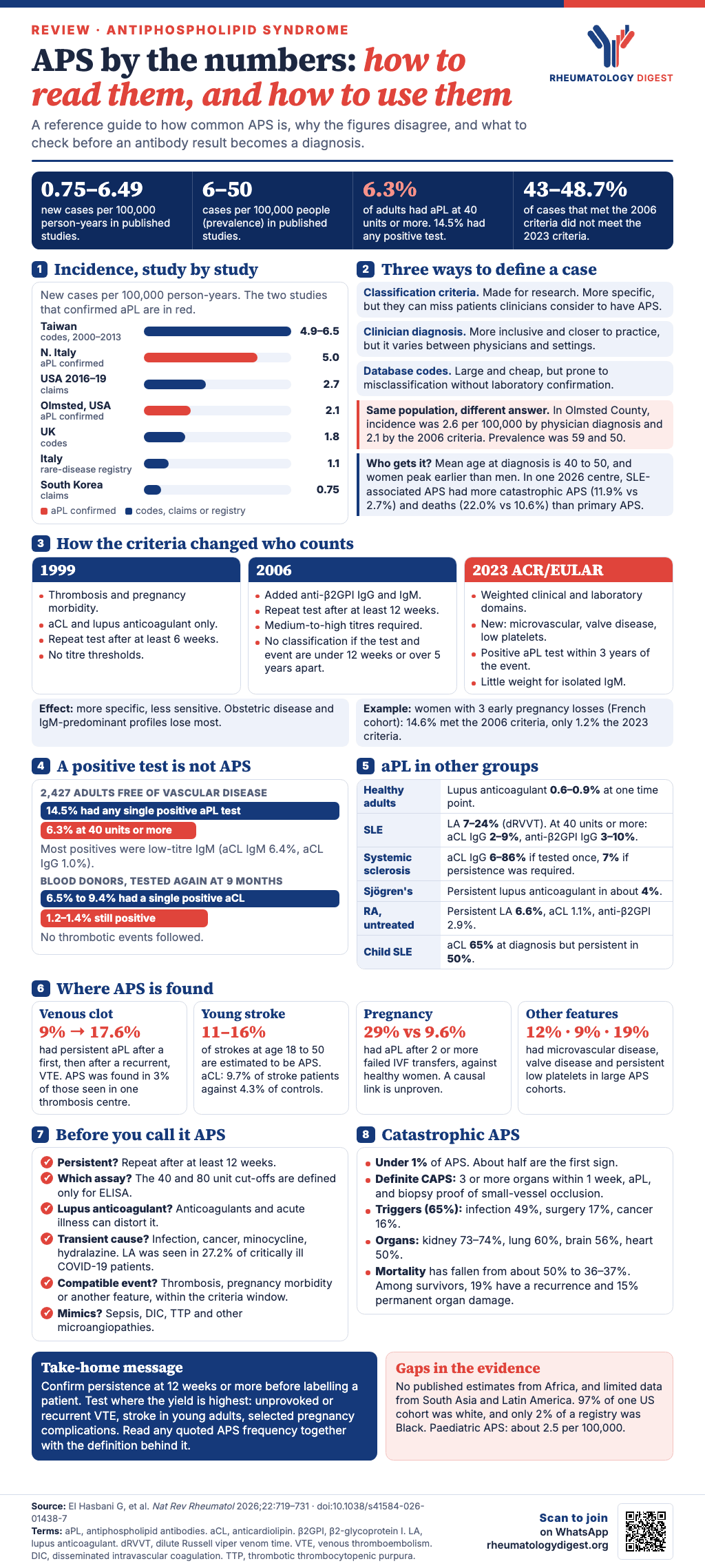
TL;DR: Antiphospholipid syndrome is rare, but its reported frequency depends so heavily on the case definition, the antibodies tested, repeat testing at 12 weeks and the reason for testing that figures cannot be compared at face value, and a single positive antibody test, which is common, does not make the diagnosis.
Antiphospholipid syndrome (APS) is a thrombo-inflammatory autoimmune disease with a widening range of manifestations, yet counting how many people have it is surprisingly hard. This review from Mayo Clinic, Ghent, Barcelona, São Paulo and the Danish Centre for Expertise in Rheumatology looks at why published estimates differ so much, what the numbers are in the general population and in selected clinical settings, and what research is still needed. It is a useful reference for any rheumatologist who has been handed a positive antiphospholipid antibody (aPL) result and has to decide what it means.
Why the numbers differ
APS is acquired and autoimmune, and it was first noticed through false-positive serological tests for syphilis in the mid-twentieth century. It was later tied to thrombosis and pregnancy morbidity and formalised in international criteria. Over the past 15 years the recognised spectrum has grown to include microvascular, cardiac valve and haematological manifestations, and there is growing interest in non-criteria antibodies and atypical presentations. The authors prefer to regard APS as a heterogeneous multisystem disease, not just a thrombophilia. At the severe end is catastrophic APS (CAPS), a rapidly progressive and life-threatening form.
The antibodies in question are anticardiolipin (aCL), lupus anticoagulant and anti-β2-glycoprotein-I (aβ2GPI). The central point of the review is that aPL positivity alone does not establish APS. It has to be interpreted together with compatible clinical manifestations and confirmation that the positivity persists.
Reported frequencies vary for reasons that go beyond geography, sex and ancestry. They also reflect differences in case definitions, laboratory methods, persistence requirements, data sources and the clinical setting where testing is done. Under-representation of people from low- and middle-income countries and from socially vulnerable populations is a major gap that limits how far current knowledge applies.
Three ways to define a case
1. Classification criteria. These were made mainly for research and have changed over time.
- 1999: emphasised macrovascular thrombosis and obstetric morbidity. The laboratory domain was limited to aCL and lupus anticoagulant, with repeat testing after at least 6 weeks. It did not separate low from high titres or require persistent positivity.
- 2006 (revised): added aβ2GPI IgG and IgM, lengthened the interval for confirmatory testing to at least 12 weeks, and specified medium-to-high antibody thresholds. It advised against classification when the gap between the laboratory and clinical findings was shorter than 12 weeks or longer than 5 years. Several major population-based studies are built on it.
- 2023 ACR/EULAR: designed to improve specificity and risk stratification. It uses weighted clinical and laboratory domains, more explicit antibody thresholds and broader clinical domains (microvascular disease, cardiac valve disease, thrombocytopenia), and refines the obstetric domain. It requires a clinical criterion and a positive aPL test within 3 years.
2. Clinician diagnosis. This is based on expert judgement. It is often more inclusive and may better reflect real practice, especially for patients with convincing thrombotic or obstetric histories who miss a formal criterion or have aPL below the criteria thresholds. It also adds variability because physicians differ between settings.
3. Algorithmic case finding. This uses billing codes, registry codes or operational definitions in electronic records and claims databases. It is pragmatic and scalable, but prone to misclassification when laboratory confirmation, persistence and clinical review are not available, so sample size and feasibility are gained at the cost of diagnostic precision.
The Olmsted County study shows how much the definition matters. By physician consensus, incidence was 2.6 per 100,000 population, against 2.1 with the 2006 criteria. Prevalence was 59 per 100,000 by physician diagnosis and 50 per 100,000 by the 2006 criteria, and the standardised mortality ratio was lower among cases found through physician diagnosis.
What the 2023 criteria do to the numbers
Early validation suggests better specificity but lower sensitivity in some settings, especially in obstetric disease and in patients with IgM-predominant profiles. Applying the 2023 criteria to existing cohorts reclassified many patients: in two cohorts, 43–48.7% of patients who met the 2006 criteria did not meet the 2023 criteria. The authors see this as the deliberate result of putting specificity ahead of sensitivity, and they expect classification-based studies using the 2023 criteria to report lower incidence and prevalence without any real fall in disease burden. Several features of the 2023 criteria contribute:
- Weighted scoring can reduce the classification of thrombotic events that occur alongside competing cardiovascular or venous risk factors.
- Three or more consecutive early pregnancy losses no longer earn enough points on their own to classify obstetric APS.
- Adding microvascular, cardiac valve and haematological domains may increase the relative share of those phenotypes.
- Requiring objectively confirmed thrombosis could reduce case finding in retrospective datasets with poor documentation (the 2006 criteria also required this).
- The 2023 criteria use ELISA-derived thresholds for aCL and aβ2GPI and give limited weight to isolated IgM positivity. Cohorts tested on automated chemiluminescent or other solid-phase platforms may need platform-specific thresholds.
- Narrowing the allowed interval between aPL detection and the clinical event from 5 years to 3 years could lower classification rates further.
The result is likely to be more uniform but narrower cohorts that are harder to compare with historical studies. The effect of the 2023 criteria on population-based estimates has still to be determined.
Why a positive test is not the same as APS
The review sets out a funnel from any antibody positivity down to a classified case, and shows how large the drop is.
Timing and persistence. A single positive test does not establish APS. Persistent positivity, ideally confirmed after at least 12 weeks, separates meaningful antibodies from transient ones caused by infection, inflammation or malignancy. Studies that do not confirm persistence overestimate aPL frequency and may over-ascertain APS.
Test method and circumstances. Lupus anticoagulant is measured with functional clot-based assays and is vulnerable to interference from anticoagulants and from acute-phase changes during thrombosis or critical illness. Solid-phase assays for aCL and aβ2GPI are less affected by anticoagulation, but may still be transiently positive in inflammatory or infectious settings. The circumstances of testing matter as much as the result.
Reasons estimates vary.
- Case definition: clinician diagnosis, classification criteria or algorithmic codes.
- Persistence and timing of testing, including timing relative to thrombosis, pregnancy loss or critical illness.
- Assays, thresholds and antibody profile: which antibodies and isotypes are measured, the platform and the cut-offs, and how isolated, double and triple positivity are defined. Low-titre thresholds and broader panels raise apparent prevalence, whereas restriction to persistent medium- or high-titre criteria antibodies gives a smaller, more specific group.
- Anticoagulant and acute-phase interference with lupus anticoagulant testing.
- Data source: population-based cohorts are best for incidence but may be geographically restricted and lack diversity, claims and electronic health record data offer scale without laboratory confirmation, and registries give richer phenotyping but over-represent severe, atypical or referral-centre cases.
- Testing context: testing is usually triggered by an event or a suspicion, so the reason for testing shapes the denominator and the phenotype mix.
The 40-unit and 80-unit thresholds for moderate and high titres are defined only for ELISA-based assays, and validated equivalents for other platforms are urgently needed.
What the antibodies look like in different populations
General population
In community cohorts, single-timepoint positivity is consistently more common than persistent positivity, and persistent positivity is the relevant measure for APS.
- Lupus anticoagulant by dilute Russell viper venom time was positive at a single timepoint in about 0.6–0.9% of relatively healthy people.
- In 1990s blood-donor samples, single aCL positivity was somewhat more common for IgM than IgG (9.4% against 6.5%), but only 1.2–1.4% stayed positive at 9 months, with no thrombotic complications. aPL IgM seems to be age-dependent, unlike IgG.
- In a study of young women with ischaemic stroke, healthy controls had aCL IgG and aβ2GPI IgG each in 0.96% when the 99th-percentile cut-off was used.
- In a contemporary population-based cohort of 2,427 people free of cardiovascular disease, 353 (14.5%) were positive for at least one aPL at a single timepoint. Most were low-titre IgM antibodies (aCL IgM in 6.4% and aβ2GPI IgM in 2.6%, against 1.0% for aCL IgG and 0.9% for aβ2GPI IgG). Only 6.3% were positive for at least one aPL at 40 units or more. Patterns varied little by sex, race or ethnicity.
Low-level or single-test positivity is therefore not rare in the general population, whereas persistent moderate- or high-titre criteria antibodies are uncommon.
Autoimmune disease cohorts
aPL are more common in autoimmune disease, especially SLE, but reported rates vary with the assay, threshold and repeat testing.
- SLE: lupus anticoagulant ranged from 8% to 18% with clot-based assays (about 50% with the kaolin partial thromboplastin time in one early study) and 7–24% with dilute Russell viper venom time. Early reports of aCL positivity as high as 43.75% included low-titre and single results. At 40 units or more, aCL was 2–9% for IgG and 1–8% for IgM, and aβ2GPI by ELISA was 3–10% for IgG and 2–8% for IgM. Repeat testing usually lowered the proportion positive, especially for IgM.
- Systemic sclerosis: single-timepoint aCL IgG ranged from 6% to 86% and IgM from 3% to 20%. When persistence was required, aCL IgG and IgM were found in 7% and 14% of patients.
- Sjögren’s disease: persistent lupus anticoagulant in about 4%, with single aCL and aβ2GPI positivity generally below 5%. Lupus anticoagulant has been linked to macrovascular thrombosis here.
- Rheumatoid arthritis: persistent lupus anticoagulant in 6.6% of untreated patients, against 1.1% for aCL and 2.9% for aβ2GPI, though other studies used low-titre thresholds without repeat testing.
- Data for dermatomyositis and spondyloarthritis are sparse.
Antibodies that appear with infection, cancer and drugs
Viral infections can induce transient lupus anticoagulant, aCL or aβ2GPI positivity, often without relevance to APS. During the COVID-19 pandemic, pooled analyses found lupus anticoagulant in 27.2% of critically ill patients, although repeat testing lowered the rate. Solid tumours have been associated with transient aPL, particularly aCL in some tumour types, though associations with aβ2GPI and lupus anticoagulant are less consistent. Some drugs, including minocycline and hydralazine, have been linked with transient positivity or APS-like syndromes. Repeat testing outside the acute illness, the active malignancy or drug exposure is needed.
How common is APS?
Contemporary population-based and large cohort studies show that APS is rare. Annual incidence ranges from about 0.75 to 6.49 per 100,000 person-years, and prevalence from about 6 to 50 per 100,000 people. Most cohorts show a female predominance and an incidence that rises with age, but the age peaks and sex ratios differ between regions and study designs. Claims and administrative studies give scale, but depend on diagnostic codes with little laboratory confirmation. Record-linkage and registry studies give more clinical detail but may be geographically restricted or enriched for particular phenotypes. The authors conclude that differences in methods and ascertainment, not geography alone, explain much of the variation.
Grouped by how cases were found, the estimates in the paper look like this (incidence per 100,000 person-years, prevalence per 100,000 people):
- Record linkage with confirmed aPL. USA, Olmsted County (2000–2015): incidence 2.1, prevalence 50, using the Sydney criteria and physician diagnosis. Northern Italy (2011–2015), thrombotic APS meeting the Sydney criteria: incidence 5.0, prevalence 26.9.
- Registry and clinical records. A regional rare-disease registry in Italy (2010–2019): incidence 1.1, prevalence 16.8.
- Claims and administrative databases, aPL not confirmed. UK (1990–2016): incidence 1.8, prevalence 43. South Korea (2008–2017): incidence 0.75, prevalence 6.19. USA (2016–2019): incidence 2.71, prevalence 10.42. Taiwan (2000–2013): incidence 4.87–6.49. Spain (2012–2017), at least one diagnostic code: prevalence 40.
Evidence is concentrated in North America, Europe and East Asia. There are no published estimates from Africa, and only limited data from South Asia and Latin America.
Outcomes and who is affected
Outcome data are less complete and less comparable than the incidence and prevalence data.
- In the Olmsted County cohort, mortality did not differ significantly from the general population, although the confidence interval was wide (standardised mortality ratio 1.61, 95% CI 0.74–3.05). The Euro-Phospholipid Project suggests that many patients survive long term, but morbidity is substantial.
- Older age, arterial involvement, CAPS, concomitant systemic autoimmune rheumatic disease and baseline cardiovascular risk factors were associated with worse survival.
- Around 25–30% of patients already have organ damage at or near diagnosis, and neurological damage is a major contributor to long-term morbidity.
- The share of APS that is obstetric differs by dataset: 22% in code-based datasets against about 9% in antibody-based studies. The 2023 criteria also stress pre-eclampsia and placental insufficiency with severe features more than early miscarriage.
- Evidence is strongest for recurrent events and organ damage, and weaker for mortality, economic burden and patient-centred outcomes.
- Mean age at diagnosis is generally 40 to 50 years, and women tend to peak earlier than men. In one US cohort 97% of participants were white, and in registry data only 2% of people with APS were Black. This could reflect poorer recruitment or a true difference in persistent aPL frequency. A large analysis of diverse SLE cohorts supports the latter: moderate-to-high titre aCL or aβ2GPI was 3–7% overall, and aCL IgG was present in 3% of Black people against 9% of white people (aβ2GPI IgG 4% against 7%).
- Paediatric APS is under-studied. One Italian regional study estimated prevalence at 2.5 per 100,000 and mean annual incidence at 0.2 per 100,000. In childhood-onset SLE, APS was reported in 4% of patients and was linked with greater disease activity and several neuropsychiatric manifestations. In 137 children with SLE, aCL, aβ2GPI and lupus anticoagulant were found at diagnosis in 65%, 41% and 26%, but persisted in only 50%, 29% and 16%.
Primary and SLE-associated APS
Most of the literature on APS with another autoimmune disease concerns SLE. In the Olmsted study 6 of 33 incident cases had SLE, and in a Korean claims analysis 57% were primary APS and 27% SLE-associated (by coding alone). Macrovascular and obstetric phenotypes largely overlap. Among 672 people with persistent aPL in the APS ACTION registry, arterial thrombosis, venous thrombosis and pregnancy morbidity were similar with and without SLE, whereas thrombocytopenia and autoimmune haemolytic anaemia were more frequent with SLE. In the Euro-Phospholipid cohort, SLE-associated APS had more arthritis, livedo reticularis, thrombocytopenia and leukopenia. Over 42 years, primary and SLE-associated APS had similar aPL profiles and rates of recurrent thrombosis, but the SLE group was younger, mostly female and more likely to have microvascular manifestations. A 2026 single-centre cohort found CAPS and death more frequent in SLE-associated than primary APS (11.9% against 2.7%, and 22.0% against 10.6%), and SLE-associated APS was independently associated with mortality.
Catastrophic APS
CAPS is a rare, life-threatening variant with rapidly progressive thrombosis and multiorgan failure. It accounts for less than 1% of APS and its true incidence is undefined, because it is rare, appears in intensive care and needs a high index of suspicion. Definite CAPS needs involvement of three or more organs within 1 week, laboratory evidence of aPL and histological confirmation of small-vessel occlusion, but many patients are too unstable for biopsy and are classified as probable CAPS. Cases come from voluntary, referral-based registries enriched for severe disease.
- About half of CAPS episodes are the first manifestation of APS.
- A trigger is identified in about 65%: infection (49%), surgery (17%) and malignancy (16%).
- The organs most often involved are the kidneys (73–74%), lungs (60%), brain (56%) and heart (50%).
- Mortality has fallen from about 50% historically to 36–37% in registry analyses from 2018, which fits with wider use of combined treatment (anticoagulation, glucocorticoids and plasma exchange and/or immunoglobulins).
- Among survivors, recurrent thrombosis occurs in 19% and permanent organ damage in 15%, though long-term data are limited.
- It has to be separated from sepsis, disseminated intravascular coagulation, thrombotic thrombocytopenic purpura and other thrombotic microangiopathies.
Where APS is found in common presentations
The yield of testing depends strongly on the clinical setting. The authors stress that these figures describe positivity within selected groups and are not population prevalences.
Venous thromboembolism (VTE).
- aPL positivity is reported in about 10% of patients with VTE, although fewer meet criteria for APS.
- Persistent aPL were present in about 9% of patients with a first provoked or unprovoked VTE, rising to 17.6% with recurrent VTE.
- In a large tertiary thrombosis-centre cohort, APS was identified in 3% of patients evaluated for VTE, against 8% for hereditary thrombophilia. Younger age, family history and fewer comorbidities favoured hereditary thrombophilia, whereas comorbidity was more typical of APS. The authors take this as evidence that APS is more than another thrombophilia.
- Lupus anticoagulant, more than the number of positive isotypes, influenced recurrent venous thrombosis in UK data (HaemSTAR).
- Evaluation has the greatest yield in younger patients, in unprovoked or recurrent VTE, and in those with obstetric or autoimmune features.
Stroke and arterial events in young adults (ischaemic stroke between 18 and 50 years, 10–20% of all strokes, with rising incidence).
- APS has been estimated to account for 11–16% of young-adult strokes, but estimates vary with design, age range, subtype, testing and whether aPL positivity or classified APS was counted.
- aPL positivity was linked with a roughly two- to three-fold higher risk of cerebral infarction in younger patients.
- In the Antiphospholipid Antibodies in Stroke study, aCL were present in 9.7% of 255 patients with a first ischaemic stroke against 4.3% of controls (adjusted odds ratio 2.31, 95% CI 1.09–4.90).
- In the RATIO study of women under 50, lupus anticoagulant was strongly associated with myocardial infarction and ischaemic stroke, and the risk was markedly amplified by smoking and oral contraceptive use.
- In the other direction, stroke occurred in 13.1% of the 1,000 patients in the Euro-Phospholipid Project, and in 21% of 804 people with aPL in APS ACTION (transient ischaemic attack 9%, peripheral arterial disease 4%). Arterial manifestations overall are reported in 13–24%. High-risk profiles (double positivity, isolated lupus anticoagulant, triple positivity) were common with arterial thrombosis.
Pregnancy morbidity.
- Detection depends on the denominator. Cohorts limited to late fetal loss or recurrent early loss report higher frequencies than those defined by one early miscarriage or composite adverse outcomes.
- In a French cohort with three consecutive pregnancy losses before 14 weeks, 14.6% were classified as APS by the 2006 criteria, against 1.2% by the 2023 criteria.
- Testing at or near a loss or placental complication may catch transient antibodies, so repeat testing outside pregnancy is more informative. Pre-existing low-dose aspirin or heparin can distort the observed frequencies.
- In IVF settings, a systematic review found aPL in 29% of women with two or more implantation failures against 9.6% of healthy fertile women (relative risk 3.06), but the causal link to definite obstetric APS is uncertain, and many studies do not separate transient low-titre from persistent high-risk profiles.
Microvascular, cardiac valve and haematological presentations. These are the hardest settings in which to estimate APS frequency, because the data come mostly from tertiary referral cohorts, testing is selective and mimics are common. Microvascular involvement was reported in 12% of patients in large international cohorts (CAPS about 1%). Cardiac valve disease was documented in 9% in APS ACTION and valve thickening in 4.6% in Euro-Phospholipid over 10 years. Thrombocytopenia was the most frequent haematological manifestation in Euro-Phospholipid (8.7% during the study, 29.6% cumulative), and 19% of APS ACTION participants had persistent thrombocytopenia below 100,000/µl. Where aPL positivity appears in immune thrombocytopenia or haemolytic anaemia, it may be incidental or reflect a coexisting autoimmune disease, particularly if titres and persistence are not confirmed. The central risk is misattribution. Over-diagnosis can expose people to long-term anticoagulation of uncertain benefit, and under-recognition of high-risk profiles can miss meaningful cases.
The authors add that visibility affects who gets counted. CAPS is rare but highly visible, macrovascular and obstetric APS are more visible, microvascular, valve and haematological disease are less visible, and asymptomatic aPL carriers are the least visible, so the phenotype mix in any study depends partly on what clinicians notice and test for.
Research priorities
- Make studies comparable. Report the screening approach, the cohort tested, the case definition (clinician-diagnosed, classification-based or operational), the assays and cut-offs, the isotypes, whether persistence was confirmed at 12 weeks or more and whether anticoagulation could have affected lupus anticoagulant results. Database studies should be validated against adjudicated cases.
- Improve denominators and follow-up. Population-based studies with laboratory linkage are needed to separate transient from persistent positivity and to define the step from positivity to disease, and longitudinal cohorts should capture obstetric, microvascular and critical-care phenotypes with clear definitions and antibody profiles.
- Include more people and more outcomes. Under-represented groups (ancestry-diverse, paediatric, low- and middle-income settings) should be included, and outcomes should extend beyond thrombosis and death to organ damage, pregnancy outcomes, health-service use, function and patient-reported outcomes.
What it adds up to
The authors conclude that APS epidemiology is shaped by biological diversity and also by methods. From asymptomatic aPL positivity to CAPS, reported incidence, prevalence, phenotype and outcomes depend on the case definition, assays, timing and confirmation of testing, and data source. Better definitions, standardised reporting of antibody profiles and testing conditions, and prospective, diverse, longitudinal cohorts with laboratory linkage are needed to size the burden of APS and describe its range properly. For a clinician, the practical messages from the paper are to confirm persistence before labelling someone, to test selectively in the settings where yield is highest (unprovoked or recurrent VTE, stroke in young adults, selected pregnancy complications), and to read any quoted APS frequency with the definition behind it in mind.
Disclosures noted in the source: the authors declare no competing interests.