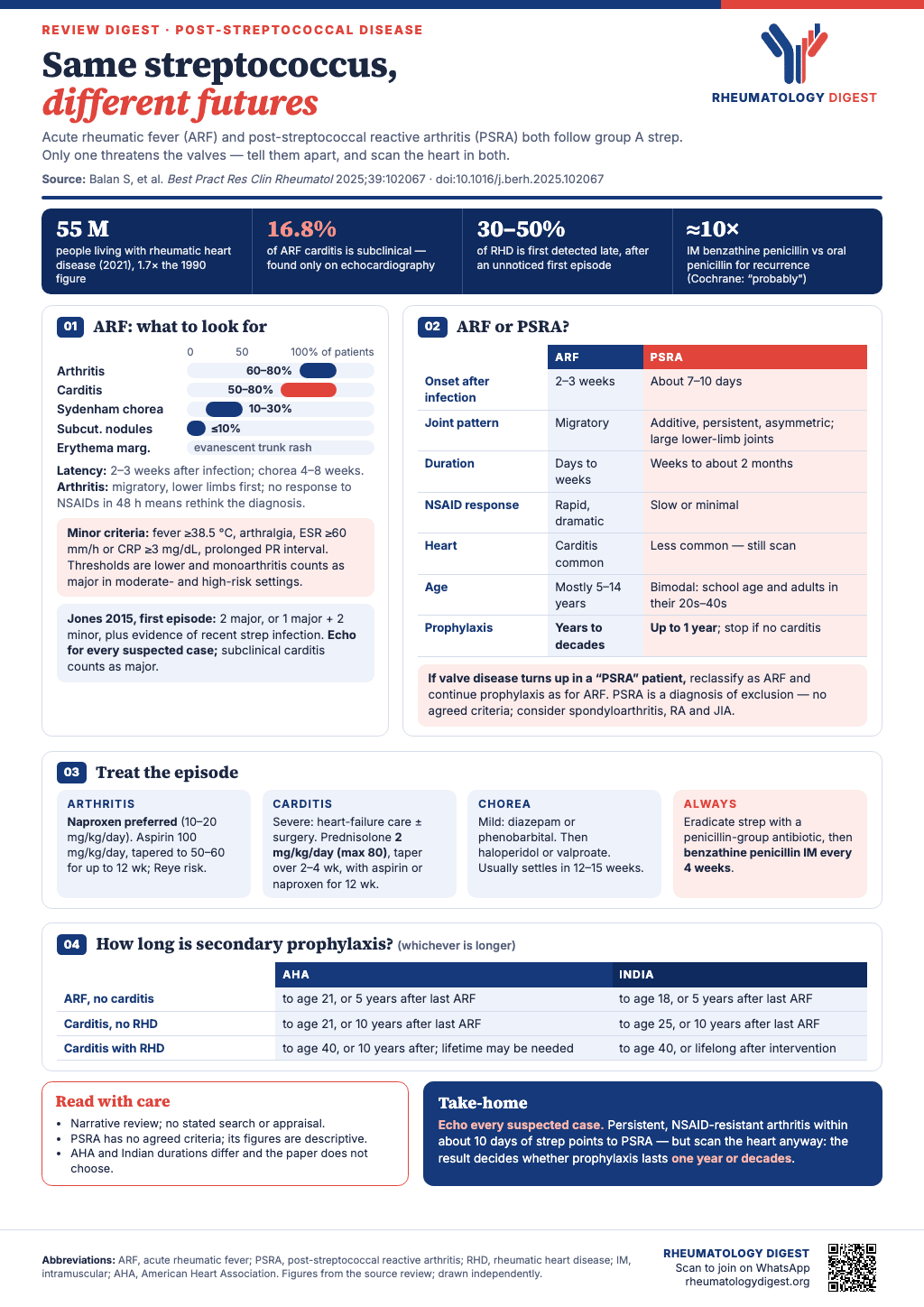
TL;DR: Both conditions follow a streptococcal infection, but ARF threatens the heart and needs years of secondary prophylaxis, while PSRA is a persistent, NSAID-resistant arthritis that rarely does — so the practical skill is telling them apart, and doing an echocardiogram either way.
Two post-streptococcal arthritides sit close together in clinic and diverge sharply in consequence. This review from Amrita Institute in Kochi, India — where the burden is real — walks through both, and ends with a direct comparison. It is a narrative review without a stated search method, and it is strongest as a clinical refresher and weakest where the evidence is thin, which for PSRA is most of the time.
The burden, and why it persists
ARF and the rheumatic heart disease (RHD) it leaves behind mainly affect children aged 5–15 in countries with limited access to care and crowded living conditions. The first episode usually occurs between 5 and 14 years of age, and recurrences are commonest in the first year. Incidence is highest in sub-Saharan Africa, South Asia and the Pacific.
The review quotes IHME figures of about 55 million people living with RHD worldwide in 2021, a 1.7-fold rise in prevalence since 1990. Age-standardised mortality fell by 48% worldwide between 1990 and 2015, by 71% in China and by 18% in India. Roughly a quarter of left heart failure and 5% of right heart failure cases in the cited studies are attributed to RHD. The WHO and World Heart Federation target of a 25% reduction in RHD mortality by 2025 is described as not on course to be met. Populations are classed as low risk when ARF incidence is under 2 per 100,000 per year in 5–14-year-olds, or all-age RHD prevalence is 1 per 1,000 or less. India’s ICMR has run a passive surveillance and secondary prophylaxis programme, but the authors note India still lacks a structured national programme for ARF and RHD.
How the immune response goes wrong
ARF arises in genetically susceptible people after group A streptococcal (GAS) infection, usually pharyngitis, though in some places (New Zealand is named) skin infection such as impetigo can also trigger it. Specific HLA class II alleles are linked to higher risk. The mechanism is molecular mimicry: immune cells and antibodies directed at streptococcal antigens cross-react with human tissue, with the group A carbohydrate epitope N-acetyl-β-D-glucosamine considered the main driver of heart and brain involvement. Autoreactive T and B cells and a cytokine cascade (IL-1, IL-2, IL-17, IFN-γ, TNF-α) sustain it, and this continues through repeated episodes into chronic RHD. The review’s pathophysiology figure runs from bacterial invasion to antigen presentation, cross-reactive T and B cells and autoantibodies, then organ-specific disease: a delayed hypersensitivity reaction in skin, cross-reactive antibodies and T cells in the heart, immune complex deposition in the joint, and antibody binding to neuronal cells in the brain.
The manifestations of ARF
Symptoms appear 2–3 weeks after the infection. The review goes through each major feature.
- Arthritis (60–80%). Classically a migrating arthritis of the large lower-limb joints first, then upper-limb joints, each lasting no more than a week, so it appears to move. A monoarticular presentation also occurs, often because early NSAID use has masked it, and pain is out of proportion to visible inflammation. Onset is within about three weeks, it is more severe in teenagers and young adults, it is non-deforming, and it responds dramatically to NSAIDs. If there is no response within 48 hours, reconsider the diagnosis, and keep arboviral disease in mind in endemic areas.
- Carditis (50–80%). It may be clinical or subclinical, with all layers of the heart potentially involved but valvulitis predominating, and mitral regurgitation the commonest lesion. It usually appears around 3 weeks after infection and is commoner in children than adults. On examination a new apical pansystolic murmur suggests mitral regurgitation, and aortic regurgitation can occur, while tricuspid involvement is less common. Complications include acute heart failure, mitral valve prolapse, annular dilatation and chordal rupture. Subclinical carditis, detectable only on echo, accounted for about 16.8% of cases in the cited data. Other manifestations are pericarditis, myocarditis and heart block. The review lists Aschoff bodies and CD4+ T cell infiltration in the valve as the histological picture.
- Sydenham chorea (10–30%). Abrupt, jerky, purposeless movements, commoner in girls aged 5–13, with a longer latency of 4–8 weeks after infection. It may be one-sided and can come with weakness, hypotonia, psychiatric symptoms and gait disturbance. The milkmaid grip and the “bag of worms” tongue are the characteristic signs.
- Erythema marginatum. A pink, painless, non-itchy, evanescent ring-shaped rash on the trunk that spares the face, fading and reappearing over hours, especially in warmth, and sometimes persisting sporadically for weeks or months.
- Subcutaneous nodules (up to 10%). Firm, painless nodules of a few millimetres to 2 cm over bony surfaces and tendons, appearing in the first weeks, lasting one to two weeks, and indicating severe carditis. Compared with rheumatoid nodules they are smaller, shorter-lived and without overlying inflammation.
The minor manifestations are fever of 38.5 °C or more (milder in high-risk groups), arthralgia, raised inflammatory markers (ESR 60 mm/h or more and CRP 3 mg/dL or more, with lower thresholds accepted in high-risk populations) and a prolonged PR interval.
Diagnosis: the Jones criteria and echo
There is no single diagnostic test. Diagnosis rests on the Jones criteria (devised in 1944 and revised in 1984, 1992 and 2015), combined with evidence of a recent streptococcal infection and exclusion of other causes. For a first episode, two major criteria, or one major and two minor, are required. A recurrence needs two major, one major plus two minor, or three minor. Evidence of infection comes from a raised ASO or anti-DNase B titre, with a throat swab for culture or antigen as an optional addition.
The 2015 revision made two changes that the review emphasises. Echocardiography is recommended for everyone suspected of having ARF, and both clinical and subclinical carditis now count as a major criterion even without typical murmurs. And the criteria differ by population risk: in moderate- and high-risk settings monoarthritis and polyarthralgia count as major criteria and monoarthralgia and lower inflammatory-marker thresholds count as minor ones. Low-risk is defined as an ARF incidence of 2 per 100,000 school-age children per year or less, or all-age RHD prevalence of 1 per 1,000 or less. The essential work-up is blood counts, ESR, CRP, a 12-lead ECG, echocardiogram, chest X-ray and ASO titre.
Treating the acute episode
Treatment has two parts: eradicating the streptococcus, and managing the manifestations.
Eradication. A penicillin-group antibiotic is the treatment of choice, with cephalosporins, macrolides or sulphonamides if penicillin cannot be used.
Arthritis. NSAIDs are first-line and the response is usually dramatic. Aspirin is started at 100 mg/kg/day in children and tapered after an adequate response to 50–60 mg/kg/day, for a total of up to 12 weeks, with adult dosing of 6–8 g/day in 4–5 divided doses. Naproxen (10–20 mg/kg/day in children, 500 mg twice daily in adults) is now preferred because of the Reye syndrome risk and more frequent dosing with aspirin; ibuprofen and ketoprofen are alternatives. Low-dose corticosteroids can be used if NSAIDs are not tolerated.
Carditis. Severe carditis with heart failure from severe regurgitation needs stabilisation first and may need surgical correction, with surgery needed urgently for chordal rupture. Where inflammatory markers are high, glucocorticoids at 1–2 mg/kg/day are used in some centres, a position included in the 2020 Australian guideline for severe carditis, and intravenous methylprednisolone in life-threatening cases. For moderate to severe carditis, oral prednisolone 2 mg/kg/day (maximum 80 mg/day) is tapered over 2–4 weeks by 2.5–5 mg every 3 days, with aspirin (50–75 mg/kg/day) or naproxen alongside and continued for 12 weeks.
Chorea. Most cases resolve over 12–15 weeks. Mild chorea is treated with a sedative such as diazepam or phenobarbital; if that is inadequate, haloperidol (0.25–0.5 mg/kg/day) or valproic acid (15 mg/kg/day) for 12 weeks or for 2–4 weeks after improvement. Moderate to severe chorea may need a short oral corticosteroid course, and limited evidence supports IVIG or plasma exchange. Low-dose, high-potency D2 blockers (haloperidol, fluphenazine, risperidone) can treat symptoms.
Immunomodulation. The review notes growing interest in hydroxychloroquine, supported by case reports in rheumatic carditis, and an ongoing New Zealand trial (the HCQ ARF trial).
From ARF to rheumatic heart disease
RHD is the most feared consequence: an autoimmune valvulitis affecting mainly the left-sided valves, and the leading cause of acquired heart disease in children and young adults in resource-limited countries. It usually develops over years after one or more episodes of ARF, and chronic valvular lesions are first detected in 30–50% of cases only at that late stage, suggesting the initial episode was missed or subclinical. Repeated streptococcal insults drive the transition, which makes it a modifiable process.
The review cites an Australian Northern Territory register of 591 Indigenous people with RHD (1999–2012): 16.2% had severe RHD at diagnosis, half of those had valve surgery within two years, and 10% had died within six years. Among those with mild or moderate RHD, 64% were stable over ten years and 11% progressed. In low- and middle-income countries, RHD often comes to light for the first time in pregnancy or with complications such as infective endocarditis, arrhythmia or stroke. Mitral stenosis is the commonest lesion, then mitral and aortic regurgitation and aortic stenosis, with tricuspid disease occasionally and pulmonary valve disease rare. The diagnosis is confirmed by echocardiography. Complications are heart failure, atrial fibrillation, thromboembolism and infective endocarditis.
Prevention at four levels
The review lays out primordial (poverty, overcrowding, sanitation, access to healthcare), primary (prompt treatment of streptococcal pharyngitis and possibly skin infection), secondary (continuous antibiotic prophylaxis after ARF or RHD) and tertiary prevention (managing heart failure, anticoagulation and cardiac interventions including surgery).
Secondary prophylaxis
Once ARF is diagnosed, continuous prophylaxis starts, because ARF can also be triggered by asymptomatic infection. Household contacts who are GAS-positive need full-course antibiotics even without symptoms.
Drugs. Long-acting intramuscular benzathine penicillin G is preferred, given every 21–28 days, with the AHA and WHO supporting four-weekly injections. A local anaesthetic (1% lidocaine) reduces injection pain, and intramuscular injections should be avoided in people on anticoagulants. The doses given are 600,000 units for children under 27 kg and 1,200,000 units above 27 kg or in adults. Oral alternatives are penicillin V 250 mg twice daily; sulfadiazine (500 mg daily under 27 kg, 1,000 mg above) if penicillin-allergic; and erythromycin or azithromycin if both are unsuitable. Azithromycin carries a rare risk of QTc prolongation and arrhythmia, so caution with antiarrhythmics.
Evidence. A Cochrane review concluded that antibiotics substantially reduce recurrence compared with none and that intramuscular benzathine penicillin is probably about ten times better than oral penicillin. The GOAL trial, in Ugandan children aged 5–17 with latent RHD found on screening echo, randomised them to benzathine penicillin or no prophylaxis, and found significantly less progression to RHD in the treatment group. The GOALIE trial, testing whether oral penicillin is non-inferior, is ongoing.
Duration differs by guideline and by what the heart shows. For ARF without carditis, the AHA advises until age 21 or 5 years after the last episode, whichever is longer, and the Indian recommendation is until 18 or 5 years. For ARF with carditis but no RHD, the AHA says until 21 or 10 years after the last episode, whichever is longer, and the Indian figure is until 25 or 10 years. For ARF with carditis and RHD, the AHA says until 40 or 10 years, with lifetime prophylaxis possibly needed, and the Indian figure is until 40 or lifelong after any intervention.
Post-streptococcal reactive arthritis
PSRA is harder to pin down, and the paper says so. It lacks standardised diagnostic criteria, its epidemiology is poorly defined, and it is a diagnosis of exclusion in many cases.
How common. The review cites a prevalence of 1–2 per 100,000, which it says is nearly double that of ARF in some developed countries including the United States. As ARF incidence has fallen with better antibiotic access, PSRA reports appear to have risen, possibly through better diagnostics, point-of-care streptococcal testing and awareness. It is probably underdiagnosed. The burden is reported mainly from sub-Saharan Africa, India, Australia and New Zealand.
Mechanisms. Less is understood than for ARF. Three are proposed: molecular mimicry between the M protein and skeletal proteins such as vimentin, laminin and keratin; autoreactive CD4+ T cells helping B cells to produce autoantibodies; and direct CD8+ T cell cytotoxicity. Immune complexes containing streptococcal antigens may deposit in the joint.
Clinical picture. A sterile, asymmetric arthritis, usually of the large lower-limb joints, that can be mono-, oligo- or polyarticular. It is persistent and additive rather than migratory, responds poorly to NSAIDs, is non-erosive and does not deform. Carditis and the other major ARF features are absent. Sacroiliitis and axial disease are uncommon and should prompt a search for spondyloarthritis. It has a bimodal age distribution, in school-age children and in adults in their second to fourth decades, and HLA-B27 prevalence is similar to the general population, which distinguishes it from classic reactive arthritis. The two features that most help separate it from ARF are an onset under about 10 days after the infection and a longer duration, generally around two months.
Diagnosis. Evidence of recent GAS infection is essential, typically a raised antistreptococcal antibody titre. Where streptococcal infection is common, baseline titres may already be high, which complicates interpretation. Throat culture and rapid antigen testing are less reliable once symptoms have resolved, and synovial fluid analysis excludes septic arthritis but does not identify the organism. The differential includes spondyloarthritis, rheumatoid arthritis and juvenile idiopathic arthritis. The history is traced through the review’s timeline of definitions, from Crea and Mortimer in 1959 to Shulman and Ayoub in 2002, whose working definition is acute, persistent, additive arthritis in one or more joints with evidence of prior streptococcal infection that does not meet the major Jones criteria.
Treatment. There is little consensus. Prevention of streptococcal sore throat is the best strategy. NSAIDs usually give minimal response. For chronic cases, sulfasalazine has shown benefit, and the role of TNF antagonists and JAK inhibitors in refractory PSRA is undefined. The 2009 AHA statement advises monitoring for carditis for several months, and giving secondary prophylaxis for up to one year after onset, stopping it if there is no carditis. If valvular disease is found, the patient should be reclassified as having had ARF and continue prophylaxis as for ARF.
ARF versus PSRA at a glance
| PSRA | ARF | |
|---|---|---|
| Onset after infection | 7–10 days | 2–3 weeks |
| Arthritis duration | Weeks to months | Days to weeks |
| Joint pattern | Additive, persistent | Migratory |
| Carditis | Less common | More common |
| Response to NSAIDs | Slow | Rapid |
The review’s own table also lists subcutaneous nodules as painless in PSRA and painful in ARF. That conflicts with its text, which describes ARF nodules as painless, so the point is left out of this comparison.
What to hold loosely
- It is a narrative review. There is no described search or critical appraisal, and the dosing and duration advice is a summary of existing guidelines and cited studies, not new evidence.
- PSRA has no agreed definition. Its epidemiology, the two-month duration and the 10-day interval are descriptive, and the prophylaxis advice comes from a 2009 AHA statement.
- Prophylaxis duration varies between the AHA and the Indian recommendations. The paper presents both and does not choose.
- Some figures are drawn from a few studies, such as the 55-million RHD estimate and the Northern Territory outcomes, and the high-burden populations they describe are not the same everywhere.
- The immunomodulation options are early. Hydroxychloroquine rests on case reports and a trial in progress.
The authors’ practice points and research agenda
Their practice points are: identify streptococcal infection early, because it is central to preventing both conditions; diagnose ARF with the modified Jones criteria, which require evidence of recent infection plus major and minor criteria; do an echocardiogram in every suspected case, since auscultation alone can miss subclinical valve disease; give patients with carditis long-term follow-up and secondary prophylaxis; recognise that PSRA is persistent, non-migratory arthritis that responds poorly to NSAIDs; and screen for carditis with echo even in PSRA, especially in children and adolescents.
Three research priorities are named: disease registries to define prevalence, detect latent disease and track long-term outcomes; immunomodulation trials to reduce ARF damage and long-term sequelae; and AI-assisted echocardiography in low-resource settings to improve diagnosis and detect RHD early where disease is endemic.
What it means in practice
The most usable message is a sequence. Suspect ARF, get an echocardiogram in every case, and apply the Jones criteria for the population you are in. If the arthritis is persistent, additive, resistant to NSAIDs and began within about ten days of the infection, think PSRA, but still scan the heart, because the result decides whether prophylaxis is for one year or for decades.
Disclosures noted in the source: the authors declare no known competing financial interests or personal relationships.