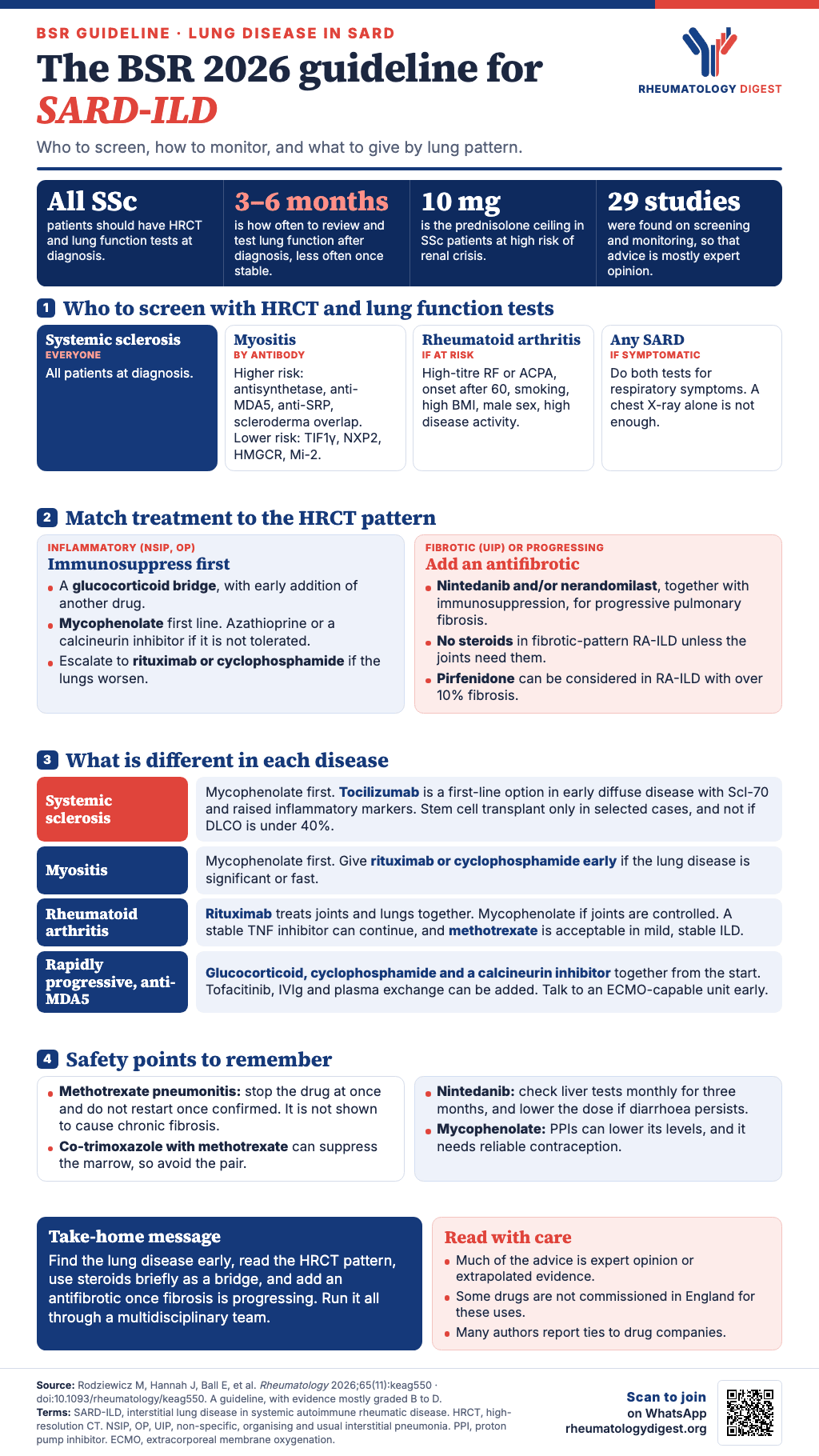
TL;DR: The first UK guideline on SARD-ILD tells rheumatologists to screen every patient with SSc (and risk-selected patients with myositis and RA) with HRCT and lung function, to treat inflammatory disease with a short steroid bridge and mycophenolate first, to add nintedanib and/or nerandomilast with immunosuppression once pulmonary fibrosis is progressing, to avoid steroids in fibrotic-pattern RA-ILD, and to run all of it through a multidisciplinary team, with most advice resting on expert opinion and low-quality evidence.
Systemic autoimmune rheumatic diseases (SARDs) are the commonest recognised cause of interstitial lung disease (ILD), accounting for about 30% of all ILDs and contributing heavily to illness and death. This guideline from the British Society for Rheumatology (BSR), written with respiratory physicians, a thoracic radiologist, a specialist pharmacist and nurse, and two people with lived experience, is the first to address SARD-ILD for UK practice. International recommendations exist from EULAR and ACR, but the authors wanted advice that reflects NHS resources, licensing and commissioning. The term SARD is used in place of connective tissue disease. The disease list covers RA, SSc, Sjögren disease, idiopathic inflammatory myopathy (IIM), mixed connective tissue disease (MCTD), SLE, ANCA-associated vasculitis and axial spondyloarthritis.
How the guideline was built, and how to read the grades
- Method. BSR Creating Guidelines protocol v5.5 with AGREE II. A systematic review for treatment questions was registered on PROSPERO and searched seven databases up to 16 September 2024, with extra studies added later by group members. Controlled designs only. Separate searches covered DMARD pneumotoxicity and screening and monitoring.
- Grades. A strong recommendation (1) means benefits clearly outweigh risks or the reverse. A conditional one (2) means a closer or more uncertain balance. Evidence quality runs from A (high) to D (very low). Every recommendation was voted on, none was kept unless every member scored at least 80 out of 100, and the mean “strength of agreement” is reported (all were 95% or higher).
- The evidence is thin. For screening and monitoring the search found only 29 studies, mostly cross-sectional or retrospective, so those recommendations are largely expert opinion. Many treatment recommendations are extrapolated from the Scleroderma Lung Study and from trials in mixed populations.
- Scope. Excluded: IPF and non-rheumatic ILD (asbestosis, silicosis, hypersensitivity pneumonitis, radiation or non-rheumatic-drug ILD), sarcoidosis (covered by a British Thoracic Society statement), children under 16, and complications such as pulmonary hypertension. Planned review is in five years, or sooner if new evidence emerges.
Definitions that drive the treatment choices
- Inflammatory versus fibrotic HRCT pattern. Predominantly inflammatory disease (nonspecific interstitial pneumonia, NSIP, and organising pneumonia, OP) is more likely to respond to immunomodulation. Predominantly fibrotic disease (usual interstitial pneumonia, UIP) may be scarring with limited reversibility. In RA-ILD, UIP often resembles IPF, where immunosuppression has been associated with harm. In SSc-ILD, higher quantitative fibrosis with ground-glass opacity may predict a response to immunosuppression.
- Ground-glass is not the same as reversible alveolitis. It is a non-specific increase in lung density that can come from alveolitis, atelectasis, heart-failure fluid or fine fibrosis. The most reliable signs of fibrosis are traction bronchiectasis, honeycombing and volume loss, though all findings vary between readers. Many patients have both, so risks and benefits need weighing case by case.
- Rapidly progressive ILD (RP-ILD). Worsening breathlessness, hypoxaemia and radiological change within three months, often within weeks. Mortality is high (up to 50%).
- Progressive pulmonary fibrosis (PPF). The guideline uses the INBUILD definition, which is also the one NICE used for nintedanib in PPF: at least one of the following within 24 months. (1) A relative fall in percent predicted FVC of 10% or more. (2) A relative fall of 5–10% with worse fibrosis on CT or worse breathlessness. (3) Worse symptoms together with more fibrosis on CT. An absolute fall of more than 10% in %FVC within 12 months has been linked to higher mortality.
- ILD with suspected SARD. The authors deliberately avoid “IPAF”, which they say has not been revised since 2015 and is outdated. They use the phrase for a positive autoantibody, with or without suggestive features, and an inflammatory pattern on HRCT or histology, in someone who does not meet classification criteria for a specific SARD. ILD can precede the SARD.
- Standards. HRCT means volumetric thin-section (under 1.5 mm), non-contrast imaging in deep inspiration (prone images can help in early or mild disease). “PFTs” means both FVC and DLCO.
Context from the guideline. ILD prevalence is estimated at 39–72% in MCTD, 44–50% in SSc, 33–50% in IIM, 12–21% in primary Sjögren disease, 3–40% in ANCA vasculitis, 3–10% in SLE and 7–30% in axial spondyloarthritis. In RA, interstitial abnormalities are common but only about 5–11% progress to clinically significant ILD. Reported survival ranges from a median of about eight years in incident RA-ILD to 6-month survival of 33–66% in rapidly progressive anti-MDA5 IIM-ILD.
Overarching principles
- Aim. Improve survival and quality of life, addressing SARD activity, symptom burden and the HRCT pattern together. Shared decision-making is central, including advance care planning when the disease is progressing, and written information and signposting to patient groups.
- Multidisciplinary team (MDT) care is the gold standard. Rheumatology, respiratory medicine and radiology should review diagnosis, which also helps exclude infection, drug toxicity, sarcoidosis, malignancy and smoking- or occupation-related lung disease. Where formal MDTs or joint clinics are not possible, timely communication between teams is the minimum. Specialist pharmacists, nurses and physiotherapists have central roles.
- England’s tiers. Starting medication that targets lung fibrosis needs approval by a regional specialist ILD MDT centre (Tier 3). Prescribing and follow-up can then be local (Tier 2). Tier 3 input should be sought whenever the diagnosis or management is uncertain.
Screening for ILD in known SARD
Recommendations
- At diagnosis and follow-up, take a careful respiratory history and examine the chest, including auscultation, in every person with a SARD (1C).
- Do not screen with chest radiography alone (1B).
- Screen all people with SSc with chest HRCT and PFTs at diagnosis (1B).
- Screen people with IIM with HRCT and PFTs at diagnosis depending on clinical subtype (1C).
- In at-risk people with RA, consider HRCT and PFTs at diagnosis (2C).
- In anyone with a known SARD who has respiratory symptoms, do HRCT and PFTs to diagnose suspected ILD (1C).
The reasoning
- HRCT is the gold standard. It carries radiation (typically 5–15 mSv) and the risk of incidental findings, so screening is justified only where the prevalence of ILD is moderate to high. It also shows other chest disease. Bronchoalveolar lavage and lung biopsy are rarely needed, but may be used for diagnostic uncertainty or to exclude infection or malignancy.
- PFTs are poor screening tools (low sensitivity and specificity, confounded by COPD, pulmonary hypertension and respiratory muscle weakness) but are useful for longitudinal monitoring. HRCT should accompany them in high-risk groups to give a baseline.
- Six-minute walk test. Not for screening. It helps assess severity, ambulatory oxygen need and transplant referral.
- SSc: up to 50% develop ILD, so everyone is screened.
- IIM: higher ILD risk goes with antisynthetase antibodies (Jo, PL-12, PL-7, OJ, EJ, KS, Zo, Ha), anti-MDA5, anti-SRP, and scleroderma overlap (clinical features, or anti-PM/Scl, Ku or RNP). Anti-TIF1γ, NXP2, HMG-CoA reductase and Mi-2 carry lower risk, and these patients need no screening if asymptomatic.
- RA: ILD affects around 10% and raises mortality. Recognised risk factors are high-titre RF or ACPA, onset after age 60, smoking, high BMI, male sex and high disease activity at diagnosis. A multicentre US study evaluated six screening algorithms and found the number needed to screen with HRCT to find one case of ILD ranged from four to six, but without validation in more cohorts the guideline leans on clinical judgement and patient preference.
- Re-screening frequency is unknown. PFTs are often used despite weak sensitivity, and frequent HRCT in asymptomatic people must be balanced against cumulative radiation.
Monitoring established SARD-ILD
The recommendations are mostly expert consensus and meant as a guide. Frequency should be individualised by subtype, risk of progression, symptoms and preference.
- Monitor with clinical assessment and PFTs at least every 3–6 months after diagnosis, reducing to 6–12 months once stable (1D).
- If symptoms or PFTs worsen, use HRCT to assess progression and exclude other causes (1D).
- SSc-ILD: PFTs every 3–6 months in the first 3–5 years after diagnosis, reducible to 6–12 months if stable (1B).
- SSc-ILD: repeat HRCT if symptoms or PFTs worsen and to exclude alternatives (1B).
- SSc-ILD: consider repeat HRCT after 1–3 years for comparison with baseline, or to compare with pre-treatment changes (2B).
Further points:
- Improvement and decline. Treatment-related improvement is more often seen in FVC than DLCO, and falls in FVC and DLCO predict mortality. If a patient cannot do PFTs reliably, or the trend is uncertain, use HRCT. Delay PFTs until an intercurrent infection has cleared.
- Home spirometry looked promising in one small two-centre study in diffuse cutaneous SSc but is not yet recommended.
- KL-6 may predict progression to PPF in SSc-ILD, but prospective evidence, inter-individual variability and the lack of an agreed threshold keep it out of routine use.
- Why SSc gets more frequent testing. Greater risk of progression.
General management for everyone
The following were agreed by consensus, with 95–99% agreement:
- Supportive care: stop smoking, treat infections, optimise nutrition, manage cough and breathlessness, consider pulmonary rehabilitation, palliative care when appropriate, and long-term or ambulatory oxygen for resting hypoxaemia or severe exertional hypoxaemia.
- Vaccination in line with national advice: pneumococcus, influenza, varicella zoster, RSV and SARS-CoV-2.
- Antibiotic prophylaxis may be considered in recurrent respiratory infection. PJP prophylaxis for those at high risk.
- Access to a specialist practitioner by telephone or electronically, written information and patient groups.
- Mental health assessment and access to clinical psychology.
- Ask about reflux symptoms and treat if present. Assess and manage multimorbidity per NICE.
- Refer early for lung transplantation in eligible people: progressing despite maximal medical therapy, with a likely survival or quality-of-life benefit, and projected survival of more than five years after surgery at an acceptable quality of life.
The supporting text adds practical detail:
- Smoking and vaping. Offer cessation support to all smokers. No studies assess vaping in ILD, but it has been linked to lung injury that can mimic SARD-ILD, so it should be avoided.
- Nutrition. In fibrotic ILD, mortality rises with BMI under 18.5, and weight loss of at least 2 kg in a year raises the risk of death in the next year. Obesity also worsens lung function and quality of life. Consider early dietetic input.
- Sleep apnoea. Affects around 60% of people with non-IPF ILD, so consider screening.
- Infection prevention. Ensure household contacts are vaccinated. In frail people with severe fibrosis and recurrent infections, consider reducing or stopping immunosuppression. For prophylactic antibiotics, the only trial evidence is one IPF RCT of trimethoprim–sulfamethoxazole, which reduced infections and all-cause mortality, with indirect support from COPD and bronchiectasis. Weigh this against resistance and adverse effects.
- PJP. Risk rises with lung disease, glucocorticoids, combined steroid and immunosuppressant use, older age and persistent lymphopenia. Studies suggest prophylaxis for prednisolone-equivalent above 15–30 mg for 2–4 weeks. Co-trimoxazole is usual, with dapsone, atovaquone or nebulised pentamidine as alternatives, and co-trimoxazole with methotrexate should be avoided because of marrow suppression.
- Mood. Depression and anxiety are more common in ILD. NICE’s two screening questions for depression and the GAD-2 for anxiety are suggested.
- Reflux. Common, especially in SSc. There are no RCTs of empirical acid suppression and a systematic review found no survival benefit, though two observational SSc-ILD studies linked PPI use with better survival. There is insufficient evidence for treating people without symptoms, and PPIs can reduce mycophenolate levels.
Glucocorticoids
Recommendations
- Initial management of inflammatory SARD-ILD should include glucocorticoids with early introduction of another immunosuppressant (1C).
- Dose tailored to severity, likelihood of rapid progression and patient factors, at diagnosis when HRCT is predominantly inflammatory (1C).
- If there is hypoxia or extensive inflammatory disease, induce remission with high-dose IV glucocorticoids, except in SSc-ILD or predominantly fibrotic RA-ILD where decisions are more nuanced (1C).
- SSc-ILD: avoid more than 10 mg prednisolone-equivalent in those at high risk of scleroderma renal crisis. In rapidly progressive SSc-ILD, weigh higher doses against that risk with an experienced specialist team (2C).
- Use glucocorticoids only as a bridge until longer-term immunosuppression is established (1C).
- Consider bone and gastric protection when starting (1A).
The reasoning. The evidence comes from a few observational studies at high risk of bias, but expert consensus holds that steroids are often needed to induce remission in inflammatory disease. No specific dose, route or duration can be recommended. High-dose IV or oral steroid is reserved for acute presentations with hypoxia or extensive disease, once infection is excluded or managed. For SSc, the guideline follows the 2024 BSR SSc guideline. Particular caution applies to anti-RNA polymerase III antibodies, early diffuse cutaneous disease, tendon friction rubs with a high ESR, prior high-dose steroids, proteinuria and hypertension, and when higher doses are used, blood pressure and renal function need close monitoring. A taper plan should be given at the start, bone protection considered if use will exceed 3 months, and a PPI if there is a bleeding or dyspepsia risk. Some members would accept long-term low-dose steroid only where immunosuppression is contraindicated or not tolerated. For exacerbations (outside the guideline’s scope), steroids may be used where an inflammatory pattern worsens and infection has been dealt with. In fibrotic-pattern RA-ILD there is no evidence that steroids help and they may harm, so they are not recommended unless needed for another reason such as active joint disease.
Immunosuppression in inflammatory SARD-ILD
These recommendations apply to predominantly inflammatory disease. If first-line treatment fails or is not tolerated, the aim is to optimise, switch or escalate, reduce reliance on steroids and limit long-term toxicity.
Recommendations (all SARD-ILD)
- Glucocorticoids with early addition of another immunosuppressant (1C).
- Mycophenolate mofetil (MMF) is a first-line option (1C).
- Azathioprine or a calcineurin inhibitor (CNI) if MMF is not tolerated or contraindicated (2D).
- Escalate if there is progression despite optimal first-line therapy, or contraindication or intolerance (1B).
- Rituximab and/or IV cyclophosphamide as second line, unless the disease is significant or rapidly progressive, or it is SSc-ILD, where they may be first line (1C).
Evidence behind the drugs
- Cyclophosphamide. In Scleroderma Lung Study I, 12 months of oral cyclophosphamide improved %FVC against placebo (adjusted absolute difference 2.97%, 95% CI 0.75–5.19), with less breathlessness and lower fibrosis scores on HRCT, but no DLCO difference. Cumulative toxicity, including haematological and urothelial malignancy, limits long-term use. IV dosing is thought as effective with fewer adverse effects. Cyclophosphamide may be preferred in extensive or rapidly progressive disease because it acts faster.
- MMF. In Scleroderma Lung Study II, MMF and oral cyclophosphamide gave similar %FVC over 24 months (mean between-group change −0.70%), and MMF was better tolerated, with fewer withdrawals, leukopenia and thrombocytopenia. It is the only RCT of MMF in any SARD-ILD, and the results are extrapolated to other SARDs with supporting observational data. Use enteric-coated mycophenolate sodium if gastrointestinal effects are a problem. Mycophenolate is teratogenic and unsafe in breastfeeding, so women of reproductive potential need at least one, ideally two, forms of effective contraception, and those planning pregnancy should be considered for azathioprine or a CNI.
- Azathioprine. One RCT in SSc-ILD used it as maintenance after cyclophosphamide, and %FVC improvement (4.19%) did not reach significance (P = 0.08), with high attrition (28 of 45 finished). A retrospective cross-SARD study found stabilisation with both azathioprine and MMF but more discontinuation for adverse effects with azathioprine (27% versus 5%). Azathioprine and CNIs are considered safe in pregnancy and breastfeeding, so they may be used first line when MMF cannot be used.
- CNIs. A small observational study found tacrolimus similar to azathioprine in SSc-ILD. Ciclosporin has been reported to stabilise ILD mainly in IIM-ILD. CNIs are associated with a higher risk of scleroderma renal crisis, so caution is needed in SSc.
- Rituximab. RECITAL (a phase 2b RCT, severe or progressive SSc-ILD, IIM-ILD and MCTD-ILD) found rituximab similar to IV cyclophosphamide on lung function, 6-minute walk and patient-reported measures, with fewer adverse events (445 versus 646) and lower cumulative steroid exposure. EVER-ILD (a phase 3 RCT in NSIP-pattern ILD of several types, with ground-glass required) found rituximab plus MMF improved %FVC by 3.60% against MMF alone (95% CI 0.41–6.80; P = 0.0273) and had higher 6-month progression-free survival (crude HR 0.47). In the SARD and IPAF subgroup the trend favoured rituximab but was not significant. The authors warn that the evidence for combinations is small, short-term trials and expert opinion, and that off-licence combined immunosuppression needs a check of infection risk and patient counselling.
SSc-ILD
Recommendations
- MMF first line. IV rituximab and/or cyclophosphamide as an alternative, especially in RP-ILD (1B).
- Tocilizumab as an alternative first line in early diffuse cutaneous SSc, with raised inflammatory markers and anti-topoisomerase (Scl-70) positivity, irrespective of ILD extent on CT (1A).
- Azathioprine if MMF is not tolerated or contraindicated (2D).
- If ILD worsens on MMF, consider adding IV rituximab and/or cyclophosphamide (1B).
- Tocilizumab as second or third line where initial therapies are contraindicated, ineffective or not tolerated (2D).
- Autologous haematopoietic stem cell transplantation (AHSCT) may be considered for early diffuse SSc-ILD in carefully selected refractory cases, where it is being considered for other SSc indications and benefit is likely to exceed risk, and not where DLCO is under 40% (2C).
Evidence
- Tocilizumab. A phase 3 RCT in early diffuse SSc missed its primary skin-score endpoint but showed lung stabilisation: least-squares mean %FVC change −0.1% with tocilizumab versus −6.3% with placebo, independent of baseline ILD extent, with improvement on quantitative HRCT. Patients had under 5 years of disease and active disease (raised acute-phase reactants, duration ≤18 months, a recent rise in skin score or a tendon friction rub). There are no RCTs in limited cutaneous SSc or later diffuse disease. A real-world propensity study showed a non-significant trend to better %FVC at 12 months. Tocilizumab is not commissioned in England for SSc or SSc-ILD.
- Rituximab in SSc. RECITAL had 37 of 97 patients with SSc-ILD and EVER-ILD 23 of 122. A Japanese RCT of rituximab on skin score also found %FVC improved (2.96%, 95% CI 0.08–5.84).
- AHSCT. Three RCTs in diffuse SSc (including patients with ILD, not selected for it) support benefit: some showed better overall and event-free survival than IV cyclophosphamide, others improved FVC but not DLCO and not survival, and recent observational data suggest outcomes similar to MMF plus rituximab. Toxicity limits use. The trials excluded DLCO under 40%, enrolled ages 18–69 and disease under 5 years, so benefit outside these limits is unclear. AHSCT is not advised first line, and an RCT on timing is ongoing (NCT04464434).
IIM-ILD
Recommendations
- Glucocorticoids with early addition of induction immunosuppression (1C).
- MMF first line (1B).
- Azathioprine or CNI if MMF is not tolerated or contraindicated (2D).
- Early induction with IV rituximab and/or cyclophosphamide for significant or rapidly progressive disease (1C).
- MMF with or without a CNI may maintain remission (2C).
- Rituximab and/or IV cyclophosphamide for worsening ILD despite optimal first-line therapy (2C).
Evidence. IIM-ILD is often highly inflammatory and responsive. Observational data show steroid monotherapy linked to higher mortality and more relapse than regimens with early added immunosuppression. No RCT has tested MMF in IIM-ILD, so the advice is extrapolated from SLS II and observational work. A single-centre study found MMF and azathioprine similar at 24 months, and a small retrospective study found MMF, azathioprine and cyclophosphamide all steroid-sparing with similar tolerability. In a Japanese retrospective study of 49 patients, adding tacrolimus to prednisolone, IV cyclophosphamide and/or ciclosporin gave longer event-free survival (HR 0.32) and disease-free survival (HR 0.25). A phase 2 open-label study found no difference between ciclosporin and tacrolimus at 52 weeks. RECITAL had 44 of 97 patients with IIM-ILD and EVER-ILD 8 of 122.
Inflammatory-pattern RA-ILD
Recommendations
- Glucocorticoids with early addition of immunosuppression (1C).
- Rituximab for both active joint disease and RA-ILD (1C).
- MMF where joint disease is otherwise controlled (2C).
- Azathioprine as an alternative to MMF where joint disease is controlled and MMF is contraindicated or not tolerated (2D).
- With active joint disease where rituximab is contraindicated or ILD progresses despite optimal immunosuppression: abatacept, a JAK inhibitor or tocilizumab may be considered (2D).
- Cyclophosphamide induction for severe or rapidly progressive inflammatory RA-ILD (2D).
- Anti-TNF agents given for joints can continue if ILD is stable after clinical review (2C).
- Methotrexate may be used for articular or extra-articular RA in people with mild, stable ILD (2D).
Approach. NSIP is the second commonest pattern after UIP and has a better prognosis. OP is rarer, highly inflammatory and usually responds to glucocorticoids. Treatment must balance joints and lungs, and the group stresses that good arthritis control helps prevent ILD progression. Where joint disease is quiescent, the general SARD-ILD advice applies.
Evidence on the biologic and targeted drugs.
- Rituximab. RA-ILD was not in RECITAL, so the recommendation draws on other SARD-ILDs, EVER-ILD (which included RA-ILD) and observational data. A UK multicentre retrospective cohort found lower all-cause mortality with rituximab than TNF inhibitors (8% versus 31%, P = 0.03).
- Conventional DMARDs. Methotrexate, hydroxychloroquine, sulfasalazine and leflunomide can treat joints, but there is insufficient evidence to recommend them for RA-ILD. A US observational study found azathioprine, MMF and rituximab gave similar improvements in %FVC and DLCO regardless of radiological pattern.
- Abatacept, JAK inhibitors, tocilizumab. No RCTs in RA-ILD. A pooled analysis of 10 phase 3 RCTs showed fewer acute ILD events with abatacept plus methotrexate than methotrexate alone (reported incidence rate ratio 4.49, 95% CI 1.23–13.42), and a Spanish cohort suggested stabilisation of lung function over a median of 18 months. Two large propensity-matched cohorts disagree: one showed a numerical trend to fewer ILD exacerbations and respiratory hospitalisations than TNFi, and another found higher all-cause mortality with abatacept than TNFi (HR 1.296, 95% CI 1.006–1.671). Long-term safety of abatacept in RA-ILD is unclear.
- TNF inhibitors. Pharmacovigilance reports describe new or worsening ILD, but a recent US veterans study found no excess mortality or respiratory hospitalisation, and UK data found no excess mortality against csDMARDs or rituximab. A diagnosis of ILD should not by itself prompt stopping a TNFi that is controlling arthritis, provided ILD is stable.
- Methotrexate. The group had no consensus about use in SARD-ILD or RA-ILD. Some respiratory physicians use it in inflammatory disease without published support, and all agreed it is safe in mild, stable ILD despite the small risk of pneumonitis.
Treatments that target fibrosis
For inflammatory disease that can still reverse, optimise immunosuppression before starting antifibrotic treatment.
Recommendations (SARD-ILD with PPF, excluding SSc-ILD)
- Nintedanib and/or nerandomilast with immunosuppressive therapy for SARD-ILD with PPF (1B).
- Nintedanib and nerandomilast can be combined where appropriate (1B).
- Lower the dose of the antifibrotic if tolerance is poor (1D).
Recommendations (SSc-ILD)
- Nintedanib is recommended for SSc-ILD (1C).
- Nerandomilast may be added to, or used instead of, nintedanib if fibrosis progresses despite adequate immunosuppression or nintedanib is not tolerated (2C).
- Reduce the dose if tolerance is poor (1C).
Evidence
- Nintedanib. In SENSCIS (SSc-ILD), it reduced the 52-week decline in FVC by 41 mL (95% CI 3–80; P = 0.04), including in patients not selected for progression, all with at least 10% fibrosis on CT, so it is not advised for less extensive disease. There was no improvement in skin score or patient-reported quality of life. About 48% of the nintedanib group were on background MMF, with similar adverse events, and a post hoc analysis suggested an additive effect of MMF. In INBUILD, 170 patients had SARD-ILD, and the annual FVC decline was reduced by 103 mL (95% CI 23–182; nominal P = 0.012). The trial excluded MMF initially, allowing it after 6 months.
- Nintedanib safety. Diarrhoea and nausea are common and may affect up to two-thirds. Manage with loperamide, then dose reduction (150 mg to 100 mg twice daily), interruption or stopping. Other effects: raised liver enzymes, hypertension, reduced appetite and weight loss. Check liver function monthly for the first three months, then as indicated, and blood pressure and weight at each visit. It is teratogenic, requiring effective contraception. Counselling matters especially in SSc, where gut involvement may overlap.
- Nerandomilast. A PDE4B inhibitor with antifibrotic and immunomodulatory effects. In FIBRONEER-ILD (PPF), 18 mg twice daily reduced the 52-week FVC decline by 67 mL overall (95% CI 32–103; P < 0.001). In the SARD-ILD subgroup (n = 325) the difference was 42 mL (95% CI −25 to 109), and in the SSc-ILD subgroup (n = 75, underpowered) 117 mL (95% CI −24 to 257). Survival was better: a 72% reduction in the risk of death in the SARD subgroup (HR 0.28, 95% CI 0.11–0.69), against 52% across the whole trial. Diarrhoea was the commonest effect, and serious adverse events and discontinuations did not differ from placebo. About 43% of participants were already on nintedanib, supporting combination safety, though the trial was not powered to show added benefit. Immunosuppressants were permitted from six months, and FVC changes were similar with or without them. FIBRONEER-SARD (NCT06806592, expected 2027) and VERANDA-SSc (NCT07497087, expected 2030) are ongoing. It has MHRA, FDA and EMA approval for PPF (EMA on 15 July 2026), and NICE was still appraising cost-effectiveness.
Predominantly fibrotic RA-ILD
Recommendations
- In RA-ILD with active arthritis, manage the joints per national guidance, weighing the risks and benefits for the person (1B).
- Do not use glucocorticoids for the ILD when the HRCT is predominantly fibrotic (UIP or probable UIP) (1D).
- Nintedanib and/or nerandomilast for fibrotic RA-ILD with PPF (1C).
- Pirfenidone may be considered with fibrosis over 10% on HRCT (2C).
- Reduce antifibrotic dose if tolerance is poor (1C).
Antifibrotics are the mainstay, but continue immunosuppression if the joints need it. INBUILD included 89 people with RA-ILD and showed a similar reduction in FVC decline to the overall trial. TRAIL-1 of pirfenidone in RA-ILD missed its primary outcome (a fall in %FVC of 10% or more, or death) but was stopped early during the COVID-19 pandemic and was underpowered. Absolute FVC fell by 66 mL on pirfenidone versus 146 mL on placebo (P = 0.0082), and %FVC fell by 1.02 versus 3.21 points, with the effect driven by the UIP pattern (−43 versus −169 mL). Of those on pirfenidone, 89% were also on stable immunosuppression. Participants needed at least 10% fibrosis on HRCT but not PPF. Some people with RA-ILD progress slowly or stabilise, so decisions should be shared.
Rapidly progressive SARD-ILD
Recommendations
- Glucocorticoids, IV cyclophosphamide and/or rituximab for induction in severe or rapidly progressive disease (1C).
- IIM with rapidly progressive ILD, especially anti-MDA5 dermatomyositis: glucocorticoids, cyclophosphamide and a calcineurin inhibitor (1C).
- Tofacitinib may be added to that regimen (2C).
- IVIg may be an adjunct (2D).
- In acutely life-threatening IIM-ILD, plasma exchange may be added (2C).
- In severe disease, consult early with an ICU that has ECMO capability, as a bridge to recovery or transplant (2D).
Context and evidence. Seek urgent specialist multidisciplinary advice. RP-ILD is a distinct entity from PPF and can occur in any SARD, frequently in anti-MDA5 IIM-ILD. Risk factors there include anti-MDA5 positivity, fever, raised CRP and raised ferritin. Cyclophosphamide is often preferred because it suppresses proliferating cells quickly, whereas MMF, azathioprine and CNIs may take up to 12 weeks. Rituximab matched cyclophosphamide in RECITAL, and a retrospective study of very low dose rituximab (100 mg) in anti-MDA5 disease showed a non-significant survival trend.
- Upfront triple therapy. In a Japanese anti-MDA5 IIM-ILD cohort, early glucocorticoid, IV cyclophosphamide and CNI gave 6-month survival of 89% against 33% with a step-up approach (P < 0.0001). The same group found the triple regimen gave a 5-year recurrence-free rate of 90% versus 56% with steroid plus CNI or cyclophosphamide alone.
- Tofacitinib. In an open-label study in anti-MDA5 disease, 6-month survival was 18/18 (100%) with tofacitinib against 25/35 (72%) with other immunosuppression, with larger improvements in %FVC and DLCO. Another observational study found lower 6-month mortality with regimens containing CNIs or tofacitinib.
- IVIg. Mostly case reports. One retrospective comparison found 6-month mortality of 22.6% with IVIg versus 52.9% without (P = 0.033).
- Plasma exchange. Retrospective cohorts suggest survival gains in refractory IIM-ILD, with benefit shown only when started within 2 weeks of immunosuppression in one study. In SSc-ILD it improved FVC and DLCO without a survival benefit. It is not advised routinely outside rapidly progressive IIM-ILD.
- ECMO. A review of 79 anti-MDA5 cases found 58% died in intensive care, 35% were bridged to transplant and only 5% bridged to recovery. The authors caution about selection and publication bias. In the UK, someone on ECMO not already known to a transplant centre and listed cannot be considered for acute transplant, so contact the centre early if they are listed.
ILD with suspected SARD
Every person with ILD and suspected SARD should be assessed by a rheumatologist. The single recommendation is that inflammatory-pattern ILD with a positive autoantibody or suspicion of SARD should be discussed with a specialised ILD service (1C). Evidence is sparse. EVER-ILD included 36 people with IPAF and favoured rituximab plus MMF across the whole cohort. A single-centre retrospective study of 56 people with IPAF and biopsy-proven UIP found more FVC improvement with first-line immunosuppression (steroid with or without a CNI) than with an antifibrotic (55% versus 15%), and better quality of life at one year, but no difference in survival. The authors recommend individualised review.
Drug pneumonitis, especially methotrexate
Recommendations
- Counsel everyone starting methotrexate about the rare side effect of pneumonitis (1D).
- If acute methotrexate pneumonitis is suspected, withhold methotrexate immediately and arrange urgent assessment (1B).
- Treat with glucocorticoids where clinically indicated (1D).
- If confirmed at a specialist ILD MDT, do not reintroduce methotrexate (1D).
- For other DMARDs and targeted drugs, arrange prompt medical assessment if acute pneumotoxicity is suspected (1D).
This section is consensus, because no studies of sufficient quality were found. Methotrexate pneumonitis incidence in people with RA starting methotrexate is reported as 0.3–2.1%, and 0.3% in a large coronary disease RCT (n = 2391); the incidence in other SARDs is unknown, and it can be fatal, especially if it presents late or in people with limited reserve. Cases have been described with most conventional and biologic DMARDs, including leflunomide, TNF inhibitors and cyclophosphamide.
- Baseline. Record respiratory symptoms, exercise tolerance, smoking and chest findings in everyone starting methotrexate, and consider PFTs or HRCT if respiratory disease or limited reserve is suspected. Some members favour a baseline chest radiograph for comparison, but there was no consensus. HRCT is the investigation of choice when pneumonitis is suspected.
- Presentation. A new dry cough, progressive breathlessness and often fever, usually within months of starting but occasionally years later. Overlap with infection, heart failure and pre-existing ILD means other causes must be excluded (inflammatory and cardiac markers, respiratory cultures, viral serology, bronchoalveolar lavage). A UIP pattern on HRCT is not a feature of pneumotoxicity and should suggest underlying SARD-ILD.
- Treatment. Withdrawal is the mainstay. Fatalities after re-exposure have been reported, so methotrexate should not be restarted when the diagnosis is made with high certainty, while low-to-moderate certainty cases should go to the MDT. A systematic review of over 6000 drug-induced ILD cases (low-quality) suggests steroids are common and might help, but there is no evidence for very high doses. Use them for severe HRCT changes with hypoxia, and consider them in hypoxic patients admitted to hospital.
- Methotrexate does not seem to cause chronic fibrotic ILD. Data from the ERAS and ERAN cohorts found no increased RA-ILD risk and possibly delayed onset. A case-control study with an international replication found methotrexate ever-use negatively associated with RA-ILD (adjusted OR 0.43, 95% CI 0.26–0.69), with ILD detected later in ever-users (11.4 ± 10.4 versus 4.0 ± 7.4 years). A meta-analysis of 486,465 people with RA and 3,928 incident ILD outcomes found no increased risk for any csDMARD. For other DMARDs, follow the same approach: stop the drug, look for alternative causes, involve the ILD MDT and consider steroids. The pneumotox.com database is recommended by the BTS as a tool.
Gaps, barriers and research priorities
- Not covered: no evidence on axial spondyloarthritis ILD, and very limited evidence on Sjögren-ILD and MCTD-ILD, which should be managed under the general SARD-ILD recommendations. Antibodies relevant to IIM and scleroderma overlap also inform screening in MCTD.
- Access in England. Nerandomilast awaits NICE guidance. Tocilizumab and rituximab are not commissioned for SSc-ILD (access may be limited to those who meet RA criteria), tofacitinib is not commissioned for IIM, pirfenidone for RA-ILD, and nintedanib for SSc-ILD without PPF. The authors hope the guideline will widen access. Limited availability of MDTs, PFTs and specialist radiology is a recognised barrier.
- Clinician responsibility. The guideline is a framework, and non-adherence is not automatically negligent. An audit tool is provided in the supplementary data.
- Research needs. Validated risk–benefit scoring for screening in SARDs other than SSc; optimal monitoring mode and frequency, including home spirometry and lung ultrasound; biomarkers and quantitative HRCT (including KL-6); redefining criteria and large trials for ILD with suspected SARD; basket trials, cohorts and registries for each SARD-ILD subtype; and evidence in children.
- Conflicts. Many authors declare consulting, speaking or advisory ties to companies that make ILD or rheumatology drugs, notably Boehringer Ingelheim, and one member is a senior medical director at an imaging-AI company. The literature review was funded by the BSR, and the article is open access under a CC BY-NC licence.
What it adds up to
The guideline’s message is to find SARD-ILD early with HRCT in SSc and in at-risk IIM and RA, to match treatment to the HRCT pattern (immunosuppression for inflammatory disease, antifibrotics once fibrosis is progressing, and neither alone in many cases), to use steroids briefly and sparingly (especially in SSc and fibrotic RA-ILD), and to treat rapidly progressive disease with early combination induction. It repeatedly says that much of this is expert opinion built on small or extrapolated evidence, which is why it asks for MDT-led care and more research.