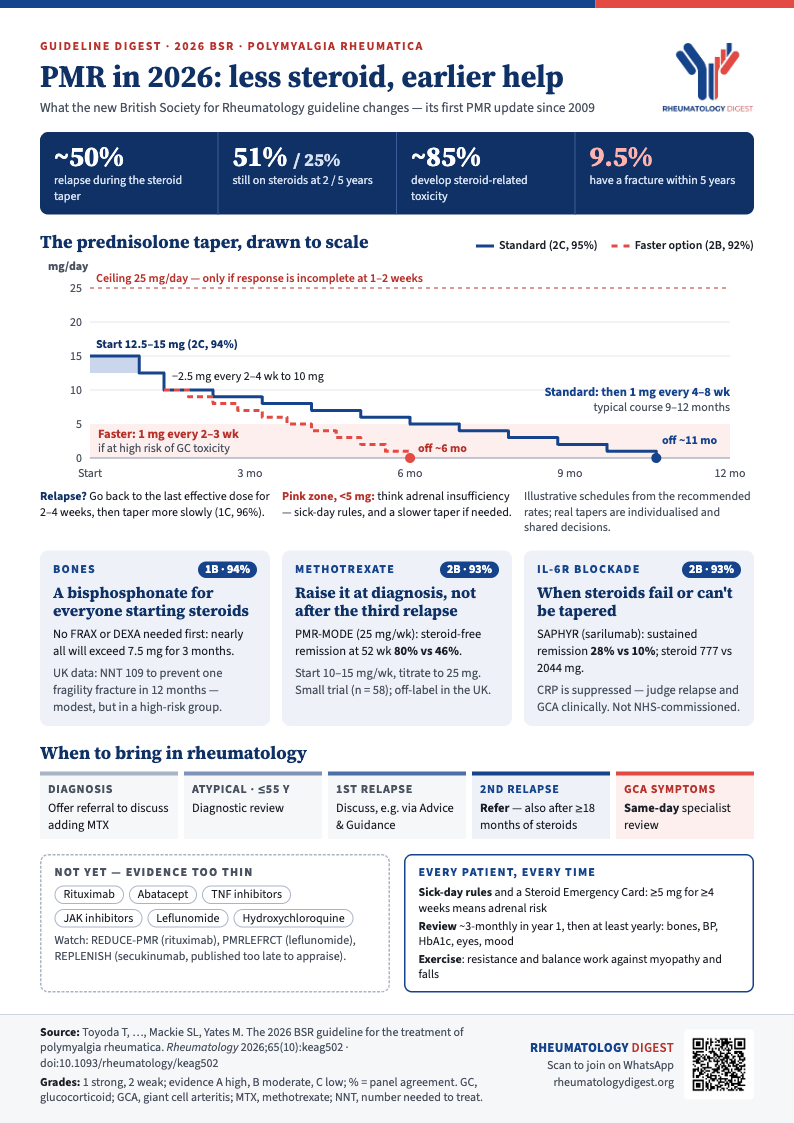
TL;DR: The 2026 BSR guideline keeps glucocorticoids as the base of PMR treatment but changes the surrounding care: bone protection for everyone, a faster taper for those at risk of toxicity, methotrexate or IL-6 blockade added earlier for selected patients, and rheumatology referral by the second relapse.
The 2009 BSR/BHPR PMR guideline predated the evidence on methotrexate and IL-6 blockade, and the 2015 EULAR/ACR recommendations preceded most of the trials this one draws on. The new guideline is written for primary care as much as for rheumatology, since most people with PMR in the UK are diagnosed and managed by GPs. It covers treatment of confirmed PMR only, not diagnosis, giant cell arteritis or immune checkpoint inhibitor-induced PMR.
Why a new guideline
PMR affects about 1% of the UK population, with a lifetime prevalence of 2.4% in women and 1.7% in men, and a peak incidence in the seventh and eighth decades. Around half of people follow a standard glucocorticoid taper without relapse and can stop treatment, and the prognosis is good once they have been off treatment and well for 6–12 weeks. The other half has a relapsing course, with one or more relapses requiring a dose increase.
The case for change is the cumulative cost of that second group. In a meta-analysis cited in the guideline, 51% of patients were still on glucocorticoids after 2 years and 25% after 5 years. Relapse occurs in up to two-thirds of people, and each relapse prolongs treatment. Around 85% of people with PMR experience treatment-related harm. In routinely collected UK data, glucocorticoids were stopped at a median of 1.31 years from diagnosis, and the median cumulative dose was 4 g prednisolone-equivalent. Approximately 5–10% of patients later develop giant cell arteritis.
How it was made
The guideline followed the BSR’s Creating Clinical Guidelines Protocol (v6.0), with GRADE and AGREE II. The working group included rheumatologists, general practitioners, physiotherapists, pharmacists, a clinical nurse specialist and three experts by experience, one a representative of the charity PMRGCAuk. Eighteen PICO questions, plus a further one on long-term glucocorticoid outcomes, drove a systematic review across eight databases. Randomised trials were included, and observational studies if they had at least 100 participants. Each recommendation carries a GRADE rating (strength 1 or 2, quality A, B or C) and a strength of agreement (SoA) from a vote of the group, with the wording revised until at least 80% agreement was reached. It is due for review in five years. The Royal College of General Practitioners and the Primary Care Rheumatology and Musculoskeletal Medicine Society endorse it.
The nine overarching principles
These are expert consensus, graded 1C, and not derived from the evidence review. In summary: decisions should be shared between clinician and patient; care should be individualised; it should be delivered by a team with continuity where possible; people should be managed in primary care with secondary care support where clinically indicated; rheumatology should be consulted after a relapse (for example through advice and guidance), with referral after a second relapse; glucocorticoid therapy should be reviewed periodically; every patient should receive clear education about their condition and treatment; they should have access to self-care information on diet, activity and pacing; and they should be supported to recognise and report anything suggesting relapse, treatment toxicity or another condition such as GCA.
The eight recommendations
Glucocorticoids
Recommendation 1 (GRADE 2C, SoA 94%). Treat newly diagnosed PMR with 12.5–15 mg prednisolone daily, increasing to a maximum of 25 mg if necessary for symptom control. After symptoms have been controlled for 2–4 weeks, begin to taper.
The evidence is six small RCTs (253 patients in total, each arm under 50) that compared glucocorticoid types and formulations, not starting doses. Observational data suggest starting doses under 10 mg are associated with incomplete response, and doses above 25 mg with more toxicity without added benefit. In routinely collected UK data, starting dose was not associated with a significant difference in cumulative dose over the disease course. The guideline says the lower end of the range (12.5 mg) may be used where there are concerns about diabetes, osteoporosis or glaucoma, and that expert consensus favours higher doses within the range for severe pain and stiffness, constitutional symptoms, very high inflammatory markers or larger body weight. Morning dosing minimises insomnia and adrenal suppression, though prominent nocturnal symptoms can be managed by splitting the dose (for example 10 mg in the morning and 5 mg in the evening). Lack of significant response after one week should prompt reconsideration of the diagnosis.
Recommendation 3 (GRADE 2C, SoA 95%). When disease activity is judged sufficiently controlled, taper by 2.5 mg every 2–4 weeks until 10 mg daily, then by 1 mg every 4–8 weeks.
No RCT has compared taper regimens. The guideline stresses that this is a provisional plan for monotherapy, not a promise that everyone can follow it, and that “sufficient control” is a clinical judgement based on symptoms, examination and inflammatory markers if needed.
Recommendation 4 (GRADE 2B, SoA 92%). In people at high risk of glucocorticoid toxicity, consider a faster taper once disease activity is controlled, for example 1 mg every 2–3 weeks, aiming to stop within 6 months of initial disease control.
The indirect evidence is the PMR-MODE trial, in which both arms followed a 24-week glucocorticoid taper and 46% of the placebo arm reached glucocorticoid-free remission at week 52, suggesting a subgroup can be exposed unnecessarily to prolonged therapy. A faster taper suits patients with frequent follow-up available or high toxicity risk, and inflammatory markers should be checked in anyone who becomes symptomatic.
Recommendation 5 (GRADE 1C, SoA 96%). If PMR relapses, return to the last effective dose for 2–4 weeks, then consider slowing the taper, accounting for patient factors. There are no RCTs on managing relapse, but the group judged a strong recommendation appropriate because the step is low-risk and the harms of under-treating a relapse were considered to outweigh the harms of the dose increase.
Bone protection
Recommendation 2 (GRADE 1B, SoA 94%, graded from external evidence). Prescribe bisphosphonates for people with PMR starting glucocorticoid therapy unless contraindicated.
This is the guideline’s most practice-changing recommendation. National Osteoporosis Guideline Group advice already recommends bone protection for anyone expected to take 7.5 mg prednisolone or more for 3 months or more, which almost everyone with PMR will meet, so the group recommends it without waiting for FRAX or DXA-based risk stratification. The rationale is that bone loss and fracture risk rise early after starting glucocorticoids. In one retrospective cohort, 9.5% of people with PMR had sustained a fracture by 5 years from diagnosis. A large UK primary care study found that 67% of people with PMR were coprescribed bisphosphonates, an improvement, but male patients and those in more deprived areas were less likely to receive them. The same study provided what the guideline describes as the first target trial emulation of bisphosphonate effectiveness in PMR, showing a significant reduction in fragility fracture risk, with a number needed to treat of 109 to prevent one fragility fracture over 12 months. The authors describe the absolute reduction as modest but set against a high background risk in older adults. Intravenous zoledronate may be preferred where oral absorption is a concern, and adequate calcium and vitamin D status should be ensured, with dietary calcium preferred. The 1B grade reflects evidence extrapolated from mixed glucocorticoid populations and reliance on bone density as a surrogate outcome. Where bisphosphonates are contraindicated, specialist referral for alternatives is advised.
Methotrexate
Recommendation 6 (GRADE 2B, SoA 93%). Discuss with people recently diagnosed with PMR the option of referral to rheumatology to consider adding methotrexate, with the aim of reducing symptoms and stopping steroids sooner.
Recommendation 7 (GRADE 2C, SoA 94%). Consider adding methotrexate alongside glucocorticoids in people who have relapsed or are at higher risk of glucocorticoid toxicity.
The evidence is five RCTs, the most recent being PMR-MODE. In the earlier trials, oral methotrexate 7.5–10 mg weekly with a taper led to lower cumulative glucocorticoid exposure (1.84 g versus 3.2 g, and 2.1 g versus 2.97 g) and, in one study, glucocorticoid-free remission at week 76 in 87.5% against 53.3%, though these were small and at high risk of bias. A meta-analysis of four trials supported higher remission and lower cumulative dose, with no significant difference in relapse. PMR-MODE tested methotrexate 25 mg weekly against placebo in newly diagnosed PMR with a rapid 24-week taper (30 methotrexate, 28 placebo) and found glucocorticoid-free remission at week 52 in 80% versus 46%, with no difference in cumulative glucocorticoid dose over 52 weeks, which may reflect the protocolised taper. Methotrexate favoured lower relapse incidence, faster glucocorticoid-free remission and better patient-reported outcomes, though the authors caution that it was a single small trial. PMR-MODE enrolled people who had been on glucocorticoids for under 8 weeks, which the guideline reads as support for introducing methotrexate early, strengthening the earlier EULAR/ACR conditional recommendation.
Practicalities: methotrexate is unlicensed for PMR in the UK, used off-label. The guideline suggests starting at a lower dose (typically 10–15 mg weekly) and escalating to 25 mg weekly as tolerated, consistent with PMR-MODE, and refers readers to the 2025 BSR DMARD prescribing guideline for pretreatment evaluation and monitoring. It may suit patients at higher risk of glucocorticoid toxicity because of comorbidities or significant side effects, though it needs regular monitoring for hepatotoxicity and bone marrow suppression and is not suitable in significant renal impairment or advanced liver disease. How long to continue it is not known, as no trial addressed stopping, so the guideline calls for an individualised shared decision. The STERLING-PMR trial is ongoing in people who have already relapsed.
IL-6 receptor antagonists
Recommendation 8 (GRADE 2B, SoA 93%). Consider adding an IL-6R antagonist alongside glucocorticoids in people who have had an inadequate response to glucocorticoids or are unable to tolerate a taper.
Three RCTs support it:
- PMR-SPARE (tocilizumab, 36 patients with new-onset PMR, 11-week taper): glucocorticoid-free remission at week 16 in 63.2% versus 11.8% (OR 12.9), with lower cumulative glucocorticoid exposure and a longer time to first relapse. The authors flag the very small sample.
- SEMAPHORE (intravenous tocilizumab, 101 glucocorticoid-dependent patients): the primary endpoint was met in 67.3% versus 31.4% (P < 0.001), with glucocorticoid-free discontinuation at week 24 in 49% versus 19.6%.
- SAPHYR (sarilumab, 118 patients with relapsing PMR, 14-week taper): sustained remission at week 52 in 28% versus 10% (P = 0.02), with a lower median cumulative glucocorticoid dose (777 mg versus 2,044 mg). There was no difference in the Glucocorticoid Toxicity Index for cumulative worsening.
The most common adverse events were neutropenia, arthralgia and diarrhoea, with more discontinuations in the active arms, and serious adverse events were infrequent and not significantly different, though the numbers were small. Three points need care in practice. CRP and ESR are suppressed by IL-6 blockade, so normal acute phase reactants are not reassuring, and relapse, intercurrent infection and GCA can all occur without raised markers, making clinical assessment and a high index of suspicion for GCA essential. The guideline is explicit that the evidence is insufficient to support routine IL-6R antagonists as a glucocorticoid-sparing strategy in newly diagnosed PMR. And sarilumab (not tocilizumab) is licensed for PMR by the FDA and EMA but has not been evaluated by NICE and is not commissioned by the NHS, so it may be prescribed in some settings but is not routinely available. There is no evidence on combining IL-6R antagonists with methotrexate.
What the guideline does not recommend
The evidence review found too little to recommend several options:
- Non-methotrexate csDMARDs. Hydroxychloroquine showed no benefit in relapse or cumulative dose except in a very low-quality study; leflunomide is documented only in two case series and an observational Argentine study (faster glucocorticoid discontinuation than methotrexate, but baseline differences limit comparison), with the PMRLEFRCT trial under way; azathioprine had a small, high-risk-of-bias study. No formal recommendation was possible.
- TNF inhibitors. Two small trials (etanercept, infliximab) were low quality, and the infliximab trial was negative. Adequately powered trials are lacking.
- Rituximab. One proof-of-concept RCT (38 newly diagnosed and 9 relapsing patients) met its primary endpoint (48% versus 0% glucocorticoid-free at week 21), but the one-year extension did not show a durable benefit. Two phase 3 trials are under way, and the group judged evidence insufficient given the risks of B-cell depletion.
- Abatacept. The ALORS trial (34 patients) showed 50% against 22% responders at week 12, not statistically significant (P = 0.07).
- JAK inhibitors. Tofacitinib was similar to glucocorticoids in an open-label trial, and baricitinib monotherapy gave sustained low disease activity in nearly 80% against 13% on placebo at 36 weeks in the BACHELOR trial, but the group considers larger, longer studies necessary.
- IL-17 blockers. No full results were available at the time. The REPLENISH study of secukinumab reported sustained remission at week 52 of 41.2% (300 mg) and 40.6% (150 mg) against 20.4% on placebo, but the full results were published too late to be appraised.
Timing and stopping DMARDs are unresolved. Relapse is common after stopping tocilizumab (the majority relapsed within six months in one study), dose reduction or spacing helped but relapse rates stayed substantial, and no robust data guide optimal duration or taper. Drug persistence is low: in a large US registry, only 13.1% were prescribed a glucocorticoid-sparing agent at baseline, and 63.8% remained on glucocorticoids after 12–24 months, with only 39% ever receiving a DMARD.
When to involve rheumatology
This is where the guideline is most explicit about changing routine practice. The group deliberately spelled out when to refer:
- Uncertain diagnosis, atypical features, age 55 or under, or features of GCA (referral for diagnostic review, with GCA symptoms needing immediate specialist review). The graphical abstract lists atypical features as joint swelling, fever, night sweats, significant weight loss, unilateral symptoms and CRP of 100 mg/L or above.
- No response or only a partial response to glucocorticoids at 1–2 weeks, or contraindication to them.
- First relapse: discuss with rheumatology, for example through advice and guidance, and convert to formal referral if appropriate.
- Second relapse: refer to rheumatology. The group’s reasoning is that these patients are at higher risk of further relapse.
- 18 months or more of glucocorticoid therapy: refer. Reasons given include difficulty distinguishing adrenal insufficiency and withdrawal symptoms from relapse, and the possibility that RA, GCA or another chronic inflammatory disease has emerged and been partly masked.
The guideline argues that “refer everybody or nobody” is a false dichotomy and acknowledges the counter-view that all suspected PMR should be seen to confirm the diagnosis, as is done for GCA. It says PMR is not a medical emergency like GCA and that deferring treatment while waiting for an outpatient appointment may be unacceptable.
Monitoring and education
The monitoring guidance is practical and is set out in the guideline’s Table 2, which it offers as a starting point for local pathways. Key suggested intervals, to be adapted to the individual:
- Bone health (risk factors, DEXA and need for protection): at diagnosis and at least every 3 years, or after any fragility fracture or after stopping glucocorticoids.
- HbA1c: at diagnosis, annually, and 3 months after a dose increase.
- Cardiovascular risk: at diagnosis, then yearly.
- Eyes: self-referral to an optician about 2 months after starting, then yearly.
- Gastroprotection, weight, mood and sleep, infection risk and vaccination: at initiation and at least annually.
- Overall review: at least annually, and in the first year most patients need review at least every 3 months; faster tapers need more frequent review.
Adrenal insufficiency is flagged: anyone who has taken 5 mg prednisolone or more for four weeks or more should be considered at risk, which can last a year or more after stopping, and steroid sick day rules and a Steroid Emergency Card are advised. Education should cover the disease course, GCA symptom awareness, relapse planning and resources such as PMRGCAuk, and the guideline notes that studies repeatedly find people with PMR experience tapering as a difficult journey that needs more information.
Exercise. The guideline recommends practitioners consider the potential benefits of exercise, extrapolating from other musculoskeletal conditions, since PMR-specific evidence is lacking. It summarises benefits in a table: aerobic exercise for metabolic and cardiovascular health, resistance training to counter glucocorticoid myopathy and sarcopenia and support bone health, balance work to reduce falls, and stretching to maintain range of movement.
Where the evidence is thin
The guideline is unusually frank about its limits:
- Most recommendations are graded 2B or 2C, with only Recommendation 5 (GRADE 1C, from expert consensus) and Recommendation 2 (1B, extrapolated from other guidelines) graded strong. The nine overarching principles are all 1C.
- The RCT base is small. The six glucocorticoid trials each had fewer than 50 patients per arm, the methotrexate trials were small and some at high risk of bias, and PMR-SPARE enrolled 36 patients.
- There are no trials on taper regimens or managing relapse, and the glucocorticoid taper in Recommendation 3 is a provisional plan.
- No validated disease activity measure exists for treat-to-target use, and definitions of remission and relapse vary. An international task force proposed a treat-to-target approach in 2024, but the group says it is not yet usable in practice.
- No licensed treatment exists in the UK for PMR other than glucocorticoids, and several recommended treatments are off-label.
- Referral pathway effects were not evaluated. The group acknowledges concern about destabilising existing pathways and lists evaluating alternative models of care as a research gap.
- Late-breaking evidence was not appraised. The REPLENISH secukinumab results came too late for inclusion.
- Some working group members have industry relationships, declared in full in the paper.
The guideline’s own research agenda names five priorities: optimal glucocorticoid tapering and alternative care pathways; head-to-head trials of DMARDs with treat-to-target and early-versus-delayed strategies; a unified definition of remission and relapse and appropriate outcome measures; risk stratification to predict who will need prolonged treatment, including the role of imaging; and non-pharmacological management.
What changes in the clinic
Three things differ from usual UK practice. Bone protection is now expected at the start of steroid therapy in essentially everyone, without waiting for a DXA or FRAX. Referral is earlier than the old “wait for repeated relapses” habit, with a discussion at the first relapse, referral after the second, and referral of everyone after 18 months of glucocorticoids. And steroid-sparing therapy is opened up earlier than before, through methotrexate discussed at diagnosis and IL-6 blockade for patients who cannot taper, with the caveat that the supporting trials are small and IL-6 blockade is not routinely funded in the NHS.
The recommendations most solidly grounded are about care around the steroid rather than any new drug: the taper, the bone protection, the monitoring, the education and the referral thresholds. The drug recommendations rest on trials that are encouraging but small.
Disclosures noted in the source: the BSR funded the evidence reviews and offered logistical support. Working group members declared interests in line with BSR policy, including consultancy, speaker and research relationships with several pharmaceutical companies, listed in full in the paper.