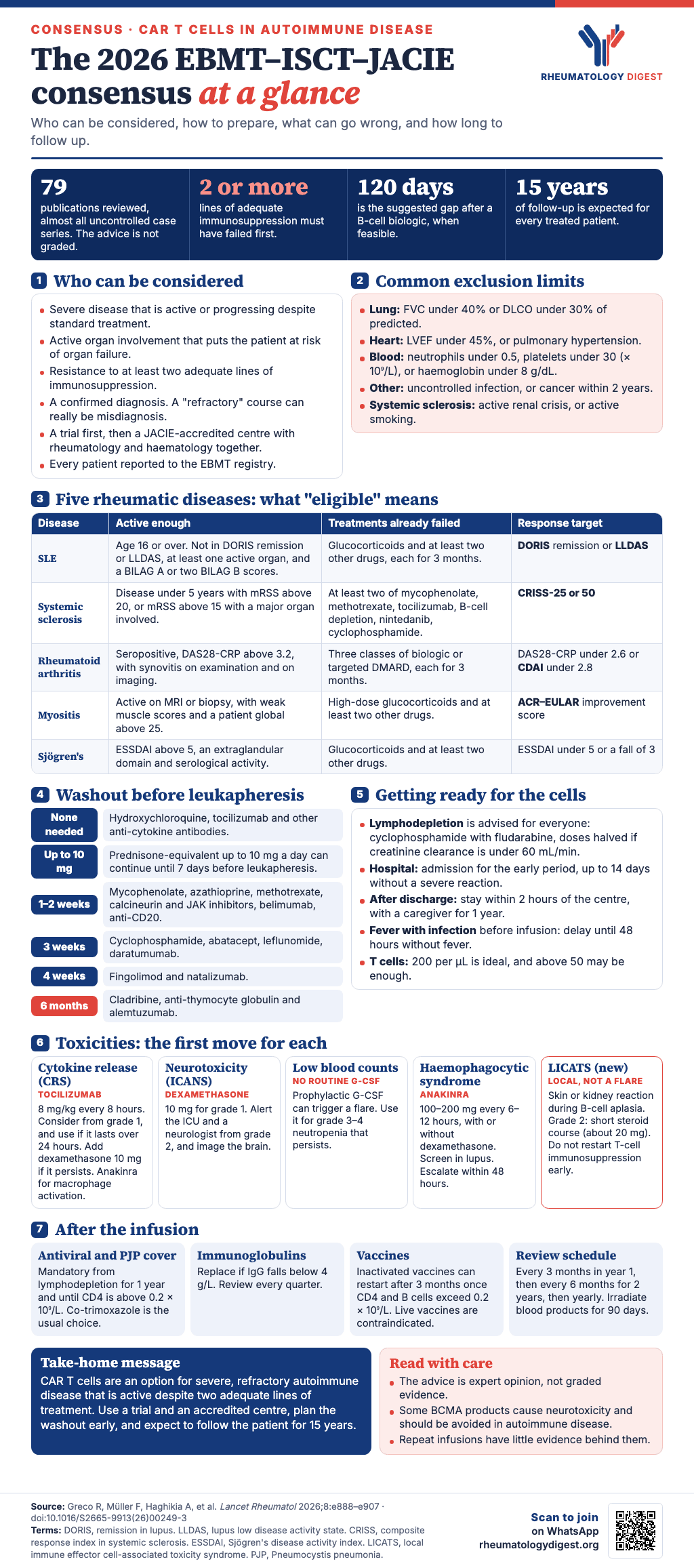
TL;DR: The 2026 EBMT–ISCT–JACIE consensus says CAR T cells can be considered only for severe autoimmune disease that is active and has resisted at least two adequate lines of immunosuppression, ideally within a trial at a JACIE-accredited centre with joint rheumatology and haematology care, and it sets out disease-specific eligibility, drug washout, lymphodepletion, toxicity management, infection prevention and 15-year follow-up, all as ungraded expert opinion.
Since the first report in lupus in 2021, CAR T-cell therapy has moved from cancer into severe autoimmune disease. This document updates the 2024 European recommendations from the European Society for Blood and Marrow Transplantation (EBMT), the International Society for Cell and Gene Therapy (ISCT) and the Joint Accreditation Committee of ISCT and EBMT (JACIE). It was written by a panel of 31 experts in autoimmune disease, haematology and cell therapy, with delegates from EULAR and the European Committee for Treatment and Research in Multiple Sclerosis. It is aimed at the clinician who may refer a patient, and at the teams that deliver the treatment.
Why CAR T cells, and what the evidence is
CAR T cells redirect cytotoxic T cells to eliminate a defined cell subset, with the hope of restoring immune tolerance by removing autoreactive cells. Two targets are in use. CD19 is expressed broadly, from B-cell precursors up to plasmablasts. B-cell maturation antigen (BCMA) is expressed on antibody-producing cells from memory B cells and plasmablasts up to long-lived plasma cells. After autologous CD19 CAR T cells, reports describe impressive short- and long-term drug-free remission in lupus and other autoimmune diseases that did not respond to standard treatment. The clinical effect lasts beyond B-cell reconstitution and, in some diseases, seems linked to loss of autoreactive antibodies, and the cells can deplete B cells deep in tissue such as lymph node and spleen.
Autologous haematopoietic stem cell transplantation (HSCT) is already standard of care in selected indications (a subset of systemic sclerosis, and active relapsing–remitting multiple sclerosis that has not responded to disease-modifying therapy), but not every patient can undergo it.
The evidence base is thin, and the panel says so plainly. It comes almost entirely from uncontrolled single-group case series, which are subject to selection and publication bias and have too little follow-up to judge durability. Because there are no randomised trials or large cohort studies, the recommendations are not graded. The literature review covered January 2010 to January 2026 and included 79 publications: 43 in rheumatic disease (16 lupus, 8 systemic sclerosis, 8 rheumatoid arthritis, 8 idiopathic inflammatory myopathy, 2 Sjögren’s disease, 1 vasculitis), 19 in neurological disease, and 17 in haematological, paediatric and other settings (including 7 studies of other CAR T-cell types). The panel drafted recommendations at a one-day meeting in Paris on 18 October 2025, circulated them for review, and finalised them on 31 January 2026.
General recommendations
Who can be considered.
- Severe autoimmune disease that is active or progressing despite standard therapy as defined by guidelines or regulatory approval.
- Active organ involvement that puts the patient at high risk of immediate or long-term organ failure or damage.
- Disease resistant to at least two lines of immunosuppression, given at an adequate dose and for long enough to judge the response. The type and number of failed drugs differs between diseases.
- A confirmed diagnosis that fulfils the disease’s criteria. A “refractory” course can in fact come from misdiagnosis, so this check comes before anything else.
Where and how.
- Use CAR T cells within a clinical trial with defined end points and eligibility whenever possible. If no trial is available, discuss the patient in a documented multidisciplinary meeting and refer to a centre with the right joint expertise. Treatment can also be given for compassionate use or, in Europe, under the hospital-exemption rule that lets custom-made advanced therapies be used in a hospital without central marketing authorisation.
- The treating centre should hold a current JACIE accreditation for immune effector cells, with the support services for early and late complications, and with autoimmune disease specialists and haematologists working together.
- Patients with affected organs (liver, kidney, heart, lung, central or peripheral nervous system) need case-by-case team discussion, with careful thought given to the lymphodepleting regimen and the CAR T strategy. Patients with complete peripheral B-cell depletion are eligible.
- Report every treated patient to the EBMT registry. Registry data are needed for long-term outcomes, durability and late toxicity, which small trials cannot supply. The centre should have systems for long-term follow-up, up to 15 years or death, as the European Medicines Agency and the US Food and Drug Administration require, with at least annual joint review by the autoimmune disease specialist and the haematology and CAR T team.
- Age alone is not a limitation, but comorbidity rises with age and counts as part of biological fitness. The cellular therapy comorbidity index developed in haematology has not been applied to autoimmune disease. Alternative non-CAR T options, including other trials, and bridging therapy should be discussed.
Disease-specific eligibility in rheumatic disease
The panel provides a table of indications, contraindications, concerns and assessment tools for each disease. It states that the list is not exhaustive and that trial protocols take priority in a trial. The details below are arranged by disease.
Systemic lupus erythematosus
- Who: age 16 or over (children under 16 may be eligible) who meet the 2019 EULAR–ACR classification criteria, with a positive anti-dsDNA, anti-histone, anti-Sm or anti-nucleosome antibody.
- How active: not in DORIS remission or LLDAS in adults, and in children a SLEDAI-2K score of 8 or more (excluding lupus headache), with at least one active organ system in both groups. In practice this means one BILAG A score or two or more BILAG B scores.
- Prior treatment: insufficient response or intolerance to glucocorticoids and to at least two of cyclophosphamide, mycophenolate, belimumab, azathioprine, B-cell depletion, anifrolumab, methotrexate, cyclosporin, tacrolimus or voclosporin, each for at least 3 months.
- Contraindications: life-threatening end-organ damage, defined as FVC under 40% or DLCO under 30% of predicted; LVEF under 45%; pulmonary hypertension (mean pressure over 30 mm Hg or systolic over 50 mm Hg); active liver disease with AST or ALT over three times normal (unless due to the autoimmune disease); neutrophils under 0.5 × 10⁹/L; platelets under 30 × 10⁹/L; haemoglobin under 8 g/dL; uncontrolled infection; a past malignancy unless free of disease for at least 2 years (basal or squamous skin cancer and carcinoma in situ of the cervix or breast excepted); and psychological, social or geographical factors that prevent adherence and follow-up.
- Concerns: lymphopenia that could stop successful cell production; irreversible kidney damage or creatinine clearance under 30 mL/min (end-stage disease is not an absolute exclusion, and cytotoxic doses must be adjusted); flare when immunosuppression is stopped; late neutropenia; fertility preservation, especially after cyclophosphamide.
- Monitoring: SLEDAI-2K, BILAG, CLASI for skin, renal tests (and biopsy if nephritis), echocardiography, lung function and CT if there is interstitial lung disease, C3, C4, dsDNA, ANA and antiphospholipid antibodies.
- Response targets: DORIS remission or LLDAS. Complete remission is uncommon in SLE, and LLDAS has shown similar rates of halting damage accrual and preventing flares. In lupus nephritis, aim for at least a partial response (a 50% or greater fall in proteinuria to subnephrotic levels with creatinine within 10% of baseline) by 6–12 months, and a complete response (proteinuria under 500 mg/day) over 12–24 months.
Systemic sclerosis
- Who: age 16 or over (juvenile disease under 16 may be eligible) who meet the 2013 ACR–EULAR criteria.
- Disease pattern: either disease duration of 5 years or less with mRSS over 20 and ESR over 25 mm or haemoglobin under 11 g/dL, or mRSS over 15 with a major organ involved. Major organ involvement means DLCO or FVC under 80% with ILD, a past renal crisis or stage 2–3 chronic kidney disease, or reversible heart failure, rhythm disturbance or a mild to moderate pericardial effusion.
- Prior treatment: insufficient response to at least two of mycophenolic acid, methotrexate, tocilizumab, B-cell depletion, nintedanib or cyclophosphamide for at least 3 months, with autologous HSCT contraindicated, unavailable, inadequate or declined.
- Contraindications: LVEF under 45%; pulmonary hypertension (the cut-offs are 30 mm Hg mean or 50 mm Hg systolic on right heart catheterisation without a fluid challenge, or above 45 mm Hg with a fluid challenge); FVC under 40% or DLCO under 30%; active renal crisis or uncontrolled malignant hypertension; active smoking.
- Concerns: extensive irreversible fibrosis; caution with gastric antral vascular ectasia, chronic kidney disease or a history of renal crisis; disease longer than 5–7 years needs individual assessment, although CAR T cells can be considered in severe progressive disease; borderline or moderate pulmonary hypertension (above 20 mm Hg on echo) or right heart dysfunction needs careful cardiology review; right heart catheterisation should follow 10 days off endothelin receptor antagonists or calcium channel blockers; cardiac tests should be refreshed if more than 3 months old; fertility preservation.
- Monitoring and response: SHAQ, mRSS, lung function, chest CT, cardiac biomarkers, echocardiography and, where relevant, cardiac MRI. Echocardiography and lung function are repeated twice a year for 2 years and yearly thereafter, and chest CT is repeated yearly for 3 years if there is ILD. Response is judged by CRISS-25 or CRISS-50 in two or three of mRSS, HAQ-DI, patient global and physician global (plus a more than 5% improvement in FVC), and by progression-free survival.
Rheumatoid arthritis
- Who: age 16 or over (younger patients in specific cases) who meet the 2010 ACR–EULAR criteria, are seropositive for rheumatoid factor or anti-CCP, and have raised CRP or ESR (infection and other causes excluded). Active disease means DAS28-CRP above 3.2 with clinical synovitis (swollen joints) and imaging evidence on power Doppler ultrasound, MRI or PET–CT.
- Prior treatment: failure or intolerance of at least three different classes of biologic or targeted synthetic DMARD, for at least 3 months each.
- Synovial biopsy: advised before and after treatment to show B cells, and many CD19-positive B cells in the synovium are strongly in favour of CD19 CAR T cells.
- Contraindications: non-inflammatory pain syndromes (neoplastic pain, fibromyalgia, mechanical pain from structural damage).
- Concerns: disease activity that rests on non-inflammatory domains, rheumatoid-arthritis ILD and other extra-articular disease to be monitored, and hypogammaglobulinaemia from earlier B-cell-depleting therapy.
- Response: EULAR–ACR remission, DAS28-CRP below 2.6 or CDAI below 2.8.
Idiopathic inflammatory myopathy
- Who: age 18 or over (juvenile dermatomyositis under 18 may be eligible) who meet the 2017 EULAR–ACR criteria, with myositis-specific or associated antibodies and active disease. Active disease needs myositis on MRI or biopsy, with or without ILD. In amyopathic or hypomyopathic disease, ILD with FVC under 80% is mandatory.
- Clinical thresholds: a CMAS score under 48 or an MMT8 score under 78 (unilateral) or 125/150 (bilateral), together with a patient global score above 25 on a 0–100 scale. Laboratory or radiological activity is also needed (CK, aldolase, LDH, AST or ALT over three times normal, or active MRI in children).
- Prior treatment: incomplete response to high-dose glucocorticoids plus at least two of IVIg, methotrexate, mycophenolate, azathioprine, cyclophosphamide, tacrolimus, JAK inhibitors or B-cell depletion.
- Concerns: rapidly progressive ILD (especially MDA5 and other antibody-defined subsets), ruling out cancer as the trigger, myocardial involvement and low functional performance from myopathy, glucocorticoids and inactivity.
- Response: the 2016 ACR–EULAR myositis total improvement score, MMT8 and patient global.
Primary Sjögren’s disease
- Who: age 18 or over who meet the 2016 ACR–EULAR criteria, with persistently high activity (ESSDAI above 5), extraglandular disease (vasculitis, haematological, lung, kidney or nervous system), serological activity (low C3 or C4, or raised CRP, ESR, IgG or rheumatoid factor, once infection is excluded) and a poor response to glucocorticoids and at least two of cyclophosphamide, azathioprine, mycophenolate, methotrexate or B-cell depletion.
- Contraindication: subjective symptoms alone, without objective inflammatory activity.
- Concerns: pre-existing irreversible salivary gland damage, the raised risk of concomitant B-cell lymphoma, hypogammaglobulinaemia and bronchiectasis (more severe and opportunistic respiratory infection).
- Response: ESSDAI under 5 or an improvement of at least 3 points, an ESSPRI improvement of at least 1 point or 15%, salivary flow, Schirmer test (increase of 5 mm or more), and falls in IgG (10% or more) and rheumatoid factor (25% or more).
Across all of these, assessments are made every 3 months in the first year and twice yearly afterwards if the response is stable.
Neurological and haematological disease
Neurological disease. Case series support CD19- and BCMA-directed CAR T cells in severe refractory disease, and trials are under way for myasthenia gravis, neuromyelitis optica spectrum disorder, multiple sclerosis and CIDP, with rarer targets including stiff person syndrome and autoimmune encephalitis. The criteria rest on expert opinion and HSCT experience. Briefly:
- Myasthenia gravis: adults with generalised disease and an inadequate response to at least two non-steroidal immunosuppressants, or two or more rescue therapies in the previous 12 months.
- NMOSD: AQP4-positive disease that relapsed after at least one biologic, including anti-B-cell, anti-IL-6 receptor or anti-C5 antibodies, or that has side effects or contraindications to approved treatment.
- Multiple sclerosis: active relapsing–remitting disease (EDSS under 6) despite high-efficacy treatment, or progressive disease (EDSS under 7) with documented progression and intrathecal IgG, with the most aggressive forms only in a trial.
- CIDP, stiff person syndrome, autoimmune encephalitis: disease that is fluctuating or unresponsive to second-line therapy, with stable disease of at least 6 months generally required for the neurological indications.
CRS and ICANS have not been reported at high frequency in the neurological CAR T literature so far.
Haematological autoimmune disease. A few case reports show short-term responses at 6 months. The criteria, which the panel stresses are based on minimal data, are:
- ITP: refractory to glucocorticoids, more than one thrombopoietin receptor agonist, spleen tyrosine kinase inhibitors and an alternative B-cell-depleting therapy, with chronic disease or life-threatening bleeding, or secondary ITP with confirmed antiplatelet antibodies. Thrombopoietin receptor agonists should be tapered with overlap, not stopped abruptly. About 20% of people with ITP show clonal haematopoiesis, and these patients should be excluded because of the risk of a secondary haematological cancer.
- Autoimmune haemolytic anaemia: positive direct antiglobulin test, ongoing haemolysis with transfusion dependence after at least three earlier lines (including rituximab in warm disease or sutimlimab in cold agglutinin disease), and an underlying malignancy ruled out.
- Acquired haemophilia A: failure to eradicate inhibitors after at least four lines (glucocorticoids with or without cyclophosphamide and rituximab), with ongoing or recurrent bleeding despite bypassing therapy.
- Other: single reports in ulcerative colitis and IgG4-related hepatobiliary disease suggest wider potential.
Preparing the patient
Drug washout before leukapheresis. Washout protects T-cell fitness, and the periods are suggestions based on drug half-life, lasting effects on T cells, infection risk and the danger of losing disease control, since there is mostly no direct data. In children, at least five half-lives of immunosuppressants should pass before both leukapheresis and CAR T infusion. The need to stop a B-cell-targeting biologic before infusion is unclear, but a washout of 120 days should be considered when feasible. Grouped by length:
- No specific washout: hydroxychloroquine, tocilizumab and other anti-cytokine antibodies, glatiramer acetate and β-interferons (an individual decision).
- Glucocorticoids: up to 10 mg/day of prednisone or equivalent can continue until 7 days before leukapheresis and afterwards until lymphodepletion (0.3 mg/kg/day at most in children). Higher doses can be used for bridging between leukapheresis and lymphodepletion.
- 1 week: dimethyl fumarate. Belimumab and B-cell-targeting antibodies such as anti-CD20 also stop at least 1 week before, although in aggressive disease they can continue up to 48 hours before, with attention to glucocorticoid premedication.
- 1–2 weeks: mycophenolate, azathioprine, methotrexate, calcineurin inhibitors, mTOR inhibitors and JAK inhibitors. If the patient is at high risk of flare or organ damage, the team can consider continuing mycophenolate until the day before apheresis.
- 2 weeks: bortezomib and other proteasome inhibitors.
- 3 weeks: cyclophosphamide, abatacept, leflunomide, teriflunomide (a forced washout within 1 week is possible for the last two) and daratumumab.
- 4 weeks: fingolimod and natalizumab.
- 6 months: cladribine, anti-thymocyte globulin and alemtuzumab. Anti-T-cell antibodies (anti-CD52, anti-thymocyte globulin, anti-CD38) should be avoided when a B-cell-directed CAR T therapy is planned next.
Product and apheresis considerations.
- A CD3-positive T-cell count of 200 per µL is the usual advice for good production, but more than 50 per µL can be enough.
- Take special care over drug doses and lymphopenia in people on long-term immunosuppression or with kidney involvement, and secure venous access early, because it can be difficult in skin disease and after long glucocorticoid use.
- Only one case of earlier autologous HSCT before CAR T cells (in multiple sclerosis) has been reported, and an interval of at least 12 months can be considered.
Lymphodepleting conditioning. It makes room for homeostatic expansion of the cells and should be considered in all patients, whatever their blood counts. It is generally cyclophosphamide with fludarabine, given after the product has arrived at the treatment site, with mesna as standard supportive care.
- Reduce doses by 50% when creatinine clearance is under 60 mL/min, and consider a longer gap before the cells to allow fludarabine metabolites to clear. Evidence for lymphodepletion on haemodialysis is insufficient, and in children with kidney impairment avoiding lymphodepletion altogether is not recommended.
- Doses can be lowered in severe cytopenia after individual risk assessment. There are hints that it is not always needed: repeated BCMA mRNA CAR T cells worked in myasthenia gravis without it, and CD19 CAR T cells worked in a patient with lupus at half the dose.
- Bendamustine carries a risk of drug-induced warm autoimmune haemolytic anaemia, and one study used cyclophosphamide alone. Whether and at what dose lymphodepletion is needed in autoimmune disease is not established, so it follows haemato-oncology guidance.
- If fever with active infection develops after lymphodepletion but before the infusion, postpone the infusion until 48 hours without fever or until the infection is controlled, and consider cryopreserving a fresh product.
Hospital stay and early follow-up. Give the cells in a FACT- or JACIE-accredited haematology department with CAR T experience, and admit the patient for the early post-infusion period, ideally up to 14 days without a severe reaction, given the frailty that comes with the disease and earlier long-term immunosuppression. After discharge the patient should stay within 2 hours of an experienced centre, with an educated caregiver present continuously for 1 year. Joint follow-up by the autoimmune specialist and a haematologist continues until full haematopoietic reconstitution, with a quarterly multidisciplinary review in the first year, then every 6 months for 2 years, then yearly.
Immune monitoring and product characterisation
Immune monitoring and biobanking should be routine, to learn how CAR T cells work in autoimmune disease and to improve protocols.
- Product: where possible (for example academic products), characterise the number, viability and proportion of CAR T cells, their differentiation stage (CD4 and CD8 proportions, naive, central memory, effector memory, terminal effector memory and regulatory cells) and exhaustion markers. Vector copy number is an important but under-reported property with a direct bearing on long-term genotoxic risk, and the panel recommends reporting it systematically in future studies and registries.
- After infusion: measure CAR T-cell expansion (peak and area under the curve), blood counts, lymphocyte and monocyte subsets, immunoglobulins, relevant autoantibodies and B-cell subsets. Suggested time points include days 7, 10 and 14, then months 1, 2, 3, 6, 12, 18 and 24, with some items needed only to month 24 and CAR T cells measured until they are no longer detectable on two assessments. Cell counts, immunoglobulins and autoantibodies are mandatory registry items. Antibody titres against vaccine antigens at month 6 help guide vaccination, and anti-CAR antibodies are checked at relapse.
- Safety: consider soluble factors linked to cytokine release (IL-1, IL-6, TNF, IL-8), and bone marrow sampling at baseline and after treatment for prolonged cytopenia.
- Anti-CAR antibodies have been detected in autoimmune patients and may be linked to failed expansion.
Managing adverse events
Toxicities follow the EBMT–EHA–ASTCT guidance, with early, prompt treatment favoured in autoimmune disease and joint monitoring to tell disease flare apart from toxicity of immune effector cells.
- Cytokine release syndrome (CRS).
- Grade 1: consider early tocilizumab (8 mg/kg intravenously every 8 hours), and give it if grade 1 persists beyond 24 hours despite appropriate management. If symptoms continue, consider dexamethasone 10 mg.
- Grade 2: tocilizumab with or without dexamethasone 10 mg every 6–12 hours, using higher steroid doses for severe or early, rapid onset.
- Grade 3–4: tocilizumab plus high-dose steroid (dexamethasone 10–20 mg every 6 hours, or methylprednisolone up to 1,000 mg/day), adding other agents if there is no improvement. Anakinra is considered for CRS with macrophage activation syndrome.
- Alert the intensive care unit for grade 2 or worse, and transfer at grade 3–4. Always investigate for infection (blood and urine cultures plus targeted tests) and treat empirically when it cannot be excluded.
- In multiple sclerosis, early tocilizumab and dexamethasone at grade 1 kept CRS low-grade with no neurotoxicity, and the cells still expanded in most patients.
- Immune effector cell-associated neurotoxicity (ICANS). Dexamethasone 10 mg every 12–24 hours for grade 1 (up to every 6 hours), 10–20 mg every 6 hours for grade 2 or worse, and high-dose steroid for grade 3–4. Alert the ICU and a neurologist for grade 2 or worse, with neuroimaging. Anakinra has worked in grade 2 and resistant cases, and higher doses (above 200 mg up to 600 mg daily) were associated with faster resolution and lower treatment-related mortality. Levetiracetam prophylaxis is reserved for selected cases (central nervous system involvement, higher-risk products, or ICANS grade 1 or worse), and prophylactic dexamethasone can be considered in diseases with nervous system involvement, such as lupus with central nervous system involvement. Baseline and serial IEC encephalopathy scores are recommended.
- Cytopenias (ICAHT). The CAR-HEMATOTOX score has been validated only in myeloma and lymphoma, not in autoimmune disease. Prophylactic G-CSF is not recommended, because it can trigger a flare. Therapeutic G-CSF is advised for prolonged grade 3–4 neutropenia, and so far no autoimmune flare after G-CSF has been reported in treated patients. For cytopenia that does not respond, exclude myelosuppressive drugs, nutritional deficiency, viral infection (CMV, parvovirus B19) and secondary haemophagocytic lymphohistiocytosis, and consider thrombopoietin mimetics in selected cases. Thrombocytopenia of grade 3 or worse is strongly linked to transfusion burden and worse survival.
- Haemophagocytic syndrome (IEC-HS). Screen for it, because HLH is part of some autoimmune diseases including lupus, and a fatal case has been reported in lupus after CAR T cells. Treat with anakinra (100–200 mg every 6–12 hours) with or without dexamethasone, escalating within 24–48 hours if there is no response, and add ruxolitinib for refractory cases, with emapalumab or etoposide as options. In systemic sclerosis, prolonged high-dose glucocorticoids need multidisciplinary oversight to avoid renal crisis.
- Local immune effector cell-associated toxicity syndrome (LICATS). This is a newly recognised, organ-specific inflammatory reaction during B-cell aplasia, confined to organs that the autoimmune disease had previously affected, most often skin and kidney. It is not regarded as a disease flare, and may reflect local cytokine release or target-cell killing. Watch and wait for grade 1, a short outpatient steroid course for grade 2 (a median maximum of about 20 mg prednisolone), higher doses for grade 3 (a median of about 67 mg), and ICU transfer for grade 4. Monitor for the first 3 months, be careful of dialysis risk when the kidney is involved (usually reversible with glucocorticoids), avoid premature restarting of immunosuppression that targets T cells, and use multidisciplinary review to tell LICATS from relapse. Apply it to children as well. In multiple sclerosis, MRI helps to distinguish the Uhthoff phenomenon from neurotoxicity.
- Other neurological events. Some BCMA products cause on-target neurotoxicity (neurocognitive disorders with delayed bradykinesia, tremor, speech or cognitive problems and facial palsies) and should be avoided in autoimmune disease. Myelopathy occurs with CD19 products in haematological use, can progress to flaccid paralysis and is easily missed in critically ill patients, and has been treated with methylprednisolone 1 g daily for 3–5 days, immunoglobulin or cyclophosphamide (tocilizumab probably does not help without CRS).
- Enterocolitis has been reported, more often after BCMA-directed therapy, with unclear frequency and mechanism.
- Late effects. Secondary malignancy and insertional mutagenesis are possible. Cardiotoxicity can appear as acute coronary syndrome, heart failure, arrhythmia, pericarditis or myocarditis. Pregnancy after CAR T cells is possible but may carry a risk of flare, effects on the unborn child are not well studied, and CAR T cells pass into breast milk, so breastfeeding is not recommended.
Supportive care, infection prevention and vaccination
- Blood products: irradiate from 7 days before leukapheresis until at least 90 days after the infusion, and monitor blood counts at every visit.
- Viral surveillance: check CMV or EBV PCR every quarter until B-cell or CD4 counts recover, and test for respiratory viruses, including SARS-CoV-2, if there are symptoms.
- Antiviral prophylaxis (valaciclovir or aciclovir) is mandatory for all, from lymphodepletion until 1 year after infusion and until the CD4 count exceeds 0.2 × 10⁹/L.
- Pneumocystis prophylaxis is also mandatory for the same period: co-trimoxazole 480 mg daily or 960 mg three times a week, or in allergy inhaled pentamidine (300 mg monthly), with dapsone or atovaquone as options.
- Antibacterial prophylaxis is not recommended in low-risk patients and can be considered once neutrophils fall below 500 per µL in those at high risk of ICAHT. Antifungal prophylaxis (mould-active, for 1–3 months) should be considered with severe or prolonged neutropenia, and is recommended when glucocorticoids are given long term (over 72 hours) or at high dose after CAR T cells.
- Immunoglobulin replacement: consider it when IgG falls below 4 g/L, with quarterly multidisciplinary review.
- Vaccines. Review vaccination status before lymphodepletion. Inactivated vaccines can be restarted from more than 3 months after CAR T cells in fully reconstituted patients (CD4 above 0.2 × 10⁹/L and CD19 or CD20 B cells above 0.2 × 10⁹/L, with no concurrent immunosuppressive or cytotoxic treatment), and earlier vaccination can be effective if guided by individual risk assessment. Live vaccines are contraindicated.
- Other follow-up: yearly endocrine checks including TSH and anti-TPO antibodies, and investigation of any secondary autoimmune disease.
Children and adolescents
For severe paediatric disease, experience is limited to single case reports with under 12 months of follow-up, and the ability of CAR T cells to reset the B-cell compartment and give long drug-free remission in monogenic autoimmune disease has still to be shown. The panel nevertheless encourages participation of children with severe or refractory disease, even where a monogenic cause is found, unless the genetic defect might be better treated with allogeneic HSCT. Decisions involve a multidisciplinary team (paediatric rheumatologist or neurologist, haematologist, and ideally an endocrinologist and a psychologist), weigh the harm of lifelong glucocorticoids and immunosuppressants on growth, bone, fertility and infection risk, and use a risk-stratified approach based on severity, refractoriness, glucocorticoid dependence and adherence. Consent comes from the legal guardians, with the child involved in an age-appropriate discussion. Dosing mirrors adults, using weight-adjusted rather than flat doses, and the lymphodepletion regimens overlap with adult ones, with dose adjustment for kidney impairment.
Wider points from the discussion
- Tolerability. After 5 years of experience, CAR T cells appear better tolerated in autoimmune disease than in cancer. Despite years of immunosuppression, cell production has been feasible with high yields. Compared with haematological patients, those with autoimmune disease show similar expansion and dynamics but less toxicity, fewer severe adverse events, shorter CAR T-cell persistence and faster recovery of adaptive immunity.
- Humoral immunity. Pre-existing antibody responses are only marginally affected by CD19 CAR T cells but are probably reduced more by BCMA CAR T cells, and infection risk depends on the disease and the degree of immunosuppression.
- Second infusions and relapse. Relapses after CAR T cells have now been reported. Treatment depends on severity and organ involvement, and prednisolone 1 mg/kg a day can be started, with disease-specific immunosuppression for more serious relapses. No formal recommendation on repeat infusion is possible, since evidence is limited to isolated reports. A second infusion can be considered for late relapse (over 6 months) with a different antigen target, and another construct if anti-CAR immune responses appear. In one patient with relapsing myositis, a second CD19 infusion failed to expand because of anti-CAR T cells, and a later BCMA infusion expanded well, cleared plasma cells from lymphoid tissue, lowered autoantibodies and restored drug-free remission. Poor expansion and antigen loss or downregulation can limit retreatment, and autologous HSCT has also worked as salvage.
- Cost and access. Academic, decentralised and point-of-care manufacturing could make treatment more accessible, and institutions with an academic good-manufacturing-practice facility could offer treatment under the hospital-exemption route to patients without trial access. Cost-effectiveness against standard treatment or HSCT is still to be studied. Unlike patients with advanced cancer, people with autoimmune disease are typically younger and may live for decades afterwards, so late-effect follow-up must be more stringent.
- Representation. Sex, gender and ethnicity data are so rarely reported that formal subgroup analysis was impossible.
Open questions and what comes next
- Place in treatment pathways. The position of CAR T cells for each disease, relative to other options including monoclonal and bispecific antibodies, remains to be defined.
- New designs under study. CRISPR editing and suicide genes for safety, allogeneic off-the-shelf cells, CAR constructs in other cell types (natural killer cells from stem cells, regulatory T cells, γδ T cells), dual targeting (CD19 plus BCMA), other antigens such as CD7 (some autoimmune diseases are enriched for CD7-negative clones) or B-cell activating factor in lupus, transient RNA-based CAR T cells (no lymphodepletion, repeat infusions possible), chimeric autoantibody receptor T cells, and in vivo generation of CAR T cells with lipid nanoparticles, which would remove ex vivo processing and its logistics.
- Data. Larger trials, registry data, long-term follow-up and health-economic studies are all needed.
What it adds up to
The panel’s conclusion is that the scientific rationale and clinical experience are growing, as they did with HSCT, and that multidisciplinary collaboration is the foundation. Safety and efficacy still have to be shown in controlled studies, and long-term outcomes and late effects matter as much, with registry reporting essential. These recommendations reflect current evidence together with expert opinion and are meant to promote patient safety and harmonise procedures, patient selection, data collection and research.
Disclosures noted in the source: many panel members report speaker fees, advisory board or consulting fees, grants and patents involving companies in the field of cell therapy and immunology, including Bristol Myers Squibb, Kite/Gilead, Novartis, Kyverna and Miltenyi. The authors state that none of these relationships related to the financing of the content of the review.