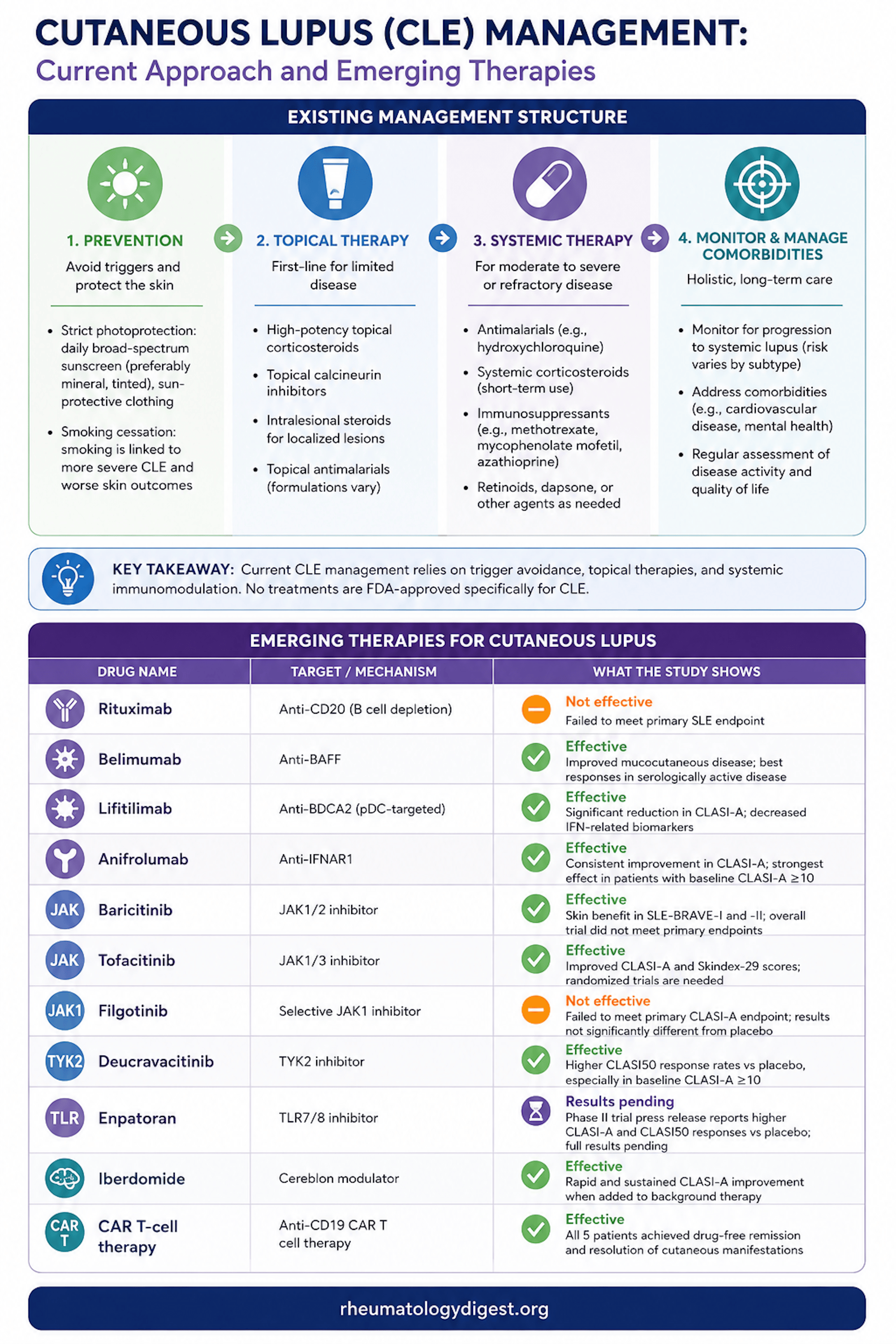
TL;DR: Cutaneous lupus still has no FDA-approved therapy, but the pipeline has acquired a mechanistic centre of gravity — the type I interferon axis, targeted at every node from TLR7/8 and pDCs through IFNAR to TYK2. Anifrolumab and deucravacitinib lead the refractory-disease options; the foundation remains photoprotection, early hydroxychloroquine and smoking cessation.
Why This Matters More Than It Looks
Skin is involved in up to 69% of SLE, and cutaneous lupus (CLE) runs from skin-limited disease to full multisystem lupus. Four reasons not to treat it as cosmetic:
- Damage is permanent. Scarring alopecia, dyspigmentation and disfigurement don’t reverse — so suppressing activity early is a damage-prevention strategy.
- The quality-of-life burden rivals heart failure or diabetes, and patients with only modest CLASI scores can still be severely affected.
- Skin-limited CLE still carries excess atherosclerotic risk — these patients need cardiovascular risk stratification, not dermatology-only follow-up.
- Progression to SLE is real but unquantified — reported rates span 0–42%, so we cannot yet give an individual patient a reliable number.
The Foundation — Still the Highest-Yield Part
Hydroxychloroquine, started early. In a 286-patient cohort, early HCQ was associated with an 87% reduction in progression to SLE (HR 0.13; progression 4.8% vs 27% on topicals alone). Observational, so confounding by indication is plausible — but the effect is large and biologically coherent. Dose at 5 mg/kg actual body weight; retinopathy stays <2% at 10 years. Add quinacrine for partial responders (no retinal toxicity), where you can get it.
Smoking cessation is pharmacology, not lifestyle advice. Concurrent smoking carried 3.15-fold odds of moderate-to-severe CLASI damage — holding after adjustment for deprivation index and race — and it blunts antimalarial efficacy.
Photoprotection, with a specific recommendation: mineral-based tinted sunscreen. Tinting blocks visible light, not just UV; photosensitivity affects up to 65% and tracks with activity.
Topicals: corticosteroids → calcineurin inhibitors (face, flexures) → topical JAK inhibitors (case reports only). One surprise: nicotinamide 4% ranked highest by CLASI in a network meta-analysis, ahead of clobetasol and tacrolimus — cheap, over-the-counter, and largely ignored as targeted therapy. Treat that ranking as hypothesis-generating, not proof.
The Interferon Axis — the Organising Idea
Nearly every new agent hits one node of the same pathway:
| Node | Agent | Status |
|---|---|---|
| TLR7/8 (IFN production) | Enpatoran | Phase II WILLOW positive — but press release and abstracts only |
| IRAK4 (downstream of TLR) | Edecesertib | Phase IIa in CLE completed Jan 2026; results pending |
| pDCs (BDCA2) | Litifilimab | Phase II LILAC positive; phase III TOPAZ-1/2 ongoing |
| IFNAR1 (receptor) | Anifrolumab | Strongest current evidence |
| TYK2 (signalling) | Deucravacitinib | Phase II positive; best indirect ranking |
| JAK (signalling) | Baricitinib, tofacitinib, filgotinib | Mixed to negative |
Anifrolumab is the most solid. Pooled TULIP-1/2 patients with baseline CLASI-A ≥10: 46% achieved CLASI-50 at week 52 vs 25% on placebo, separating by week 12. Real-world series in multirefractory patients (mean 6.3 prior therapies) report 89–100% response, with mean CLASI-A falling 13.9 → 2.1 and prednisone 4.9 → 2.4 mg — small and uncontrolled, but a real steroid-sparing signal.
Deucravacitinib is mechanistically distinct: it binds the regulatory (pseudokinase) domain, locking TYK2 inactive, rather than the conserved active site that conventional JAK inhibitors hit. That buys selectivity — relative sparing of JAK1/2-dependent thrombopoiesis and erythropoiesis.
Two Findings Worth Carrying Around
Pathway membership doesn’t guarantee efficacy. Type I IFN signals through JAK1 and TYK2, so selective JAK1 inhibition “should” work — yet filgotinib failed its phase II CLE trial outright, missing both CLASI-A and CLASI-50, while deucravacitinib succeeded. Potency, tissue penetration and cytokine breadth matter more than class logic.
The pDC dogma is being revised. Recent immunophenotyping suggests pDCs are not detectable IFN producers in many discoid and subacute lesions — yet BDCA2 blockade still works, implying an IFN-independent pathogenic role.
Also worth knowing: iberdomide (cereblon modulator, degrading Ikaros/Aiolos) improved SCLE and CCLE in phase II — a non-interferon route to skin benefit.
The Structural Problem
Almost all CLE evidence is borrowed. Skin outcomes in SLE trials are secondary, exploratory or post hoc; effect sizes come from enriched subgroups (CLASI-A ≥10); and patients with isolated cutaneous disease are systematically excluded from the very programmes that generate the evidence. The population with the greatest unmet need produces the least data.
Read the numbers accordingly. The much-quoted deucravacitinib OR 8.28 for CLASI-50 (vs litifilimab 2.54, anifrolumab 2.25) comes from indirect network comparison across heterogeneous trials, not head-to-head data — hypothesis-generating, not a prescribing rank order.
A Working Algorithm
- Everyone: mineral tinted sunscreen + protective clothing, hydroxychloroquine unless contraindicated, smoking cessation, cardiovascular risk assessment.
- Topicals for all: corticosteroids → calcineurin inhibitors → topical JAK inhibitors.
- Partial response: add quinacrine.
- Extensive/refractory: anifrolumab or deucravacitinib.
- If unavailable: methotrexate, mycophenolate, or belimumab — allowing ~20 weeks before judging cutaneous response.
- Subtype-specific: dapsone (bullous LE); thalidomide/lenalidomide (~90% response) in carefully selected refractory cases.