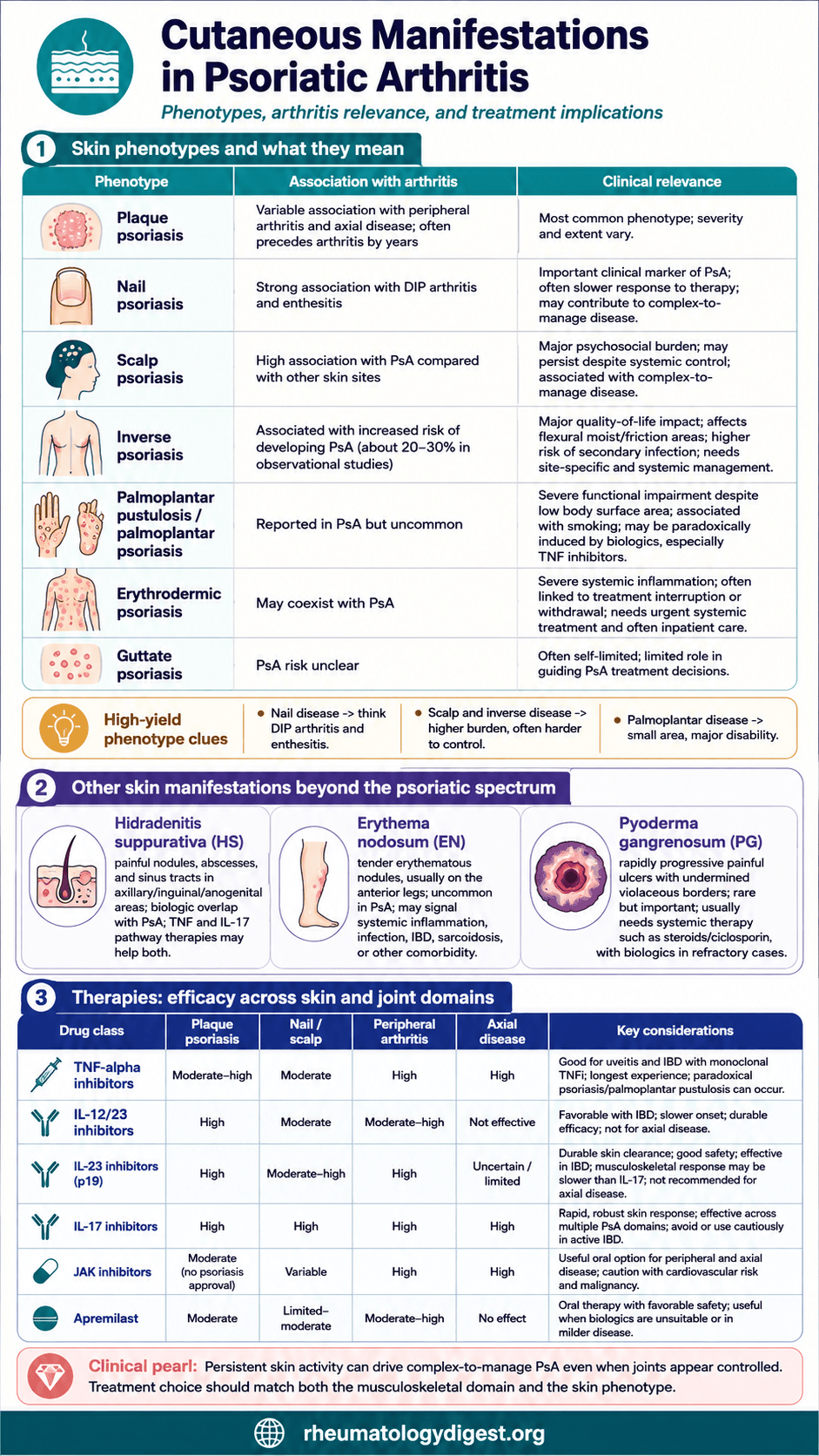
TL;DR: Specific psoriasis phenotypes — nail, scalp, palmoplantar, inverse — carry their own diagnostic and prognostic weight in PsA, respond differently to therapy, and drug-class selection should follow the cutaneous pattern in front of you as deliberately as it follows the joint count.
Why skin isn’t a side issue in PsA
Psoriatic arthritis has an annual incidence of about 6 per 100,000 and a prevalence of 100–120 per 100,000, with equal distribution between sexes. Among people with psoriasis, PsA prevalence runs higher than 13% and as high as 30%, depending on classification criteria and how it’s ascertained. The temporal relationship matters clinically: psoriasis precedes arthritis in 60–70% of patients, but in 15–20% arthritis comes first, with skin lesions developing later — so the absence of psoriasis at presentation does not rule out PsA, and recognising this ordering is what allows early detection of joint disease in patients who already carry a psoriasis diagnosis.
Treatment responses are often disproportionate between skin and joints, which is exactly why understanding the dermatologic side of this disease is not a side interest for a rheumatologist — it changes drug selection.
The shared pathogenesis behind the skin-joint axis
Skin inflammation in PsA reflects the same immune dysregulation driving joint disease, which is why treating one domain so often moves the other.
The initiating event is thought to involve antimicrobial peptides — LL37, defensins, S100 proteins, cathelicidins — released by keratinocytes after microinjury. These complexes activate plasmacytoid dendritic cells, driving type I interferon (predominantly IFNα) production, which in turn matures myeloid dendritic cells and drives TNFα, IL-23 and IL-12 output.
IL-23 pushes naïve T cells toward Th17/Tc17 differentiation and activates innate lymphoid cells type 3 (ILC3); both populations produce IL-17. Tissue-resident memory T cells also produce IL-17 and aggregate at sites of healed psoriatic plaques, where they can be reactivated by external stimuli including scratches — the Koebner phenomenon. IL-23 signals through IL23R, which depends on JAK/TYK signalling.
IL-17, the pathogenic centrepiece, drives keratinocyte hyperproliferation and — together with TNFα — induces IL-1β, IL-6, IL-8 and further TNFα, recruiting neutrophils and γδ T cells and amplifying the inflammatory environment. TNFα acts across T lymphocyte, Th1 and Th17 lineages, upregulating adhesion molecules and further inducing IL-17 and IL-22 — a self-perpetuating loop that has made the IL-23/IL-17 axis the central pathogenic pathway linking skin and joint disease.
Downstream, TNF, IL-17, IL-23, IL-22 and IL-36 activate MAPK and NF-κB signalling across skin, nails, entheses and synovium, with dermal fibroblasts and synovial/entheseal fibroblast-like cells sustaining disease propagation through cytokine and chemokine production. This is the mechanistic basis for calling it a unified skin–joint axis rather than two separately inflamed compartments.
The cutaneous phenotypes, and what each one means for PsA
| Phenotype | Association with joint disease | Clinical implications |
|---|---|---|
| Plaque psoriasis | Variable association with peripheral arthritis and axial disease; often precedes arthritis by years | Most common phenotype; extent and severity variable |
| Nail psoriasis | Strongly associated with DIP arthritis and enthesitis | Clinical marker of PsA; often slower response to therapy; may contribute to complex-to-manage status |
| Scalp psoriasis | High association with PsA compared with other localisations | Significant psychosocial burden; may persist despite systemic disease control |
| Inverse (flexural) psoriasis | Associated with 20–30% increased risk of PsA in observational studies | Disproportionate QoL impact; high-moisture/friction sites; increased secondary infection risk |
| Palmoplantar pustulosis/psoriasis | Reported in PsA but uncommon | Severe functional impairment despite low BSA; associated with smoking; may represent paradoxical reaction to bDMARDs, mainly TNF inhibitors |
| Erythrodermic psoriasis | May coexist with PsA | Severe systemic inflammation; often associated with treatment interruption or withdrawal; requires inpatient management |
| Guttate psoriasis | PsA risk unclear | Often self-limited; limited role in guiding PsA treatment decisions |
Nail psoriasis. Subungual hyperkeratosis, onycholysis, pitting and the oil-drop sign occur across psoriasis subtypes, but nail involvement is particularly common in PsA — present in roughly 80% of patients, against about 60% of fingernails and 35% of toenails in psoriasis generally. The anatomic proximity of the nail matrix to the DIP enthesis gives a structural basis for the correlation with DIP arthritis and enthesitis, and nail disease is regarded as a clinical marker that should heighten suspicion of PsA in a psoriasis patient and steer therapy toward agents effective in both nail and joint domains.
Scalp psoriasis. Affects up to 80% of people with psoriasis — clearly defined erythematosquamous lesions with silver-white scaling, often extending past the hairline onto the face or retroauricular skin. It is not typically associated with hair loss, though telogen effluvium shows on trichograms from affected areas, and scarring alopecia has been reported with prolonged plaques. It is highly noticeable, can extend to the face, and is a major driver of psychosocial burden.
Plaque psoriasis. The most common phenotype associated with PsA, with reported prevalence in PsA patients ranging from 2% to almost 26% depending on population and diagnostic criteria. Typically symmetric, favouring extensor surfaces — elbows, knees — but also trunk, face, ears and genitalia. Severity is assessed by BSA and quantified with PASI (erythema, induration, scaling). Chronic barrier disruption and mechanical stress make PsA-associated skin more prone to inflammation and ulceration, which can become secondarily infected.
Pustular psoriasis. Sterile, non-infectious pustules on erythematous skin, divided into a localised form — palmoplantar pustulosis (PPP) — and a generalised form (GPP, including von Zumbusch psoriasis and acrodermatitis continua of Hallopeau). PsA prevalence varies by subtype: one single-centre retrospective study reported PsA in roughly 8% of GPP patients and up to 28% of PPP patients. Neutrophil accumulation in the epidermis drives clinical severity. Acute GPP can present with extensive pustulation, fever, chills and systemic toxicity, progressing to secondary infection, sepsis or multiorgan involvement — this variant requires urgent assessment and, in severe cases, hospitalisation.
Palmoplantar pustulosis specifically occurs more often in women aged 30–50 and is strongly associated with smoking, with trauma, drugs and irritant exposure as common triggers. It accounts for only 3–4% of all psoriasis cases, but its functional impact is disproportionate — pain and fissuring can severely impair daily activity despite limited BSA involvement. Paradoxical induction or exacerbation of PPP has been reported with biologic therapy, particularly TNFα inhibitors, and also with IL-17 inhibitors, occurring despite adequate control of joint manifestations and thought to reflect a type I interferon pathway shift with altered neutrophil recruitment. Recognising this pattern matters because persistent palmoplantar disease can be disabling and frequently requires switching to a biologic from a different class.
Inverse (flexural) psoriasis. Erythematous, sometimes slightly erosive plaques in intertriginous areas — axillae, inframammary folds, perianal region, umbilicus, retroauricular skin, external genitalia. High moisture and friction promote irritation and secondary infection, and there is greater susceptibility to fungal infection in affected areas. Common in children, including newborns, where it may present as “napkin psoriasis,” and frequently seen with elevated BMI. Reported prevalence varies widely, 3–36%, and this phenotype is specifically linked to an increased risk of developing PsA. One detail worth remembering clinically: sudden-onset inverse psoriasis in an adult may signal underlying HIV infection.
Erythrodermic psoriasis. Rare and severe — extensive erythema affecting most of the BSA, often estimated at 80–90%. May bring fever, chills, malaise and increased infection risk from a compromised skin barrier, with dehydration, tachycardia, thermoregulatory dysfunction, generalised pruritus and skin exfoliation. This presentation can be life-threatening, with potential hypotension and shock, and typically requires hospitalisation for stabilisation, IV fluids, antibiotics where infection or sepsis is suspected, and systemic immunomodulatory therapy. Triggers include infections and — notably — abrupt withdrawal of systemic immunosuppressants, particularly ciclosporin or biologics, in patients who had previously responded well. Although the presentation can resemble erythroderma from other causes, management and prognosis are determined by the underlying psoriatic disease.
Guttate psoriasis. Predominantly a paediatric and young-adult presentation — numerous small, round “drop-like” papules mainly on the trunk and extremities. Often self-limited and may resolve without specific intervention, though in some patients it evolves into chronic plaque psoriasis or coexists with other morphologies. Triggers include upper respiratory infections, particularly streptococcal pharyngitis, along with mechanical stress and cutaneous trauma. Roughly 10% of psoriasis patients report a past episode of guttate disease, though fewer than 2% have active lesions at diagnosis. Unlike nail or scalp disease, its role as a risk predictor for PsA is neither well established nor proven in cohort studies.
Non-psoriatic skin disease that turns up in PsA
Several non-psoriatic inflammatory skin diseases occur in PsA patients, many falling within the neutrophilic dermatoses and sharing overlapping pathogenic pathways — particularly IL-17, TNFα and innate immune dysregulation.
Hidradenitis suppurativa (HS). A chronic follicular epithelium disorder — axillary, inguinal and anogenital involvement with painful nodules, abscesses and sinus tracts. A recent meta-analysis found HS prevalence higher in PsA patients (0.3%) than the general population (0.05–0.25%), and this coexistence correlates with more severe HS disease. The shared IL-17- and TNFα-driven inflammation, with neutrophil and macrophage recruitment, is reflected therapeutically — TNFα and IL-17 (both A and A/F) inhibitors are effective in both diseases.
Erythema nodosum (EN). Frequently diagnosed alongside systemic rheumatic disease and IBD; its specific frequency in PsA is uncertain and considered uncommon but well recognised. Clinically a panniculitis — tender, warm, erythematous nodules on the anterior lower legs, sometimes with systemic symptoms. May resolve spontaneously or need glucocorticoids, colchicine, methotrexate, ciclosporin, azathioprine or TNFα inhibitors. Histopathology typically shows septal panniculitis with neutrophilic infiltrates and granulomatous features. In PsA, EN — though uncommon — may signal heightened systemic inflammation, an underlying infection, associated comorbidities, or other conditions including IBD and sarcoidosis.
Pyoderma gangrenosum (PG). A neutrophilic dermatosis rarely associated with PsA — a case-report-based systematic review found PsA accounted for 8.5% of PG cases, with higher rates in rheumatoid arthritis and IBD-associated arthritis. Characterised by rapidly developing ulcers with necrolytic, undermined violaceous borders. Proposed mechanisms include heightened IL-1β, TNFα, IL-8 and IL-17 activity, consistent with an autoinflammatory phenotype. First-line treatment is typically systemic glucocorticoids or ciclosporin, with csDMARDs, IVIG and bDMARDs — particularly TNFα inhibitors and anakinra — effective as steroid-sparing agents or in refractory cases.
Treating the skin in PsA
Management requires coordinated planning, because skin involvement affects drug selection and survival, not just symptom burden. Nail, scalp and inverse disease frequently respond differently to treatment than classic plaque psoriasis, and the approach can differ depending on whether care is primarily rheumatology- or dermatology-led — which is itself an argument for integrated management.
Topical therapies remain appropriate for mild, localised disease or as an adjunct to systemic treatment for joint disease, controlling residual plaques and psoriasis in sensitive sites even though they don’t touch musculoskeletal inflammation. Corticosteroids, often combined with vitamin D analogues (calcipotriol, calcitriol), remain the mainstay for localised plaque psoriasis. Calcineurin inhibitors — tacrolimus, pimecrolimus — are valuable in intertriginous and facial psoriasis, where corticosteroid-related skin thinning is more of a concern. Keratolytics (salicylic acid, tazarotene) help in scalp and palmoplantar disease. Targeted narrowband UV-B phototherapy can benefit localised thick plaques or scalp disease, adjunctively, with clinical improvement typically after about 2 months.
For moderate-to-severe disease — there’s no consensus definition, though moderate is often set somewhere between 3–5% and 10% BSA, severe at 10% or more — systemic treatment becomes the primary approach: biologics, oral agents and phototherapy, alone or combined. For more extensive phototherapy, narrowband UV-B is preferred over broadband for its efficacy, longer remission and lower carcinogenic risk; PUVA retains a role in severe or refractory palmoplantar psoriasis but is limited by long-term skin malignancy risk.
Oral systemic agents and csDMARDs. Methotrexate is the most commonly used csDMARD in PsA and improves both plaque psoriasis and nail disease while also addressing peripheral arthritis. Ciclosporin can be used for severe cutaneous flares such as erythrodermic psoriasis, but has no disease-modifying effect on axial disease and isn’t generally recommended for peripheral joint control. Apremilast, a targeted synthetic DMARD, offers benefit for both psoriasis and peripheral PsA with a favourable safety profile, though its skin efficacy is moderate. Acitretin is useful for hyperkeratotic or palmoplantar disease and may be combined with phototherapy, but doesn’t affect musculoskeletal manifestations.
How the biologic and targeted synthetic classes compare
| Drug class | Plaque psoriasis | Nail/scalp | Peripheral arthritis | Axial disease | Notable in PsA |
|---|---|---|---|---|---|
| TNFα inhibitors | Moderate/high | Moderate | High | High | Longest clinical experience; class-effect risk of paradoxical psoriasis and palmoplantar pustulosis |
| IL-12/23 inhibitors (ustekinumab) | High | Moderate | Moderate/high | Not effective | Slower onset of skin and joint responses but durable; not recommended for axial disease |
| IL-23 inhibitors (p19: guselkumab, risankizumab) | High | Moderate/high | High | Uncertain/limited data | Durable skin clearance; MSK response may be slower than IL-17 inhibitors |
| IL-17 inhibitors | High | High | High | High | Rapid, robust skin responses; risk of onset or flare of IBD |
| JAK inhibitors | Moderate (no PsO approval) | Variable | High | High | Selected for axial and peripheral disease; caution in cardiovascular risk, malignancy |
| Apremilast | Moderate | Limited–moderate | Moderate/high | No effect | Favourable safety, suitable with multiple comorbidities including metabolic syndrome and diabetes |
TNFα inhibitors — the monoclonal antibodies plus the fusion protein etanercept — are the longest-lived approved biologics for psoriasis and PsA, giving substantial improvement in plaque, scalp and nail disease, plus advantages in patients with concomitant IBD or uveitis and robust long-term safety data. Their well-described class-effect risk is paradoxical psoriasiform reaction, most often manifesting as palmoplantar pustulosis, which can appear despite adequate musculoskeletal control and frequently requires switching biologic class. Infections including tuberculosis and hepatitis B/C reactivation, drug-induced lupus and demyelinating CNS disorders have also been reported.
IL-12/23 inhibition (ustekinumab), targeting the shared p40 subunit, improves plaque psoriasis with established efficacy for peripheral PsA and concurrent IBD, though skin responses tend to be slower and sometimes less complete than with newer IL-17 or IL-23 inhibitors. Safety remains excellent, with low rates of serious infection or malignancy.
IL-23 inhibitors (p19 blockers) — guselkumab and risankizumab — are proven, effective therapies for cutaneous disease, providing durable, often complete skin clearance across common PsA phenotypes, with a favourable safety profile and sustained responses supporting long-term control. Musculoskeletal efficacy is somewhat less rapid than with IL-17 inhibitors but shows sustained benefit in peripheral arthritis and enthesitis. Worth watching: icotrokinra, a novel oral IL-23 receptor inhibitor already approved for moderate-to-severe plaque psoriasis, is now under investigation for psoriatic arthritis, aiming to establish whether oral IL-23 inhibition can match injectable biologics for durability and musculoskeletal efficacy. There is also emerging, largely indirect and hypothesis-generating evidence that IL-23 blockade might influence disease interception — modifying the skin–joint axis and potentially preventing PsA onset — but this concept is not established in clinical practice.
IL-17 inhibitors — secukinumab and ixekizumab (IL-17A), brodalumab (IL-17 receptor inhibitor), and bimekizumab (dual IL-17A/F blockade) — are among the most potent skin-directed therapies available, providing rapid and substantial psoriasis clearing along with strong efficacy across PsA domains including enthesitis, dactylitis and axial involvement. Bimekizumab’s dual inhibition has shown high rates of both skin clearance and arthritis resolution, with a safety profile consistent with IL-17 pathway blockade; pooled data report low incidence of uveitis and IBD in PsA patients treated with bimekizumab, still under further evaluation. IL-17 inhibitors are typically avoided in patients with active IBD given the risk of exacerbation or drug-induced colitis. Secukinumab and bimekizumab have also shown clinical efficacy in HS, supporting a role in moderate-to-severe disease there too.
JAK inhibitors (tofacitinib, upadacitinib) show efficacy in both peripheral and axial arthritis and provide improvement in cutaneous disease, but are not approved for treating psoriasis and are used in PsA primarily for their musculoskeletal efficacy. Oral administration, rapid onset, and efficacy in arthritis and IBD make them useful options, but safety considerations — increased risk of infections including herpes zoster, malignancy, and cardiovascular and thromboembolic events — warrant careful patient selection and monitoring. Deucravacitinib, a selective TYK2 inhibitor, has shown high efficacy in plaque psoriasis and is approved for psoriasis; it may become relevant for PsA management as its indications expand.
Skin-oriented targeted therapies still investigational
IL-36 inhibition. IL-36, an IL-1 family member, signals through the IL-36 receptor to activate NF-κB and MAPK via the MyD88/IRAK complex. Dysregulated IL-36 signalling is strongly implicated in pustular forms of psoriasis, particularly GPP, which is associated with loss-of-function mutations in the IL-36 receptor antagonist. Spesolimab, a monoclonal antibody against the IL-36 receptor, has demonstrated rapid disease control in early-phase studies and has shown efficacy in phase II and III trials for GPP. Its role in PsA is not established, but IL-36 inhibition may be clinically relevant in PsA patients who develop pustular flares or paradoxical pustulosis during biologic therapy.
RORγt inhibitors target a transcription factor critical for Th17 differentiation and IL-17 production. Oral agents such as VTP-43742 have shown clinical efficacy against plaque psoriasis in phase II studies, with associated reductions in IL-17A and IL-17F consistent with Th17 axis modulation. Larger, later-phase studies are needed to clarify efficacy and safety and to determine any role in psoriatic arthritis.
ROCK2 inhibitors modulate Th17-driven immune responses by regulating transcriptional programs involved in IL-17 and IL-23 expression, attenuating pro-inflammatory cytokine production while preserving other immune pathways. A proof-of-concept trial supports mechanistic relevance in skin disease, but these agents are not currently approved for psoriasis or PsA, and no musculoskeletal efficacy data are available yet.
Emerging formats. The field is shifting toward smaller molecular formats and multispecific targets aimed at both skin and joint disease. Sonelokimab, a trivalent IL-17A/IL-17F-inhibiting nanobody designed for enhanced tissue penetration and simultaneous cytokine blockade, showed significant improvements in both joint endpoints and skin clearance in a randomised phase 2 trial of active PsA. Izokibep, another novel IL-17 pathway agent, showed promising efficacy and safety in a phase 2 study of active PsA. Combination biologic or targeted approaches may offer enhanced control in highly refractory disease when a single agent fails to control both musculoskeletal and extra-musculoskeletal manifestations, though this evidence remains early, largely observational and case-based — investigational rather than routine practice, but potentially addressing an unmet need in selected refractory cases.
Quality of life, and why skin drives complex-to-manage PsA
In a multinational cohort of 1,286 PsA patients, 80% reported skin or nail symptoms over the past year, a substantial proportion still had active skin involvement despite receiving treatment for PsA, and the majority — 55% — reported skin-related discomfort. Skin manifestations have a genuinely deleterious effect on health-related quality of life.
A discordance worth registering in clinic: in a retrospective analysis of a multinational PsA program, physician global assessment scores did not significantly differ between patients with and without active skin involvement — but patient-reported outcomes were substantially worse among those with active skin disease. In other words, the clinician’s global impression may miss what the patient is actually experiencing. Post hoc analyses of the phase 3 ixekizumab trials (SPIRIT-P1 and SPIRIT-P2) reinforced this: improvements in health-related quality of life depended on amelioration of both skin and joint symptoms, not joint control alone.
This is where the concept of complex-to-manage (C2M) PsA connects directly to skin disease. As defined by recent GRAPPA consensus, C2M PsA refers to persistent symptoms or inflammation despite at least one trial of a biologic or targeted synthetic DMARD, with consideration of comorbidities, treatment-related challenges, and patient-reported burden — a broader concept than classical treatment resistance. Skin disease is a key contributor: persistent or extensive psoriasis can exacerbate patient-reported symptoms, impair quality of life, and increase overall disease burden, and discordant responses between skin and joint domains may themselves drive treatment escalation or switching, even when joint symptoms are adequately controlled.
Registry data support this. A Greek PsA registry identified associations between C2M features and female sex, smoking, higher BMI, unemployment, axial involvement, nail disease and concomitant IBD, with extensive psoriasis (BSA > 3%) also linked to a C2M profile — an association corroborated by higher BSA in an Italian cohort. A French retrospective cohort found that patients meeting C2M criteria were more likely to discontinue a prescribed biologic due to inadequate skin disease control compared with non-C2M patients, prompting therapeutic adjustment. Skin is not incidental to the complex-to-manage phenotype — it’s one of its drivers.
Reading this review with the right caveats
This is a narrative review, not a systematic one: the authors searched PubMed and Embase from January 1999 to January 2026 using combinations of terms like “psoriatic arthritis,” “psoriasis,” “cutaneous,” “phenotype,” “burden” and “treatment,” but applied no formal inclusion or exclusion criteria — studies were selected for relevance to clinical scope, with priority given to trials, observational studies, systematic reviews and international recommendations. That means the selection, while sensible, isn’t protocolised, and the drug-class comparisons in the table above (efficacy rated high/moderate/limited) are the authors’ clinical synthesis rather than a formal network meta-analysis. Several of the newer agents discussed — icotrokinra, sonelokimab, izokibep, spesolimab in PsA, RORγt and ROCK2 inhibitors — are supported by phase 2 data or mechanistic studies rather than confirmatory phase 3 evidence, and are explicitly flagged by the authors as investigational.
What this changes in practice
- Ask about nail, scalp, palmoplantar and inverse disease specifically in any psoriasis patient being assessed for PsA — each carries its own association with joint disease and its own treatment logic, and a clean plaque-psoriasis history doesn’t rule these out.
- A worsening palmoplantar pustulosis on a TNF inhibitor (or occasionally an IL-17 inhibitor) may be a paradoxical drug reaction, not treatment failure — recognise the pattern before assuming the joint regimen needs escalating, since the fix is often a class switch, not a dose increase.
- Match the biologic class to the dominant phenotype, not just the joint pattern. Extensive, difficult-to-treat skin disease (scalp, nail, palmoplantar, inverse) generally favours agents with stronger cutaneous efficacy — IL-17 or IL-23 inhibitors; concomitant uveitis or IBD favours monoclonal TNF inhibitors or IL-23 inhibitors; active IBD is a reason to avoid IL-17 inhibitors.
- Don’t rely on your own global impression to judge skin burden. Physician global assessment did not track with active skin disease in the data cited here — patient-reported outcomes did. Ask directly, or use a patient-reported measure.
- Persistent skin activity despite adequate joint control is a legitimate reason to modify therapy, not a separate dermatology problem to defer — it is one of the defined drivers of complex-to-manage PsA and a documented reason for biologic discontinuation in real-world cohorts.
- Sudden-onset inverse psoriasis in an adult is worth a screening thought for HIV.