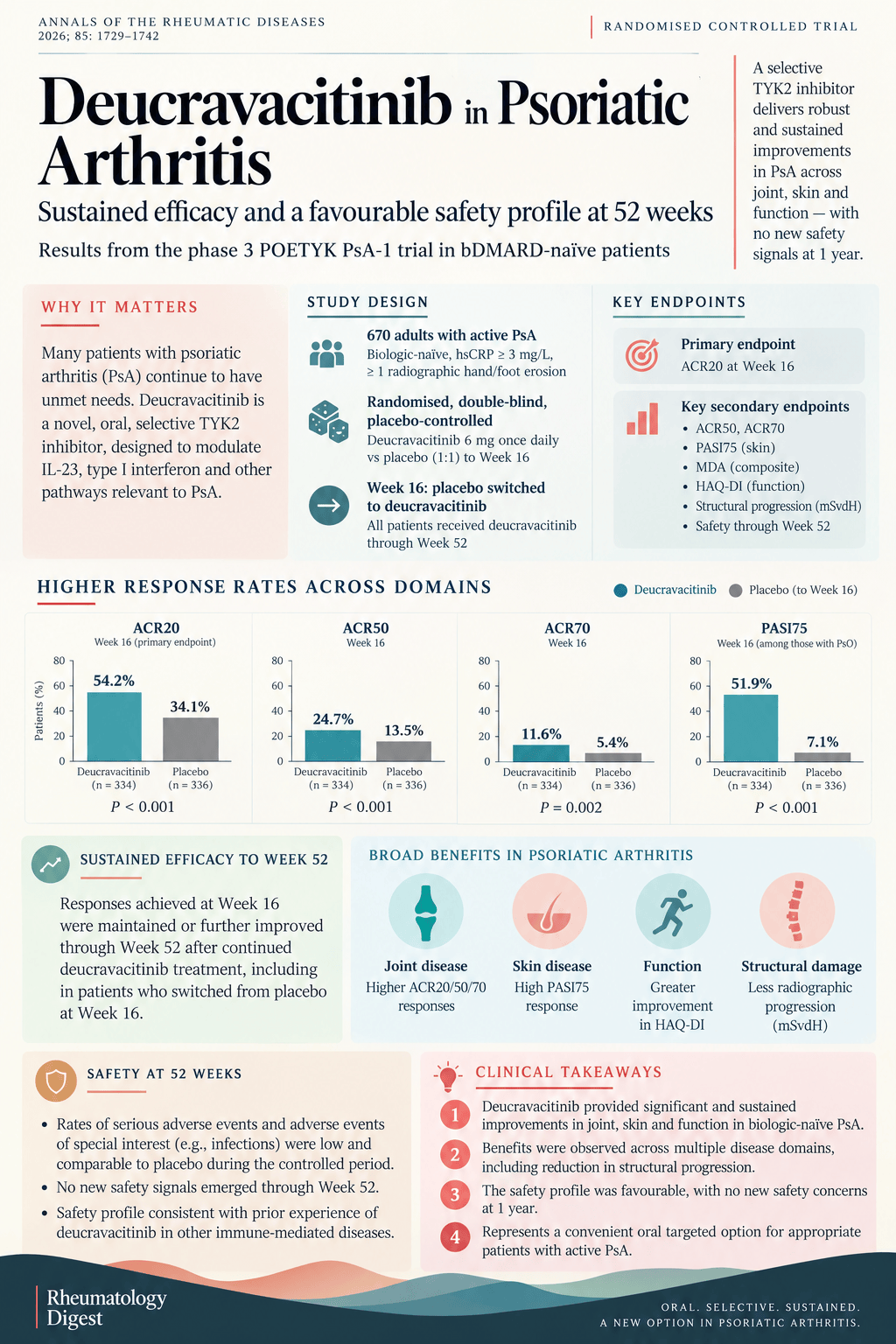
TL;DR: Deucravacitinib clearly outperformed placebo on joint, skin and function outcomes in biologic-naïve psoriatic arthritis, but the pre-specified radiographic endpoint was negative — the claim of structural protection rests on a post hoc reanalysis.
POETYK PsA-1 is one of two phase 3 trials that took deucravacitinib, already approved for plaque psoriasis, into psoriatic arthritis. The headline result is clean: the primary endpoint was met with a 20-point margin, and responses in joints, skin, function, pain and fatigue held or improved through a year. The more interesting reading is in the secondary endpoints, where the statistical hierarchy broke earlier than the abstract suggests, and where the structural-damage conclusion depends on an analysis that was not the one the trial pre-specified. Both matter for how confidently the drug can be positioned.
A different kind of oral kinase inhibitor
Deucravacitinib is a first-in-class, oral, selective tyrosine kinase 2 (TYK2) inhibitor, approved in multiple countries for moderate to severe plaque psoriasis and for active PsA, with more than five years of long-term psoriasis data.
What distinguishes it from the JAK inhibitors is where it binds. JAK1/2/3 inhibitors act on the catalytic domain; deucravacitinib binds the TYK2 regulatory (pseudokinase) domain instead. That allosteric mechanism is what gives it selectivity for TYK2 over JAK1/2/3. Blocking TYK2 prevents downstream signalling of several cytokines implicated in PsA — IL-23, IL-12 and type I interferons. A phase 2 trial in PsA met its primary and all key secondary endpoints with an acceptable safety profile, which set up the two phase 3 programmes.
The trial, and who was in it
POETYK PsA-1 was a multicentre, randomised, double-blind, placebo-controlled phase 3 study at 186 sites across 21 countries in North America, South America, Europe, Australia and Asia, running from July 2021 to May 2025.
Patients were randomised 1:1 to deucravacitinib 6 mg once daily or placebo through week 16, stratified by hsCRP (<10 vs ≥10 mg/L) and concomitant csDMARD use. At week 16, everyone on placebo switched to deucravacitinib through week 52 — so there is no placebo comparison after week 16.
The population was selected with some care, and that selection shapes how the results should be read:
- Biologic-naïve — prior approved or investigational biologic therapy for PsA or psoriasis excluded
- Active disease: ≥3 swollen and ≥3 tender joints
- hsCRP ≥3 mg/L and at least one PsA-related hand or foot erosion on radiograph — an entry criterion explicitly designed to enrich for radiographic progression
- Active or documented psoriasis
- Concurrent csDMARD, oral glucocorticoid and NSAID use permitted at stable doses
- Excluded: active fibromyalgia, other autoimmune or inflammatory joint disease, non-plaque psoriasis
Of 1,840 screened, 670 were randomised (334 placebo, 336 deucravacitinib), and 81.8% completed 52 weeks. Mean age was 52, half were female, 80.9% were White, and mean disease duration was 7.7 years. The disease burden was substantial: mean tender joint count 19.0, swollen joint count 10.5, DAS28-CRP 5.0 and HAQ-DI 1.4. 38.5% had hsCRP ≥10 mg/L and 69.9% were on a csDMARD at baseline — mostly methotrexate (58.5%), then leflunomide (7.1%) and sulfasalazine (4.8%). Polyarthritis predominated (78.1%), with oligoarthritis in 10.3% and DIP-predominant disease in 8.4%; 15.5% had axial plus peripheral involvement. Enthesitis was present in 63.7% by SPARCC and 51.5% by LEI, and 35.8% had dactylitis.
The primary endpoint was met comfortably
At week 16, ACR20 was achieved by 54.2% on deucravacitinib versus 34.1% on placebo — a difference of 20.0 percentage points (95% CI 12.7–27.4; P < .001). ACR50 was 24.7% versus 13.5% and ACR70 11.6% versus 5.4%, both nominally significant. Across every individual ACR component — joint counts, patient and physician global assessments, pain, HAQ-DI and hsCRP — deucravacitinib produced numerically greater improvement.
A previously published longitudinal analysis showed the arms separating as early as week 4.
Where the hierarchy held — and where it broke
This is the part of the paper that deserves the closest reading.
The trial controlled type I error with a fixed-sequence hierarchical strategy: once the primary endpoint was met, the nine key secondary endpoints were tested in a predefined order, and the moment one failed, everything after it could only be reported as nominally significant. The order and results at week 16 were:
- HAQ-DI change: −0.39 vs −0.22 (difference −0.17; P < .001) ✓
- PASI75 (in patients with ≥3% BSA and sPGA ≥2): 51.9% vs 7.1% (difference 44.1; P < .001) ✓
- SF-36 physical component: 6.06 vs 3.71 (difference 2.34; P < .001) ✓
- Minimal disease activity: 19.0% vs 10.2% (difference 8.9; P = .001) ✓
- Enthesitis resolution by LEI (pooled with PsA-2): 50.3% vs 45.1% — P = .18, not significant. ✗ The hierarchy breaks here.
- Radiographic progression (mSvdH change): 0.78 vs 0.64 — P = .76, not significant
- FACIT-Fatigue: 4.6 vs 2.0 — nominal only
- Dactylitis resolution (pooled): 57.6% vs 44.1% — nominal only
- DAS28-CRP change: −1.33 vs −0.83 — nominal only
So four key secondary endpoints are formally established: function, skin, physical quality of life and minimal disease activity. Everything from enthesitis onward — including fatigue, dactylitis and the structural-damage endpoint — is hypothesis-generating rather than confirmed, however striking the numbers.
Enthesitis and dactylitis
The enthesitis result is worth unpacking because the two instruments disagreed. By LEI, resolution was not significantly different. By SPARCC, a non-ranked endpoint, resolution was 47.1% versus 36.1% (difference 10.8; nominal P = .002).
The authors offer two explanations. LEI examines only 6 peripheral entheses against 16 for SPARCC, so it may underestimate total enthesitis burden — and secukinumab likewise showed no LEI difference in FUTURE-2. But they also note that SPARCC may not be the ideal indicator either: when ultrasound is used to separate inflammatory from non-inflammatory PsA phenotypes, higher SPARCC scores can reflect pain and fibromyalgia rather than persistent inflammation. The honest conclusion is the one they reach — a better understanding of how deucravacitinib affects enthesitis is still needed.
Dactylitis resolution favoured deucravacitinib (57.6% vs 44.1% in pooled data), nominally significant only because it sat below the break in the hierarchy.
Skin
The skin result is the least ambiguous in the trial, which is unsurprising given the drug’s psoriasis pedigree. PASI75 at week 16 was 51.9% against 7.1% — a 44-point difference. By week 52, PASI75 reached 66.0% in patients on continuous deucravacitinib, with PASI90 at 45.1% and PASI100 at 30.9%.
Function, pain and fatigue
The patient-reported outcomes moved in the same direction across the board. Beyond the HAQ-DI and SF-36 physical component results above, a clinically meaningful HAQ-DI improvement (≥0.35) was achieved by 51.3% versus 38.8% (nominal P = .001). Pain improved on every measure used: SF-36 bodily pain (16.8 vs 9.5), EQ-5D-5L pain/discomfort (−0.6 vs −0.3) and pain VAS (−23.1 vs −13.3), all nominally P < .001. FACIT-Fatigue improved by 4.6 versus 2.0 points.
On composite disease activity, DAPSA low disease activity or remission was reached by 34.8% versus 21.6% (nominal P = .001). BASDAI50 was not different between groups (25.5% vs 14.3%; P = .19) in the subset with spondylitis.
Response by sex
ACR20 superiority held in both sexes: 56.4% vs 37.8% in men and 51.8% vs 30.6% in women, with no significant treatment-by-sex interaction (P = .67). The authors place this alongside tofacitinib and upadacitinib, noting that — like the JAK inhibitors — deucravacitinib appears to show a less disparate response by sex than IL-17 and IL-23 inhibitors, for which higher response rates are reported in men.
Beyond week 16: responses kept climbing
After the switch at week 16, responses in the continuous deucravacitinib arm continued to rise. ACR20/50/70 increased through week 24 and began to plateau at approximately 28 weeks for ACR20, 36 weeks for ACR50 and 40 weeks for ACR70 — which means the week-16 primary endpoint captures the drug well short of its maximal effect. That is a useful counselling point for patients who are not impressed at four months.
At week 52, the two arms had converged, with patients switched from placebo achieving results similar to those on continuous treatment:
- ACR20: 60.8% (switched) vs 63.1% (continuous)
- ACR50: 44.0% vs 40.5%
- ACR70: 25.7% vs 25.0%
- Minimal disease activity: 34.4% vs 33.9% — over one-third of patients
- Dactylitis resolution: 63.3% vs 71.0%
- Enthesitis resolution (LEI): 59.9% vs 58.8%
- HAQ-DI change: −0.49 vs −0.51
These week-52 analyses were exploratory, without the estimand strategy used at week 16, and have no placebo comparator.
The radiographic story needs careful reading
The abstract states that inhibition of structural damage was observed at weeks 16 and 52, and the conclusion describes superiority for “structural damage inhibition”. The path to that conclusion is worth setting out plainly.
The pre-specified analysis was negative. Using the protocol-defined parametric ANCOVA, there was no difference in radiographic progression at week 16 (mean mSvdH change 0.78 on deucravacitinib vs 0.64 on placebo; P = .76). In that analysis the point estimate actually favoured placebo.
Two problems with that analysis prompted a post hoc revision. First, the radiographic data were not normally distributed, which a parametric ANCOVA handles poorly. Second, a strict windowing rule — requiring week-16 films between days 100 and 127 or before the first active dose — excluded roughly 20% of available radiographs. The authors therefore ran a post hoc nonparametric rank ANCOVA without missing-data imputation, in two populations: the protocol-defined one and a full population including every patient with baseline and week-16 films regardless of timing.
The post hoc analysis was positive. Deucravacitinib significantly inhibited progression in both the protocol-defined (rank ANCOVA P = .019) and full (P = .009) populations. As observed, mean mSvdH change from baseline to week 16 was 0.40 on deucravacitinib versus 0.57 on placebo, and to week 52 was 0.71 with continuous deucravacitinib versus 0.90 in those switched from placebo. The proportion of non-progressors (mSvdH change ≤0) at week 16 was 82.0% versus 72.9% in the protocol-defined population (P = .017) and 82.0% versus 71.5% in the full population (P = .003). Using the looser ≤0.5 threshold, the difference was significant only in the full population (86.6% vs 79.7%; P = .028), not the protocol-defined one (86.5% vs 81.7%; P = .16).
The authors note the magnitude of the non-progressor difference is consistent with guselkumab in APEX and secukinumab in FUTURE 5.
Three things are worth holding together here. The methodological reasons for the reanalysis are legitimate — rank-based methods are appropriate for non-normal radiographic data, and discarding a fifth of the films is a real cost. But the reanalysis was chosen after the pre-specified test failed, which is exactly the situation hierarchical testing exists to guard against — and in any case, the radiographic endpoint sat below the enthesitis break in the hierarchy, so it could not have been confirmatory even if its pre-specified test had succeeded. And the absolute progression in both arms was small, well under one mSvdH unit over sixteen weeks, in a population deliberately enriched to progress. The authors themselves note that a 16-week placebo period may be too short to detect radiographic progression with an instrument as insensitive as plain radiography. The structural signal is encouraging and plausible; it is not yet established.
Safety in the placebo-controlled period
Through week 16, adverse events occurred in 60.2% on deucravacitinib versus 48.0% on placebo, and treatment-related events in 19.3% versus 11.7%. But the events that drive decisions were low and comparable: serious adverse events 1.8% versus 2.4%, and discontinuation for adverse events 2.4% versus 1.8%. Upper respiratory tract infection was the most common adverse event (5.1% vs 3.0%). No deaths occurred.
The adverse events of special interest followed the drug’s known profile from psoriasis. Skin events were the most frequent — 30 patients (9.0%), 18 of them acneiform. Among infections: COVID-19 in 9 (2.7%), herpes simplex in 5 (1.5%), influenza in 4 (1.2%) and herpes zoster in 1 (0.3%). There were no inflammatory bowel disease events or IBD flares, and no MACE, VTE, malignancy or opportunistic infection signals in the placebo-controlled period.
Safety through week 52
Over the full year, exposure-adjusted incidence of adverse events was 196.0 per 100 patient-years in those switched from placebo and 218.7 in those on continuous deucravacitinib. Serious adverse events ran at 9.0 and 8.9 per 100 patient-years, and discontinuations for adverse events at 5.2 and 6.0. The most common events (≥5% in any arm) were upper respiratory tract infection, nasopharyngitis, hypertension (7.8% on continuous deucravacitinib), COVID-19 and urinary tract infection. Skin and infection AESIs did not increase in incidence compared with the placebo-controlled period.
Skin events remained the most frequent AESI — 12.3% on continuous deucravacitinib (15.0 per 100 patient-years) and 11.1% in the switch group (19.0 per 100 patient-years). Rash was the most frequent skin AESI; all rash events were mild to moderate and none was serious. Four skin events led to discontinuation: urticaria in one continuous-treatment patient, and urticaria, allergic dermatitis and rash in the switch group.
Adjudicated events of interest across both deucravacitinib exposures were few: one myocardial infarction, one haemorrhagic stroke, one ischaemic stroke and one deep vein thrombosis, plus four malignancies — two prostate cancers, one glioblastoma and one endometrial cancer. The authors report no new safety signals for MACE, VTE, malignancy or opportunistic infection, and no deaths. Laboratory monitoring showed no meaningful changes in ALT, AST, creatine kinase or fasting triglycerides, and no cases of drug-induced liver injury or rhabdomyolysis.
One structural point about these data: after week 16 every patient was on deucravacitinib, so the 52-week safety figures are descriptive rather than comparative.
Where this leaves the JAK comparison
The implicit question behind every TYK2 trial is whether selectivity avoids the cardiovascular and malignancy concerns raised for JAK inhibitors by ORAL Surveillance. The authors argue TYK2 selectivity may result in a differentiated safety profile, and report no increase in adjudicated MACE, VTE or malignancy.
They also make the relevant comparison themselves: these events were in line with the low incidence observed in the pivotal PsA trials of upadacitinib and tofacitinib. That is the honest frame. The concern about JAK inhibitors did not emerge from their pivotal PsA trials, which also showed low rates, but from the post-authorisation ORAL Surveillance study in other rheumatic diseases. So these reassuring numbers place deucravacitinib where the JAK inhibitors stood at the same stage of their development — they cannot yet show it is different. The profile here is consistent with the five-year psoriasis data and a phase 2 lupus study, and long-term PsA safety will come from the open-label extension.
Limitations the authors acknowledge
- Study site was not modelled as a random effect, though with 186 sites and few patients per site the population-average analysis was aligned with the estimand.
- The 16-week placebo period may have been too short to observe radiographic progression in the placebo arm with radiography.
- The population was enriched for radiographic progression, which affects generalisability.
- The pre-specified ANCOVA was used despite non-normally distributed radiographic data, and the windowing rule excluded about 20% of available radiographs — the reasons for the post hoc reanalysis.
To these one might add that the trial enrolled only biologic-naïve patients, so it does not address deucravacitinib after TNF, IL-17 or IL-23 inhibitor failure.
Bottom line
For biologic-naïve PsA, deucravacitinib is an effective oral option with a clear advantage in skin, confirmed benefits in function and physical quality of life, and a meaningful minimal disease activity signal — reaching MDA in over a third of patients by a year. Its safety profile at 52 weeks is consistent with the psoriasis experience: acneiform and other rash, upper respiratory infections, and hypertension worth monitoring, without liver, CK or lipid signals. Two things remain open. Its effect on enthesitis is uncertain, with the two instruments disagreeing. And its effect on structural damage is supported only by a post hoc reanalysis after the pre-specified test failed — plausible, but not yet something to promise a patient. POETYK PsA-2, the companion trial, is the natural reference to read alongside it.
Disclosures noted in the source: the study was funded by Bristol Myers Squibb, which also funded medical writing support. Six authors are employees and shareholders of BMS, and most other authors report consulting, research or speaker relationships with multiple companies including BMS. The first author is an Associate Editor of Annals of the Rheumatic Diseases and had no involvement in the peer review of this article.