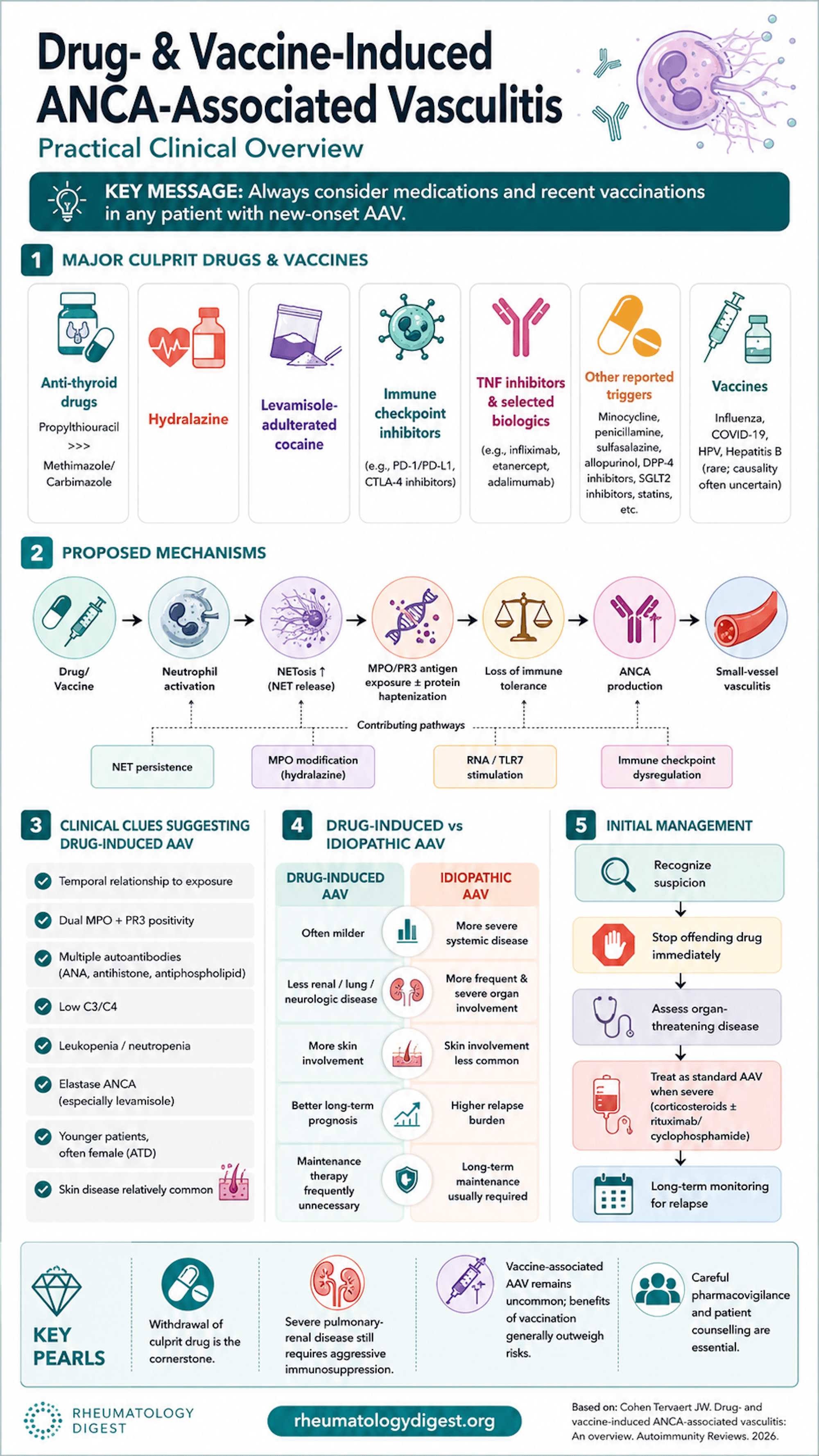
TL;DR: A proportion of ANCA-associated vasculitis is drug-triggered, and getting it right changes everything — the serology gives it away (dual MPO/PR3 positivity, elastase-ANCA, high IgM MPO-ANCA, scattergun autoantibodies, low C4, neutropenia), the course is milder, long-term maintenance is often unnecessary, and the single most effective intervention is stopping the drug. Antithyroid drugs, hydralazine and levamisole-adulterated cocaine dominate real-world practice.
The Clinical Problem
ANCA-associated vasculitis is usually approached as an idiopathic autoimmune disease — GPA, MPA or EGPA, treated with induction and prolonged maintenance immunosuppression. But a proportion of cases are triggered by something the patient is taking, and getting this wrong has direct consequences: the prognosis differs, the treatment intensity differs, the duration of maintenance differs, and the single most effective intervention — stopping the drug — is one no amount of rituximab can substitute for.
The difficulty is that drug-induced AAV is clinically almost indistinguishable from idiopathic AAV. Symptoms and signs overlap; there is no pathognomonic histological or laboratory marker; different drugs produce different disease patterns; and definitive proof of causation requires rechallenge, which is ethically unacceptable. The clinician is left working from suspicion, pattern recognition and serological clues.
Two further pressures make this timely. First, the therapeutic armamentarium in rheumatology and oncology has expanded enormously — biologics and immune checkpoint inhibitors are now themselves implicated. Second, the global COVID-19 vaccination programme generated a cluster of reports of de novo AAV, raising a question that must be answered honestly and carefully rather than dismissed or amplified.
Methodology — and Its Stated Limits
The author is upfront that this is an overview, not a systematic review: a purposive, judiciously selected survey rather than an evidence-based synthesis. A mixed PubMed search was run across combinations such as drug-induced ANCA (223 articles), drug-induced GPA (64), drug-induced MPA (143), drug-induced EGPA (294), plus corresponding vaccine-induced searches (vaccine-induced ANCA 46, vaccine-induced GPA 9, vaccine-induced EGPA 7). Inclusion required publication before June 2025. The author explicitly states the inclusion/exclusion criteria were not as rigorous as a systematic review would demand and that the review is not exhaustive. This is a strength of candour, but it matters when interpreting the vaccine and biologic sections.
The Suspects — Virtually Everything, But Three Drugs Dominate
The paper’s catalogue is essentially “virtually all drugs are potential offenders”: vaccines (influenza, COVID-19, HPV, hepatitis B), allergic desensitisation, intravesical BCG, checkpoint inhibitors, G-CSF/GM-CSF, gemcitabine, cisplatin, EGFR/oestrogen-receptor/aromatase inhibitors, statins, NSAIDs, a long antibiotic list headed by minocycline, antidiabetics (including DPP-4 and SGLT-2 inhibitors), essentially the whole biologic antirheumatic class plus JAK inhibitors, the anti-asthma biologics, antithyroid drugs, antihypertensives headed by hydralazine, anticonvulsants, antiarrhythmics (procainamide, amiodarone, quinidine), drugs of abuse (levamisole-tainted cocaine, methamphetamine, heroin), and a miscellany including allopurinol, D-penicillamine, sulfasalazine, isotretinoin, clozapine, iodinated contrast, mirabegron, nintedanib, interferon alpha and sofosbuvir.
In practice, three account for most real-world cases: antithyroid drugs, levamisole-contaminated cocaine, and hydralazine.
The Clinical Signature — How Drug-Induced AAV Differs
Compared with idiopathic AAV, drug-induced disease tends to occur in:
- Women more than men
- Younger patients
- A milder clinical course
- Less weight loss, fever, glomerulonephritis, lung involvement and neuropathy
- More skin involvement
- Long-term maintenance therapy often not required
- Generally better prognosis
The Serological Signature — the Most Practically Useful Part
There is no unique pathological marker, but drugs provoke a more polyclonal immune activation, and this leaves fingerprints:
- Dual MPO-ANCA and PR3-ANCA positivity (“double positive”) — in idiopathic AAV most patients recognise a single ANCA antigen; in drug-induced AAV, multiple antigens are common.
- Elastase-ANCA — rarely seen in idiopathic AAV, and therefore usable as a marker antibody for drug-induced disease.
- Reactivity to other ANCA antigens (anti-cathepsin G, anti-lactoferrin).
- High IgM MPO-ANCA levels — recently proposed as a biomarker.
- Persistently elevated MPO- or PR3-ANCA during follow-up.
- Positive ANA, anti-chromatin, anti-histone antibodies.
- Positive lupus anticoagulant, anti-β2-glycoprotein-1, anticardiolipin.
- Low complement C4 (and/or C3).
- Additionally: leukopenia and/or neutropenia in a newly diagnosed AAV patient is strongly suggestive of a drug cause.
There are still no formal diagnostic criteria. Identification remains a trial-and-error judgement, guided by whether stopping the suspected agent improves things — and early cessation appears to improve prognosis.
Epidemiology — Sparse, But the Pharmacovigilance Signal Is Striking
True incidence and prevalence figures do not exist. What exists are drug-specific estimates and disproportionality signals:
- Antithyroid drugs were implicated in AAV in 4% of patients in a long-term (3–6 year) follow-up study.
- Median prevalence of ANCA positivity: propylthiouracil 30%, methimazole 6%.
VigiBase (WHO Uppsala) case/non-case reporting odds ratios — note the orders of magnitude:
| Drug | Reporting odds ratio |
|---|---|
| Hydralazine | 2683.5 |
| Propylthiouracil | 1201.5 |
| Penicillamine | 170.3 |
| Thiamazole | 138.7 |
| Sofosbuvir | 74.6 |
| Minocycline | 72.4 |
| Carbimazole | 44.9 |
| Levamisole | 6.5 |
For COVID vaccine-associated AAV, no epidemiological data or ROR values are yet available. This asymmetry — hard numbers for hydralazine, none for vaccines — is worth holding in mind through the later sections. The author flags the known limitations of the case/non-case approach: reporting bias, notoriety bias, no denominator.
Pathophysiology — NETs as the Unifying Mechanism
The central mechanistic thread is neutrophil extracellular traps. Disordered NETosis is an important route to ANCA production; persistent NETs expose intracellular autoantigens and can break tolerance. Cocaine, levamisole, antithyroid drugs and hydralazine all significantly induce NET formation.
The most compelling experimental demonstration is Nakazawa’s rat model of propylthiouracil-induced AAV:
- PTU induced NETs of abnormal conformation.
- These abnormal NETs were poorly digested by DNase.
- Rats immunised with these abnormal NETs developed MPO-ANCA-associated pulmonary capillaritis.
- Rats given oral PTU plus intraperitoneal phorbol myristate acetate (a NET inducer) developed ANCA-associated pauci-immune glomerulonephritis.
Complementary mechanisms:
- Haptenisation of MPO — the drug (or its chemically altered metabolite) binds MPO and renders it immunogenic; proposed for hydralazine, PTU and procainamide.
- Inhibition of MPO oxidative activity — proposed for PTU.
- Leukotriene receptor stimulation imbalance — proposed for montelukast.
- Checkpoint inhibitors act by disturbing the regulation of immune activation, increasing Th1/Th17 responses.
- Vaccines may act as adjuvants; RNA-containing vaccines may drive ANCA production.
Causality — the Rose-Witebsky Bar Has Been Cleared Exactly Once
To formally prove that a trigger causes an autoimmune disease, the Rose-Witebsky criteria are the standard. They have been fulfilled only for hydralazine, through Xi et al.’s experiments:
- Hydralazine binds MPO, causing conformational change and altered immunogenicity.
- Patients with hydralazine-induced AAV carry high titres of IgM anti-hydralazine-modified MPO.
- Transfer of splenocytes from MPO-knockout mice immunised with hydralazine-modified MPO caused glomerulonephritis in Rag-2 knockout recipients.
For everything else, causality is inferred. Because ANCA are themselves pathogenic, demonstrating that a drug induces ANCA is taken as reasonable evidence — established for propylthiouracil. In one patient who developed AAV after influenza vaccination, RNA-containing vaccines stimulated ANCA production in vitro, with TLR-7 (the natural ligand of ssRNA) stimulation responsible.
Otherwise the field relies on Bradford Hill criteria, and more recently proposed machine-learning approaches to pharmacovigilance causality — neither of which has yet been applied to drug- or vaccine-induced AAV. The challenge-dechallenge-rechallenge paradigm is limited because rechallenge is unethical.
The paper’s illustrative case — an inadvertent natural rechallenge, and worth teaching:
A 42-year-old woman presented with arthralgias, myalgias, chronic nasal discharge, intermittent abdominal pain and violaceous ulcerating leg lesions. Elastase-ANCA positive; MPO- and PR3-ANCA both negative. She denied cocaine use and urine toxicology was negative — but hair testing was positive for both cocaine and levamisole, after which she admitted past use. She recovered fully with abstinence and supportive wound care alone. Two months later she relapsed into cocaine use and returned with arthralgias and renal failure, now positive for both MPO- and PR3-ANCA, with a kidney biopsy showing pauci-immune necrotising crescentic glomerulonephritis. She required high-dose corticosteroids plus cyclophosphamide.
An important caveat: adverse drug reactions are heterogeneous even for a single agent. With hydralazine, some patients develop drug-induced lupus, some develop AAV, and some an overlap of both — arguing that host factors, not the drug alone, determine phenotype.
Antithyroid Drug-Induced AAV
- ATDs are thiourea-family organosulfur compounds: propylthiouracil, methimazole (thiamazole), benzylthiouracil, carbimazole. About 60% of Graves’ patients remit on ATD.
- Agranulocytosis is the familiar early adverse event (typically <25–35 days). AAV is the late one.
- Patients may develop MPO-ANCA, elastase-ANCA, PR3-ANCA, or combinations. PTU causes more severe adverse effects than methimazole and produces MPO-ANCA more often.
- Crucially, only a minority of ANCA-positive patients develop vasculitis — approximately 31% over 3–6 years. This is direct clinical support for AAV being at least a two-hit disease: ANCA alone is not sufficient.
- Timing is unpredictable and often very long: about one quarter develop vasculitis within 1 year, half between 1 and 5 years, and the remaining quarter after more than 5 years — some as late as 14 years of ATD use. Easily the most clinically actionable single fact in the paper.
- Phenotype: most present as mild MPA with skin, musculoskeletal and/or renal involvement; some fulfil GPA or EGPA criteria. Compared with idiopathic AAV — younger, less kidney and nervous system involvement, but more cutaneous and ocular involvement. Biopsies typically pauci-immune.
- Severe presentations do occur: alveolar haemorrhage, dialysis-dependent renal failure.
- Management: mild cases may remit on drug withdrawal, sometimes with a short glucocorticoid course. About two-thirds — those with renal or pulmonary involvement — need glucocorticoids ± rituximab, cyclophosphamide or methotrexate. Prognosis is better than idiopathic AAV, but relapses can occur without rechallenge, implying that once tolerance is broken some patients behave like idiopathic AAV thereafter.
Hydralazine-Induced AAV
- Hydralazine-induced lupus has been recognised since 1954, affecting an estimated 8–13% of patients on high doses. Separately, 5–10% of hydralazine users may develop vasculitis.
- By VigiBase it is the most frequently reported form of drug-induced AAV (ROR 2683.5). Prescribing is heavier in the USA, particularly in patients of African descent, and lighter in Europe.
- Historical anchor: Nassberger (1991) described nine patients with MPO-ANCA and elastase-ANCA and hydralazine-induced glomerulonephritis.
- Presentation: arthralgias are common, and kidney involvement is common. Lung, upper airway, skin and nerve involvement are less frequent; pulmonary-renal syndrome is reported but rare.
- Serology: frequently ANA, anti-histone, anti-dsDNA and antiphospholipid antibodies. Hypocomplementaemia in more than half. IgM MPO-ANCA levels exceed those in idiopathic AAV, and these IgM antibodies react with hydralazine-modified MPO, induce neutrophil degranulation and cause glomerulonephritis in mice.
- Risk factors (a genuinely useful list for practice): cumulative dose >100 g, female sex, thyroid disease, HLA-DR4 genotype, slow hepatic acetylator status, and the C4 null gene.
- Histology is not reliably pauci-immune here — biopsies may show immune complexes (“lupus-like nephritis”) or none. Six cases of IgM-dominant immune complex-mediated glomerulonephritis have been reported.
- Lupus and AAV can occur simultaneously (“AAV/SLE overlap syndrome”), and importantly, hydralazine-induced AAV needs more aggressive treatment than hydralazine-induced lupus alone.
Biologics and Checkpoint Inhibitors — the Iatrogenic Paradox
- In a systematic review of vasculitis induced by biologics, 83% of reported cases occurred on anti-TNF therapy; cases also occurred with secukinumab, rituximab, abatacept, ustekinumab and tocilizumab.
- Of those who developed vasculitis on biologics, 67% had cutaneous or IgA vasculitis — but about 20% developed AAV.
- The paradox is explicit: anti-TNF may have a therapeutic role in AAV, yet may also cause it. (Its use in AAV is anyway constrained by increased risk of solid and haematological malignancy.)
- JAK inhibitors have recently been implicated too.
- Immune checkpoint inhibitors (PD-1, PD-L1, CTLA-4) are reported both as a cause of de novo AAV and as a trigger of relapse. A mechanistically satisfying observation closes the loop: Wilde et al. showed the inhibitory PD-1/PD-L1 axis is already defective in idiopathic GPA — so pharmacologically blocking that axis reproduces a lesion that occurs naturally in the disease.
Drug-Induced EGPA — the Unmasking Problem
- Triggers reported include allergic desensitisation therapy and vaccinations, plus leukotriene receptor antagonists, 5-lipoxygenase inhibitors and inhaled corticosteroids.
- More recently, EGPA has been described after omalizumab (anti-IgE), dupilumab (anti-IL-4) and anti-IL-5 agents. The European EGPA study group reported that 30 of 529 EGPA patients (5.7%) developed EGPA while on biologics (“anti-T2 therapy”) for severe asthma.
- The unresolved interpretive question: is this causal, or unmasking? These agents permit steroid tapering, and withdrawal of steroids may simply reveal EGPA that was already present and suppressed. The paper poses the question without resolving it — appropriately.
- Other implicated agents: penicillin, sulfonamides, macrolides, anticonvulsants, thiazides and, recently, IL-6 inhibitors.
Cocaine and Levamisole — the Most Operationally Important Section
- Historical origin: Citron (1970) described 14 drug abusers with renal failure and necrotising vasculitis with arterial aneurysms. Polysubstance use made attribution impossible then, and confounders remain — IV drug users are frequently hepatitis B/C or HIV positive and at increased risk of endocarditis, itself a well-recognised cause of ANCA positivity.
- Scale: roughly 20 million people aged 15–64 report cocaine use; annual prevalence 2.4% in the USA and 1.4% in Western Europe. Global supply is at record levels.
- Around 70–80% of available cocaine is adulterated with levamisole, an anthelminthic used mostly in veterinary medicine — added because it raises endogenous morphine levels and potentiates cocaine’s euphoric effect.
- Mechanistic division of labour: cocaine is a potent vasoconstrictor that induces endothelial adhesion molecules and promotes leukocyte transmigration; levamisole acts as an adjuvant, driving neutrophil and monocyte migration, increasing NK and activated T cells, and amplifying antibody formation. Both induce NETs, and these NETs are enriched in elastase — which elegantly explains the elastase-ANCA signature.
- Levamisole toxicity in its own right: neutropenia and agranulocytosis, vasculitis, leukoencephalopathy, retiform purpura and other skin necrosis, arthralgias.
CIMDL versus loco-regional GPA — the differential that matters most:
- Cocaine-induced midline destructive lesions (CIMDL) arise from repeated nasal vasoconstriction → mucosal erosion and necrosis → septal perforation and destruction of sinus, orbital walls and hard palate.
- Clinically: nasal obstruction, discharge with large crusts, epistaxis, septal perforation, nasal bridge collapse, orbital cellulitis; severe cases develop palate perforation and naso-orbital fistulas. Also retiform purpura with necrosis and bullae, fever and arthralgias. Severe AAV with glomerulonephritis and, rarely, diffuse alveolar haemorrhage can occur.
- Serology is the discriminator: loco-regional GPA is C-ANCA/PR3-ANCA or P-ANCA/MPO-ANCA positive. CIMDL is P-ANCA/elastase-ANCA positive, and in 50% also PR3- and/or MPO-ANCA positive. Where elastase-ANCA testing is unavailable, P-ANCA with PR3-ANCA, or dual MPO/PR3 positivity, should raise cocaine use.
- CIMDL patients also often have ANA, anti-dsDNA and antiphospholipid antibodies. Leukopenia with neutropenia is another discriminating feature.
- Histology: nasal biopsies are non-specific (necrosis, non-specific inflammation); skin shows leukocytoclastic vasculitis ± thrombotic vasculopathy; kidney shows necrotising crescentic glomerulonephritis.
- Toxicology practicalities: patients frequently deny use, out of shame or fear of legal or medical consequences. Benzoylecgonine (urine) is detectable only for the first few days after consumption — a negative urine screen proves nothing about the preceding months. Hair testing detects cocaine for 3–4 months and is the appropriate retrospective test.
- Treatment: complete abstinence plus intermittent or chronic antibiotics (e.g. co-trimoxazole). Severe cocaine-induced AAV warrants intensive immunosuppression as in idiopathic disease.
Vaccine-Induced AAV — Handled with Deliberate Balance
The author is careful to state that the evidence base is case reports and small series, anecdotal, and does not establish causality, and that large pharmacoepidemiological and registry-based studies are urgently needed.
What has been reported:
- Guillevin (1983) described EGPA triggered by vaccination or allergic desensitisation. In 1987, 19 cases had received desensitisation within four weeks before EGPA onset, and 5 of 42 had been vaccinated; one patient had two episodes of EGPA, each preceded by vaccination — a natural challenge-rechallenge.
- At least nine patients have developed AAV after influenza vaccination; one case after hepatitis B vaccination. Intravesical BCG has triggered MPO-AAV (systemic BCG vaccination has not).
- COVID-19: 44 patients with de novo AAV after vaccination have been reported; the Pfizer-BioNTech mRNA vaccine was implicated in 57%, with other vaccines also reported; in one study 93% developed it after the second dose. Increases in AAV incidence were reported from Santander, Spain (2021) and Nagasaki, Japan (2021–2023) around mass vaccination — the author states this suggests causality but that causality is only rarely proven.
Proposed mechanisms in genetically susceptible individuals: vaccine-induced NETosis; molecular mimicry; adjuvant activity expanding autoreactive natural lymphocytes; stimulation of age-associated B cells; bystander activation; possible superantigen activity of the spike protein; and ssRNA-driven ANCA production via TLR-7.
The counterbalancing evidence is given equal weight, and this is the section to quote in clinic:
- Influenza vaccination is safe in patients with quiescent AAV, and the relapse rate is lower in vaccinated than unvaccinated AAV patients.
- AAV patients are at greater risk of severe COVID-19 and influenza.
- New-onset AAV and flares following the vaccine-preventable diseases themselves are more frequent than those following vaccination.
- The explicit recommendation is therefore to vaccinate AAV patients, to actively address concerns in vaccine-hesitant patients, and to observe closely afterwards.
Management Principles
- Stop the offending drug — the cornerstone; early cessation improves prognosis.
- Have a transparent conversation with the patient about the possibility that the drug or vaccine caused the vasculitis.
- Complete remission is sometimes achievable on withdrawal alone (classically in ATD-induced AAV).
- Stopping the drug does not guarantee immunosuppression can be avoided — steroids and immunosuppressants remain necessary in severe disease.
- Long-term maintenance is often unnecessary, but surveillance for relapse remains mandatory, exactly as in idiopathic AAV.
- Overall prognosis, including renal outcome and mortality, is better than in idiopathic AAV.
Key Takeaways
- Ask “what are they taking?” in every new AAV diagnosis. Virtually any drug can be implicated, but three dominate practice: antithyroid drugs, hydralazine, and levamisole-adulterated cocaine. The reporting odds ratios for hydralazine (2683) and propylthiouracil (1201) are not subtle signals.
- The serology tells you before the history does. Dual MPO/PR3 positivity, elastase-ANCA, high IgM MPO-ANCA, a scattergun of other autoantibodies (ANA, anti-histone, antiphospholipid), low C4, and leukopenia/neutropenia together form a recognisable pattern. Idiopathic AAV is typically monospecific; drug-induced AAV is polyclonal.
- ANCA positivity is not vasculitis — AAV needs a second hit. Only ~31% of ATD-associated ANCA-positive patients develop vasculitis over 3–6 years, and PTU induces ANCA in ~30% of users. The cleanest clinical evidence for the two-hit model, and a reason not to reflexively stop a needed drug for seropositivity alone.
- The latency can be extraordinarily long. A quarter of ATD-induced AAV appears more than 5 years after starting the drug, occasionally at 14 years. Recent initiation is not required for attribution — “she’s been on carbimazole for years” is not a reason to exclude it.
- NETs are the common mechanistic road. Cocaine, levamisole, antithyroid drugs and hydralazine all induce NET formation; abnormally conformed, DNase-resistant NETs can immunise an animal into MPO-ANCA pulmonary capillaritis. Haptenisation of MPO is the complementary mechanism, and the only one to have satisfied the Rose-Witebsky criteria — for hydralazine.
- In destructive midline disease, think cocaine before you think GPA. P-ANCA/elastase-ANCA positivity, dual MPO/PR3 positivity, and neutropenia point away from loco-regional GPA. Denial is the norm, urine toxicology has a window of days, and hair testing covers 3–4 months. Getting this wrong means committing a patient to cyclophosphamide instead of abstinence.
- Our own drugs are on the list. Anti-TNF agents account for 83% of reported biologic-induced vasculitis (~20% of which is AAV); JAK inhibitors are emerging; anti-IL-5, anti-IgE and dupilumab are linked to EGPA (5.7% of a 529-patient European cohort), though unmasking versus causation is unresolved; and checkpoint inhibitors can both cause AAV and trigger relapse — biologically coherent, given the PD-1/PD-L1 inhibitory axis is already defective in idiopathic GPA.
- On vaccines, hold two things at once. De novo AAV after vaccination — particularly COVID-19 vaccines — is genuinely reported and mechanistically plausible, but the evidence is anecdotal, no epidemiological or ROR data exist, and causality is rarely proven. Meanwhile, influenza vaccination is safe in quiescent AAV and associated with fewer relapses, and the diseases vaccines prevent trigger AAV onset and flares more often than the vaccines do. The paper’s own conclusion is to vaccinate, counsel, and observe.
- When a drug is the cause, treat it as a better disease. Milder course, less renal/pulmonary/neurological involvement, better renal outcome, lower mortality, and often no need for prolonged maintenance. But relapse can occur without re-exposure — once tolerance is broken, some patients behave like idiopathic AAV, so surveillance does not stop.
- Read this as well-informed expert opinion, not as evidence. The author states plainly that this is not a systematic review, that inclusion criteria were not rigorous, and that evidence-based guidelines cannot yet be written. Bradford Hill and machine-learning causal inference have not been applied to this field at all. The honest bottom line is a call for large pharmacoepidemiological and registry studies.