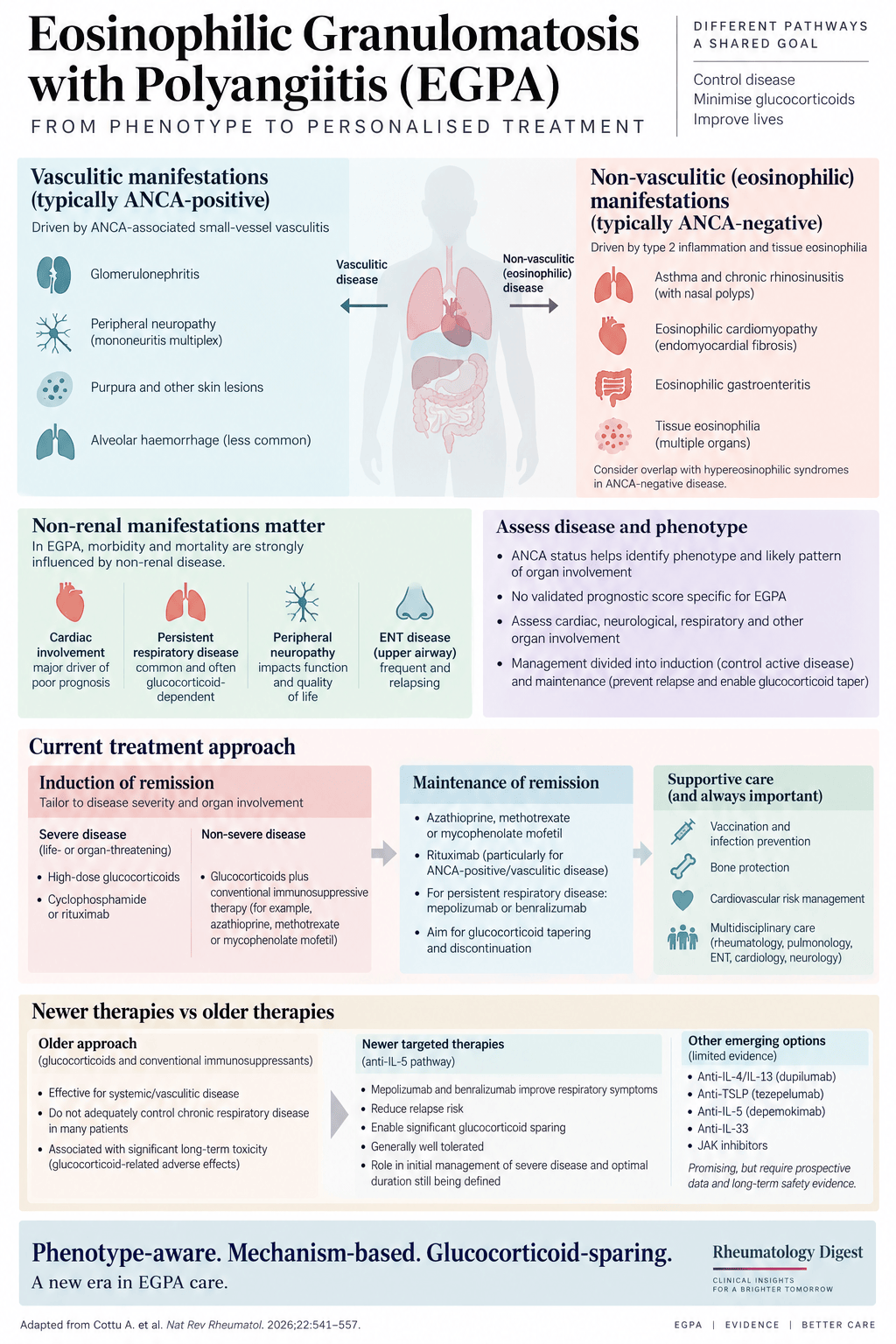
TL;DR: Anti-IL-5 therapy has shifted the goal in EGPA from controlling vasculitis to achieving complete glucocorticoid withdrawal — but steroids and cyclophosphamide remain the induction backbone, rituximab failed to show superiority in two trials, and avacopan’s approval is now being withdrawn after its pivotal trial data were found to have been manipulated.
Why EGPA needs its own treatment logic
EGPA is the rarest of the ANCA-associated vasculitides — incidence 1–4 per million per year, global prevalence around 15 per million, rising to 80 per million among people with asthma. It was first described in 1951 by Jacob Churg and Lotte Strauss.
Asthma is present in nearly all cases and appears a mean of 3–12 years before the EGPA diagnosis, characteristically worsening just before systemic and vasculitic manifestations develop. Rhinosinusitis, with or without nasal polyps, occurs in 50–80% — and unlike GPA, it is typically non-crusting and non-destructive.
Fewer than half of cases are ANCA-positive, predominantly MPO-ANCA, and that split maps onto phenotype:
| ANCA-positive EGPA | ANCA-negative EGPA | |
|---|---|---|
| Predominant manifestations | Vasculitic — glomerulonephritis, mononeuritis multiplex, purpura | Eosinophilic — cardiomyopathy, gastroenteritis |
| Overlap | — | Can overlap with hypereosinophilic syndromes |
The point that justifies treating EGPA separately from GPA and MPA: in those diseases, long-term prognosis depends on controlling initial organ involvement and preventing relapse. In EGPA, more than half of patients continue to have glucocorticoid-dependent, difficult-to-control upper and lower airway disease even after the systemic vasculitis is controlled. That chronic steroid dependency is what drives osteoporosis, type 2 diabetes, cataract, glaucoma, hypertension and infection in over half of patients — and it is the problem the last decade of drug development has actually been trying to solve.
Prognostic stratification, and where the FFS falls short
The five-factor score still guides induction intensity — kidney involvement, cardiomyopathy, severe gastrointestinal involvement, CNS involvement, with the 2009 revision adding age. Scores of 1 and ≥2 carry roughly doubled and quadrupled five-year mortality.
But the review is candid that the FFS fits EGPA imperfectly:
- Severe peripheral neuropathy is excluded because it does not predict mortality — yet undertreating it leads to persistent neurological sequelae.
- Chest CT findings such as ground-glass opacities are excluded, despite being linked to elevated risk of glucocorticoid dependency.
- Cardiac involvement may be overestimated with increasing cardiac MRI use. Late gadolinium enhancement can occur without overt cardiomyopathy, has no effect on cardiac manifestations or outcomes, and cannot reliably distinguish acute inflammatory from chronic fibrotic lesions. ¹⁸F-FDG-PET-CT might detect active myocardial inflammation, but has never been prospectively validated in EGPA.
One useful distinction: acute eosinophilic myocarditis carries higher short-term mortality than chronic inflammatory myocardiopathy, and the LATE-EAST score has been proposed to separate them.
Current recommendations stratify induction by a non-restrictive list of organ- or life-threatening features: cardiac involvement, glomerulonephritis, mesenteric ischaemia, mononeuritis multiplex and CNS vasculitis.
Glucocorticoids — and why the PEXIVAS lesson may not transfer
This is one of the more clinically important arguments in the paper.
In GPA and MPA, PEXIVAS and LOVAS showed reduced-dose glucocorticoid induction was non-inferior to standard dosing while reducing serious infection — targeting 5 mg daily within 5 months and complete withdrawal within 2 years. ADVOCATE went further, shortening steroid exposure to as little as 4 weeks by combining with avacopan.
The review argues those regimens may not be appropriate for EGPA, because non-severe, glucocorticoid-dose-dependent respiratory relapses are common. In EGPA studies predating widespread IL-5-targeted therapy, the median maintenance dose remained around 10 mg daily after several years of follow-up.
So the recommended approach remains an initial 0.5 mg/kg (non-severe) to 1 mg/kg (severe) daily, with pulse methylprednisolone first in severe cases, tapering slowly to 15–20 mg at 3 months and 5 mg at 6 months.
The authors then immediately undercut their own conservatism, and this is the honest part: that long-standing paradigm of slow tapering and prolonged maintenance might now need reconsidering given T2-targeting therapies — and prospective evaluation of optimal tapering and withdrawal strategies is still lacking entirely.
Cyclophosphamide and rituximab
Cyclophosphamide remains the induction treatment of choice for severe EGPA. Uncontrolled studies suggested a remission rate near 90% in patients with FFS ≥1, and two 2024 European target trial emulation studies corroborated this — intravenous cyclophosphamide reduced vasculitis relapse and glucocorticoid-dependent respiratory manifestations in patients with poor prognosis, but not in those without poor prognostic factors.
An important caveat the review states plainly: the original trials were not powered to evaluate cyclophosphamide in EGPA specifically, making generalisation from pooled EGPA/PAN/GPA populations uncertain. Cumulative dose should not exceed 30 g, and continuation is not recommended beyond 6 months once remission is achieved.
Rituximab is where the news is, and it is negative twice over.
- REOVAS (2025) was the first prospective RCT comparing rituximab with conventional strategy (glucocorticoids ± cyclophosphamide by severity) for induction in newly diagnosed or relapsing EGPA. It failed to show superiority — remission rates at 6 months were similar at 61–64%.
- MAINRITSEG (NCT03164473) compared rituximab with azathioprine for maintenance. Preliminary results presented at ACR Convergence 2025 showed no significant difference in remission duration, and no clear differences across secondary outcomes including steroid dose thresholds, vasculitis relapse rate, asthma/rhinosinusitis exacerbations or quality of life.
Neither trial was designed to test non-inferiority in ANCA-positive or severe disease, so existing recommendations stand. The practical read: rituximab may be preferred over cyclophosphamide for its safety profile — less leucopenia and pneumonia in RAVE, lower long-term malignancy risk — while cyclophosphamide remains the choice in life-threatening disease. The authors use rituximab for maintenance preferentially in MPO-ANCA-positive patients and those with severe vasculitic manifestations such as glomerulonephritis or peripheral neuropathy.
One negative finding worth carrying: retrospective studies suggested better rituximab response in ANCA-positive EGPA, but this was not confirmed in either REOVAS or MAINRITSEG — treatment decisions should not be based on ANCA status.
Conventional synthetic DMARDs come off badly. Over 90% of patients without poor prognosis achieve remission on glucocorticoids alone, but up to half relapse within 2 years. CHUSPAN2 found adding azathioprine made no difference to induction failure or relapse — though again in a pooled EGPA/MPA/PAN population, underpowered for the EGPA subgroup. In the IL-5 trials, only 24–52% of patients were on a csDMARD at enrolment, which the authors read as evidence of limited efficacy. Their position is explicit: they favour IL-5 pathway therapies over csDMARDs, particularly for persistent airway disease.
Plasma exchange added to cyclophosphamide failed to show superiority and is not recommended routinely. IVIg rests on one small prospective study without a control group; reserved for severe and refractory cases.
The IL-5 pathway — the transformative part
A dosing point that explains a lot of real-world variation: compared with EGPA, eosinophilic asthma and CRSwNP have a lower eosinophil burden — only 0.3% of people with asthma have counts above 1,500/mm³, with trial medians around 300–450/mm³ — and asthma patients have far lower steroid exposure. This is why asthma dosing should not be extrapolated to EGPA, and why the higher EGPA regimens exist.
Mepolizumab (MIRRA, 2017)
136 patients with non-severe, glucocorticoid-dependent (≥7.5 mg prednisone) or relapsing EGPA, randomised to mepolizumab 300 mg every 4 weeks versus placebo. Baseline mean prednisone 12 mg/day; 60% on an additional immunosuppressant.
| Outcome | Mepolizumab | Placebo |
|---|---|---|
| Remission at weeks 36 and 48 (BVAS 0, GC ≤4 mg) | 32% | 3% |
| Composite response (remission, ≥50% GC reduction, no relapse) | 78% | 32% |
| Relapse at 1 year | HR 0.32 | — |
| Time to first major relapse | HR 0.51 | — |
| Glucocorticoid intake | 4.3 mg/day lower (OR 0.20) | — |
So roughly 80% of mepolizumab-treated patients derived some clinical benefit, even though strict remission was only 32%.
The open-label extension (108 patients, mean 3.2 further years, some to 7 years) is arguably more informative for practice: 66% halved their initial daily steroid dose, 38% reached ≤4 mg, and 20% stopped glucocorticoids entirely. A third still reported respiratory manifestations; 27% discontinued the biologic, though fewer than half of those for inefficacy or adverse events; 18% reported serious infections, four considered treatment-related.
The gap the review is careful about: mepolizumab’s efficacy for maintenance is well documented, but its efficacy and safety for remission induction remain unestablished in placebo-controlled trials.
Benralizumab (MANDARA, 2024)
Benralizumab targets IL-5Rα and is afucosylated, which increases affinity for FcγRIIIα on NK cells, macrophages and neutrophils — enhancing antibody-dependent cell-mediated cytotoxicity and producing near-complete depletion of blood and tissue eosinophils and their progenitors. In asthma it depletes more profoundly than mepolizumab; in eosinophilic GI disease it achieves complete tissue depletion.
MANDARA randomised 140 patients (characteristics similar to MIRRA) to high-dose benralizumab versus mepolizumab:
- Non-inferior for remission at weeks 36 and 48 — 58% versus 56%.
- Relapses at 1 year: 30% in both groups. Major relapses occurred only in four patients, all in the mepolizumab arm.
- Initial daily steroid dose reduced by ≥50% in 85% (benralizumab) versus 74% (mepolizumab).
- Complete glucocorticoid withdrawal: 41% with benralizumab versus 26% with mepolizumab.
In the open-label extension, patients switching from mepolizumab to benralizumab tapered off steroids just as well as those on benralizumab throughout — 44% discontinued glucocorticoids and two-thirds achieved remission. A 2025 prospective Japanese cohort reported 64% remission with 36% complete steroid withdrawal at nearly 2 years.
Real-world remission and withdrawal rates have run higher than MANDARA, which the authors attribute partly to growing physician experience and prioritisation of steroid sparing.
Two practical differentiators favour benralizumab: the superior steroid-sparing effect, and administration — a single 30 mg injection versus three 100 mg injections for mepolizumab, both every 4 weeks.
Can response be predicted? Largely, no
More than 40% of MANDARA patients did not achieve remission within a year, usually from persistent airway activity or steroid intake above 4 mg.
The review is refreshingly blunt about how little predicts response:
- ENT involvement was not associated with better response to either agent, and both upper and lower airway manifestations improved — despite asthma-literature suggestions to the contrary.
- Systemic manifestations and ANCA status were inadequately represented in both prospective and retrospective studies, so whether one involvement type responds better remains genuinely uncertain.
- Baseline eosinophil count is the one partial signal: counts below 150/mm³ were associated with limited mepolizumab response in MIRRA; the equivalent benralizumab association appeared retrospectively but was not confirmed in MANDARA.
- FeNO is driven predominantly by IL-13, so it does not consistently fall with IL-5-targeted therapy — elevated FeNO on treatment may signal a need for something acting further upstream, such as anti-TSLP.
- A post hoc pharmacogenetic analysis of MIRRA failed entirely — neither candidate gene nor genome-wide approaches found significant associations with response.
The safety caution that follows from all this is worth internalising: tapering glucocorticoids and stopping conventional immunosuppressants after respiratory improvement on IL-5 therapy could unmask underlying systemic vasculitis — as has been reported in asthma patients who developed systemic EGPA after starting IL-5-targeted treatment. Patients with vasculitic or ANCA-positive features rather than predominantly eosinophilic disease may be more prone to systemic relapse and less responsive to IL-5 blockade. The authors stop short of discouraging its use in that subgroup, but do call for increased vigilance during tapering.
Managing IL-5 therapy in practice
Start at the EGPA regimen, not the asthma one. Respiratory function and quality of life usually improve within weeks, but complete remission can take 6 months or, in some cases, years.
If there is no response, three options in order:
- Confirm you are using the EGPA dose. Dose escalation has benefited some patients with refractory EGPA and HES. Do not label someone a non-responder on an asthma-dose regimen.
- Switch between the two agents. A 2025 real-world study suggested benralizumab is more effective than standard-asthma-dose mepolizumab, consistent with asthma data on switching. But note: prior primary or secondary mepolizumab failure predicted lesser benralizumab response, probably marking more severe or non-T2-driven disease.
- Add an upstream anti-T2 agent (such as tezepelumab) or a conventional immunosuppressant, or prioritise trial inclusion.
On de-escalation once goals are met: a small retrospective study of 12 patients found stepping down mepolizumab maintained remission and steroid-sparing over a median 27.5 months, though half had recurrent sinus symptoms. Against that, the COMET asthma trial found stopping mepolizumab after a median 44 months caused eosinophil recurrence, more exacerbations and worse control. Optimal duration in EGPA is unresolved and currently extrapolated from asthma.
The pipeline
| Agent | Target | Trial | Population | Note |
|---|---|---|---|---|
| Depemokimab | Long-acting anti-IL-5, every 6 months | OCEAN (NCT05263934) | Non-severe relapsing/refractory | 200 mg twice yearly vs mepolizumab; already approved for asthma |
| SHR-1703 | Long-acting anti-IL-5 | NCT05979051 (China) | Non-severe relapsing/refractory | Depletion lasting up to 6 months |
| Tezepelumab | Anti-TSLP | RACEMATE (NCT06230354), phase IIb | Non-severe refractory/relapsing | Works independent of blood eosinophilia; IL-5 therapy allowed concurrently |
| NS-229 | Selective JAK1 inhibitor | NCT06046222, phase II | Active EGPA | First JAK inhibitor trial in EGPA, ± concomitant IL-5 therapy |
| Mepolizumab | Anti-IL-5 | E-MERGE (NCT05030155), phase III | Newly diagnosed or relapsing | Testing superiority over conventional induction — recruitment complete |
| Rituximab | Anti-CD20 | MAINRITSEG (NCT03164473) | Remission after induction | Follow-up complete; preliminary results negative |
E-MERGE is the one to watch. If mepolizumab beats conventional strategy for induction, it would redefine the treatment algorithm toward a less toxic, less immunosuppressive approach — the review says as much.
Two agents to be careful with:
- Dupilumab (anti-IL-4/IL-13) improves CRSwNP outcomes more than mepolizumab, making it superficially attractive for persistent upper airway disease. But it frequently raises blood eosinophil counts, which has been linked both to EGPA onset in asthma patients and to EGPA flares. With dupilumab monotherapy for relapsing or refractory EGPA, flares occurred in a third of patients, preceded by eosinophilia in 88%. Off-label monotherapy is explicitly not recommended.
- Omalizumab (anti-IgE) has shown limited efficacy, likely because atopy is uncommon in this population. Its use is not advised.
The avacopan development, which deserves separate attention
This is the item most likely to be news.
Avacopan, the oral C5a receptor antagonist, enabled faster glucocorticoid tapering and improved renal outcomes in MPA and GPA in ADVOCATE, with post hoc signals for ENT, lung manifestations and alveolar haemorrhage. It has been part of the AAV conversation ever since.
In 2026, both the FDA and EMA proposed withdrawing avacopan’s marketing approval, after concluding that sponsor staff who were not blinded had tampered with the primary endpoint data in ADVOCATE, which leaves the trial’s efficacy claims unreliable. Separately, hepatotoxicity including fatal cases of vanishing bile duct syndrome was identified as a serious safety concern.
The review’s assessment is that pending resolution, the guideline-based rationale for using avacopan in rapidly progressive MPO-ANCA glomerulonephritis or alveolar haemorrhage would probably be modified. For EGPA specifically, the C5a receptor might contribute to IL-5-independent eosinophil activation — but that is now of theoretical interest only, since any clinical exploration would first require these efficacy and safety questions to be resolved.
If you have been carrying avacopan in your mental algorithm for severe AAV, this is the update.
Practical considerations that are easy to skip
- Serious infections occurred in 7–18% of patients in long-term IL-5 therapy studies. Vaccinate — influenza, SARS-CoV-2, pneumococcal, RSV, herpes zoster, Haemophilus influenzae — and do it before starting induction where possible, since immunosuppression blunts the response.
- Case reports describe new-onset or relapsed EGPA, including vasculitic manifestations, after SARS-CoV-2 and influenza vaccination. Causality is uncertain, but vigilance in the weeks after vaccination is warranted. That is a genuinely awkward pairing with the recommendation above, and the review presents both.
- Pneumocystis jirovecii prophylaxis for patients on cyclophosphamide or rituximab during induction. Screen for hepatitis, tuberculosis and Strongyloides stercoralis where risk exists.
- Smoking worsens asthma and ENT control, lung function and cardiovascular risk. Occupational exposures — crystalline silica, organic solvents, chemical agents, farming — are associated with predisposition to EGPA.
- Pregnancy: plan during remission. Cyclophosphamide, methotrexate and mycophenolate are contraindicated; rituximab and azathioprine should be avoided where possible. No study has prospectively assessed IL-5-targeting therapy safety in pregnancy in either asthma or EGPA — but no safety signal has emerged, so these agents might be preferred over conventional immunosuppressants.
- For persistent symptomatic nasal polyps, IL-5-targeted therapy before surgery is reasonable, since the need for surgery falls during treatment.
How much to believe
The trial evidence base is thinner than the confidence of the recommendations suggests. Much of what governs EGPA induction derives from studies pooling EGPA with MPA, GPA or PAN — underpowered for the EGPA subgroup and of uncertain generalisability. The review says this repeatedly, and it is the single most important interpretive caveat.
The measurement tools are wrong for the disease. BVAS was built for heterogeneous vasculitis populations and does not adequately separate vasculitic from respiratory disease activity — which is precisely the distinction that matters in EGPA, where the two do not evolve in parallel. The authors call for an EGPA-specific activity index, routine use of validated asthma and ENT scores in trials, and an EGPA-specific patient-reported outcome measure, noting existing tools (ACQ-6, SNOT-22, HAQ, SF-36, AAV-PRO) capture either global function or respiratory symptoms but not the multisystem burden.
Definitions are unstable. Relapse and refractoriness remain insufficiently standardised, and the remission threshold itself has moved — from the older EULAR definition (BVAS 0, GC ≤7.5 mg) to the stricter MIRRA/MANDARA standard (BVAS 0, GC ≤4 mg). That shift is a real marker of progress, but it makes cross-trial comparison harder.
Competing interests are extensive and directionally relevant. Most of the author group declares consulting, advisory board or speaker relationships with AstraZeneca and GlaxoSmithKline — the manufacturers of benralizumab and mepolizumab respectively — in a review that strongly endorses IL-5 pathway therapy. The first author declares none. That does not make the conclusions wrong; the RCT evidence for both drugs is real. But it is worth registering when reading recommendations to introduce these agents early.
What this changes
- Do not import the PEXIVAS steroid-reduction strategy into EGPA uncritically. Glucocorticoid-dependent respiratory relapse is the defining problem of this disease, and reduced-dose induction was validated in GPA and MPA, not here.
- Rituximab did not beat conventional therapy in REOVAS, nor azathioprine in MAINRITSEG. It remains a reasonable safety-driven alternative, particularly for MPO-ANCA-positive or severe vasculitic disease — but not on evidence of superiority.
- ANCA status should not drive the rituximab decision, despite retrospective data suggesting otherwise; neither trial confirmed it.
- Use the EGPA dose of anti-IL-5, not the asthma dose — mepolizumab 300 mg or benralizumab 30 mg every 4 weeks — and do not declare non-response until the higher regimen has been tried.
- Benralizumab’s edge is glucocorticoid withdrawal (41% versus 26%) and convenience (one injection versus three), with non-inferior remission.
- Watch for unmasked vasculitis when tapering. Respiratory improvement on IL-5 blockade is not the same as systemic disease control, particularly in ANCA-positive patients.
- Avacopan’s position has changed materially — approval withdrawal proposed on both sides of the Atlantic after data manipulation was identified in ADVOCATE, plus hepatotoxicity concerns.
- Complete glucocorticoid withdrawal is now a realistic endpoint, not an aspiration. That reframing is the review’s central claim, and the MANDARA and open-label extension figures support it.
For the mechanistic and trial detail on the two approved agents specifically, see the earlier post on IL-5 pathway inhibitors in EGPA — this review sets that evidence in the context of the whole treatment algorithm, including what comes before and after anti-IL-5.