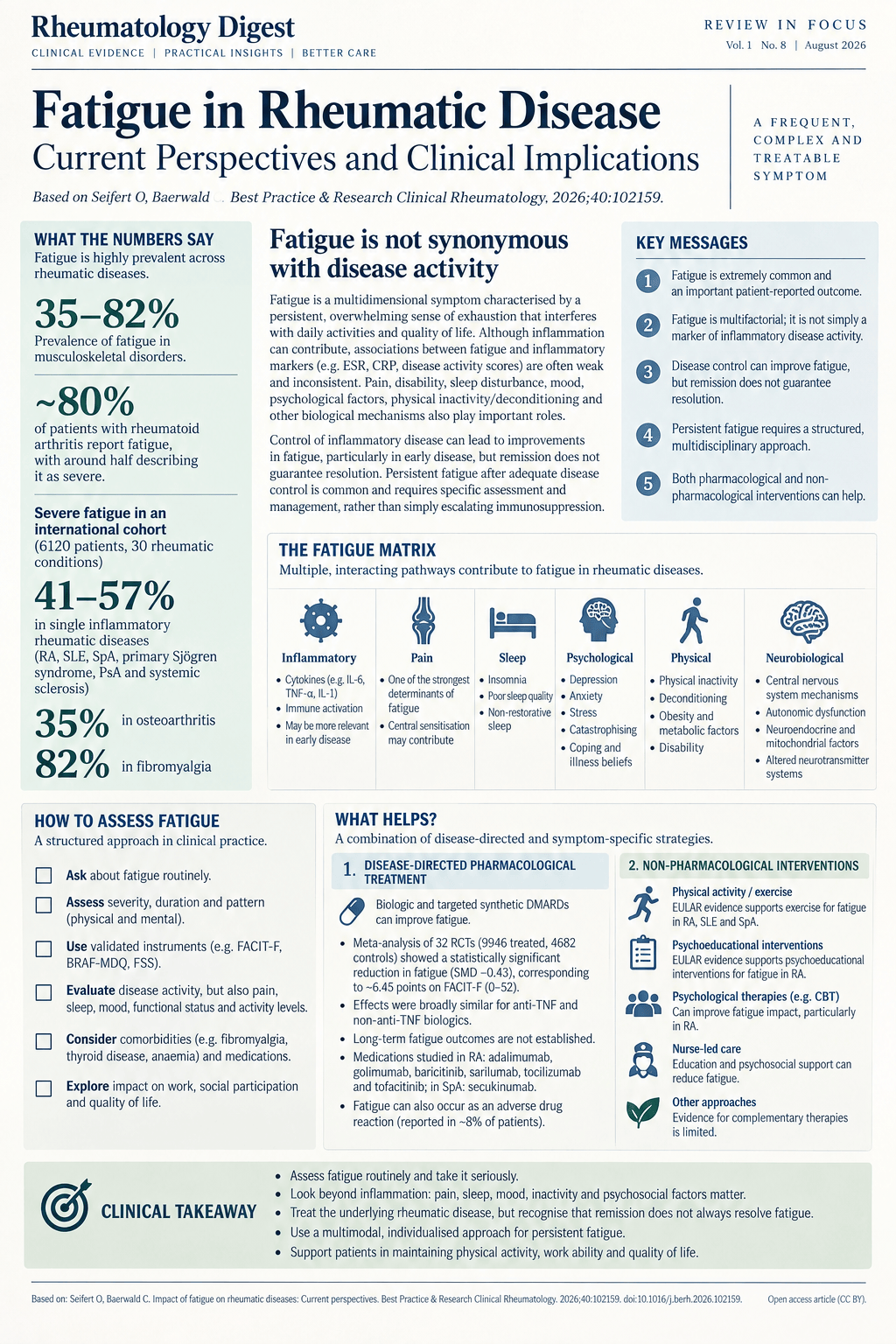
TL;DR: Fatigue in rheumatic disease is only loosely coupled to inflammation — pain, sleep and mood explain far more of it than CRP or DAS28 do, which is why suppressing disease activity improves fatigue without resolving it.
Fatigue is the symptom patients rank as a treatment priority and clinicians address least often. This review from Leipzig assembles what is actually known — the measurement problem, the biology, the evidence that fatigue is only partly an inflammatory phenomenon, and what the trial data support. The uncomfortable summary is that we treat fatigue by proxy, through disease activity, and the proxy is weaker than we assume.
The problem starts with the definition
There is no clear or universally accepted definition of fatigue — neither as a general construct nor for its subtypes. It is commonly characterised as an overwhelming, persistent, debilitating sense of exhaustion that impairs functional capacity and limits the ability to perform activities of daily living. Reported prevalence across musculoskeletal disorders varies enormously: 35% to 82%.
Acute fatigue subsides as the precipitating factor diminishes and normal homeostasis is restored. Fatigue persisting for six months or longer is conventionally called chronic fatigue. Severity ranges from mild inconvenience to profound impairment, and both severity and its dimensions may fluctuate over time as a consequence of the natural course of the disease or the effects of treatment. Around 80% of RA patients report fatigue, with about half describing their symptoms as severe.
One comparison sharpens what that means. A retrospective analysis of two cohort studies using the EORTC QLQ-FA12 fatigue module compared RA with cancer. Patients with RA reported significantly higher physical fatigue (mean difference 7.0, 95% CI 4.2–9.7; p < 0.001) and greater social sequelae (mean difference 7.5, 95% CI 4.7–10.2; p < 0.001) than patients with cancer. Cancer patients had higher cognitive fatigue (mean difference 3.5, 95% CI 1.4–5.6; p < 0.001). No significant differences emerged for emotional fatigue (p = 0.678) or interference with activities of daily living (p = 0.098). The burden of fatigue in RA is comparable to — and in some domains exceeds — that in cancer.
The structural reason fatigue is underestimated in routine practice is that clinical assessment of rheumatic disease relies predominantly on objective parameters, while fatigue is inherently subjective and can only be experienced and reported by the patient.
Which instrument, and which ones actually hold up
Twenty-two fatigue measures have fulfilled inclusion criteria and been systematically evaluated; a further 17 met some criteria but never progressed beyond initial development. Among the shorter instruments, the Fatigue Severity Scale (FSS), Fatigue Impact Scale (FIS) and Brief Fatigue Inventory (BFI) demonstrated favourable psychometric properties. Three multidimensional instruments — the Fatigue Symptom Inventory (FSI), the Multidimensional Assessment of Fatigue (MAF) and the Multidimensional Fatigue Symptom Inventory (MFSI) — showed comparable performance. Importantly, only four (BFI, FSS, FSI, MAF) demonstrated responsiveness to change over time — the property that matters most if you intend to use the score to judge treatment.
In rheumatic disease the FSS and MAF have been used most extensively. The FSS, developed to assess disabling fatigue in multiple sclerosis and SLE, was first published in 1989 and evaluates the impact of fatigue on physical, social and cognitive functioning. The MAF was developed specifically for RA and covers four domains: severity, distress, interference with activities of daily living, and frequency and change over the preceding week. The MFSI is a 20-item self-report instrument assessing five dimensions — general, physical and mental fatigue, reduced motivation and reduced activity.
The BRAF-MDQ (Bristol Rheumatoid Arthritis Fatigue Multi-Dimensional Questionnaire) encompasses four dimensions: physical fatigue, living with fatigue, cognitive fatigue and emotional fatigue. The BRAF-NRS numerical rating scales cover severity, effect and coping. A multicentre study across six European countries (France, Germany, the Netherlands, Spain, Sweden, the UK) enrolled 1,276 patients — 76% female, 25% with disease duration under five years, median HAQ 1.0 — and found the BRAF-MDQ consistently identified the same four dimensions across all countries, with a robust factor structure, high internal consistency and moderate-to-good construct validity. The revised BRAF-NRS V2 showed improved construct validity and has replaced the original.
An MDHAQ-based study across RA (n = 173), osteoarthritis (n = 199), SLE (n = 146) and fibromyalgia (n = 94) found fatigue significantly correlated with all other MDHAQ domains, with stronger associations in RA and SLE than in OA and FM. Independent predictors differed by disease: higher pain and symptom scores in RA, younger age and greater symptom burden in OA, higher pain scores in SLE — and no independent predictors identified in fibromyalgia at all.
The FACIT-F has been validated in RA, though only 10 of its 13 items are directly relevant to RA patients. PROMIS employs item response theory with a T-score metric, and the PROMIS Fatigue item bank incorporates FACIT-F items, enabling score conversion between the two. A study examining PROMIS Fatigue scores derived from two baricitinib RA trials found baseline scores indicating severe fatigue across all treatment groups, with good agreement irrespective of scoring approach. All four conversion methods were able to discriminate active treatment from placebo by week 12.
A recent systematic review evaluated the psychometric properties of 27 fatigue instruments. Most studies focused on construct validity (54/60, 90%) and inter-method reliability (45/60, 75%), with an overall low risk of bias. Test–retest reliability (13/60, 21.7%) and responsiveness (14/60, 23.3%) were evaluated far less frequently, and evidence on discrimination in clinical trials and thresholds for clinically meaningful change was limited or lacking. Of the 27, only five fulfilled OMERACT endorsement criteria: FACIT-F, the Vitality domain of the SF-36, BRAF-MDQ, BRAF-NRS and FSS.
Central versus peripheral: what the objective measures show
No objective instrument for quantifying fatigue is available. In practice “fatigue” is often difficult to distinguish from tiredness and task failure, though these represent two fundamentally different phenomena: central fatigue, manifested as tiredness, and peripheral fatigue, which originates within the skeletal muscle itself.
Electromyography has been proposed as a potential objective tool. Peripheral muscle fatigue is associated with alterations in motor unit recruitment strategies, whereas central fatigue is thought to result from changes in membrane excitability and central neural mechanisms. Multichannel surface EMG permits localisation of motor units within muscle tissue, decomposition of the interference signal into constituent motor unit action potential trains, and analysis of single motor unit characteristics.
A study of EMG parameters of neuromuscular fatigue in the knee extensors of RA patients found no association with clinical or treatment-related variables. EMG findings did, however, correlate with subjective fatigue perception, age, physical functioning, SF-36 vitality scores and physical activity levels — suggesting primary muscular factors contribute to perceived fatigue and deserve consideration in management.
A fibromyalgia study recorded EMG activity of the deltoid simultaneously with self-reported muscle fatigue during sustained isometric shoulder abduction. Compared with healthy controls, women with FM exhibited shorter times to exhaustion but fewer objective signs of muscle fatigue — evidence that perceived fatigue in FM predominantly originates from central mechanisms, and support for the hypothesis that central nervous system dysfunction is a key pathological feature of the disease.
Current diagnostic guidelines devote relatively little attention to the heterogeneity of fatigue. Three principal patterns have been proposed according to underlying origin: muscle weakness associated with neuromuscular disorders; asthenia related to organic disease, resulting from excessive energy expenditure, impaired energy production (as in endocrine disorders) or inadequate recovery; and weariness, reflecting the adverse effects of psychological stress and depression on quality of life. Establishing the prevalence and relative contribution of these patterns across rheumatic disease is flagged as a research priority.
The biology: several converging mechanisms, no unifying model
The biological basis of fatigue remains poorly understood and no unifying pathophysiological model has been established. Numerous studies have demonstrated only weak associations between fatigue and inflammatory markers, suggesting fatigue is multifactorial — likely involving complex interactions between clinical factors such as pain and physical disability, and psychosocial variables including mood, coping strategies and illness-related beliefs, with the relative contribution varying considerably between individual patients.
Genetics and mitochondria. In primary Sjögren’s syndrome, transcriptomic analyses comparing patients with different degrees of fatigue identified 27 differentially expressed genes, with alterations affecting pathways localised to mitochondria, endosomes, endoplasmic reticulum and cytoplasm — predominantly related to interferon-mediated biological processes. Whether this translates into novel therapeutic approaches remains to be established. Separately, analysis of microarray datasets demonstrated that basal oxygen consumption rate, ATP-linked respiration, maximal respiratory capacity and reserve capacity were all significantly reduced in pSS compared with healthy controls, while non-mitochondrial respiration, basal glycolysis and glycolytic reserve showed no differences — supporting impaired mitochondrial bioenergetics as a contributor. Whole-genome expression profiling of blood from 133 extensively phenotyped patients in the UK Primary Sjögren’s Syndrome Registry found no single gene independently associated with fatigue, but gene set enrichment identified 19 metabolic pathways significantly enriched in severe fatigue, largely attributable to a subset of 55 genes, which support vector machine classification showed could predict fatigue status.
Inflammatory and immune mechanisms. A broad spectrum of abnormalities has been implicated: elevated pro-inflammatory cytokines including IL-1, IL-6, TNF-α and IFN-α; oxidative and nitrosative stress (O&NS)-induced muscle dysfunction; activation of Toll-like receptor signalling through pathogen-associated and damage-associated molecular patterns, including heat shock proteins; alterations in glutamatergic and dopaminergic neurotransmission; mitochondrial dysfunction; and O&NS-induced impairment of sodium–potassium pump activity.
The kynurenine pathway has produced one of the cleaner signals. In pSS, patients with severe fatigue exhibited lower serum tryptophan and higher kynurenine concentrations than both less-fatigued patients and healthy controls. The kynurenine-to-tryptophan ratio was significantly increased in severe fatigue and showed a strong positive correlation with fatigue severity (r = 0.624, p < 0.001).
Within skeletal muscle, findings include reductions in maximal voluntary muscle force, downregulation of PGC-1α — the master regulator of mitochondrial biogenesis — a metabolic shift towards glycolysis, and accumulation of potentially toxic metabolites within myocytes.
Two candidate biomarkers are worth noting. Serum from 88 patients with various rheumatic diseases was analysed for anti-NR2 antibodies (against the N-methyl-D-aspartate receptor subunit 2) and neurofilament light chain (NfL), with fatigue severity assessed using the Fatigue Scale for Motor and Cognitive Functions. Elevated anti-NR2 titres were detected in patients with both autoimmune and non-autoimmune rheumatic disease, and these patients predominantly experienced severe fatigue. Circulating NfL showed no association with either anti-NR2 titres or fatigue severity. The association between severe fatigue and anti-NR2 antibodies irrespective of the underlying rheumatic condition suggests a potential pathophysiological role, though further studies are needed before they could serve as diagnostic or stratification biomarkers. Separately, a pSS study comparing 20 patients with high fatigue and 20 with low fatigue measured HSP32, HSP60, HSP72 and HSP90α: severe fatigue was associated with significantly higher plasma HSP90α, with a non-significant trend for HSP72 — supporting the hypothesis that fatigue in pSS may represent an adaptive response mediated by cellular defence mechanisms.
Mental fatigue as a cost–benefit calculation
The neural mechanisms underlying mental fatigue are more complex than previously assumed and cannot be explained solely by diminished activity in task-related brain regions. Increasing evidence supports the existence of both facilitation and inhibition systems that modulate the activity of task-related neural networks and thereby regulate cognitive performance under conditions of mental fatigue.
A conceptual framework has been proposed integrating the nucleus accumbens, orbitofrontal cortex, amygdala, insula and anterior cingulate cortex. These structures evaluate both the anticipated rewards associated with a task and the energetic costs required to accomplish it. Behaviour is initiated and sustained only when expected rewards outweigh the perceived expenditure of additional energy. Mental fatigue arises when anticipated energetic costs exceed predicted rewards, resulting in diminished motivation and reduced willingness to engage in cognitive tasks.
Neuroimaging supports a central role. Fifty-four RA patients with clinically relevant fatigue underwent MRI at baseline and again after six months, with fatigue severity assessed using the Chalder Fatigue Scale and patients stratified by whether fatigue improved or remained unchanged. The highest predictive accuracy for change in fatigue (67.9%) was achieved using MRI-derived metrics, whereas prediction based on clinical variables performed no better than chance.
Autonomic dysregulation, a receptor polymorphism, and obesity
Fatigue has been associated with dysregulation of the hypothalamic–pituitary–adrenal axis and with alterations of the autonomic nervous system, characterised by sympathetic overactivity and reduced vagal tone. Genetic variation affecting autonomic function may contribute to susceptibility: polymorphisms of the β2-adrenergic receptor gene have been implicated in RA fatigue, with a specific allele characterised by isoleucine at position 164 significantly associated with fatigue (odds ratio 7.33, 95% CI 1.09–59.8; p = 0.049), the strongest association being observed for mental fatigue. The confidence interval is wide enough to warrant caution.
Metabolic factors matter too. Approximately 70% of adults with RMDs are either overweight or obese. Beyond increasing the risk of developing rheumatic disease, obesity adversely affects disease activity and exacerbates both pain and fatigue. A pre-specified secondary analysis of the TITRATE trial in moderately established RA found obese patients exhibited greater disease activity and achieved remission less frequently over 12 months, with obesity independently associated with greater pain intensity and increased fatigue — an argument for weight management as an important component of holistic care.
In RA, fatigue and disease activity are only loosely coupled
This is the central finding, and it is consistent across study designs.
Inflammatory activity as assessed by swollen and tender joints, ESR, CRP and DAS28 has shown only inconsistent associations with fatigue. Several studies identify female sex, increased pain severity, impaired mental health and reduced functional capacity as predictors of greater fatigue. Strong correlations have been demonstrated between fatigue, pain intensity and patient global assessment scores, whereas associations with DAS28 and markers of inflammation have generally been weak.
A systematic review comprising 121 studies and more than 100,000 patients with RA found fatigue positively associated with pain, CRP, ESR and DAS28, whereas no significant associations were observed with the swollen-to-tender joint count ratio or disease duration. Among these, pain emerged as the dominant determinant. Although disease activity correlated positively with fatigue, its contribution became negligible after adjustment for pain — highlighting pain control as a prerequisite for improving fatigue.
An mHealth study combined smartphone-based symptom monitoring with contemporaneous dried blood spot sampling. Over 30 days, 38 participants (12 RA, 13 OA, 13 FM) recorded fatigue, pain and mood twice daily; dried blood spots were obtained on days 1–7, 14 and 30 for CRP. Fatigue data were recorded on 1,085 of 1,140 study days (95.2%). Although fatigue, pain and mood exhibited substantial day-to-day variability, clinically meaningful changes in CRP (≥5 mg/L) were infrequent — day-to-day fluctuations in fatigue are not necessarily paralleled by changes in systemic inflammation.
Approximately 50% of the variability in fatigue in RA remains unexplained by disease activity scores, demographic variables or psychological factors. Because MRI detects joint inflammation with greater sensitivity than clinical joint counts, it was hypothesised that MRI-defined inflammation might explain the gap. In a longitudinal study of 199 patients with annual fatigue assessment and MRI of hands and feet at baseline, 12 and 24 months, synovitis, tenosynovitis and osteitis were quantified as a composite measure. At diagnosis, higher DAS scores were associated with more severe fatigue — but patients with greater MRI-detected inflammatory burden did not experience higher fatigue. And although reductions in DAS over two years were associated with improvements in fatigue, decreases in MRI-defined inflammation were not. Even highly sensitive imaging failed to explain fatigue at diagnosis or during follow-up.
Where inflammation does explain fatigue: the preclinical window
The relationship appears to be phase-dependent. In studies of patients with clinically suspect arthralgia (CSA) and high anti-citrullinated protein antibodies, fatigue was measured in the period preceding the onset of clinically apparent arthritis. In 88 patients who subsequently developed RA, fatigue increased progressively before arthritis onset at approximately seven points per year on a 0–100 scale. By contrast, fatigue decreased by approximately four points per year in patients who did not progress to RA.
At the onset of CSA, inflammatory activity was strongly associated with fatigue (β = 18, corresponding to an increase of 18 fatigue points for each unit increase in Disease Activity Score), and inflammation explained a greater proportion of fatigue variance in CSA than in established RA. Inflammatory mechanisms appear to be particularly important during the preclinical stages of disease — which is a different claim from saying inflammation drives fatigue once RA is established.
Trajectories: fatigue is largely set early, and stays set
Longitudinal data suggest the course of fatigue is influenced by early treatment response. Patients reporting low fatigue at three months maintained significantly lower fatigue scores throughout follow-up than those with moderate or severe fatigue at the same time point. Interestingly, maximal improvement in fatigue appeared to lag behind the achievement of remission by approximately six months — a delay worth mentioning to patients. Treatment responses achieved within the first three months were associated with both short- and long-term reductions in fatigue.
One study identified four distinct fatigue trajectories in early RA: rapid improvement (10%), gradual improvement (14%), transient improvement (56%) and early deterioration (20%). Patients in the early deterioration group experienced more severe pain and poorer mental health and emotional functioning. Although fatigue evolved dynamically during the early phase, the majority failed to achieve sustained improvement despite intensive DMARD treatment. Higher fatigue at five years was associated with greater perceived disease impact and — counterintuitively — lower swollen joint counts at baseline. Effective control of inflammatory activity early in the disease course was strongly associated with improved long-term fatigue outcomes, suggesting an early window of opportunity for preventing persistent fatigue.
Another early RA study found fatigue prevalence declined from 69% at baseline to 38% after 24 months of treat-to-target therapy. Failure to achieve remission within the first six months was associated with an increased likelihood of clinically relevant fatigue at 24 months. Baseline characteristics associated with persistent fatigue included low objective disease activity together with high patient global assessment scores — the discordant pattern.
Ten-year follow-up of an early RA cohort identified three relatively stable trajectories: high fatigue (18%), moderate (52%) and low (30%). The high-fatigue group was predominantly female with higher inflammatory activity and disease severity at baseline. Female sex, pain, psychological distress and the presence of sicca symptoms were associated with increased risk of belonging to it. Notably, fatigue levels remained remarkably stable within each trajectory over time, and inflammatory activity itself was not an independent predictor of severe fatigue.
The tREACH trial data tell the same story. Nearly half of patients (n = 246) reported high fatigue at baseline, decreasing only modestly over time; at 12 months, 43% remained fatigued. Among those fatigued at baseline, 23% improved, whereas fatigue levels increased in 15% of initially non-fatigued patients. The strongest predictor of fatigue was baseline fatigue status (AUC = 0.89). Higher depression scores and poorer coping with limitations were associated with developing fatigue over time among patients not fatigued at baseline.
Sleep, mood and central sensitisation
Fatigue is frequently associated with depression, sleep disturbance, anxiety and coping style, and inflammation has been proposed as a common biological link between fatigue, pain and depression. But a study in RA patients demonstrated that despite low inflammatory activity in the majority, 47.3% continued to report moderate-to-severe pain and fatigue — most of them showing minimal signs of inflammation alongside high levels of fatigue, pain catastrophising and sleep disturbance, a pattern suggestive of chronic widespread pain syndrome.
Longitudinal studies support a causal direction. Data from 1,249 individuals at five-year follow-up and 791 at 18-year follow-up showed that sleep problems and fatigue independently predicted the onset of chronic widespread pain after five years — supporting the concept that disturbances in sleep and fatigue contribute to the development and maintenance of central pain sensitisation.
Physical activity findings are more nuanced than “do more”. Patients with fatigue and those with FM exhibited significantly lower physical activity (8,834 ± 5,967 and 8,813 ± 5,549 MET × minutes respectively) than healthy controls (9,541 ± 5,533; p < 0.001), and patients with fatigue had the longest sleep duration (466 ± 86 min) compared with FM and healthy controls (450 ± 67 and 446 ± 56 min; p < 0.001). A linear relationship between physical activity, sleep duration and symptom severity was observed only in healthy controls. In patients, both insufficient and excessive physical activity, and both short and prolonged sleep duration, were associated with greater symptom burden — an argument for individualised rather than uniform advice.
In SLE, a study of 570 patients from the Lupus BioBank of the Upper Rhine (89.1% female) found fatigue reported by 386 (67.7%) and severe fatigue in 209 (36.7%). Both fatigue and severe fatigue were strongly associated with depression and anxiety; disease activity and glucocorticoid treatment were independently associated with fatigue.
Depression in RA has an estimated prevalence of 9.5% to 41.5% depending on population and diagnostic approach, and is associated with higher pain, increased fatigue and reduced quality of life. The relationship appears bidirectional, with mutual reinforcement between affective symptoms and disease burden.
A comparative study of 303 participants set autoimmune rheumatic disease (RA, seronegative spondyloarthritis, connective tissue disease) against chronic fatigue syndrome. After adjustment for age and disease duration, the CFS group reported higher fatigue, psychological distress and sleep disturbance, leading to poorer social adjustment, and demonstrated higher levels of symptom non-acceptance and avoidance/resting behaviours. The rheumatic disease group exhibited higher levels of catastrophising, maladaptive illness beliefs and symptom focusing — partially shared trans-diagnostic processes, but with differences that argue for tailoring treatment to the specific symptom-maintaining mechanism.
A meta-analysis of psychological variables related to fatigue in RA identified 29 studies spanning six categories: affect and common mental disorders; RA-related cognitions; non-RA-related cognitions; personality traits; stress and coping; and social support. The most consistent association was between mood and fatigue, with low mood frequently linked to increased fatigue. Some evidence supported associations with RA self-efficacy and with non-RA-related cognitions such as goal ownership. Evidence for stress and coping or personality traits was limited, and findings on social support were mixed.
Sleep measurement itself is contested. In RA patients assessed daily over 14 days using both actigraphy and the Karolinska Sleep Diary, subjective sleep parameters correlated significantly with PROMIS fatigue scores — longer total sleep time, higher sleep efficiency and better perceived sleep quality all associated with lower fatigue — whereas objective actigraphy-based parameters were not significantly associated with fatigue at all. In polymyalgia rheumatica, severe fatigue was far more common than in controls (36% and 35% at baseline and follow-up versus 3% at both), and poor sleep quality more prevalent (77% and 84% versus 56%), yet no significant association was found between fatigue and poor sleep.
What patients actually report
Patients identify fatigue as an important patient-reported outcome and consider its management a treatment priority; however, healthcare providers address it infrequently, and physicians rarely consider it a primary outcome parameter in RA treatment.
An international study using the SF-36 collected questionnaires from 6,120 patients (88% female, mean age 47) across 30 different rheumatic conditions. Severe fatigue was present in 41% to 57% of patients with single inflammatory rheumatic diseases such as RA, SLE, SpA, pSS, PsA and SSc. It was least prevalent in osteoarthritis (35%) and most prevalent in fibromyalgia (82%). Logistic regression associated severe fatigue with fibromyalgia, the presence of multiple rheumatic diseases without fibromyalgia, younger age, lower educational level, and country — highest in France, lowest in the Netherlands.
A 2017 meta-analysis of eight qualitative studies comprising 212 people with RA (69% women, aged 20 to 83) summarised the patient experience in a single phrase: “a vicious circle of an unpredictable symptom”. Four subthemes emerged — being alone with fatigue, time as a challenge, language as a tool for increased understanding, and strategies to manage fatigue. Patients plan and prioritise, pace themselves, and incorporate rest and relaxation. They use a range of words and metaphors to explain to others that RA-related fatigue is distinct from normal tiredness — and despite this, often feel alone with the symptom. The unpredictability is described as dominant, pervasive and cyclical, with physical, cognitive, emotional and social consequences.
Fatigue also varies seasonally. An analysis of monthly variation demonstrated statistically significant fluctuations in VAS fatigue score (p < 0.01) and in BRAF-MDQ total score and the Living and Cognition (p < 0.001) and Physical (p < 0.05) subscales, but not the Emotional subscale. The greatest variation was between January and September, with higher fatigue in January; seasonally, fatigue was higher in winter than summer. No significant differences were found between sexes or age groups.
Work, disability and quality of life
Fatigue is an independent predictor of work disability. A study of patients initiating etanercept found that in spondyloarthritis, fatigue was significantly associated with presenteeism and activity impairment, but not with work productivity loss or absenteeism. In RA, fatigue was associated with presenteeism, activity impairment, work productivity loss and absenteeism — a significant and independent effect across all four, with a more limited effect in SpA.
Illness perception accounted for 51% of the variance in the physical components of quality of life in RA; a stronger belief in the consequences of RA and in recurrent disease episodes was significantly associated with poorer physical quality of life. Illness perception accounted for 45% of the variance in the mental component, where emotional representation and fatigue were both significantly associated with mental quality of life in the fully adjusted model.
The European Scleroderma Observational Study demonstrated that in early systemic sclerosis, worsening HAQ-DI over 12 months was strongly associated with increasing skin thickening as measured by the modified Rodnan skin score, declining hand function and increasing fatigue.
A rehabilitation-centre study in Greece examining fatigue and quality of life in OA and RA using the Fatigue Assessment Scale and the Missoula-VITAS Quality of Life Index-15 found no statistically significant correlation between fatigue and overall quality of life in the total sample or in either subgroup (r = −0.159; p = 0.126) — but statistically significant associations between certain aspects of fatigue and specific dimensions of quality of life. OA patients had significantly lower MVQoLI-15 scores than RA patients (13.73 ± 1.811 vs 14.61 ± 1.734) and lower FAS scores (26.14 ± 3.668 vs 29.94 ± 3.377). Different dimensions of fatigue affect different dimensions of quality of life, which is an argument for targeting early.
Can wearables measure it?
Assessments currently rely on patient-reported outcome measures, which are subjective and prone to recall bias. Wearable devices offer valid and continuous estimates of human activity and physiological parameters and may provide objective indicators.
In pSS, 72 participants wore a VitalPatch chest sensor for two separate seven-day continuous monitoring periods while completing fatigue PROMs up to four times daily. None of the activity-based time measures differed significantly between groups, and only a limited number of respiratory rate measures showed significant differences. However, 64% of heart rate parameters were able to distinguish participants with persistent fatigue from those without, and machine-learning analysis demonstrated that HR-derived features could classify fatigue persistence groups with an accuracy of up to 77%.
A separate pSS study investigated performance fatigability — objective measures of performance decline — alongside perceived fatigability, in 39 patients and 27 healthy controls. Performance fatigability was assessed via force decline during a sustained 124-second maximal voluntary contraction of the index finger abductor, with voluntary muscle activation assessed using peripheral nerve stimulation. Voluntary muscle activation was reduced in pSS patients, although force decline during the sustained contraction did not differ between groups. Self-reported fatigue was significantly higher in pSS. Both performance fatigability (force decline) and perceived fatigability (pain and depression) were associated with the physical domain of the MFIS — indicating that performance fatigability in pSS is impaired because of a reduced capacity of the central nervous system to activate muscle.
Treatment: biologics and JAK inhibitors
Fatigue can be improved by treating the underlying disease with conventional and biological DMARDs, as well as through non-pharmacological approaches. Age does not appear to be a major determinant of fatigue, so similar treatment strategies apply across all age groups, including older patients.
In a cohort of 6,835 RA patients, the prevalence of severe fatigue at baseline was 38.8%. Among those with severe fatigue, approximately 70% experienced clinically meaningful improvement on biologic therapy and 66% transitioned to the non-severe category, with a mean reduction in fatigue three times greater than the minimum clinically important difference.
The meta-analysis is the key number. Thirty-two studies in RMDs reported fatigue: 20 evaluated anti-TNF agents (adalimumab, certolizumab, etanercept, golimumab, infliximab) and 12 assessed five non-anti-TNF biologics (abatacept, canakinumab, rituximab, tocilizumab, and an anti-interferon-γ monoclonal antibody), with 9,946 patients receiving active treatment and 4,682 controls across five instruments. Biologics produced a statistically significant improvement in fatigue with a standardised mean difference of −0.43 (95% CI −0.38 to −0.49), corresponding to roughly 6.45 points on the 0–52 FACIT-F scale. Anti-TNF and non-anti-TNF agents showed broadly similar effects. Most studies had a double-blind period of 24 weeks or less and no trials assessed long-term fatigue outcomes. The conclusion is a small-to-moderate improvement with comparable effects across classes — and it remains unclear whether this reflects a direct effect on fatigue or is mediated indirectly through reductions in inflammation and disease activity.
A Cochrane systematic review including 19 RCTs confirmed that all studied medications were superior to placebo in reducing fatigue in RA — adalimumab, golimumab, baricitinib, sarilumab, tocilizumab and tofacitinib — with a dose–response relationship for sarilumab, tocilizumab and tofacitinib. In spondyloarthritis excluding PsA, secukinumab was also superior to placebo at 16 weeks with a dose–response effect.
Individual agents fill in the detail. Adalimumab produced significant reductions in fatigue and disease activity from baseline to six months, with disease activity the strongest predictor of fatigue severity in a predictive regression model. Rituximab in pSS: at baseline 86% of patients identified physical fatigue as the symptom most in need of improvement (median importance score 10), ahead of pain, dryness and mental fatigue. After treatment, approximately one third achieved a physical fatigue score below 5, corresponding to a patient-acceptable symptom state — meaning the majority continued to experience physical fatigue above the PASS threshold. Physical fatigue was significantly associated with absolute B-cell counts, dryness and mental fatigue, but not with ESSDAI, IgG levels or IgM rheumatoid factor.
A multicentre prospective study of 99 RA patients initiating or switching biologic therapy found a high baseline prevalence of fatigue (89%), sleep disturbance (95%) and depression (67%). Improvements were observed in 58.6%, 26.3% and 34.3% respectively. Factors significantly associated with fatigue improvement at three months were elevated baseline ESR and a favourable EULAR response; predictive of lack of improvement were a higher number of swollen joints (>5) and the use of psychotropic medication.
For tofacitinib, a post hoc analysis pooling three phase III RA trials showed significant improvements in FACIT-F total scores and SF-36 composite and domain scores; correlations between disease activity and FACIT-F were moderate, with SF-36 general health and composite correlations ranging from low to moderate (0.20–0.39). In the baricitinib comparison, moderate correlations were observed between improvements in disease activity and fatigue, and between improvements in pain and fatigue; reductions in pain (≥50%) and achievement of remission or low disease activity (CDAI ≤10) were significantly associated with fatigue improvement at week 24, and a substantial proportion of the fatigue improvement across treatment arms was attributable to reductions in pain and disease activity. In axial SpA, bimekizumab reduced nocturnal and total spinal pain and BASDAI alongside increased FACIT-Fatigue scores, with improvements continuing to week 52, by which point more than half of patients achieved a clinically meaningful FACIT-Fatigue response.
There is a counter-current worth knowing. Fatigue can also occur as a patient-reported adverse drug reaction: of 1,382 participating RMD patients, 108 (8%) reported fatigue as an ADR of biologic therapy. Those patients were significantly younger, used infliximab and rituximab more frequently and etanercept less frequently. A prospective cohort study assessed fatigue via web-based numeric rating scales across three waves of five days surrounding bDMARD injection — 609 patients’ assessments surrounding 1,541 injections. Average fatigue severity was 4.5 (± SD 2.4), and 78% experienced severe fatigue in at least one assessment. Of 398 patients completing all three waves, 61% had no clinically relevant change in at least two of three waves, 13% had a pattern of worsening fatigue and 18% a pattern of improving fatigue, with 36% showing a consistent pattern across all three waves — meaning some patients reliably experience specific fatigue patterns around their injection.
Notably, improvements in fatigue and pain during anti-TNF therapy appear to reflect changes in central rather than peripheral inflammatory processes — raising the possibility that therapies directed at central pain-processing pathways could further enhance fatigue outcomes, and that patients with persistent fatigue despite adequate peripheral suppression may derive particular benefit from them.
Treatment aimed at fatigue itself
SSRIs and SNRIs. Duloxetine was assessed in a two-phase, 24-week study in outpatients with fibromyalgia meeting ACR criteria, randomised to duloxetine 60–120 mg/day (N = 263) or placebo (N = 267) during the initial 12-week phase. At week 12, duloxetine significantly reduced scores across all MFI domains, as well as pain, anxiety, depressed mood and stiffness (all p < 0.05). Improvements were maintained at week 24 in those treated throughout, and patients switched from placebo to duloxetine in the extension showed significant within-group improvements in physical, general and mental fatigue and reduced activity, along with pain, anxiety, sleep disturbance and stiffness. The authors note SSRIs may be valuable not only because they improve mental health but because of recently demonstrated anti-inflammatory effects.
Non-invasive vagus nerve stimulation. A study using the gammaCore device compared active and sham stimulation in pSS: 40 patients randomly assigned to active (n = 20) or sham (n = 20) stimulation twice daily for 54 days in a double-blind design. Significant reductions in patient-reported fatigue were observed only in the active group at day 56. No significant changes were detected in muscle bioenergetics or heart rate variability, but immediate post-stimulation analyses showed correlations between fatigue reduction and frontal alpha activity, suggesting a possible role for cholinergic system modulation.
Exercise, CBT, and what EULAR endorses
Pedometers. In 96 RA participants, both intervention groups significantly increased step counts (+1,441 steps, P = 0.004 in the pedometer plus diary group; +1,656 steps, P = 0.001 in the pedometer, diary and step-targets group), whereas the education-only group showed a non-significant decrease (−747 steps, P = 0.14); the group-by-time interaction was significant (P = 0.0025). Mean changes in fatigue from baseline to week 21 were −1.6 (P = 0.26), −3.2 (P = 0.02) and −4.8 (P = 0.0002) for the education, pedometer and pedometer-plus-targets groups respectively — a dose-response favouring the addition of explicit targets.
Resistance exercise. An assessor-blinded randomised multicentre trial of 130 women with FM aged 22–64 compared person-centred progressive resistance exercise twice weekly over 15 weeks with an active control. A greater improvement was observed in the MFI-20 physical fatigue subscale (intervention Δ −1.7, SD 4.3; controls Δ 0.0, SD 2.7; p = 0.013), effect size 0.33. Sleep efficiency was the strongest predictor of improvement in general fatigue (β = −0.54, p = 0.031), while participation in resistance exercise (β = 1.90, p = 0.010) and fewer working hours per week (β = 0.84, p = 0.005) independently predicted improvement in physical fatigue (R² = 0.14).
HIIT. High-intensity interval training combined with strength exercise over 12 weeks had beneficial effects on fatigue, sleep, mood, pain and health-related quality of life in RA compared with a control group, with improvements in both fatigue and quality of life maintained at 12-month follow-up.
Physical inactivity. In a cross-sectional analysis of 25,471 adults with RMD from the 2018 National Health Interview Survey, those who were physically inactive had 2.81 times higher odds of experiencing fatigue than those who were sufficiently active.
CBT. In a randomised controlled trial, patients receiving CBT showed better fatigue impact scores after 18 weeks on both the MAF and VAS, with effect sizes of 0.59 and 0.77 respectively. The intervention addressed thoughts, emotions, behaviours, interpersonal factors, stressors and other determinants influencing fatigue. A multicentre two-year randomised trial further suggested that incorporating cognitive behavioural approaches into patient education programmes may enhance self-management.
Cost-effectiveness is where the comparison gets interesting. CBT and a personalised exercise programme (PEP) were each added to usual care in patients with inflammatory rheumatic disease and chronic moderate-to-severe fatigue, using individual patient data from a three-arm randomised trial over 56 weeks. Both were more costly than usual care — but PEP was also significantly more effective, giving an incremental cost-effectiveness ratio of £13,159 for PEP versus usual care, against £793,777 for CBT. Adding a personalised exercise programme is likely to be a cost-effective use of resources; adding CBT, on these figures, is not.
Self-management and nurse-led care. Two studies of tailored lifestyle advice versus generic dietary advice within a self-management framework, using a randomised crossover design with weekly smartphone assessments over 20 weeks, found fatigue severity improved most prominently, followed by self-efficacy, with tailored advice more effective — particularly when aligned with individual biopsychosocial characteristics. Self-management strategies may be particularly useful as a bridge during waiting periods for guided interventions such as CBT. Separately, a meta-analysis of six RCTs including 994 patients found fatigue decreased significantly with nurse-led care (education and psychosocial support delivered through 30-minute to 2-hour consultations, visits and brief interventions) compared with controls.
Other modalities. In a small randomised study in RA, aromatherapy massage (n = 17, both knees for 30 min) and reflexology (n = 17, both feet for 40 min) during weekly home visits both significantly decreased pain and fatigue compared with no intervention (p < 0.05), with reflexology reducing pain and fatigue earlier. High-frequency (10 Hz) transcranial magnetic stimulation of the left dorsolateral prefrontal cortex in 26 FM patients (14 active, 12 sham) over four weeks — 20 sessions of 75 trains of 4 s at 120% of resting motor threshold — produced significantly greater improvement in physical fatigue (p = 0.045) and general fatigue (p = 0.023) on the MFI-20 at one-month follow-up, with the active group 2.84 times more likely to achieve at least a 30% reduction in pain intensity (p = 0.024).
The EULAR taskforce. From 4,150 records, 454 were selected for full-text review, 82 met inclusion criteria and 55 randomised controlled trials entered meta-analyses. Physical activity and exercise were effective in reducing fatigue in RA, SLE and SpA — but no significant reduction was observed in primary Sjögren’s syndrome or systemic sclerosis. Psychoeducational interventions were effective in RA but not in SLE. Follow-up consultation models and multicomponent interventions did not demonstrate significant reductions in RA. The taskforce concluded that physical activity/exercise and psychoeducational interventions are effective and safe strategies for managing fatigue in RMDs.
Finally, complementary and alternative medicines are often used by patients despite insufficient evidence, encouraged by social media and influencer-based marketing without rigorous processes to ensure scientific accuracy. The review’s argument is that clinicians should remain current with both the literature and social media trends, so that patients can be advised on standard-of-care therapies and evidence-based lifestyle modifications and CAM approaches can be safely and effectively integrated into an overall plan.
What this adds up to
The authors’ practice points are modest and worth restating. Patients identify fatigue as an important patient-reported outcome. Health professionals should acknowledge and address its impact on everyday life, and it should be routinely assessed using appropriate validated questionnaires. Support in managing fatigue and in developing strategies to increase physical activity and maintain work ability is essential. Fatigue can be improved through conventional and biological antirheumatic drugs as well as through physical activity and psychosocial interventions. And a focus on psychological variables associated with fatigue may identify targets for interventions such as CBT.
The research agenda is equally frank: new diagnostic guidelines are needed to investigate the various patterns of fatigue; further studies should focus on the biological underpinnings of both mental and physical fatigue; and basic and clinical research should aim to disentangle the interactions between inflammatory changes, neurobiological function and metabolic modulation of central nervous system parameters including neurotransmitter systems.
Approximately one in two patients with a rheumatic disease experiences severe fatigue. The evidence assembled here does not support treating it as a downstream consequence of inflammation that will resolve once disease activity is controlled. It behaves more like a parallel problem with its own determinants — pain, sleep, mood, physical conditioning — that happens to travel alongside the disease. Which means the practical response is not a new drug but a different consultation: ask about it, measure it with something validated, treat the pain, address the sleep and the mood, and put the patient in front of an exercise programme.
Disclosures noted in the source: both authors report consultancy and/or speaker fees from multiple pharmaceutical companies, listed in full in the paper.