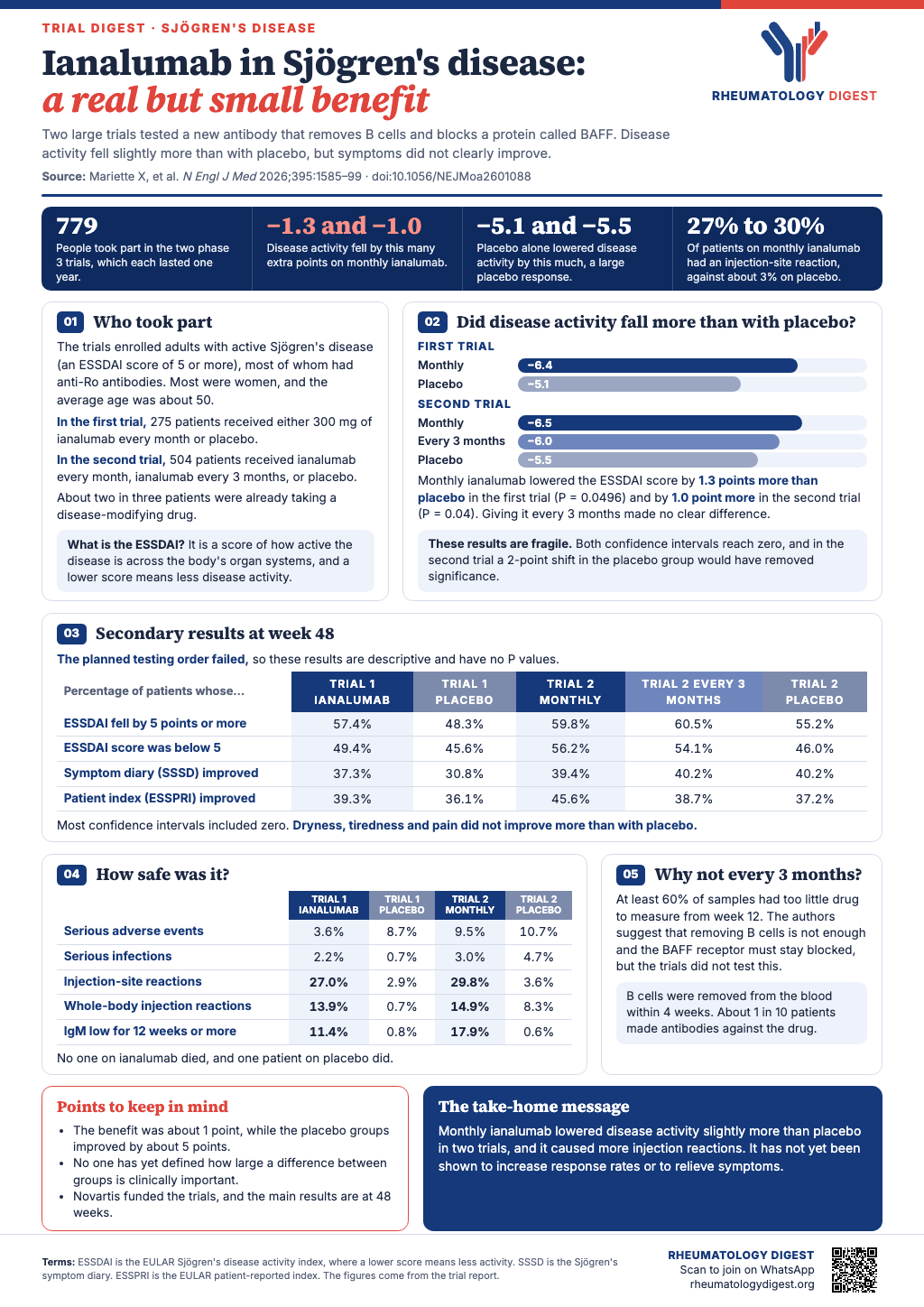
TL;DR: Ianalumab 300 mg monthly lowered Sjögren’s disease activity slightly more than placebo in both phase 3 trials, but the margin was about one ESSDAI point, responder rates and symptom scores did not separate, and the placebo arms improved substantially.
Sjögren’s disease has no approved targeted therapy, and a run of biologic trials aimed at B cells and BAFF has been negative or inconclusive. These two trials were the large, definitive test of a drug designed to hit both at once. They are positive on the primary endpoint and unconvincing on almost everything that matters to a patient, and the paper says so with unusual directness.
Why a dual-mechanism B-cell drug
Sjögren’s disease is a systemic autoimmune disease with lymphocytic infiltration of exocrine glands. It is among the commonest rheumatic autoimmune diseases and affects women about nine times as often as men. Reports suggest 30–40% of patients have systemic manifestations, and the risk of B-cell lymphoma is 15–20 times that of the general population. Guidelines concentrate on symptomatic care, topical therapy, immunosuppressants and glucocorticoids, none of which addresses the underlying dysregulation.
B cells and BAFF are central to the pathogenesis: serum BAFF is raised, salivary epithelial cells secrete it in response to interferon, and higher levels correlate with autoantibody levels and disease activity and with clonal B-cell expansion and lymphoma. Depleting B cells alone (rituximab) or inhibiting BAFF alone (belimumab) has given inconsistent results. The authors note that rituximab plus belimumab, which counters the BAFF rise that follows depletion, deepens B-cell depletion in salivary glands compared with monotherapy, and that finding supports a synergistic effect.
Ianalumab is an afucosylated, fully human IgG1 antibody with two actions: enhanced B-cell depletion through antibody-dependent cellular cytotoxicity, and blockade of the BAFF receptor, which inhibits B-cell activation and survival. A phase 2b dose-ranging study showed a dose response, with the largest effect at week 24 with 300 mg monthly, sustained through week 52.
The two trials
NEPTUNUS-1 and NEPTUNUS-2 were phase 3, multicentre, double-blind, randomised, placebo-controlled trials, each with a 52-week treatment period. NEPTUNUS-1 (92 sites, 18 countries) compared ianalumab 300 mg monthly with placebo. NEPTUNUS-2 (158 sites, 26 countries) added a third arm, 300 mg every 3 months, with placebo given between doses to keep the blind. Enrolment ran from September 2022 to May 2024, and both were funded by Novartis.
Who was eligible: adults meeting the 2016 ACR–EULAR criteria, diagnosed within the previous 7.5 years, with an ESSDAI of 5 or more, activity of 5 or more within eight specified domains, stimulated salivary flow of at least 0.05 ml/min, and anti-Ro (SSA) positivity, or a centrally confirmed positive salivary-gland biopsy if anti-Ro negative. Stable background hydroxychloroquine (up to 400 mg/day), methotrexate (up to 25 mg/week), azathioprine (up to 150 mg/day) and prednisone or equivalent (up to 10 mg/day) were allowed. Patients received 50 mg of prednisone or prednisolone (or equivalent) as premedication 1–2 hours before the first dose.
Primary endpoint: change from baseline in ESSDAI at week 48. The first key secondary endpoint differed by trial: ESSDAI response (a reduction of at least 5 points) in NEPTUNUS-1, and change in the Sjögren’s Syndrome Symptom Diary (SSSD, Plan A) or ESSPRI (Plan B) in NEPTUNUS-2. Other secondary endpoints included low disease activity (ESSDAI under 5), SSSD and ESSPRI responses, physician and patient global assessments, FACIT-Fatigue and stimulated salivary flow. The authors integrated two regulatory analysis plans for the paper. A pooled analysis of the monthly arms was also prespecified.
The patients
779 patients were randomised: 275 in NEPTUNUS-1 (137 ianalumab monthly, 138 placebo) and 504 in NEPTUNUS-2 (168 monthly, 167 every 3 months, 169 placebo). Between 83% and 89% completed treatment in each arm, and discontinuations were mainly patient decisions.
They were typical of a clinical-trial Sjögren’s population: mean age about 48–51, 92–95% women, more than 90% anti-Ro positive, mean time since diagnosis about 2.4–3.3 years, and mean baseline ESSDAI about 11.5–12.7, so moderate rather than high activity on average (a score above 13 counts as high, and 25–37% were above it). Mean ESSPRI was about 6. Roughly 60–69% were on a DMARD (hydroxychloroquine in 47–61%), and 25–34% were taking systemic glucocorticoids. Between 56% and 65% of the patients were White. The groups were generally balanced, though background immunosuppressive therapy was more common in the placebo arms (73.2% and 75.1%) than in the ianalumab arms (64.7–70.2%), which the authors suggest may have contributed to the high placebo response.
The primary result
In both trials ianalumab monthly produced a statistically significant, small additional reduction in ESSDAI at week 48:
| Ianalumab monthly | Placebo | Difference (95% CI) | P | |
|---|---|---|---|---|
| NEPTUNUS-1 (LSM change) | −6.4 | −5.1 | −1.3 (−2.6 to 0.0) | 0.0496 |
| NEPTUNUS-2 (LSM change) | −6.5 | −5.5 | −1.0 (−2.0 to 0.0) | 0.04 |
In NEPTUNUS-2, every-3-months dosing did not separate from placebo (−6.0 against −5.5; difference −0.5, 95% CI −1.5 to 0.5). The prespecified pooled analysis of the monthly arms, which the paper calls exploratory in its discussion, showed a difference at week 16 of −0.8 points (95% CI −1.5 to −0.1), widening to −1.2 points (95% CI −2.0 to −0.4) at week 48.
Two details deserve attention. Both confidence intervals touch zero, and the P values sit right at the 0.05 line. And the sensitivity analyses were not reassuring in one trial: in a tipping-point analysis, a shift of just −2.0 points in the placebo group lost significance in NEPTUNUS-2, which the authors describe as meaning the primary result is sensitive to small deviations from the missing-data assumptions. (Missing data after discontinuation in the ianalumab arms were imputed by a copy-increments-in-reference approach, and the paper reports 83–89% completion.)
The authors also put the numbers in context. A minimal clinically important improvement of at least 3 ESSDAI points has been validated for an individual patient, and the ianalumab arms improved by 6.4–6.5 points, but so did placebo, by 5.1–5.5. A validated threshold for a between-group difference has not been established.
Where the hierarchy broke
Because the first key secondary endpoint did not reach significance in either trial, the hierarchical testing strategy was broken and no P values are reported for any secondary endpoint. The paper states that causal inferences should not be drawn from them. With that caveat, the point estimates run as follows (95% CIs unadjusted).
NEPTUNUS-1, ianalumab monthly against placebo
- ESSDAI response at week 48: 57.4% against 48.3% (difference 9.1 points; 95% CI −2.1 to 20.2)
- ESSDAI under 5: 49.4% against 45.6%
- SSSD response: 37.3% against 30.8%; ESSPRI response: 39.3% against 36.1%
- SSSD change: −1.47 against −1.08; ESSPRI change: −1.73 against −1.40 (difference −0.33; 95% CI −0.78 to 0.12)
- Physician global: −27.6 against −22.1 (difference −5.5; CI −10.1 to −0.9); patient global: −12.9 against −6.3 (difference −6.6; CI −11.4 to −1.8). These two intervals exclude zero, but they are unadjusted.
NEPTUNUS-2, ianalumab monthly, every 3 months, placebo
- ESSDAI response: 59.8%, 60.5% and 55.2%
- ESSDAI under 5: 56.2%, 54.1% and 46.0%
- SSSD response: 39.4%, 40.2% and 40.2%; ESSPRI response: 45.6%, 38.7% and 37.2%
- SSSD change: −1.58, −1.37 and −1.44; ESSPRI change: −1.74, −1.45 and −1.50
- Physician global: −30.2, −30.9 and −29.1; patient global: −13.9, −11.4 and −9.9; FACIT-Fatigue 7.2, 6.5 and 6.6
The pattern across all of these is the same: the direction usually favours ianalumab monthly, the margins are small, and almost every confidence interval includes zero. In particular, dryness, fatigue and pain, the symptoms patients actually live with, did not improve more than on placebo. Differences in stimulated salivary flow were small, with confidence intervals that included zero. The authors suggest further analyses may identify patient clusters or subgroups with domain-specific responses.
Pharmacology: what the biomarkers say
Ianalumab depleted peripheral CD19+ B cells by week 4, the first post-dose assessment, and kept them deeply depleted throughout treatment. IgG, IgA, IgM and rheumatoid factor fell, while C3 and C4 rose over time, although the C3 rise was inconsistent in NEPTUNUS-2. BAFF rose after the first dose and stayed stable on monthly dosing.
The every-3-months regimen is informative. It gave only a transient peak and then low drug levels, with at least 60% of samples below the lower limit of quantification from week 12, and BAFF fell after week 4 to levels below those on monthly dosing. Antidrug antibodies were found in about 10.4–10.5% of patients, with more neutralising antibodies in the every-3-months group. The authors read the lack of effect of the less frequent schedule as suggesting that peripheral B-cell depletion alone is not sufficient and that sustained BAFF-R blockade matters, neutralising the BAFF surge that follows depletion. That is a plausible interpretation, but the trials were not designed to test it.
Safety
The overall safety profile was similar to placebo except for injection reactions.
| NEPTUNUS-1: monthly / placebo | NEPTUNUS-2: monthly / every 3 mo / placebo | |
|---|---|---|
| Serious adverse events | 3.6% / 8.7% | 9.5% / 7.8% / 10.7% |
| Adverse event leading to discontinuation | 3.6% / 3.6% | 8.3% / 6.6% / 3.6% |
| Serious infection | 2.2% / 0.7% | 3.0% / 3.0% / 4.7% |
| Local injection-site reaction | 27.0% / 2.9% | 29.8% / 23.4% / 3.6% |
| Systemic injection-related reaction | 13.9% / 0.7% | 14.9% / 13.2% / 8.3% |
- Infections were the commonest adverse events in all arms (about 55–67%). Opportunistic infections were rare: none in NEPTUNUS-1, and three in NEPTUNUS-2 (tuberculosis on monthly ianalumab, oesophageal candidiasis on every-3-months, cytomegalovirus viraemia on placebo).
- Neutropenia was mostly mild or moderate, never led to discontinuation and had no accompanying serious infection.
- Immunoglobulins. IgG fell below the lower limit of normal at some visit in 5.1% (NEPTUNUS-1, monthly) against 0.7% on placebo, with sustained falls (12 weeks or more) in 3.7% against none. In NEPTUNUS-2, IgG fell below normal in 3.0% on monthly dosing, 6.0% every 3 months and 1.2% on placebo. IgM was lower for 12 weeks or more in 11.4% against 0.8% (NEPTUNUS-1) and in 17.9%, 8.8% and 0.6% in NEPTUNUS-2. The authors judge these changes consistent with B-cell depletion and not associated with safety concerns.
- Injection reactions mostly followed the first dose. All local reactions were mild to moderate, and systemic reactions were rarely severe (two cases, 1.2%, on every-3-months dosing in NEPTUNUS-2).
- Cancer: one case on placebo in NEPTUNUS-1 (Waldenström macroglobulinaemia). In NEPTUNUS-2, four cases: two breast cancers (one each on monthly and every-3-months dosing), a squamous-cell skin carcinoma and an adrenal neoplasm (both every-3-months). All were judged unrelated to the trial regimen and arose within about 2.5–14 months.
- Deaths: none on ianalumab, one on placebo (NEPTUNUS-1).
How to read it
What the trials establish. Ianalumab at 300 mg monthly has a measurable, reproducible effect on systemic disease activity, seen in two independent trials, in a pooled analysis and as early as week 16, and it is well tolerated apart from injection reactions. Every-3-months dosing does not work. That is a genuine result in a disease with a long record of negative trials.
What they do not show. The effect is small, about one ESSDAI point beyond a placebo response of five. There is no evidence of benefit on responder rates, low disease activity or symptoms, and the authors state this plainly. Whether a 1–1.3 point difference is clinically meaningful is unanswered, since no between-group threshold has been validated.
Reasons for caution the paper itself lists:
- The hierarchy broke, so every secondary result is descriptive.
- The primary result is fragile. P values of 0.0496 and 0.04, intervals touching zero, and in NEPTUNUS-2 a tipping-point shift of 2 points in the placebo arm erased significance.
- High placebo responses. The authors point to high expectations in a disease with no approved drugs, regression to the mean in patients enrolled during higher-than-usual activity, and more background therapy in the placebo arms.
- A single systemic score. They note that single measures such as the ESSDAI, like those used in lupus, are limited by modest separation, placebo response and heterogeneity of manifestations, and that composite endpoints may detect differences more sensitively.
- The population and duration. Patients with other active autoimmune diseases were excluded, and the primary endpoint was at week 48, so durability and long-term safety beyond a year (an extension study is collecting these data) are untested, as is any effect on lymphoma risk.
- Industry design. Novartis designed the trials with the steering committee, collected and analysed the data, and employs several authors.
What it adds up to
The authors conclude that ianalumab 300 mg monthly reduced disease activity more than placebo over 48 weeks, although the effect was small and responder rates and symptom scores did not differ significantly. Set against a field of negative or inconclusive biologic trials, two phase 3 trials with a positive primary endpoint and a dose-response story that holds together are a real step. Set against what patients live with (dryness, fatigue, pain), they are a modest one, and the secondary data cannot be used to argue otherwise. What remains open, as the authors say, is whether further analyses can identify patient groups with domain-specific responses, what a clinically meaningful between-group ESSDAI difference actually is, and what the extension study shows beyond one year.
Disclosures noted in the source: the trials were funded by Novartis Pharma, which collected and analysed the data. Several authors are Novartis employees; the full author disclosure forms are available with the paper. All patients gave written informed consent.