TL;DR: Adding tirzepatide to ixekizumab produced large weight loss and a modest, statistically significant gain in joint response in PsA with overweight or obesity — in an open-label, sponsor-run trial whose primary endpoint was driven mainly by weight.
Obesity is a modifiable risk factor and a poor-prognosis feature in psoriatic arthritis, and it blunts the response to biologics. TOGETHER-PsA tests the obvious combination: treat both diseases at once. The result is clear on weight and cardiometabolic measures. How much it adds on the joints is a smaller and more arguable question, and the answer depends on which endpoint is read.
Why the question matters
Overweight or obesity affects an estimated 72–82% of people with PsA, and obesity is associated with up to twofold higher prevalence of PsA. It promotes low-grade inflammation through adipokines and cytokines such as TNF, IL-17 and IL-6, while mechanical stress at the entheses and reduced physical activity worsen musculoskeletal symptoms. Higher body weight is associated with greater disease activity, attenuated response to biologics, and a lower likelihood of reaching minimal disease activity, and weight loss of 5% or more has been linked to better outcomes. Ixekizumab maintains efficacy across BMI categories though with reduced response rates at higher weight.
Tirzepatide is a dual GIP and GLP-1 receptor agonist approved for weight management that also lowers hsCRP and IL-6. The trial was designed around the idea that an IL-17A inhibitor plus an effective weight-loss drug might give additive benefit.
The design
TOGETHER-PsA is a phase 3b, randomised, multicentre, open-label trial run in the United States and Puerto Rico, with a 52-week design (the paper reports week 36 and the trial is ongoing). The sponsor, Eli Lilly, contributed to the design, analysis, interpretation and writing.
Participants were 18–80 years old with PsA for at least six months meeting CASPAR criteria and active disease (at least 3 tender and 3 swollen joints), with overweight (BMI 27 to under 30) plus at least one weight-related comorbidity, or obesity (BMI 30 or more). Comorbidities included hypertension, dyslipidaemia, obstructive sleep apnoea, cardiovascular disease or type 2 diabetes. Patients who had failed more than three classes of advanced therapy, previously used ixekizumab or tirzepatide, or had failed an IL-17 inhibitor or GLP-1 agonist were excluded.
Treatment. Ixekizumab 160 mg subcutaneously at week 0, then 80 mg every four weeks (or the psoriasis-dosing schedule for the few with moderate-to-severe psoriasis). Tirzepatide weekly, starting at 2.5 mg and escalated by 2.5 mg every four weeks to the maximum tolerated dose of 5, 10 or 15 mg. All participants received dietitian counselling on diet and exercise. After week 36, investigators could adjust background therapy or use rescue medication in patients without 20% improvement in joint counts.
Open-label, with blinded assessors. The authors chose open label because patients would likely guess their treatment from early weight loss, and used blinded assessors for joint counts, entheses and skin. The same assessor performed all assessments for a participant where possible.
Endpoints. The primary endpoint was simultaneous ACR50 and at least 10% weight reduction at week 36. Key secondary endpoints, in a closed multiplicity-controlled order, were ACR50, simultaneous ACR20 and at least 5% weight reduction, and at least 10% weight reduction. The analysis used a hypothetical estimand (events such as treatment discontinuation or prohibited medication were handled with multiple imputation, with data after the event excluded).
Who was enrolled
Of 405 screened, 271 were randomised and analysed: 138 on ixekizumab plus tirzepatide, 133 on ixekizumab alone (eight further participants lacking a weight-related comorbidity were excluded). Mean age was 55.0 years, 69.7% were women, mean weight 106.1 kg, mean BMI 37.6, with 87.5% having obesity. Mean time since PsA diagnosis was 8.9 years, and 71.6% had psoriasis. About 63% had prior advanced therapy and 18.8% had failed two or more classes. Baseline disease activity was substantial (mean TJC 26.7, SJC 12.3, DAPSA 51.3, HAQ-DI 1.3), and the groups were comparable, although the combination arm had somewhat lower weight (104.6 vs 107.6 kg) and fewer participants with obstructive sleep apnoea.
Completion at week 36 was 84.1% on the combination and 66.9% on ixekizumab alone. Discontinuation was 15.2% versus 33.1%. In the ixekizumab-alone arm, 16 patients (12.0%) withdrew by their own decision and 9 (6.8%) stopped for lack of efficacy, against 3 (2.2%) and 1 (0.7%) in the combination arm. The authors found no consistent pattern in withdrawals; only three patients said specifically that they wanted to pursue GLP-1 agonist therapy. Among those on the combination, 78.9% reached the 15 mg tirzepatide dose.
The primary result
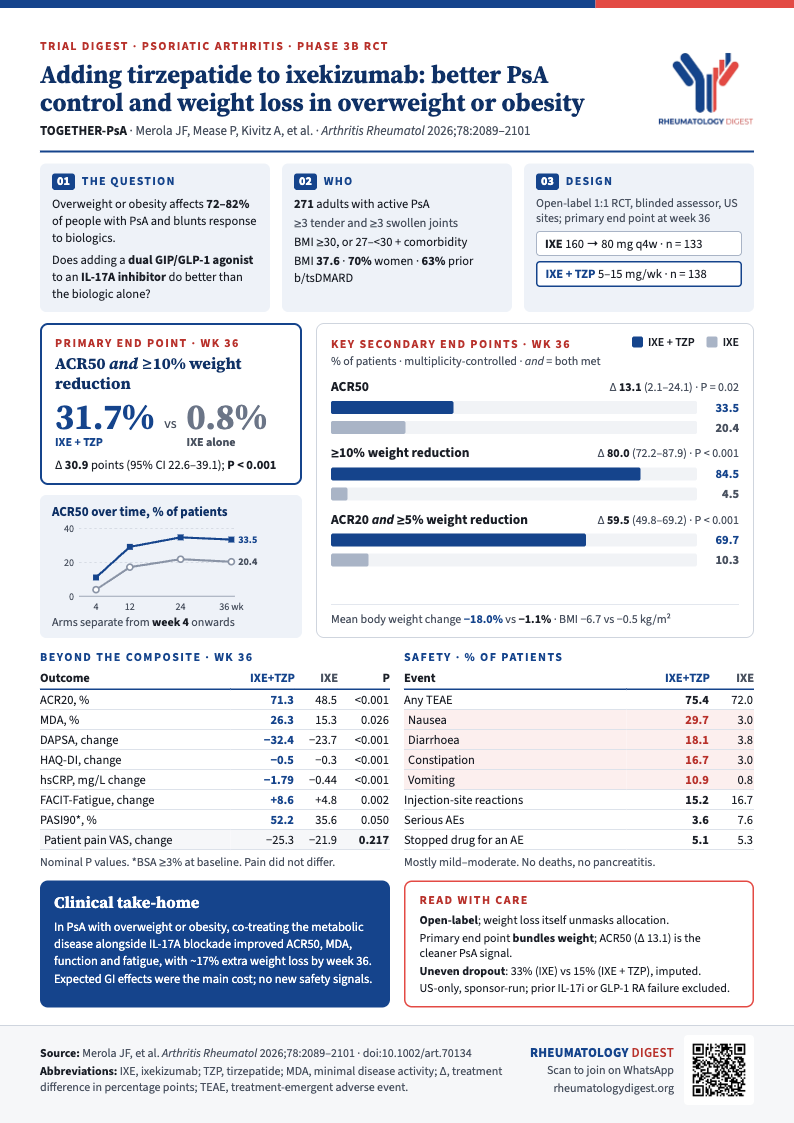
Simultaneous ACR50 and at least 10% weight loss at week 36: 31.7% versus 0.8% (treatment difference 30.9 percentage points; 95% CI 22.6–39.1; P < 0.001).
The size of that gap says as much about the endpoint as about the drug. The composite requires both components, and the ixekizumab-alone arm had almost no one reaching 10% weight loss: at least 10% weight reduction was achieved by 84.5% on the combination and 4.5% on ixekizumab alone (difference 80.0 points). Almost all of the primary-endpoint difference is therefore the weight component. The authors say this plainly: the multicomponent endpoint was chosen to capture benefit across both conditions, not to isolate the joint effect.
The joint effect on its own
The question for a rheumatologist is what the combination adds in the joints, and the data to read are the individual components.
- ACR50: 33.5% versus 20.4%, a difference of 13.1 points (95% CI 2.1–24.1; P = 0.020). This was a key multiplicity-controlled secondary endpoint, and it was met, but the lower bound of the interval is close to zero.
- ACR20: 71.3% versus 48.5% (difference 22.8; 95% CI 10.0–35.6; P < 0.001, nominal).
- ACR70: 15.7% versus 8.4% (difference 7.3; 95% CI −0.3 to 14.9; P = 0.060), not significant.
- Minimal disease activity: 26.3% versus 15.3% (difference 11.0; P < 0.05, nominal).
- DAPSA change from baseline: −32.4 versus −23.7 (difference −8.7; 95% CI −12.7 to −4.7).
- Separation as early as week 4: ACR50 11.1% versus 3.9% (nominal P < 0.05), with the gap persisting at weeks 12, 24 and 36. This early separation, before much weight loss, is read by the authors as suggesting a weight-independent contribution of tirzepatide to joint disease, though the trial cannot separate weight-dependent from independent effects.
- Components: significant differences in tender joint count (−16.9 vs −12.1), swollen joint count (−9.7 vs −7.2), patient and physician global, HAQ-DI (−0.5 vs −0.3), hsCRP (−1.79 vs −0.44 mg/L) and enthesitis. Patient-assessed pain VAS did not differ significantly (−25.3 vs −21.9; P = 0.217), the only ACR component to miss.
- Function and quality of life: HAQ-DI improvement exceeded the minimal clinically important difference of −0.35 with the combination; FACIT-Fatigue improved by 8.6 versus 4.8 points; PsAID, SF-36 physical component and mental component all favoured the combination.
Skin. PsO was not the focus, since only 4.4% had moderate-to-severe disease and psoriasis was not required for entry. In the 151 participants with at least 3% body surface area, PASI75 was 64.4% versus 52.5%, PASI90 52.2% versus 35.6% and PASI100 36.9% versus 26.6%, with confidence intervals that cross zero; the improvement in absolute PASI was nominally significant (−4.3 vs −3.3), and a separate trial in psoriasis (NCT06588283) is under way.
Metabolic outcomes. Mean weight change was −18.0% on the combination against −1.1% on ixekizumab alone, BMI fell by 6.7 versus 0.5 units, and systolic blood pressure by 10.8 versus 3.9 mm Hg. Glucose, HbA1c, total cholesterol and triglycerides improved; HDL and LDL cholesterol did not differ. These are nominal values.
Safety
Overall 75.4% on the combination and 72.0% on ixekizumab alone had at least one treatment-emergent adverse event, mostly mild to moderate. The difference lay in gastrointestinal events, as expected from tirzepatide:
| Event | Ixekizumab + tirzepatide | Ixekizumab |
|---|---|---|
| Nausea | 29.7% | 3.0% |
| Diarrhoea | 18.1% | 3.8% |
| Constipation | 16.7% | 3.0% |
| Vomiting | 10.9% | 0.8% |
| Injection-site reactions | 15.2% | 16.7% |
| Serious adverse events | 3.6% | 7.6% |
| Discontinued for an adverse event | 5.1% | 5.3% |
There were no deaths. Discontinuation because of a GI event was 2.9% on the combination, comparable to the weight-management trial of tirzepatide alone. Opportunistic infections occurred in 1.4–1.5% of each arm, and upper respiratory infections were less frequent with the combination (3.6% vs 5.3%). Severe adverse events were 2.9% versus 4.5%. One participant in each arm had inflammatory bowel disease reported as an adverse event, and the paper notes that colitis with ulceration could not be definitively confirmed as IBD. The authors report no new safety signals.
How to read the result
What is solid. The weight and cardiometabolic effects are large and consistent with tirzepatide’s known effect, the combination was tolerated with the expected GI profile, and the joint response was higher on every major measure, with an ACR50 difference that met its multiplicity-controlled test.
What deserves caution:
- Open label. Participants and investigators knew the treatment, which can inflate patient-reported outcomes and may influence decisions about discontinuation and rescue. Blinded joint and skin assessors mitigate this for the clinician-measured endpoints. Pain VAS, the one ACR component that was not significantly different, is a patient-reported measure, which is worth noting against the other patient-reported benefits.
- The primary endpoint cannot be read as a joint result. Almost all of its 31-point difference comes from the weight component. For joint efficacy, the ACR50 result (33.5% versus 20.4%, interval 2.1 to 24.1) is the number to use.
- Differential discontinuation. One in three ixekizumab-alone patients had discontinued by week 36 against about one in seven on the combination. Under a hypothetical estimand with multiple imputation, the missing data in the control arm carry weight, and the authors note the reasons for lack-of-efficacy discontinuation did not distinguish inadequate joint response from lack of weight loss, or a combination of both.
- It cannot separate weight from drug. The early separation at week 4 is suggestive, but there is no weight-matched or tirzepatide-alone comparator, so the share of the joint effect attributable to weight loss, to a direct anti-inflammatory effect, or to better adherence is unknown.
- Industry sponsorship. Eli Lilly made both drugs, designed and analysed the trial, and employs several authors, and the paper states that publication was not contingent on its approval.
- Population. The trial enrolled only patients with overweight and a comorbidity or obesity, in the United States, and excluded prior IL-17 inhibitor or GLP-1 agonist failure. Whether the result applies to normal-weight patients, to other biologics or to patients who have failed IL-17 inhibitors is outside what it tested; the authors point to an ongoing trial in IL-17 inhibitor inadequate responders (NCT06864026).
- 52 weeks was planned; only week 36 is reported. Durability and what happens to disease control if weight loss plateaus or the drug is stopped are not yet known.
What it means for practice
The authors conclude that concomitant ixekizumab and tirzepatide produced clinically meaningful improvement in PsA activity, function, weight and quality of life without new safety concerns, and call it a potential paradigm shift. A more careful reading is that the trial shows the combination is feasible, well tolerated and effective for weight and cardiometabolic risk in this population, and that it probably adds something in the joints, though the size of that addition is moderate, from an open-label design, and not attributable to any single mechanism.
The trial’s contribution is to show that adding tirzepatide to an IL-17 inhibitor in PsA with overweight or obesity was tolerated and was associated with better joint, function and metabolic outcomes than ixekizumab alone, which supports addressing both conditions together, as the EULAR and GRAPPA recommendations the authors cite advise for comorbidities. What it does not show is that joint benefit would persist beyond week 36 or apply outside the population studied.
Disclosures noted in the source: the trial was supported by Eli Lilly and Company, which provided medical writing support and contributed to design, analysis and interpretation. Several authors are Lilly employees and shareholders, and most others report consulting, research or speaker relationships with the company and other pharmaceutical firms, listed in full in the paper.