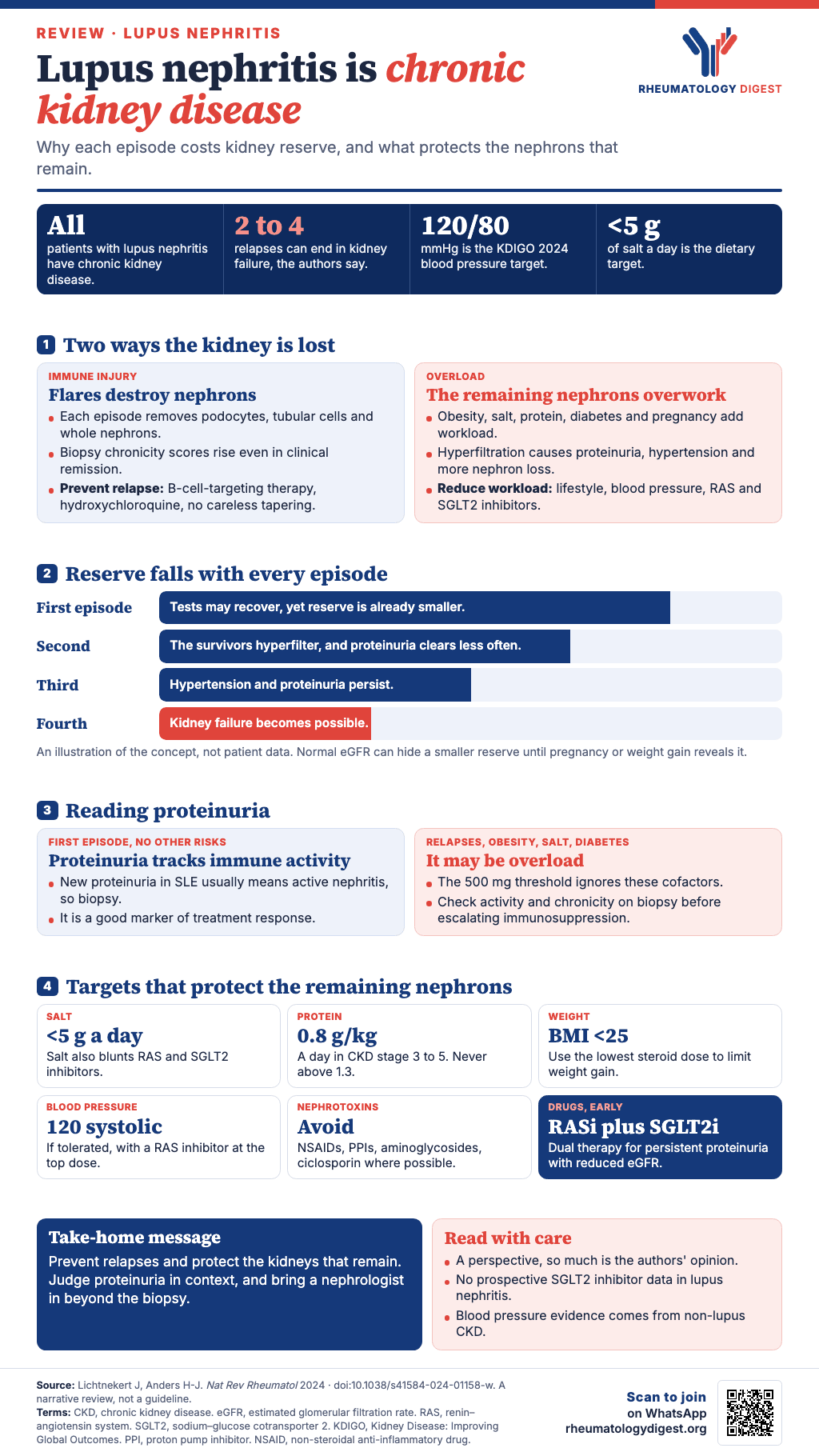
TL;DR: This review argues that every patient with lupus nephritis has chronic kidney disease, that relapses permanently shrink kidney reserve and so proteinuria becomes an unreliable marker of immune activity, and that care should therefore pair relapse prevention with control of salt, weight, blood pressure, diabetes and nephrotoxins plus early renin–angiotensin and SGLT2 inhibition, which is a conceptual framework and the authors’ opinion, with prospective evidence in lupus nephritis still missing.
Lupus nephritis (LN) is a major driver of illness and death in SLE. Treatment has been built around immunosuppression, with reversal of proteinuria used as the sign that it worked. In this perspective, Julia Lichtnekert and Hans-Joachim Anders (LMU Munich) propose a broader frame: LN-related chronic kidney disease (CKD). The article is a narrative review and often argues a position, so this summary flags where something is the authors’ view or a hypothesis. They also say plainly that some of what follows lies outside the usual scope of a rheumatologist, and that it is meant to raise awareness of the need for interdisciplinary care with nephrologists.
The central claim: all lupus nephritis is CKD
KDIGO defines CKD as an outcome-relevant kidney abnormality lasting more than three months. That covers any patient with persistent proteinuria, haematuria or histological change, which is the large majority of those with proliferative or membranous LN. CKD begins long before creatinine rises or GFR falls. Even in patients in complete clinical remission, repeat biopsies show a rising chronicity index, a marker of irreversible scarring and nephron loss.
- Kidney reserve is lost. Healthy kidneys have a functional reserve beyond the GFR needed day to day. It is used for pregnancy, weight gain and recovery from injuries. After a first episode of LN, much of that reserve is lost for good, even if GFR and proteinuria return to normal. The authors say this loss shows up as higher rates of maternal and fetal complications in women with previous LN.
- Relapses add up. Each further episode removes more nephrons. They state that LN relapses can shorten kidney lifespan by decades, and that 2–4 relapses can result in kidney failure.
- CKD drives other SLE complications. Progressive CKD increases cardiovascular risk through renal anaemia, activation of the renin–angiotensin and sympathetic systems, mineralocorticoid receptor signalling, FGF23-driven left ventricular hypertrophy, retained anti-angiogenic metabolites, modified atherogenic lipids, vascular calcification, gut microbiome changes and persistent inflammation. It also causes a secondary immunodeficiency (impaired clearance of immunoregulatory metabolites, gut dysbiosis, and sometimes urinary loss of immunoglobulins). Cardiovascular disease and infection are the commonest causes of death in SLE with LN, and the authors suggest CKD may be the most important cause of SLE-associated cardiovascular disease.
Treatment goals
The goals are those of SLE generally: lower mortality and prevent irreversible organ injury and its consequences.
- Minimise disease activity. SLE activity reflects ongoing activation of autoreactive memory T and B cells and plasma cells. Any documented activity requires checking adherence or escalating treatment, and flares can also follow non-adherence or inappropriate tapering. Because immune memory may not fade, lifelong immunomodulation is theoretically required.
- Prevent irreversible organ injury. Persistent proliferative or membranous LN destroys podocytes and tubular epithelial cells, producing proteinuria and a falling eGFR.
- Prevent infection-related harm. Infections are the commonest cause of death in SLE and LN, and also the second commonest in CKD patients who receive no immunosuppression. Preventing CKD progression without more drug-induced immunosuppression could therefore reduce infections, and the authors present prioritising measures that are not immunosuppressive as an emerging concept.
Targeting autoimmune activity
- Why SLE is harder than single-antigen diseases. In conditions such as ANCA vasculitis or primary membranous nephropathy, one or a few autoreactive clones persist. In SLE, loss of tolerance to many antigens means many T cell, B cell and plasma cell clones. Primary (not SLE-related) membranous nephropathy responds to rituximab alone, whereas severe SLE needs combination therapy to silence the larger set of clones.
- B cells are the key target. Deep depletion by CD19 CAR-T cells has profound effects in refractory SLE in mice and humans, and treated patients did not seem to need maintenance therapy, which the authors take as a rationale for developing drugs that deplete B cells deeply. T-cell or plasma-cell targeting alone cannot do the same but may help in combination.
- Biopsy and endpoints. A protocol biopsy remains the gold standard for judging immunological activity (activity index) and accumulated damage (chronicity index) in proliferative LN. The authors regard histological class and class switches as clinically irrelevant for this purpose. Because the aim is to prevent CKD progression, the ultimate trial endpoint is the annual eGFR slope or the number of patients reaching a defined eGFR loss.
Targeting non-immune factors: workload versus capacity
The kidney’s total workload (fluid and metabolic load) stays constant or rises, but after nephron loss it falls on fewer nephrons. The result is hyperfiltration, with barotrauma to podocytes and metabolic stress to tubular cells. After an LN episode, recovery is weaker in hyperfiltering kidneys because inflammation and barotrauma injure the kidney together. This shows clinically as hypertension (sodium retention and volume expansion), persistent proteinuria (hyperfiltration) and rising creatinine (reduced clearance). With each episode, the chance of meeting traditional response criteria falls, and the cardiovascular, kidney-failure and mortality risks rise. The authors compare CKD progression to atherosclerosis, in which many risk factors act together, independently of autoimmune activity.
Non-modifiable risk factors
- Genetics. Podocytopathy variants and basement-membrane variants can contribute to proteinuria and make a patient more vulnerable. Class II LN with nephrotic syndrome in a carrier of such variants is now called lupus podocytopathy, and patients with GBM variants can develop membrane rupture, haematuria and glomerulosclerosis earlier. Heavy proteinuria that LN alone does not explain warrants genetic testing, to avoid unnecessary immunosuppression.
- Male sex. Men with CKD progress faster, and men with LN tend to have more severe disease and worse prognosis, for reasons not fully understood.
- Poor nephron endowment. Preterm birth is the commonest cause, because most nephrons form in weeks 32–36 of gestation and nephrogenesis stops after birth. Hypertension is often the first sign. Ask about birth term and congenital urinary tract abnormalities.
- Previous kidney injury. Examples include neonatal acute kidney injury from nephrotoxic antibiotics, childhood AKI (often missed because criteria are less sensitive in the young), stones, pyelonephritis, IgA vasculitis or infection-related glomerulonephritis.
- Ageing. Nephron loss and GFR decline with age, along with accumulating risk factors that consume reserve.
Modifiable risk factors
- Overweight and obesity. More body mass per nephron means hyperfiltration and shear stress, and obese patients are less likely to meet proteinuria response criteria regardless of immune activity. Use the lowest glucocorticoid doses to limit weight gain. The authors suggest incretin agonists may help with weight loss.
- Type 2 diabetes. Hyperglycaemia raises proximal glucose and sodium reabsorption, causing oxidative stress and loss of tubuloglomerular feedback, which dilates the afferent arteriole and causes hyperfiltration. Glucocorticoids and tacrolimus are diabetogenic and should be used cautiously in at-risk patients.
- Hypertension. More a complication of CKD than a cause, but it adds to glomerular barotrauma and CKD-related cardiovascular disease. KDIGO 2024 sets a target below 120/80 mmHg, ideally with sodium restriction and a renin–angiotensin system inhibitor (RASi) at the highest tolerated dose. The authors note this evidence comes from non-SLE populations, but believe the benefits are independent of the cause of kidney disease.
- Pregnancy. A kidney “stress test”, requiring a 50% rise in GFR for nine months. Reduced reserve from obesity, diabetes, low nephron number or previous LN raises the risk of pre-eclampsia, and proteinuria tends to rise during pregnancy after LN. Maternal risks include permanent kidney damage, and fetal risks include placental failure, growth restriction, preterm birth and low nephron number. Counselling should consider kidney function and reserve.
- Salt. Volume expansion drives hyperfiltration and proteinuria and increases tubular sodium load. Salt also directly opposes RAS and SGLT2 inhibitors, so cutting it is needed for their full effect. Processed food is common among adolescents and young adults, who make up most LN patients.
- Protein. Transient hyperfiltration after protein is harmless with intact reserve but damaging with a reduced filtration surface. For CKD stage G3 or above, the suggested intake is 0.8 g/kg/day, which supplements can easily exceed.
- Smoking and nephrotoxins. Offer cessation support, and avoid PPIs, NSAIDs and aminoglycosides where alternatives exist. On calcineurin inhibitors: both KDIGO 2024 and EULAR 2023 endorse them without specifying LN class, and they show superiority in trials through potent antiproteinuric effects, but ciclosporin is nephrotoxic and promotes fibrosis, tacrolimus has been linked to faster eGFR decline and drug-induced diabetes, and no nephrotoxicity has yet been reported with voclosporin within three years of LN treatment.
Practical targets the review lists:
- sodium chloride under 5 g/day
- protein 0.8 g/kg/day or less in CKD stage 3–5, and never more than 1.3 g/kg/day
- a plant-based, low-ultraprocessed diet, with phosphate and potassium reduction when needed
- moderate exercise over 150 minutes a week
- no smoking
- HbA1c 7.5% or less in type 1 diabetes and 6.5–8.5% in type 2
- BMI below 25
- systolic blood pressure 120 mmHg if tolerated
- a statin or statin–ezetimibe in CKD patients over 50
- NSAIDs, PPIs, aminoglycosides and contrast only when benefits outweigh risks
Drugs that protect the remaining nephrons. RASi, SGLT2 inhibitors, GLP-1 agonists, non-steroidal mineralocorticoid antagonists (finerenone), dihydropyridine calcium channel blockers and other diuretics, and statins. The authors favour early dual therapy with a RASi at the maximum tolerated dose plus an SGLT2 inhibitor to reduce remnant nephron overload, and say it shifts the use of RASi from blood pressure control to preventing hyperfiltration injury. Guidelines already suggest an SGLT2 inhibitor for LN with GFR below 60, but prospective data are missing. A mouse study reporting that an SGLT2 inhibitor lowered anti-dsDNA and total IgG is mentioned only to be questioned, since the effect cannot be explained by the drug’s mechanism, and the authors list other methodological concerns. Finerenone is proposed for more advanced CKD, while spironolactone and eplerenone are not currently recommended in SLE. Growing pill burden may hurt adherence, which fixed-dose combinations and dual-acting drugs (such as sparsentan) might help.
How to read proteinuria
The authors question the habit of managing LN mainly by controlling proteinuria, since guidelines, trials and regulators all treat it as a sensitive marker of LN, a marker of response and an indicator of autoimmune activity.
- A healthy kidney does not leak protein unless glomerular hypertension or hyperfiltration exceeds the filtration barrier’s capacity. New proteinuria in a patient with SLE usually signals active LN, so the recommendation to biopsy is valid.
- The 500 mg threshold ignores cofactors. It does not account for obesity, diabetes, salt intake, pregnancy or nephron number. A young patient with proliferative LN and no other risk factors might need immunosuppression even below 500 mg. An older patient with obesity, low nephron endowment and high salt intake might show only class II LN on biopsy despite 800 mg, meaning mild autoimmune activity is not the main prognostic factor.
- Response. Complete absence of proteinuria is an assumption, not a certainty. Residual proteinuria can persist from hyperfiltration even when immune injury is controlled, especially after severe or repeated episodes. Proteinuria is therefore a much better response marker in the first episode than later, and the chance of complete response falls with each episode.
- Protocol biopsy. Some clinicians now rebiopsy at one year to exclude persistent immunological activity and to predict outcome. Non-invasive biomarkers are an unmet need and must be validated against rebiopsy.
- Chronic phase. Persistent or rising proteinuria is often read as activity and used to justify more immunosuppression or delayed steroid tapering. Weight gain from steroids after major nephron loss can itself raise proteinuria, so proteinuria becomes increasingly unreliable as a marker of immunological activity.
What to do at each stage (the review’s box)
First episode. Fast suppression of kidney inflammation with steroids plus a B-cell-targeting agent until treatment goals are met. Consider a protocol biopsy to confirm immunological remission. If remission is not reached, question adherence (education, shared decisions, drug levels). Taper carefully to find the minimum effective dose, and continue hydroxychloroquine and possibly a B-cell agent. Advise on weight, minimise steroids, advise a low-salt diet, start a RASi, treat diabetes, and advise postponing pregnancy until disease has been inactive for over a year and teratogenic drugs can be avoided.
Later episodes. Question previous dose reductions and adherence. Use a B-cell-targeting drug if none was used, or consider a B-cell-depleting agent if one was. Ask whether proteinuria reflects active nephritis or non-immune nephron loss. Encourage weight loss, minimise steroids, reinforce low salt, start dual RASi and SGLT2 inhibitor therapy, treat diabetes, and give pregnancy counselling about continuing loss of reserve.
Implications for research (the authors’ view)
- Extrarenal immune memory. After tolerance is lost, activity depends on autoreactive clones in lymphoid organs and long-lived plasma cells in bone marrow. The authors argue that SLE therapy will stay lineage-directed, not clone-directed, because it has so many autoantigens. They consider kidney-focused transcriptomics conceptually unhelpful for understanding LN, since it is a systemic disease, and expect it to yield no treatment better than pulse steroids for the initial phase.
- Immune injury inside the kidney. Complement is a key mediator, and complement inhibitors might replace pulse steroids initially. Podocyte resilience is a possible target, and quantitative activity and chronicity indices should guide immunomodulatory versus CKD therapy.
- Stratifying trials. Trials currently enrol on historical LN class and proteinuria without an activity threshold. Patients with low immunological activity may dilute a study and raise the risk of failure even if the drug works, a hypothesis the authors offer for the failure of the LUNAR rituximab trial.
- New response markers. Proteinuria-based entry criteria and endpoints may contain conceptual errors and explain why potent drugs fail to reach proteinuria endpoints, and biomarkers of intrarenal inflammation must be validated against rebiopsy.
- Non-immune drugs such as finerenone, incretin agonists, sparsentan and fixed-dose combinations need testing in LN-related CKD.
What it adds up to
The review’s message is that LN care should treat two problems at once: autoimmune relapses that destroy nephrons, and workload on the nephrons that remain. That reframes the low complete-remission rates in trials as possibly a CKD problem as much as an immunosuppression failure, makes pregnancy counselling and cardiovascular prevention part of kidney care, and strengthens the case for nephrologists in LN management beyond biopsy. It is a conceptual argument. The specific claims that proteinuria is unreliable after relapses, that SGLT2 inhibitors help in LN, and that trial design should change are the authors’ hypotheses, and prospective data in lupus nephritis are still missing.