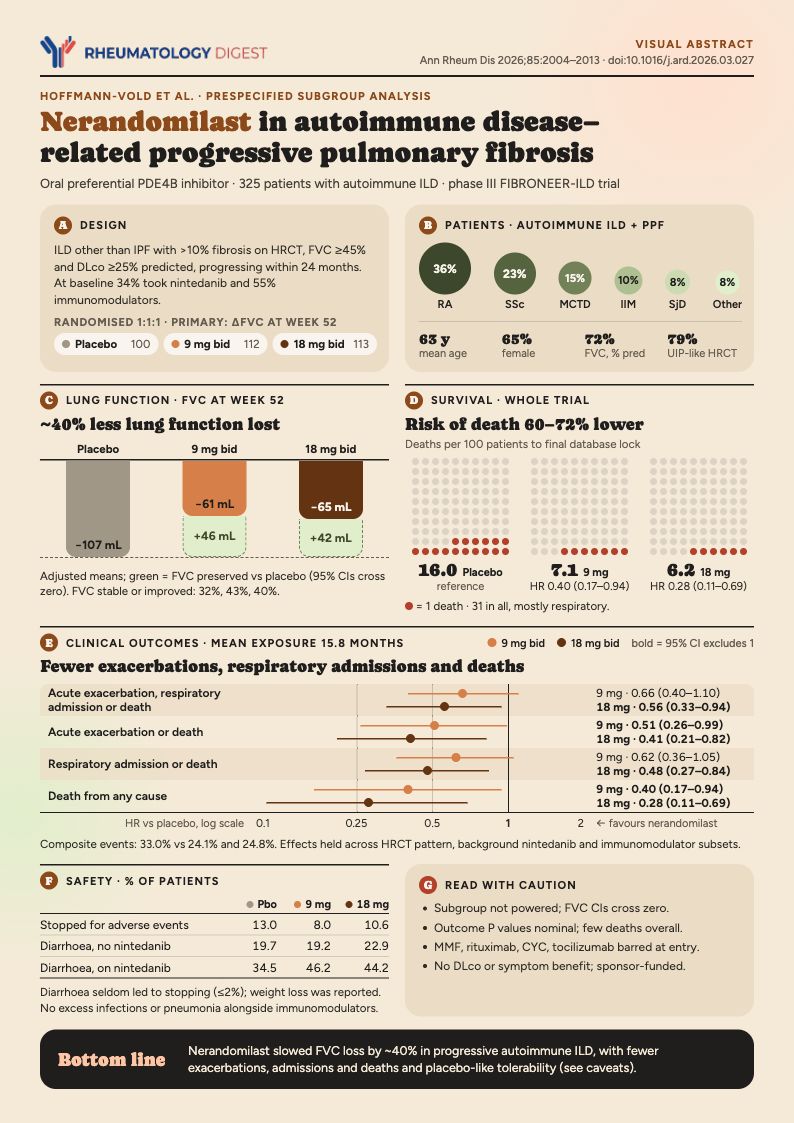
TL;DR: In the autoimmune-ILD subgroup of FIBRONEER-ILD, nerandomilast slowed FVC decline and lowered the risk of exacerbation, hospitalisation or death to a degree that matched the whole trial — a consistent signal from a subgroup the trial was not designed to test.
Most of the patients rheumatologists see with progressive fibrosing lung disease have an autoimmune ILD, not idiopathic pulmonary fibrosis, and the evidence for slowing their fibrosis has leaned heavily on nintedanib. This analysis asks whether nerandomilast, a new oral drug that was positive in the whole FIBRONEER-ILD population, works in the autoimmune subgroup. The answer is “consistent with the overall result”, and the most useful part of the paper is how precisely it says what that does and does not establish.
The drug and the trial
Nerandomilast is a preferential inhibitor of phosphodiesterase 4B with immunomodulatory, vascular and antifibrotic effects. In the phase III FIBRONEER-ILD trial in patients with progressive pulmonary fibrosis (PPF), both doses of nerandomilast, 9 mg and 18 mg twice daily, reduced the decline in forced vital capacity over 52 weeks against placebo, which was the primary endpoint. Over the whole trial the drug also reduced clinically significant outcomes, including death, and was reported to have a favourable safety and tolerability profile with similar proportions discontinuing for adverse events.
The patients. Eligible patients had an ILD other than IPF, fibrosis on HRCT affecting more than 10% of the lung, FVC of at least 45% predicted and DLco of at least 25% predicted. They also had to show progression within the previous 24 months, defined as a relative FVC decline of at least 10%, or a relative decline of 5% to under 10% with worsened respiratory symptoms, or increased fibrosis on imaging with worsened symptoms. Patients could be on a stable dose of nintedanib for at least 12 weeks, or off it for at least 8 weeks; pirfenidone was not allowed. Recent use of prednisone above 15 mg/day, cyclophosphamide, tocilizumab, mycophenolate or rituximab was excluded at screening (with look-back windows from 4 weeks to 6 months), though these could be started after 6 months of the trial to manage worsening systemic disease.
The design. Patients were randomised 1:1:1 to nerandomilast 9 mg twice daily, 18 mg twice daily or placebo, stratified by nintedanib use and HRCT pattern (UIP or UIP-like versus other fibrotic patterns). Treatment continued blinded until all patients had finished week 52, with mean exposure of 15.8 months and a mean observation period of 17.3 months.
Who the autoimmune subgroup was
325 patients with autoimmune ILD received at least one dose: 100 on placebo, 112 on nerandomilast 9 mg and 113 on 18 mg. The investigator-reported diagnosis was:
- RA-ILD: 118 (36.3%)
- SSc-ILD: 75 (23.1%)
- MCTD-ILD: 47 (14.5%)
- ILD associated with inflammatory myopathy: 33 (10.2%)
- Sjögren’s-ILD: 27 (8.3%)
- Other autoimmune ILD: 25 (7.7%)
At baseline, 65.2% were women, the mean age was 63.4 years, mean FVC was 71.5% predicted and mean DLco 51.5% predicted. 78.8% had a UIP or UIP-like fibrotic pattern on HRCT. About half the patients were of Asian ethnicity, and only 3 patients were Black. The groups were similar at baseline.
Background treatment was substantial. 111 patients (34.2%) were taking nintedanib and 179 (55.1%) were taking an immunomodulatory medication other than prednisone; 58 (17.8%) were taking both. Methotrexate, azathioprine and hydroxychloroquine were the most common immunomodulators. Over the trial, immunomodulatory medication was added in 14%, 19.6% and 9.7% of the placebo, 9 mg and 18 mg groups respectively. Completion of the 52-week observation was high: 93.0% in the placebo group, 93.8% on 9 mg and 91.2% on 18 mg.
FVC: a smaller decline on both doses
The adjusted mean change in FVC at week 52 was:
- Placebo: −107.1 mL
- Nerandomilast 9 mg: −61.2 mL, a difference of 45.9 mL (95% CI −20.8 to 112.6), a 43% relative reduction
- Nerandomilast 18 mg: −64.9 mL, a difference of 42.2 mL (95% CI −24.9 to 109.3), a 39% relative reduction
The paper notes these relative reductions are consistent with the 49% and 41% seen in the overall trial population. The two doses performed almost identically, and the curves separated early. The proportion with stable or improved FVC (any change above zero) was 32% on placebo, 43% on 9 mg and 40% on 18 mg.
Both confidence intervals include zero. That is not surprising for a subgroup of about 100 patients per arm, and the authors do not present it as a standalone positive result. Its weight comes from agreement with the larger trial in which the same drug was positive.
DLco and patient-reported outcomes
DLco % predicted declined slightly on all arms: −0.7 on placebo, −2.2 on 9 mg and −2.7 on 18 mg. The differences were −1.5 (95% CI −5.2 to 2.3) and −2.0 (95% CI −5.9 to 1.8), both with intervals spanning zero, so there is no clear effect either way. Dyspnoea, cough and fatigue on the L-PF questionnaire were similar across all groups. The authors state plainly that a benefit on patient-reported outcomes was not demonstrated.
Exacerbation, hospitalisation and death
These time-to-event results run over the whole trial, up to final database lock, and are described by the authors as nominally significant where the interval excludes 1.
Acute exacerbation of ILD, respiratory hospitalisation or death (composite)
- Placebo: 33 patients (33.0%)
- 9 mg: 27 (24.1%), HR 0.66 (95% CI 0.40–1.10)
- 18 mg: 28 (24.8%), HR 0.56 (0.33–0.94), a 44% reduction
Acute exacerbation of ILD or death
- Placebo 23 (23.0%); 9 mg 14 (12.5%), HR 0.51 (0.26–0.99); 18 mg 13 (11.5%), HR 0.41 (0.21–0.82)
Respiratory hospitalisation or death
- Placebo 31 (31.0%); 9 mg 24 (21.4%), HR 0.62 (0.36–1.05); 18 mg 23 (20.4%), HR 0.48 (0.27–0.84)
Death
- Placebo 16 (16.0%); 9 mg 8 (7.1%), HR 0.40 (0.17–0.94); 18 mg 7 (6.2%), HR 0.28 (0.11–0.69)
Most deaths were adjudicated as respiratory-related, and the authors say the mortality reduction was driven by fewer respiratory deaths. The 18 mg dose reached nominal significance on every endpoint, while the 9 mg dose did so on two of four. Note what these figures rest on: 31 deaths in total across the three arms, and results that are nominal and not adjusted for multiplicity. The direction is consistent across every endpoint, which counts for more than any single hazard ratio.
Did it depend on background therapy?
The trial looked at whether the effect differed by nintedanib use, HRCT pattern and immunomodulatory therapy. It was consistent across all of them, with no significant treatment-by-subset interaction.
For immunomodulators, the numbers do vary, and they are worth seeing next to their caveats. Among patients not taking an immunomodulator at baseline (43, 49 and 54 analysed), the FVC change was −92.8 mL on placebo, −81.0 on 9 mg and −69.0 on 18 mg, a relative reduction of 13% and 26%. Among patients taking one (56, 63 and 59), it was −113.6 mL on placebo, −44.7 on 9 mg and −58.9 on 18 mg, a relative reduction of 61% and 48%. The composite endpoint had hazard ratios of 0.75 and 0.67 without immunomodulators and 0.62 and 0.40 with them.
The effect looks larger in patients on immunomodulators, but the interaction P values were 0.39 and 0.64, the FVC intervals cross zero in both subsets, only one composite estimate (18 mg, with immunomodulators) excludes 1, and these subsets are small. The authors treat these subset analyses as exploratory, and the safe reading is that nerandomilast showed no sign of working worse alongside immunosuppression, not that it works better.
Safety
The proportions of patients with any adverse event and with adverse events leading to treatment discontinuation were similar across groups. Discontinuation because of adverse events was 13.0% on placebo, 8.0% on 9 mg and 10.6% on 18 mg.
Within subsets, the picture was also balanced. In patients on immunomodulators, adverse events leading to discontinuation were 12.3% (placebo), 9.5% (9 mg) and 10.2% (18 mg), and serious adverse events were 33.3%, 33.3% and 30.5%. In patients not on immunomodulators, serious adverse events were 51.2%, 38.8% and 51.9%, with fatal adverse events in 9.3%, 2.0% and 3.7%.
Diarrhoea was the most common adverse event, and it was more frequent in patients taking nintedanib. Diarrhoea occurred in 19.7%, 19.2% and 22.9% of patients not on nintedanib (placebo, 9 mg, 18 mg), against 34.5%, 46.2% and 44.2% of those on it. It was more frequent with nerandomilast than placebo but rarely led to discontinuation. Weight loss was also identified as an adverse event associated with nerandomilast. Importantly for a population on immunosuppression, there was no increase in upper respiratory tract infections, pneumonia or sepsis among patients taking nerandomilast with immunomodulatory medication compared with placebo.
What the placebo arm shows
The placebo group is informative on its own. Its FVC fell by 107 mL over 52 weeks, and 19% had an FVC decline above 10%. Nearly a third had an acute exacerbation, a respiratory hospitalisation or death over a mean observation of about 17 months, despite about a third taking nintedanib and more than half taking immunomodulators. And 16% of the placebo group died during the trial. The authors take this as confirmation that autoimmune ILD with PPF keeps progressing, with poor outcomes, even on current treatment.
They also comment on the high UIP-like proportion, nearly 80%, which was higher than in real-world autoimmune ILD cohorts that were not selected for progression. They suggest that is because the trial selected progressive disease, and UIP patterns are associated with greater progression. The effect of nerandomilast was consistent across UIP-like and other patterns.
How to read the result
What supports it. The FVC effect matches the overall trial in size and direction at both doses, all four time-to-event endpoints move the same way, the effect did not depend on nintedanib, HRCT pattern or immunosuppressant use, and tolerability was good, including in patients on immunosuppression.
What limits it:
- The trial was not powered for this subgroup. The authors state it was not powered to assess efficacy in autoimmune ILD, and the number of patients with any single autoimmune disease was too small for analyses by diagnosis. The SSc-ILD group, for example, was 75 patients, and nothing is reported for it separately.
- The FVC intervals include zero and the hazard ratio for the composite endpoint at 9 mg includes 1. The statistical significance in the paper is “nominal”.
- Subset analyses are exploratory, and the paper describes the immunomodulator, nintedanib and HRCT analyses as such. Only the FVC change, the composite endpoint and adverse events in the autoimmune group were prespecified; the others were post hoc.
- Some guideline-recommended drugs were excluded. Patients taking medications recommended in ACR/CHEST and ERS/EULAR guidelines, including mycophenolate, could not be enrolled if they had recent exposure, so efficacy and tolerability alongside those drugs are unknown.
- No patient-reported benefit was shown.
- Representation is limited. Only three Black patients took part.
- Industry sponsorship. The trial was funded by Boehringer Ingelheim, which also funded writing support and was given the opportunity to review the manuscript. Several authors are company employees, and many report consulting, speaker and advisory relationships with industry, listed in full in the paper.
Where this leaves practice
The authors conclude that nerandomilast slowed the decline in FVC and reduced the risk of clinically relevant outcomes in patients with autoimmune ILD and PPF, consistent with the overall population, and that these findings support its use as a treatment for PPF in this group. A cautious reader can accept the conclusion on the strength of the whole trial, with the subgroup acting as reassurance that autoimmune ILD does not respond differently, and still note three things that remain open: its effect on top of the mycophenolate or rituximab regimens that many of these patients receive, how it compares with or combines with nintedanib beyond the allowed background use, and whether any of this translates into patients feeling better.
Disclosures noted in the source: the FIBRONEER-ILD trial was supported by Boehringer Ingelheim International GmbH, which also funded writing assistance; five authors are employees of the company and the others report grants, consultancy, speaker and advisory fees from many companies, listed in the paper. Patients gave written informed consent.