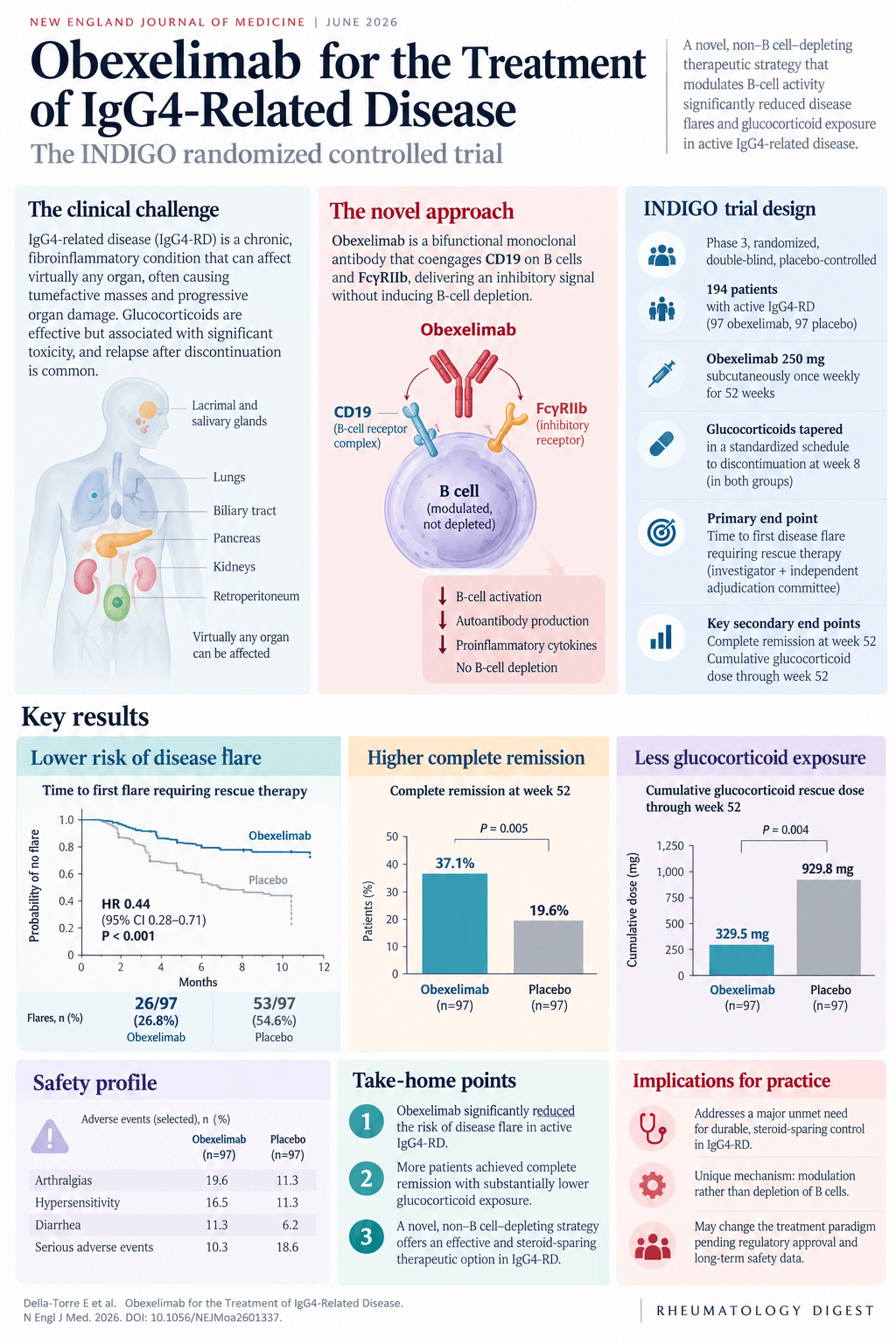
TL;DR: In INDIGO, weekly subcutaneous obexelimab cut IgG4-related disease flares by more than half versus placebo and substantially reduced steroid exposure — a clear positive result, against a comparator of steroid taper alone rather than an approved B-cell-targeted drug.
IgG4-related disease is chronic, relapsing and steroid-responsive, and those three facts define its treatment problem: steroids work, stopping them usually fails, and the patients are middle-aged or older with the comorbidities that make long steroid courses costly. INDIGO tests a B-cell-directed drug built around a different idea from depletion — turning B cells down rather than removing them.
The problem the trial is aimed at
IgG4-related disease is a chronic fibroinflammatory condition that can involve almost any organ. Its histology shows lymphoplasmacytic infiltration, storiform fibrosis and obliterative phlebitis, and it often forms tumefactive masses that mimic cancer. The pancreas, biliary tract, kidneys, retroperitoneum, lungs and the major salivary and lacrimal glands are the usual sites, and multi-organ disease is common. Progression is often indolent, and nearly 60% of patients present with irreversible organ damage. It affects middle-aged and older adults and is about twice as common in men.
Glucocorticoids are the standard therapy because most patients enter remission, but 30–60% relapse within months of stopping, and the toxicity burden is heavier in older patients with other conditions. Conventional immunosuppressants are widely used to spare steroids despite little strong evidence that they work. Inebilizumab was recently approved as the first therapy indicated for IgG4-related disease, and rituximab acts through B-cell depletion as well. Depletion over long periods raises concern about infection, impaired vaccine response and hypogammaglobulinaemia, and a disease that relapses needs long-term therapy, which makes the safety question sharper.
How obexelimab works
Obexelimab is a humanised bifunctional monoclonal antibody that coengages CD19 and FcγRIIb, mimicking the natural inhibitory signal delivered by immune complexes. The result is broad inhibition of B-cell receptor-dependent and independent activity: proliferation, differentiation, cytokine secretion, antibody production and antigen presentation are all suppressed.
The point of difference is that it does not deplete B cells. It produces a partial reduction in their number rather than a sustained depletion, and B-cell counts recover rapidly after treatment stops — in the earlier phase 2 study they returned to about 75% of baseline within six weeks of the last dose. That phase 2 pilot, in 15 patients, produced a clinically significant response in 14 with an acceptable safety profile.
Trial design
INDIGO was a phase 3, double-blind, randomised, placebo-controlled trial in adults with active IgG4-related disease, run at 114 sites in 19 countries, with patients enrolled across 15 countries between January 2023 and November 2024.
Who was eligible: adults with a clinical diagnosis meeting the 2019 ACR–EULAR classification criteria, with an independent adjudication committee — blinded to treatment — confirming each patient met them. Patients needed active disease at screening, defined as a flare for which the investigator judged glucocorticoid initiation, or an increase from a stable dose of 10 mg/day prednisone-equivalent or less, to be necessary. Exclusions included active infection, more than 60 mg/day prednisone-equivalent within four weeks before screening, and B-cell-depleting therapy or other immunomodulators within six months.
The sequence:
- A screening period of up to four weeks with glucocorticoid induction (20–60 mg/day prednisone-equivalent for 3–6 weeks, tapering to 20 mg/day by the day of randomisation).
- Patients with no disease activity were then randomised 1:1 to obexelimab 250 mg or placebo subcutaneously once weekly for 52 weeks, stratified by number of affected organs (one versus more than one) and by disease status (newly diagnosed versus recurrent).
- Glucocorticoids were tapered on a fixed schedule to discontinuation by week 8, with later use permitted only to treat a flare. Concomitant immunosuppressants were not allowed.
Weekly doses were given at home by the patient, a caregiver or a home health provider, or in clinic at the patient’s discretion, with monthly clinic visits.
The primary endpoint was time to the first flare of IgG4-related disease requiring rescue therapy, determined by both the investigator and the independent adjudication committee. Flare criteria were developed for the trial by an expert panel and drew on clinical, laboratory, imaging and pathological data, including whole-body CT or MRI at week 52 to catch subclinical flares. The key secondary endpoints were tested in a fixed hierarchy: investigator-determined time to first flare; total number of adjudicated flares; complete remission at week 52; and cumulative rescue glucocorticoid dose through week 52. The sample size assumed flare in 35% of the placebo group and 15% of the obexelimab group, with 44 adjudicated events giving 90% power for a hazard ratio of 0.38.
Who was enrolled
Of 287 patients screened, 194 were randomised, 97 to each group, and 172 (88.7%) completed the 52-week double-blind period (87.6% on obexelimab, 89.7% on placebo). The mean age was 59.1 years and 66.5% were men. About two-thirds (66.5%) had recurrent disease and a third (33.5%) were newly diagnosed; only 6.7% had one organ involved, 60.3% had two to four, and 33.0% had more than four. The most commonly involved organs were the salivary glands (64.9%), lacrimal glands (53.1%), pancreas (46.9%) and lymph nodes (44.8%). Mean disease duration was 2.8 years, median ACR–EULAR score 38, and 11.9% had received rituximab previously.
The groups were not perfectly balanced. The obexelimab group had more Asian patients (60.8% vs 52.6%) and fewer White patients (27.8% vs 40.2%), and the placebo group had a higher median peak serum IgG4 (747 vs 511 mg/dl). Just over half of all patients were enrolled in Asia.
The primary result: flares were halved
Obexelimab produced a significantly longer time to first adjudicated flare requiring rescue therapy: hazard ratio 0.44 (95% CI 0.28–0.71; P<0.001). Flares occurred in 26 patients (26.8%) on obexelimab versus 53 (54.6%) on placebo. The median time to flare was 11.7 months in the placebo group and not calculable in the obexelimab group, since fewer than half flared. The Kaplan–Meier curves began separating at about month 3, after the glucocorticoid taper was complete. Agreement between the investigators and the adjudication committee on whether a flare had occurred was high.
The four key secondary endpoints all favoured obexelimab
All four were met in the prespecified order:
- Investigator-determined time to first flare: HR 0.41 (95% CI 0.26–0.66), with flares in 26.8% versus 57.7% (P<0.001).
- Adjusted annualised flare rate (adjudicated): 0.34 versus 0.70 flares per year, a rate ratio of 0.48 (95% CI 0.32–0.74; P<0.001), based on 36 versus 72 adjudicated flares.
- Complete remission at week 52: 37.1% versus 19.6% (risk difference 17.7 percentage points; 95% CI 5.4–30.0; P=0.005). Complete remission required no flare per the adjudication committee, no treatment for flare, and either an IgG4-RD Responder Index score of zero or no active disease per the investigator.
- Cumulative rescue glucocorticoid dose through week 52: 329.5 mg versus 929.8 mg (least-squares mean difference −600.3 mg; 95% CI −1011.1 to −189.5; P=0.004), adjusted to a body weight of 80 kg.
Glucocorticoid toxicity
The trial also measured steroid-related toxicity with the Cumulative Worsening Score of the Glucocorticoid Toxicity Index. At week 52 the least-squares mean score was 28.2 with obexelimab versus 39.6 with placebo, a difference of 11.4 points (95% CI 1.7–21.1) in favour of obexelimab, and the pattern was consistent across domains, favouring obexelimab in 6 of 8 domain scores. A smaller share of the obexelimab group had a worsening score of at least 20 or 30 points. The index’s minimal clinically important difference is 15 points, so the mean difference falls below that threshold even though the confidence interval spans it.
This was an additional secondary endpoint outside the hierarchy: the other secondary analyses were not adjusted for multiplicity, and the confidence intervals were explicitly not to be used in place of hypothesis testing.
What happened to B cells and IgG4
Mean CD20+ B-cell counts fell initially on obexelimab but stayed above the lower limit of the reference range (74 per µl) throughout treatment, consistent with partial reduction rather than depletion. Serum IgG4 declined in both groups during the glucocorticoid induction period. On obexelimab it stayed down through week 52; on placebo it climbed back over the year.
Safety
Adverse events were common and similar in frequency: 97.9% on obexelimab and 95.9% on placebo. The events at least four percentage points more frequent with obexelimab were:
- Arthralgia: 19.6% vs 11.3%
- Nasopharyngitis: 18.6% vs 14.4%
- Hypersensitivity: 16.5% vs 11.3%
- Diarrhoea: 11.3% vs 6.2%
- Pyrexia: 7.2% vs 3.1%
- Urticaria: 6.2% vs 1.0%
Upper respiratory tract infection went the other way (15.5% vs 22.7%).
On severity the picture favoured obexelimab. Grade 3 or higher adverse events occurred in 11.3% versus 23.7%, and serious adverse events in 10.3% versus 18.6%. There was one death, in the placebo group, from a cardiovascular event judged unrelated to treatment; none occurred on obexelimab.
Three results deserve a straight reading:
- Discontinuation for adverse events was more frequent with obexelimab: 9.3% (9 patients) versus 3.1% (3 patients). The paper does not break down the reasons in the main text.
- Adverse events of special interest occurred in 22.7% versus 15.5%, driven by hypersensitivity (16.5% vs 11.3%, defined as CTCAE grade 2 or higher). Severe infection (grade 3 or higher) was uncommon and not higher with obexelimab: 2.1% versus 4.1%. Injection-site reactions of grade 2 or higher were in 2.1% versus 1.0%.
- Cancers were reported in 3 patients (3.1%) on obexelimab and none on placebo: a squamous-cell carcinoma, a prostate cancer, and a renal-cell carcinoma that was identified retrospectively on the patient’s screening imaging. Numbers this small cannot establish or exclude a signal, and one case predated treatment.
How to read the result
The effect is large and consistent. The primary and all four key secondary endpoints went the same way, investigator and adjudication committee agreed, and the toxicity index and the pharmacodynamics (IgG4 and B-cell data) point in the same direction. A halving of flare risk against a steroid-free comparator in a disease where 30–60% relapse is an unambiguous efficacy signal.
The comparator needs naming. The control arm received glucocorticoid induction, then a taper to zero by week 8, with no other immunosuppressant — and 54.6% flared, which sits inside the historical 30–60% relapse range quoted for steroid withdrawal. INDIGO therefore shows that obexelimab beats steroid taper alone. It says nothing about how it compares with inebilizumab or rituximab, which the trial did not include, and the paper’s design doesn’t allow a view on that.
Remission is a minority outcome. Even on active treatment, 37.1% achieved complete remission at week 52, which means roughly six in ten did not. The flare result and the remission result describe different things: obexelimab kept most patients from flaring, not most patients in full remission.
The rescue steroid endpoint is tied to flares. Rescue glucocorticoid dose is given only to treat a flare, so the 600 mg difference largely follows from the flare difference rather than being independent confirmation. The toxicity index is the better test of whether the steroid sparing translated into less harm, and there the mean difference was real but modest relative to the 15-point threshold.
Safety is reassuring on severity, less so on tolerability. Fewer severe and serious events is a strength. A threefold higher discontinuation rate and excess hypersensitivity, arthralgia and urticaria are the practical price, and patients will notice those.
Limitations the authors state
- Fifty-two weeks does not establish durability. The trial cannot show how long the effect lasts, fully characterise the safety profile, or address the economic implications of extended treatment, which is how a drug like this would actually be used.
- The open-label extension is ongoing, with follow-up planned up to three years. It will also allow observation of B-cell recovery after stopping, and it collects B-cell data to test whether obexelimab offers long-term immunologic and safety advantages over B-cell-depleting agents — which is a hypothesis the trial has not yet tested.
- Racial and regional imbalances between the arms despite randomisation may affect generalisability.
The trial was designed by several authors including employees of the sponsor, Zenas BioPharma, which funded it and the medical writing support; all authors vouch for the data.
Where this leaves practice
The result supports obexelimab as a steroid-sparing option with a different mechanism from the depleting antibodies and a subcutaneous, self-administered format, which the authors point to as a practical advantage over infusion therapy in a disease that needs long-term maintenance. Whether the non-depleting mechanism translates into fewer infections, better vaccine responses or less hypogammaglobulinaemia over time is the question that matters most and is the one INDIGO cannot yet answer — the evidence for that rests on the extension and on future comparison with depleting agents.
Disclosures noted in the source: the trial was funded by Zenas BioPharma. Several authors are sponsor employees, and the full author disclosure forms are available with the paper.