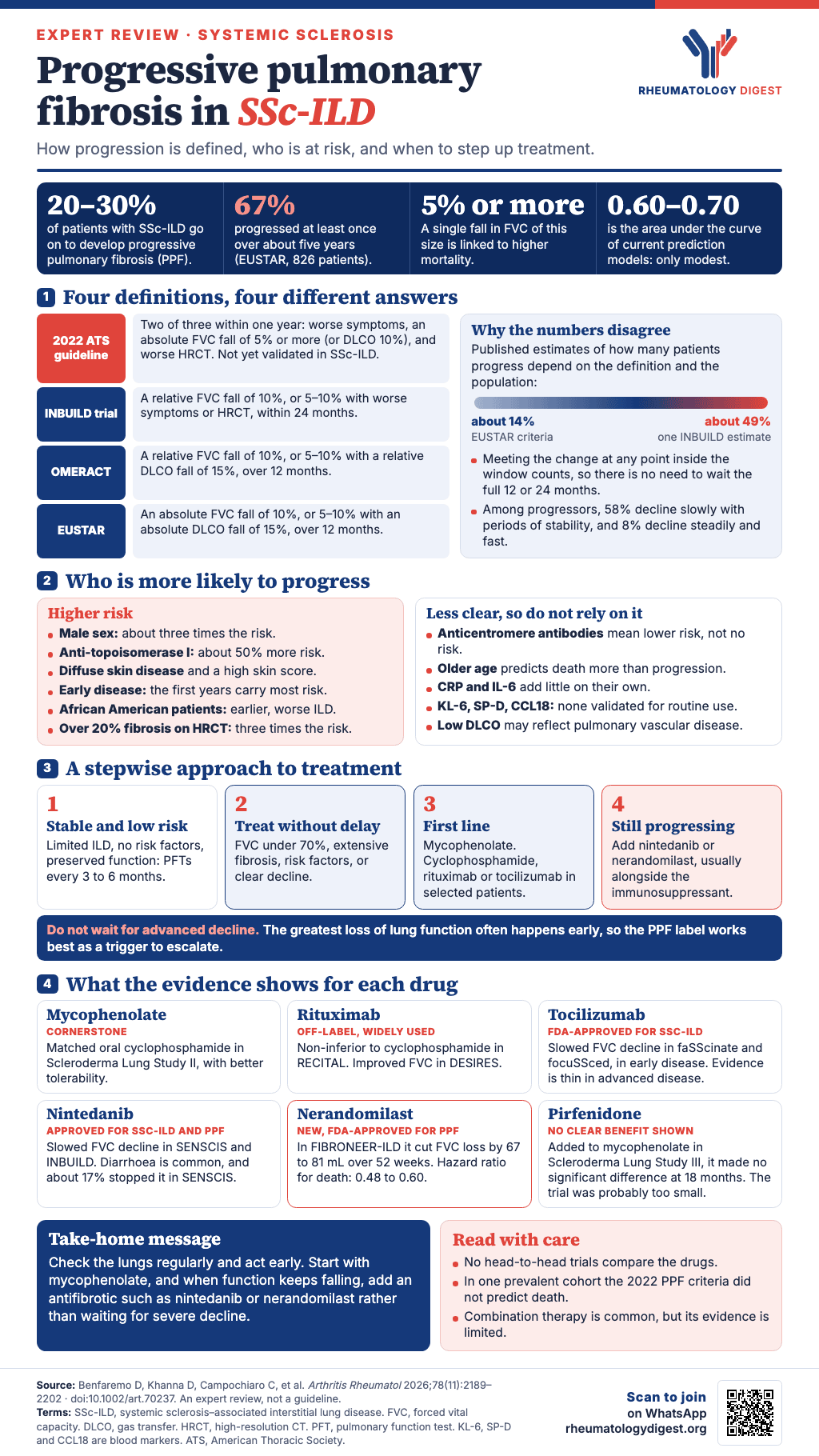
TL;DR: About 20–30% of patients with SSc-ILD develop progressive pulmonary fibrosis, but the definitions disagree, no tool reliably predicts who will progress, and head-to-head treatment trials are missing, so this expert review advises treating “progression” as a trigger to escalate early: mycophenolate first, then rituximab, tocilizumab or an antifibrotic (nintedanib, or the newly approved nerandomilast), often in combination.
Interstitial lung disease (ILD) is among the most serious complications of systemic sclerosis (SSc), affecting up to three-quarters of patients and contributing heavily to morbidity and death. Its course varies widely. Some patients have mild, non-progressive disease, and others deteriorate rapidly. This narrative review by an international group of rheumatologists and pulmonologists (Italy, USA, France) looks at the evolving definition of progressive pulmonary fibrosis (PPF), what it means for prognosis, who is at risk, and how to treat it. The authors say plainly that this is a clinically oriented synthesis, not a formal guideline.
The clinical challenge
The review opens with a patient who shows how the story can go. A 40-year-old woman of Ivorian origin presented with a year of Raynaud phenomenon and skin thickening that progressed to diffuse cutaneous SSc, followed by exertional dyspnoea, synovitis of the wrists and hands, and a 6 kg weight loss. She had a high-titre ANA (1:2,500), anti-topoisomerase I (anti-Scl-70) antibodies, a CRP of 15 mg/L and polyclonal hypergammaglobulinaemia. Lung function already showed severe restriction (FVC 39% of predicted, TLC 52%) with an unmeasurable DLCO, although echocardiography showed no pulmonary hypertension and imaging suggested mild ILD (10–20%) with a non-specific interstitial pneumonia (NSIP) pattern.
She received a calcium-channel blocker, low-dose glucocorticoids, a proton-pump inhibitor and methotrexate, changed after three months to mycophenolate (up to 3 g daily) because skin and lung disease were progressing. Over the next year her dyspnoea worsened (NYHA class III), FVC fell to 35% and pulmonary hypertension appeared. Mycophenolate was stopped because it was poorly tolerated, and rituximab with methotrexate was started. She still needed oxygen, was listed for transplant and underwent lung transplantation. The authors use her as an example of a rapidly progressive course in a patient with several adverse prognostic features.
How to define progression
There is no universally accepted definition of progression in SSc-ILD. The criteria in use differ in what they measure, in whether the change is relative or absolute, and in the time window:
- Cottin and colleagues (2018), the first outline of “progressive fibrosing ILD”: a relative FVC fall of 10% or more, a relative DLCO fall of 15% or more, or an FVC fall of 5–10% accompanied by worse symptoms or imaging, within two years.
- OMERACT (CTD-ILD working group, applicable to SSc-ILD): a relative FVC fall of 10% or more, or an FVC fall of 5–10% together with a relative DLCO fall of 15% or more, over 12 months.
- INBUILD trial criteria (the trial that tested nintedanib across fibrosing ILDs, requiring at least 10% extent on HRCT): a relative FVC fall of 10% or more; or a 5–10% fall with worse symptoms or more fibrosis on HRCT; or worse symptoms plus more fibrosis on HRCT, all within 24 months. These criteria were also used to select patients for the FIBRONEER-ILD trial.
- EUSTAR criteria: an absolute FVC fall of 10% or more, or 5–10% with an absolute DLCO fall of 15% or more, over 12 months.
- 2022 ATS/ERS/JRS/ALAT guideline definition of PPF: at least two of three features within one year, namely worsening respiratory symptoms; physiological progression (an absolute FVC fall of 5% predicted or more and/or a DLCO fall of 10% predicted or more, with no other cause such as pulmonary hypertension); and radiological progression. This is the most recent definition and the one that has yet to be validated in SSc-ILD. It differs from the earlier ones by using absolute rather than relative changes.
- FVC decline alone (an absolute fall of 5% or 10%, over 6–24 months) is common in older studies, from before composite criteria existed.
One point the authors emphasise: the time window is a look-back period, not a waiting period. A patient who meets the criteria at any point inside the window can be classified as progressing and does not have to wait for the full 12 or 24 months.
How common is progression?
The answer depends on the definition and the population. Across all patients with SSc, estimates vary widely because ILD is ascertained and followed differently. In patients with established SSc-ILD, estimates are more consistent: roughly 20–40% over one to two years. Scleroderma Lung Study II and European cohorts report about 19–30%. Higher figures, up to about 40%, come from incident (new-onset) or early ILD cohorts using the 2022 ATS criteria.
The review’s figure showing prevalence by definition makes the point numerically: published estimates run from about 14% (EUSTAR criteria) and 17% (OMERACT) up to 39–49% for some applications of the INBUILD criteria, with ATS-criteria estimates between roughly 19% and 40%. Studies cannot be compared directly without looking at which definition, population and follow-up length they used.
Trajectories are heterogeneous. The landmark EUSTAR analysis (826 patients with SSc-ILD) found that:
- 27% progressed over a 12 ± 3-month period (FVC fall of 5–10% or more than 10%), and 23–27% did so in any given 12-month interval, but only a small subset progressed in consecutive periods.
- The commonest pattern, in 58% of progressors, was a slow decline interspersed with periods of stability or improvement. About 8% had a steady, rapid decline.
- Overall, about 67% progressed at some point during an average of five years of follow-up.
- A more recent study classed 25–30% of patients as progressors at each 12-month review, depending on the definition, and found that progression at the first follow-up lowered the risk of progressing subsequently. The authors caution that regression to the mean and a threshold effect may explain part of this.
Prognosis
ILD has been the leading cause of death in SSc for decades, including in the EUSTAR registry. Patients with ILD at diagnosis have reduced survival even when it is mild and FVC is in the normal range. Falls in %FVC or %DLCO over 12 months are consistently linked with poorer survival, and even a single episode of a 5% or greater FVC decline is independently associated with higher mortality after adjusting for other risk factors. Early decline is therefore both a marker of progression and a candidate surrogate end point for trials. Relying on PFTs alone can still miss patients whose volumes are preserved but whose imaging or symptoms are worsening, which is the argument for multidimensional criteria such as PPF.
The prognostic value of the guideline PPF criteria in SSc-ILD is still uncertain, although it is confirmed in non-fibrotic ILDs. In an incident SSc-ILD cohort, meeting the PPF criteria was independently associated with a 2.6-fold higher mortality. In a prevalent cohort, it did not significantly predict long-term mortality, whereas Goh staging, the INBUILD criteria and a 5% FVC decline did. The authors read this as suggesting that the PPF criteria may identify high-risk patients less effectively than looser definitions.
Screening and monitoring
Screening combines symptoms, chest auscultation, PFTs and HRCT. ILD can be present without symptoms or abnormal PFTs, so PFTs alone are a problem for screening, though they remain central to longitudinal follow-up. HRCT is more sensitive and is the diagnostic gold standard, but how it is used varies widely worldwide.
The two recent guidelines agree on the core and differ on emphasis:
- Who to screen. ERS/EULAR (2025) make a strong recommendation to screen all patients with SSc with HRCT, independent of risk factors. ACR/CHEST (2023) make a conditional recommendation for PFTs and HRCT in patients with SSc who are at risk.
- Tests to avoid. Both discourage chest radiography and surgical lung biopsy for routine screening. ACR/CHEST also advise against routine 6-minute walk distance and chest radiography for monitoring, and conditionally recommend ambulatory desaturation testing.
- Intervals. ERS/EULAR suggest PFTs every 3–6 months during the early or unstable period and at least every 6–12 months thereafter, and repeating HRCT every 12 months in high-risk patients with under five years of disease (every 1–2 years in SSc generally, unless a change is suspected). ACR/CHEST are more conditional but give similar suggested intervals (PFTs every 3–6 months at first, ambulatory desaturation every 3–12 months as needed).
- Triggers. Both use symptoms, PFT decline and desaturation as triggers for intensified monitoring or repeat HRCT.
Quantitative HRCT and artificial intelligence–assisted analysis are emerging as more reproducible and more sensitive than visual scoring. Photon-counting CT, lung MRI and fibroblast activation protein inhibitor PET/CT may add early detection and insight into active fibrosis. All of these remain investigational.
Who is at risk of progressing?
Many of the factors that predict ILD onset also predict progression.
Demographic.
- Male sex is the most consistent factor, conferring about a three-fold higher risk of PPF.
- Older age is linked more to mortality than to progression itself.
- African American patients consistently show more severe ILD and develop lung involvement at a younger age.
Disease-specific.
- Anti-topoisomerase I (ATA) antibodies carry about a 50% higher risk of PPF. Anti-Ro52 is linked to greater severity. Antifibrillarin, anti-Th/To and anti-PM/Scl antibodies are also associated with ILD.
- Diffuse cutaneous disease and a higher modified Rodnan skin score predict functional decline. Limited cutaneous disease, particularly with a high-risk antibody profile, can still progress significantly.
- Anticentromere antibodies generally mean a lower risk, but not no risk.
- Early disease carries the highest risk, which is why trials concentrate on early SSc, though progression can occur later, including in fluctuating or relapsing patterns.
- Gastro-oesophageal reflux is associated with a modest increase in risk whose independence from other disease features is uncertain. CRP and IL-6 correlate with worse lung function and outcomes but add little as independent predictors. Arthritis and exercise-induced desaturation improve early identification in composite models.
Lung-specific.
- Extent of fibrosis on HRCT is more strongly associated with progression and mortality than radiological pattern (an extent over 20% is cited as raising risk three-fold), although its independent value has not been consistent across studies.
- Lower baseline FVC predicts progression. Reduced DLCO predicts overall mortality better than progression, and it must be interpreted carefully in SSc because pulmonary vascular disease is common.
- Short-term falls in FVC and DLCO over the first one to two years are stronger indicators of long-term outcome than baseline values.
Prediction is still weak. Multivariable models using demographic, clinical, functional and serological variables perform only modestly (area under the curve about 0.60–0.70), lack external validation, and were not improved much by machine learning on large cohorts. One example is the SPAR model, which uses arthritis and low SpO₂ to predict early progression of mild ILD.
Biomarkers. None is validated for routine use. KL-6, surfactant protein-D and CCL18 correlate with the presence, severity and functional impact of ILD, and KL-6 and CCL18 also have prognostic associations with progression and mortality (changes in KL-6 may reflect treatment response). CXCL4 is linked to PPF risk and may identify patients more likely to respond to immunosuppression. Anti-CXCR3 and anti-CXCR4 antibodies differ between progressive and stable disease, and a high type I interferon score is associated with worse lung involvement in diffuse cutaneous SSc. The authors’ conclusion is that integrated, longitudinal assessment is needed rather than reliance on any single marker.
A stepwise approach to treatment
The authors propose a structured but flexible approach, guided by baseline severity, risk factors and evidence of progression over time:
- Limited ILD, no risk factors, preserved lung function, no progression. Close monitoring with PFTs every three to six months and periodic imaging is appropriate.
- Clinically significant ILD at baseline (for example FVC under 70% or extensive fibrosis), risk factors, or objective decline in lung function, symptoms or HRCT. Start or escalate treatment without delay.
- First line: mycophenolate, particularly in early or inflammatory disease. Cyclophosphamide, rituximab or tocilizumab may be considered in selected patients (rapidly progressive or early inflammatory disease, or intolerance of first-line therapy), though practice varies.
- Progression despite adequate immunosuppression, or a predominantly fibrotic phenotype: consider an antifibrotic, either nintedanib or nerandomilast. In practice this usually means combination therapy (an immunosuppressant plus an antifibrotic), but evidence on the best sequence is limited.
- Do not wait for advanced decline. The greatest loss of lung function frequently, though not exclusively, happens early. Decisions should be individualised to trajectory, radiological pattern, extra-pulmonary SSc, comorbidities (including pulmonary hypertension) and patient preference. The review’s practical point is that a progressive fibrosing phenotype works as a trigger for escalation and is not merely a label.
The evidence for each treatment
Initial treatment and timing. Untreated patients with SSc-ILD may progress in up to 40% of cases, about as many as those on immunosuppression, so the observation does not settle whether treatment helps. Earlier intervention may prevent worsening in early SSc, but in a real-life study earlier immunosuppression did not prevent ILD onset, and the authors note that this was limited by heavy use of methotrexate, which has not been shown to work in SSc-ILD.
Mycophenolate. It is the cornerstone. In Scleroderma Lung Study II it stabilised lung function comparably to oral cyclophosphamide with better tolerability. Real-life studies report improved progression and quality-of-life measures, it is the first-line choice for most patients with mild to moderate ILD, and it is often continued long-term because of its safety profile. Consensus panels and recent guidelines recommend it.
Rituximab. It stabilised or improved lung function in small trials, was non-inferior to cyclophosphamide in the RECITAL trial (severe CTD-ILD) with a better safety profile, and improved FVC in the DESIRES trial, especially in patients with elevated CRP, with a steroid-sparing benefit. It is widely used off-label, particularly in refractory or overlapping disease.
Tocilizumab. It slowed FVC decline in the faSScinate and focuSSced trials, with possibly greater benefit in ATA-positive patients, and has been linked to improved imaging, less skin involvement and favourable long-term safety. Those trials were in early disease, and evidence in advanced or refractory SSc-ILD is limited. It is FDA-approved for SSc-ILD.
No head-to-head trials. EUSTAR registry data suggest comparable effectiveness for mycophenolate, tocilizumab, rituximab and cyclophosphamide. Surveyed clinicians perceived safety as similar and efficacy as highest for rituximab and nintedanib. The ERS/EULAR recommendations therefore follow trial inclusion criteria rather than direct comparisons.
Nintedanib. It is approved for both SSc-ILD and PPF on the strength of SENSCIS and INBUILD. SENSCIS enrolled a broad SSc-ILD population not selected for progression (with at least 10% HRCT extent) and showed less FVC decline over 52 weeks, including in patients on background immunosuppression. Diarrhoea is the commonest adverse event and often manageable, though about 17% of SENSCIS patients stopped the drug because of adverse events. INBUILD, which included patients with SSc-ILD, showed a significant reduction in the rate of FVC decline. Observational data on nintedanib in SSc-ILD agree on FVC trajectory and tolerability. It is often used second-line after progression on immunosuppression, but progression is not a prerequisite for benefit, and the ERS/EULAR guidance suggests upfront combination of mycophenolate with nintedanib in patients at high risk of progression. EUSTAR data show a shift towards more immunosuppression and combinations over time, with progression rates falling, though a substantial proportion still progress.
Pirfenidone. The open-label LOTUSS study showed acceptable safety. In Scleroderma Lung Study III, mycophenolate plus pirfenidone did not differ from mycophenolate plus placebo in %FVC at 18 months, though the trial is thought to have been underpowered.
Nerandomilast. It is a preferential PDE4B inhibitor, intended to give antifibrotic and anti-inflammatory effects with better tolerability than pan-PDE4 inhibitors. In preclinical work it reduced fibrotic markers, suppressed fibroblast-to-myofibroblast differentiation and improved endothelial barrier integrity. A phase II trial in idiopathic pulmonary fibrosis (18 mg twice daily) stabilised FVC over 12 weeks regardless of background antifibrotic, and post hoc analysis suggested an additive effect with nintedanib. Two phase III trials followed:
- FIBRONEER-IPF (idiopathic pulmonary fibrosis): the placebo-adjusted FVC difference at 52 weeks was +68.8 mL for the 18 mg dose.
- FIBRONEER-ILD (PPF): differences of +67.2 mL (18 mg) and +81.1 mL (9 mg). Mortality was significantly reduced, with hazard ratios of 0.48 (18 mg) and 0.60 (9 mg) against placebo.
- Diarrhoea was the commonest adverse event, particularly at the higher dose (41.3% against 16.0% with placebo), and no excess psychiatric or vasculitic events were seen.
On this basis the FDA has approved nerandomilast for PPF. Trials in SSc-ILD and SSc more broadly are under way.
Combination therapy. It is gaining ground because SSc-ILD has a dual pathogenesis, immune-mediated inflammation and progressive fibrosis. Monotherapy remains the standard first line, but many patients keep progressing. In SENSCIS, nintedanib reduced FVC decline in patients on background mycophenolate, and post hoc analyses support the safety and possible additive benefit of the pair. Combining mycophenolate or other immunosuppressants with rituximab is also getting attention, especially in refractory or overlapping disease. Early data and the ERS/EULAR guidance support such strategies in high-risk patients, but robust trial evidence is limited, though expert surveys and registries show that combinations (especially with nintedanib and rituximab) are already widely used.
Refractory disease. Options discussed are:
- Haematopoietic stem cell transplantation: significant long-term benefit in selected patients, including better event-free survival and lung outcomes, at the cost of early treatment-related morbidity and mortality.
- CAR T-cell therapy: investigational, with early promise in refractory autoimmune disease including SSc-ILD.
- Bispecific T-cell engagers: early-phase data suggest clinical improvement and ILD stabilisation even in treatment-refractory SSc, but these approaches carry significant safety considerations.
- Lung transplantation for end-stage disease or PPF despite maximal medical therapy.
Drugs in development
Several agents are being tested in PPF, mostly in trials of PPF as a group rather than SSc specifically. The ones listed in the review are inhaled pirfenidone (phase 2b), HEC585 (phase 2b), admilparant, an LPA1 antagonist (two phase 3 trials, with syncopal events among the end points), inhaled treprostinil in the TETON-PPF phase 3 trial (698 patients), the hedgehog inhibitor taladegib (phase 2b) and the tyrosine kinase inhibitor anlotinib (phase 2–3). Because the fibrotic ILDs share mechanisms, some of these may eventually help patients with SSc-ILD who progress.
Unmet needs the authors highlight
- Predicting progression. Identifying which patients will progress within one to three years is still not possible, and the heterogeneity dilutes treatment effects in trials.
- Why some patients progress and others stay stable for years. The simple “progressive versus stable” model is being reconsidered because many patients fluctuate or decline slowly and steadily. Episodic triggers such as subclinical infection, microaspiration, immune flares or environmental exposures may be involved, along with genetic or epigenetic factors affecting repair and shifts in the immune and fibrotic microenvironment.
- Slow, continuous decliners. Patients who lose lung function slowly over years without meeting formal PPF criteria are hard to classify. Progression is not confined to high-risk phenotypes: patients with anticentromere or less common antibodies can progress too, usually at a slower and more variable rate. The authors take this as an argument against complacency in “lower-risk” groups, and say that slow progressors should not be overlooked and may warrant strategies like those used in higher-risk patients.
- What to do after mycophenolate falls short. Whether to move to a second or third immunosuppressant (rituximab, tocilizumab) or to add an antifibrotic is unanswered and needs systematic research.
What it adds up to
The review’s message is that the clinical utility of the PPF construct in SSc is not yet fully established, and that it matters mainly as a practical prompt to act. Surveillance with baseline HRCT and serial PFTs, early recognition of decline, and timely escalation matter more than the label. Future treatment will probably combine immunomodulatory and antifibrotic drugs tailored to the individual’s risk profile, and the approval of new antifibrotics marks what the authors call a new era in PPF treatment. More SSc-specific prospective data are needed to refine risk stratification and validate the newer therapies.