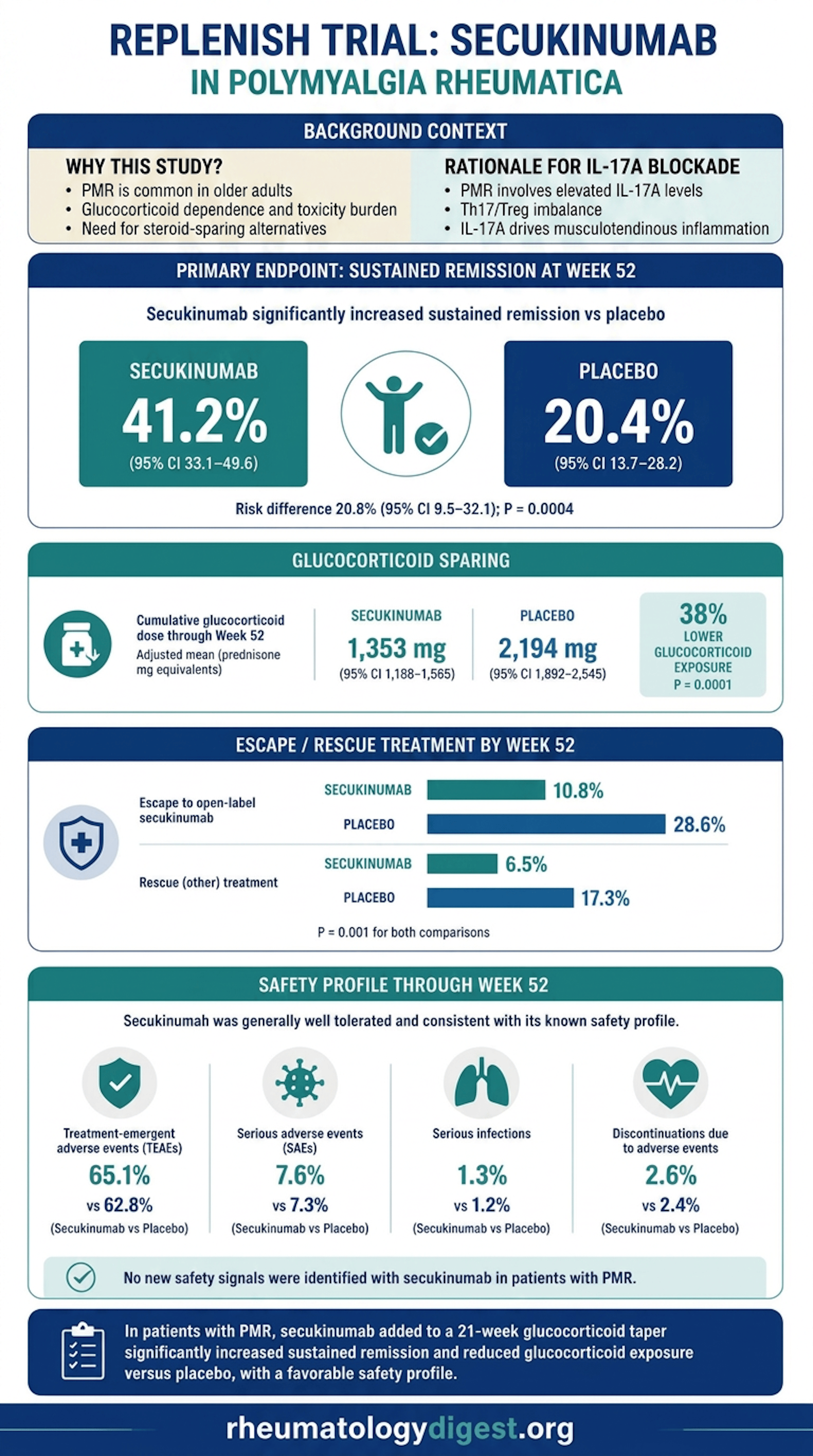
TL;DR: Adding secukinumab to a 24-week prednisone taper doubles sustained remission in relapsed PMR and halves the need for escape steroid — but it maintains remission rather than inducing it, and six in ten treated patients still do not reach the endpoint.
The problem this is trying to solve
PMR is the second most common idiopathic inflammatory rheumatic disease after RA, and we have essentially one thing to offer it. Glucocorticoids work, which is precisely the difficulty: the toxicity — infection, diabetes, osteoporosis, pathological fracture, hypertension, heart failure, neuropsychiatric effects — lands on older adults and on women, who are the people who get PMR. Tapering frequently fails. Relapse occurs in 43% within the first year, and 25% of patients are still on glucocorticoids five years after diagnosis. Sarilumab is the only approved biologic.
The rationale for targeting IL-17A is reasonable rather than speculative. PMR features raised IL-17A levels and an imbalance between proinflammatory Th17 cells and Tregs, and IL-17A drives inflammation in the musculotendinous compartment — the bursitis and tendinitis that define the disease. Secukinumab is already established in ankylosing spondylitis and psoriatic arthritis, with a preliminary phase 2 signal in giant cell arteritis (TitAIN).
Who was studied — and this is the key framing
381 patients across 148 sites in 28 countries, randomised 1:1:1 to secukinumab 300 mg, secukinumab 150 mg or placebo — given subcutaneously weekly to week 4, then every 4 weeks — with every arm on top of an identical protocol-specified 24-week prednisone taper starting at 10 or 15 mg/day.
These were not newly diagnosed patients. Entry required 2012 EULAR–ACR-defined PMR with CRP ≥10 mg/L or ESR ≥30 mm/h, at least one PMR relapse while tapering prednisone at ≥5 mg/day within the preceding 12 weeks, plus documented prior exposure of ≥10 mg/day for ≥8 consecutive weeks. More than 63% had relapsed at doses below 10 mg/day. This is the steroid-dependent group in whom a sparing agent is most needed — and equally, the group in whom placebo should be expected to perform poorly. GCA was an exclusion criterion.
Two design features matter when reading the results. Escape meant increasing or restarting glucocorticoid while the patient continued blinded study drug; rescue meant any alternative therapy, with blinded drug stopped. And ESR and CRP were concealed from investigators and trial personnel, so escape and rescue decisions were driven by clinical assessment rather than by a number — a genuine safeguard against functional unblinding through the acute-phase response.
The baseline comorbidity profile is the reason any of this matters: mean age 70, 70% women, hypertension in 56%, diabetes in 17%, prior fracture in 11%.
Sustained remission roughly doubled
| Arm | Sustained remission at week 52 | 95% CI |
|---|---|---|
| Secukinumab 300 mg | 41.2% | 32.8–49.7 |
| Secukinumab 150 mg | 40.6% | 32.2–49.0 |
| Placebo | 20.4% | 13.6–27.2 |
Both differences — +20.8 and +20.2 percentage points — were significant at P<0.001, and results were consistent in men and women. Sustained remission meant remission achieved by week 12 and held continuously to week 52, with no PMR recurrence and no new GCA warranting treatment.
Two things follow. 150 mg and 300 mg are indistinguishable; the confidence intervals essentially superimpose. If that replicates, it favours the lower dose on exposure and cost grounds, though the trial was not powered for dose comparison and cannot formally establish equivalence. And fewer than half of actively treated patients met the endpoint. The headline doubles a low number: roughly 59% of secukinumab-treated patients did not achieve sustained remission. The number needed to treat is about 5.
Adding normalised acute-phase reactants — complete sustained remission — widens the gap sharply, to 28.2% and 24.5% versus 4.7%, a roughly six-fold relative difference. Read that one carefully. Secukinumab suppresses CRP directly, through IL-6 downstream of IL-17A signalling, so part of the widening reflects the drug’s biochemistry rather than clinical benefit. It is not merely cosmetic either — raised CRP and ESR are themselves established predictors of relapse.
The most useful finding: this is a maintenance drug
| Component | 300 mg | 150 mg | Placebo |
|---|---|---|---|
| Remission by week 12 | 88.9% | 85.7% | 78.0% |
| No PMR signs or symptoms, weeks 12–52 | 42.9% | 42.9% | 24.4% |
| No ESR/CRP elevation, weeks 12–52 | 52.4% | 54.0% | 33.9% |
Nearly 80% of placebo patients were in remission by week 12. Induction is a glucocorticoid effect. The drug’s separation appears almost entirely in holding remission through the taper and beyond.
That ought to determine how secukinumab is positioned and how patients are counselled. It is not an alternative to steroids at the front end; it is an attempt to prevent the relapse that follows.
Steroid sparing and escape treatment
| Arm | Adjusted annual cumulative prednisone | Difference vs placebo |
|---|---|---|
| Secukinumab 300 mg | 1603.7 mg | −489.4 mg (−734.5 to −244.3), P<0.001 |
| Secukinumab 150 mg | 1683.2 mg | −409.9 mg (−661.8 to −157.9), P=0.002 |
| Placebo | 2093.0 mg | — |
A 20–23% reduction in annual cumulative exposure — roughly 1.1–1.3 mg/day averaged across the year. Modest in absolute terms, but achieved on top of an already-brisk uniform taper.
The escape and rescue data are the most clinically legible result in the paper:
| Arm | Needed escape or rescue | Median time to first use |
|---|---|---|
| Secukinumab 300 mg | 50.8% | 337 days |
| Secukinumab 150 mg | 51.6% | 282 days |
| Placebo | 75.6% | 157 days |
Three-quarters of the placebo arm required escape or rescue, at a median of 157 days — mid-taper. Secukinumab halved the hazard (HR 0.5 for both doses) and roughly doubled the median time to first use. Half of actively treated patients still needed it.
Fatigue, function and measured toxicity
Both patient-reported outcomes favoured secukinumab by margins exceeding accepted thresholds for a minimal clinically important difference: +6.1 points on FACIT-Fatigue (MCID ~3–4) and −0.44 on HAQ-DI (MCID ~0.22), both P=0.002. One presentational caution — the FACIT-Fatigue changes are printed as negative in every arm while higher scores indicate less fatigue, so the directionality reads oddly on the page; the between-group difference is the meaningful figure.
The Glucocorticoid Toxicity Index, exploratory and with the BMD domain excluded, fell in a graded fashion — aggregate improvement score 32.4 / 54.0 / 84.3 and cumulative worsening score 69.0 / 90.1 / 123.5 across 300 mg, 150 mg and placebo. It is interesting that toxicity looks dose-related while efficacy does not. But these are descriptive figures reported without confidence intervals or P values: supportive and directionally reassuring, not established.
Safety
Serious adverse events were comparable across all three arms — 13.5%, 15.9% and 14.2% — and both severe adverse events and discontinuations for adverse events were actually lower on secukinumab, consistent with the placebo arm carrying a heavier glucocorticoid load. Serious infections ran at about 3% in all three groups.
The excess on secukinumab was nasopharyngitis, urinary tract infection, upper respiratory infection, back pain, hypersensitivity reactions (eczema, dermatitis, rash — all non-serious, none causing discontinuation) and fungal infection: 6.3% and 10.3% versus 3.1%, a recognised class effect of IL-17A blockade and mostly mucocutaneous candidiasis. Most infections, fungal ones included, were mild to moderate.
There were three deaths. One cardiac failure and one suicide (placebo), and one cryptococcal meningitis on 150 mg, in an older patient with long-term glucocorticoid exposure and a pre-existing meningioma, judged by the investigator as potentially related to secukinumab. That is a single event in an already-immunosuppressed host — but invasive fungal infection in an elderly, steroid-exposed, IL-17-blocked patient is biologically coherent, and deserves naming rather than burying.
GCA developed in two patients over 52 weeks, one on 300 mg and one on placebo — far too few events to say whether IL-17A blockade protects against GCA emergence or masks it.
How much to believe
The methodology is strong. Multiplicity was controlled with a graphical sequential testing strategy, an estimand framework counted intercurrent events as non-response, and the biomarker concealment described above is a real protection. Non-responder imputation is the conservative choice and the correct one here, since discontinuation in a steroid-taper trial is rarely uninformative.
The substantive limits:
- Nothing beyond 52 weeks, and nothing at all about what happens after withdrawal. In a disease whose central question is how long can we keep people off steroids, one year is a first answer rather than the answer.
- No active comparator. Sarilumab is the approved biologic, and this trial says nothing about how IL-17A blockade compares with IL-6R blockade on efficacy, sparing or cost. Cross-trial contrast with SAPHYR is not a substitute.
- Did the 24-week taper disadvantage placebo? The authors meet this directly, citing SAPHYR (14% sustained remission on placebo) and GiACTA (14% with a 26-week taper versus 18% with 52 weeks) to argue that longer tapering does not substantially improve sustained remission. A fair defence, but it rests on cross-trial comparison rather than a randomised taper-duration arm within REPLENISH.
- Remission was investigator-judged on signs and symptoms, without a validated composite activity index — PMR has none. Blinding and biomarker concealment mitigate this considerably, but the endpoint remains softer than something like a swollen joint count.
- The primary endpoint is all-or-nothing: remission by week 12, held continuously to week 52, so a single transient flare disqualifies a patient. Clinically meaningful, but it produces low absolute rates in both arms and may under-represent partial benefit.
- Higher discontinuation in the placebo arm may have under-detected adverse events attributable to conventional glucocorticoid management — biasing the safety comparison, if anything, against secukinumab.
- GCA was excluded, though 16–21% of PMR patients have it, and that is precisely the group where an IL-17A inhibitor’s behaviour is most interesting given the TitAIN signal.
- Sponsor involvement was extensive. Novartis participated in design, monitored sites, and collated and analysed the data; several authors are employees; medical writing was company-funded. The methods look sound, but the structural conflict is worth registering.
- Generalisability. 70% White, mean age 70, with an Asian stratum of about 13%. And the cost of a year of an IL-17A inhibitor is a real constraint in most health systems where PMR is otherwise managed with inexpensive prednisone.
Where this sits in practice
IL-17A is now a validated pathway in PMR, with prospective placebo-controlled phase 3 evidence sitting behind the Th17/Treg biology. That is a mechanistic advance and not merely a drug result — and it gives a field that has had one biologic a second, mechanistically distinct option, useful for patients who relapse on taper and cannot tolerate or do not respond to sarilumab.
If it reaches practice, the best-defined candidate is the trial patient: ≥50 years, EULAR–ACR-defined PMR, raised acute-phase reactants, at least one documented relapse on taper at ≥5 mg/day, no GCA. 150 mg looks as effective as 300 mg and is a reasonable default until dose-comparative data exist — the numerically higher fungal infection rate at the lower dose is most likely chance. Counsel on mucocutaneous candidiasis and monitor for it, keeping the cryptococcal death in mind for the frailest, most steroid-exposed patients.
And set expectations honestly. About four in ten will reach sustained remission; about half will still need escape steroid at some point in the year. That is a genuine advance over a standard of care that fails three-quarters of patients on taper — but it is not a solution to PMR.