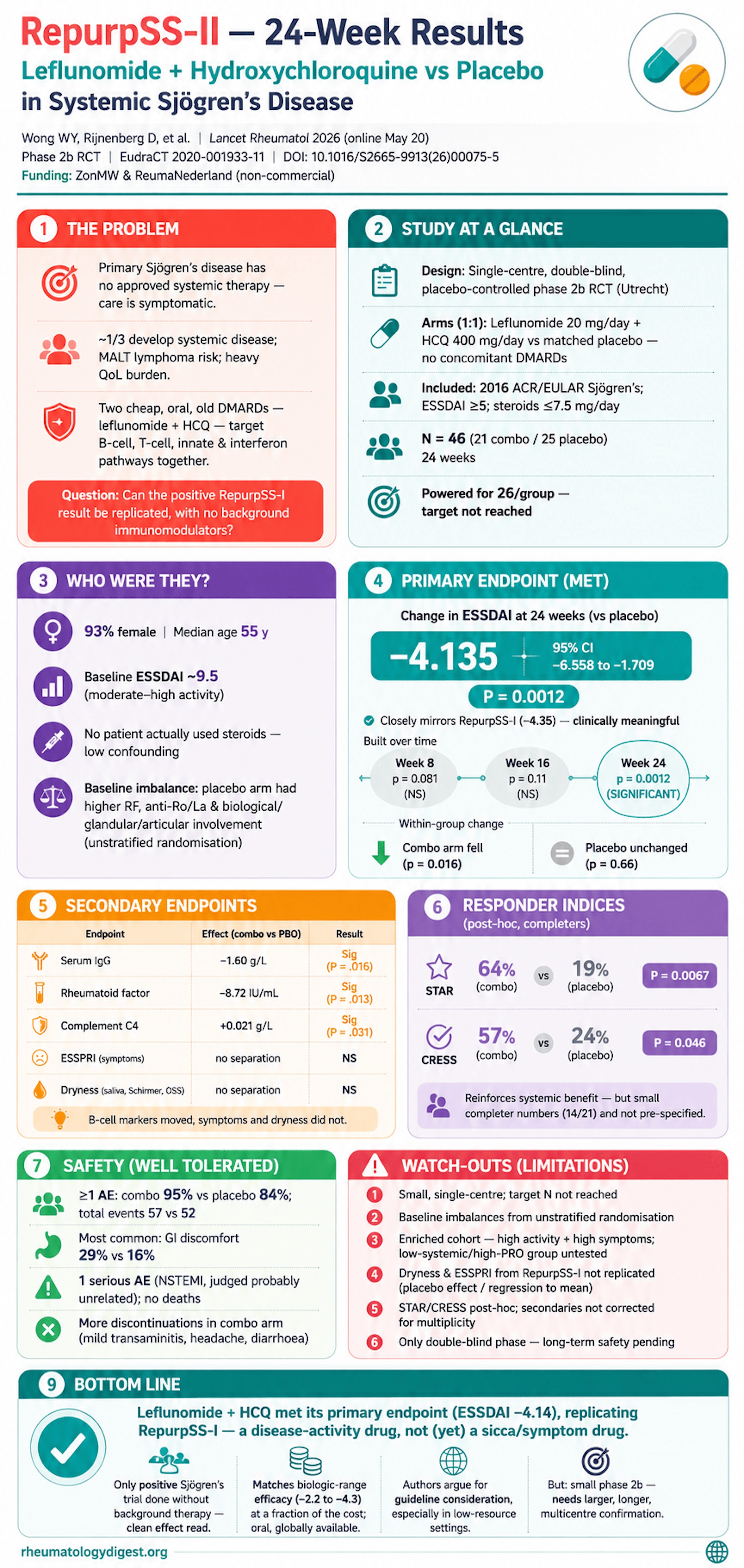
TL;DR: In this phase 2b trial given without any background immunosuppression, leflunomide + hydroxychloroquine met its primary endpoint with a clinically meaningful ESSDAI improvement (−4.14 at 24 weeks), replicating RepurpSS-I — but this is a disease-activity drug, not a sicca one: dryness and patient-reported symptoms (ESSPRI) did not separate from placebo.
The Clinical Problem
Primary Sjögren’s disease is a systemic autoimmune disorder driven by lymphocytic infiltration of the salivary and lacrimal glands, producing sicca symptoms alongside disabling fatigue and pain. Roughly a third of patients develop systemic manifestations, and the disease carries a recognised risk of MALT lymphoma and a substantial quality-of-life burden.
Despite this, there is still no approved systemic disease-modifying therapy — care remains largely symptomatic. A long list of immunomodulators has failed in trials. The authors frame two persistent obstacles:
- Outcome-measure immaturity. Robust, validated metrics arrived late. The field now leans on ESSDAI (systemic activity), ESSPRI (patient-reported), and two newer composite responder indices — STAR and CRESS — which fold together systemic activity, patient-reported outcomes, and objective dryness into a single response definition.
- Complex pathophysiology. Beyond the classical central role of B-cell hyperactivity, T cells, innate immune cells, and interferon signalling are all now implicated — providing the rationale for hitting multiple immune pathways at once rather than a single target.
Leflunomide and hydroxychloroquine (HCQ) are cheap, oral, widely available conventional synthetic DMARDs with complementary mechanisms. The earlier RepurpSS-I (phase 2a) was the first double-blind trial to show a significant systemic-activity benefit from a conventional DMARD combination in Sjögren’s (ESSDAI between-group difference −4.35, 95% CI −7.45 to −1.25; p=0.0078), with the combination outperforming either drug alone in suppressing B-cell hyperactivity.
The Research Question
Can the RepurpSS-I result be replicated? Specifically — in patients with active systemic Sjögren’s disease and no concurrent immunomodulatory therapy, does 24 weeks of leflunomide + HCQ improve systemic disease activity (ESSDAI) versus placebo, and is it safe and tolerable?
The “no background therapy” design is deliberate and central: it isolates the true treatment effect without the confounding of concomitant DMARDs.
How the Study Was Designed
Population
- Adults 18–75 years, meeting 2016 ACR/EULAR classification criteria.
- Moderate-to-severe systemic activity: ESSDAI ≥5.
- Oral glucocorticoids permitted only up to 7.5 mg prednisolone/day; other immunosuppressants had to be stopped ≥3 months before entry.
- Excluded: wish to conceive within 2 years of study completion; leflunomide or HCQ use in the prior 6 months.
Randomisation & masking (1:1)
- Leflunomide 20 mg once daily + HCQ 400 mg/day (200 mg BID, or 200 mg OD if <60 kg) vs matched placebo, for 24 weeks.
- Both arms took three identical capsules daily; patients, investigators, and lab staff masked until week 24.
- Randomisation was performed by the drug manufacturer, without blocking or stratification — a detail that matters (see results/limitations).
Endpoints
- Primary: between-group difference in change in ESSDAI, baseline → 24 weeks, adjusted for baseline ESSDAI.
- Secondary: between-group change in ESSPRI and inflammatory markers (serum IgG, RF, C3, C4, anti-Ro/SSA, anti-La/SSB); objective dryness (unstimulated/stimulated whole saliva, Schirmer, tear break-up time, ocular staining score).
- Exploratory: dryness VAS, quality of life (SF-36, MFI); transcriptomic/proteomic work reported separately.
- Post-hoc: STAR and CRESS composite responder rates (completers only).
Statistics
- Powered from RepurpSS-I pilot data (SD 4.16) to detect a conservative 3.5-point ESSDAI reduction, two-sided α=0.05, 80% power → 26 patients per group required.
- Linear mixed-effects model (repeated ESSDAI at weeks 8/16/24; treatment × visit interaction; baseline ESSDAI as covariate; random intercept per patient); intention-to-treat.
- Within-group change assessed in per-protocol completers (paired t / Wilcoxon); secondary and exploratory endpoints were not corrected for multiple testing — so those p-values are nominal.
The Results
Recruitment & who was studied
- Oct 2021 – July 2024: 243 approached → 46 randomised (21 to leflunomide-HCQ, 25 to placebo). The unequal split despite 1:1 reflects the absence of block randomisation in a small sample.
- Median age 55 y; 93% female. Baseline ESSDAI ~9.5 in both arms.
- Not-so-obvious point: although glucocorticoids up to 7.5 mg were allowed, no patient actually used them — reducing steroid confounding.
- Baseline imbalances were present: constitutional-domain involvement and unstimulated saliva were higher in the treatment arm, while biological, glandular, articular, and pulmonary domains — plus RF and anti-Ro/La positivity — were higher in the placebo arm. Overall mean ESSDAI was still similar.
- The treatment arm saw more discontinuations (7 stopped treatment, 3 for possible drug-related events: mild transaminitis; headache/dizziness; fatigue/diarrhoea).
Primary endpoint — met
- ESSDAI change at 24 weeks favoured the combination: −4.135 (95% CI −6.558 to −1.709; p=0.0012) — closely mirroring RepurpSS-I (−4.35) and clinically meaningful.
- Important nuance on trajectory: the effect was not significant at week 8 (−2.07; p=0.081) or week 16 (−1.95; p=0.11), reaching significance only at week 24. Separation built over time rather than appearing early.
- Within-group: ESSDAI fell significantly in the combination arm (p=0.016); placebo did not change (p=0.66). Multiple domains (biological, glandular, articular, constitutional, lymphadenopathy) contributed.
Secondary — biological markers moved, symptoms did not
- Serum IgG −1.600 g/L (p=0.016), RF −8.715 IU/mL (p=0.013), C4 +0.021 g/L (p=0.031) all favoured the combination — consistent with dampened B-cell hyperactivity. C3 did not change.
- No between-group difference in ESSPRI, or in any objective dryness measure (saliva, Schirmer, tear break-up, ocular staining).
- Counterintuitive detail: within-group ESSPRI improved significantly in the placebo arm (p=0.033), not in the treatment arm (p=0.091) — pointing to placebo response / regression to the mean on subjective outcomes.
- SF-36 and MFI: no between-group difference.
Composite responder indices (post-hoc, completers)
- STAR: 9/14 (64%) responders on combination vs 4/21 (19%) placebo — p=0.0067.
- CRESS: 8/14 (57%) vs 5/21 (24%) placebo — p=0.046.
- These reinforce the systemic-activity benefit — but rest on small completer numbers (only 14 of 21 in the treatment arm) and were not pre-specified.
Safety — generally well tolerated
- ≥1 AE: 95% (combination) vs 84% (placebo); total events 57 vs 52 — broadly similar.
- Most frequent: GI discomfort 29% vs 16%; mild upper-respiratory infection 24% vs 16%.
- One serious AE (combination): a non-ST-elevation MI needing brief admission, judged probably unrelated (a pre-existing condition on cardiac work-up). Placebo: one severe amoxicillin allergy (unrelated). No deaths.
Study Limitations
- Small, single-centre trial. The pre-specified sample size (26/group) was not reached (46 randomised), and completer numbers were smaller still — yet a significant effect emerged, which the authors argue supports robustness. Generalisability remains limited.
- Baseline imbalances from unstratified randomisation could cut either way; the primary analysis adjusted for baseline ESSDAI, but domain-level and serological differences (e.g. higher RF and anti-Ro/La in placebo) complicate interpretation of some secondary markers.
- Enriched population. Only patients with both moderate-to-high systemic activity and high patient-reported burden were included. Many real-world Sjögren’s patients have high symptom burden but low systemic activity — whether this combination helps their PROs is untested (the NECESSITY trial is addressing that group).
- Dryness and ESSPRI benefits from RepurpSS-I were not replicated. Possible explanations include lower baseline B-cell activity/IgG here than in RepurpSS-I, regression to the mean, and expectation bias on subjective outcomes — the well-known placebo problem in Sjögren’s research.
- Only the double-blind phase is reported; the open-label extension is pending, so long-term tolerability (including hepatic and haematological monitoring) is not yet characterised.
- STAR/CRESS were post-hoc, and secondary/exploratory endpoints were not adjusted for multiple comparisons — treat those p-values as hypothesis-generating.
- Relevance to secondary Sjögren’s is uncertain.
How This Study Adds to Practice
- It is the first trial to replicate a positive conventional-DMARD result in Sjögren’s, and the only positive trial conducted entirely without background immunomodulatory therapy — giving an unusually clean read on the treatment effect.
- It offers an affordable, oral, globally available option in a disease with no licensed systemic therapy — the authors explicitly argue it warrants consideration in treatment guidelines, with particular appeal in low-resource settings.
- The signal is mechanistically coherent: the combination suppresses B-cell readouts (IgG, RF, C4/biological domain), and prior molecular work ties response to inhibition of B-cell, T-cell, innate, type 1/2 interferon, and chemokine (CXCL9/10/11/13) activity — raising the prospect of an inflammatory endotype that predicts responders.
- It sits alongside recent Sjögren’s signals from iscalimab, dazodalibep, remibrutinib, telitacicept, low-dose IL-2, and FcRn blockers (efgartigimod, nipocalimab), whose ESSDAI improvements cluster around −2.2 to −4.3 — placing this cheap combination in the same efficacy range as far more expensive biologics.
Final Take-Aways
- Leflunomide + HCQ produced a clinically meaningful, statistically significant ESSDAI improvement (−4.14) at 24 weeks, replicating RepurpSS-I and meeting the primary endpoint.
- The benefit is on systemic inflammatory activity — supported by IgG, RF, C4, and STAR/CRESS responder rates — but dryness and ESSPRI did not separate from placebo. This is a disease-activity drug, not (on this evidence) a sicca or symptom-burden drug.
- The effect emerged late (significant only by week 24), and the composite-index results rest on small completer numbers.
- Well tolerated, with GI discomfort the main issue and one probably-unrelated cardiac event; longer-term safety data are awaited.
- This is small, single-centre, phase 2b work — promising and pragmatic, but needing larger, longer, multicentre confirmation, and specific study in the low-systemic / high-PRO population before it can reshape practice. Its greatest strength is being an inexpensive, guideline-plausible oral option in a therapeutic void.