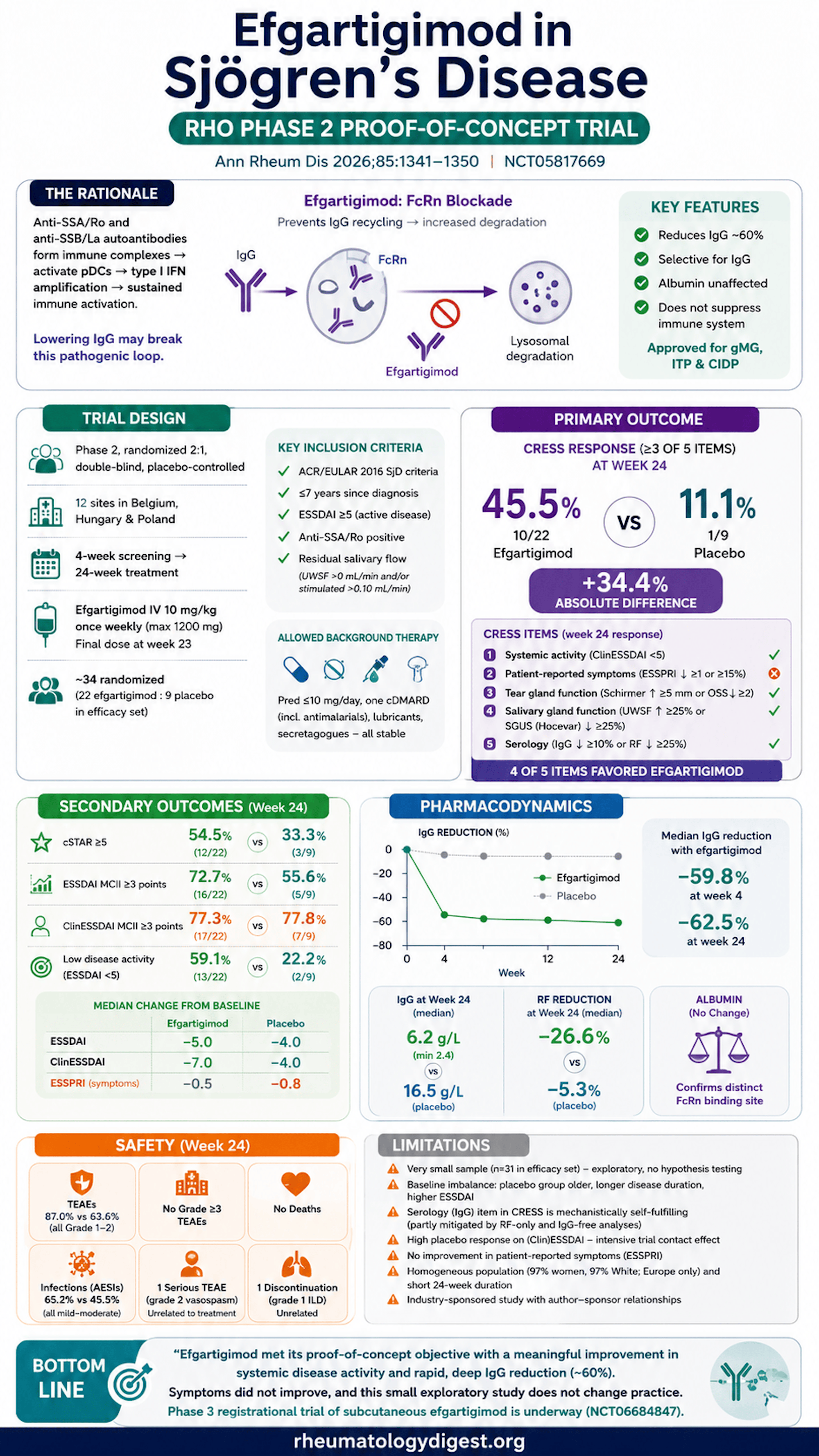
TL;DR: RHO is a small phase 2 proof-of-concept trial showing that the FcRn antagonist efgartigimod — which clears circulating IgG rather than depleting the B cells that make it — met its exploratory CRESS endpoint (45.5% vs 11.1% at week 24) with deep, selective IgG reduction; but systemic activity improved while patient-reported symptoms did not, and with only 31 patients and no hypothesis testing, this justifies phase 3, not practice change.
The Clinical Problem
Sjögren’s disease (SjD) still has no approved systemic disease-modifying therapy. DMARDs are used off-label for individual organ manifestations, but management remains largely symptomatic — an unmet need that has persisted despite decades of trials.
The pathogenic argument this trial tests. Anti-SSA/Ro and anti-SSB/La antibodies are IgG autoantibodies and a hallmark of SjD. The proposed loop runs: autoantibodies bind their RNA-binding autoantigens → immune complexes form → plasmacytoid dendritic cells are activated → type I interferon production is amplified → immune activation is sustained.
Several strands support these antibodies being pathogenic rather than merely diagnostic:
- They can precede clinical onset and are embedded in the classification criteria.
- Anti-SSA/Ro and anti-SSB/La associate with earlier onset, parotid enlargement, extraglandular disease, greater severity, B-cell hyperactivity, and possibly lymphoma risk.
- The clearest human proof of pathogenicity: transplacental transfer causing congenital heart block in neonatal lupus.
- Immunising mice with Ro60 induces an SjD-like phenotype.
- Only anti-SSA/Ro is in the ACR/EULAR 2016 criteria, since isolated anti-SSB/La positivity does not track with the SjD phenotype.
Why target FcRn rather than B cells. Long-lived plasma cells are resistant to B-cell-depleting therapy such as rituximab and can keep producing autoantibody regardless. Blocking IgG recycling sidesteps this entirely — it removes the antibody rather than the cell that makes it.
Efgartigimod is an engineered human IgG1 Fc fragment with enhanced affinity for the neonatal Fc receptor (FcRn). Normally FcRn rescues IgG from lysosomal degradation, extending its half-life. Efgartigimod outcompetes endogenous IgG for FcRn binding, so unbound IgG is degraded. Two features make this attractive:
- It reduces IgG selectively — without suppressing antibody production or the rest of the immune system.
- Because it binds FcRn at a site distinct from albumin, it does not lower albumin or raise LDL.
It is already approved for generalised myasthenia gravis, primary immune thrombocytopenia, and CIDP.
The Research Question
In adults with SjD and at least moderate systemic disease activity, does IV efgartigimod improve disease across a composite of clinically relevant domains versus placebo, and is it tolerated?
How the Study Was Designed
- Design: Phase 2, randomised (2:1), double-blind, placebo-controlled, multicentre — 12 sites across Belgium, Hungary, and Poland. 4-week screening, 24-week treatment, then optional 48-week open-label extension or 56-day follow-up.
- Regimen: Efgartigimod IV 10 mg/kg once weekly (max 1200 mg if ≥120 kg), ~1-hour infusion, at site or by home nursing; final dose at week 23.
- Key inclusion: ACR/EULAR 2016 criteria; ≤7 years since diagnosis; ESSDAI ≥5; anti-SSA/Ro positive; and residual salivary flow (UWSF >0 mL/min and/or stimulated flow >0.10 mL/min).
- Key exclusion: total IgG <4 g/L at screening; overlap with another autoimmune rheumatic disease.
- Stratification: by screening IgG (>16.0 vs ≤16 g/L). Post-baseline IgG results were withheld from sites to protect the blind — a necessary precaution given how conspicuous a 60% IgG drop would be.
- Background therapy: not required, but had to be stable; permitted were prednisone-equivalent ≤10 mg/day, one conventional DMARD (including antimalarials), lubricants, and secretagogues.
- Missing data: non-responder imputation.
Primary outcome — CRESS response (≥3 of 5 items) at week 24. CRESS is a composite built for SjD’s heterogeneity, and this is the first trial to use it as a primary endpoint:
- Systemic activity — ClinESSDAI <5
- Patient-reported symptoms — ESSPRI fall ≥1 point or ≥15%
- Tear gland function — Schirmer’s increase ≥5 mm or OSS decrease ≥2
- Salivary gland function — UWSF increase ≥25%, or SGUS (Hocevar) decrease ≥25%
- Serology — IgG reduction ≥10% or RF reduction ≥25%
Secondary: cSTAR ≥5; MCII (≥3-point improvement) in ESSDAI and ClinESSDAI; low disease activity (score <5); changes in ESSDAI/ClinESSDAI/ESSPRI; % change in IgG, anti-SSA/Ro, anti-SSB/La; anti-drug antibodies; safety.
Statistics — read this carefully: the trial enrolled ~30 patients and no formal statistical hypothesis was tested. All analyses were exploratory and descriptive. The sample size was chosen so that, assuming a 50% response rate, the lower bound of the one-sided 95% confidence limit would sit near 33% — set against historical CRESS placebo response rates of 24–32%.
The Results
Participants: 51 screened → 34 randomised (23 efgartigimod, 11 placebo). Three were excluded pre-unblinding for prohibited medication, leaving 31 in the efficacy set (22 vs 9). 27 completed.
Baseline: median age 49; 97% women, 97% White; median 4 years since diagnosis; median ESSPRI 6.3 and ESSDAI 12.5 — genuinely active disease. Commonest ESSDAI domains: articular, haematological, lymphadenopathy, biological. All anti-SSA/Ro positive; ~half anti-SSB/La positive; ~80% RF-positive. Note the baseline imbalance — the placebo group was older (58 vs 49), had longer disease duration (6 vs 3 years) and higher ESSDAI (17 vs 12).
Primary outcome — CRESS ≥3/5 at week 24: efgartigimod 45.5% (10/22) vs placebo 11.1% (1/9) — treatment difference 34.4 percentage points.
CRESS item-by-item:
| CRESS item | Efgartigimod | Placebo |
|---|---|---|
| Systemic activity (ClinESSDAI <5) | 59.1% | 33.3% |
| Serology | 86.4% | 11.1% |
| Salivary gland function | 36.4% | 22.2% |
| Tear gland function | 27.3% | 11.1% |
| Patient-reported symptoms (ESSPRI) | 31.8% | 33.3% |
Four of five items favoured efgartigimod. Patient-reported symptoms did not.
The obvious circularity — and how the investigators addressed it. Since the drug’s entire mechanism is IgG reduction, the serology item is close to a foregone conclusion. The authors therefore re-ran the analysis:
- CRESS without the IgG component: similar treatment benefit retained.
- Serological response by RF alone: 32.0% vs 0%. This matters — RF is not a direct pharmacodynamic readout, so a signal here suggests real biological effect rather than assay tautology.
Secondary outcomes:
- cSTAR ≥5: 54.5% (12/22) vs 33.3% (3/9).
- ESSDAI MCII ≥3 points: 72.7% vs 55.6% (similar direction at ≥4 and ≥5 thresholds).
- ClinESSDAI MCII ≥3 points: 77.3% vs 77.8% — no difference.
- Low disease activity: ESSDAI <5 in 59.1% vs 22.2%; ClinESSDAI <5 in 59.1% vs 33.3%.
- Median change from baseline: ESSDAI −5.0 vs −4.0; ClinESSDAI −7.0 vs −4.0; ESSPRI −0.5 vs −0.8 (numerically favouring placebo).
Pharmacodynamics:
- IgG fell rapidly, with maximal effect from week 4: median reduction 59.8% at week 4 and 62.5% at week 24. Placebo: +0.8%.
- Week 24 median IgG 6.2 g/L (minimum 2.4) vs 16.5 g/L on placebo.
- RF fell 26.6% vs 5.3% on placebo.
- Albumin was unchanged — confirming the distinct binding-site mechanism.
Safety:
- TEAEs: 87.0% vs 63.6% — but all grade 1 or 2. No grade ≥3 events, no deaths.
- One serious TEAE (grade 2 vasospasm requiring hospitalisation), judged unrelated; treatment resumed after 3 weeks without recurrence.
- Infections were AESIs given the IgG reduction: 65.2% vs 45.5%, all non-serious and mild-to-moderate. The authors note placebo patients spent less time on study (most discontinuations by week 3), which likely inflates the apparent difference.
- Common TEAEs: headache, nasopharyngitis, URTI, UTI (both groups); influenza only with efgartigimod. One discontinuation for grade 1 interstitial lung disease (deemed unrelated).
Study Limitations
- Very small and underpowered — 22 vs 9 in the efficacy set. The authors state plainly that this is insufficient to estimate CRESS, STAR, or ClinESSDAI with reasonable precision. All differences are numerical, not statistically tested.
- Baseline imbalance — placebo patients were older, with longer disease duration and higher ESSDAI; with N=9, a single patient’s trajectory shifts the whole arm.
- Serology item is mechanistically self-fulfilling — partly mitigated by the IgG-free and RF-only re-analyses, but the primary result is still inflated by it.
- High placebo response on (Clin)ESSDAI — plausibly driven by weekly infusions and intensive trial contact. ClinESSDAI MCII was identical between arms.
- No effect on patient-reported symptoms — the outcome patients care about most.
- Homogeneous population — 97% White, 97% women, three European countries; short 24-week horizon with no durability data.
- Industry-sponsored, with several author employment relationships and sponsor-funded medical writing.
How This Study Adds to Practice
- It is a proof of concept, not a practice-changing result — but a meaningful one, because it offers human pharmacologic evidence that IgG autoantibodies are pathogenic in SjD, not merely diagnostic markers. Lower the IgG, and systemic disease activity moves.
- It converges with DAHLIAS (nipocalimab, also anti-FcRn), giving two independent trials pointing the same way and strengthening the FcRn class hypothesis in SjD.
- It offers a mechanistically distinct route to B-cell-adjacent disease control: rather than depleting B cells — which leaves rituximab-resistant long-lived plasma cells intact — it removes the product. Conceptually this sits alongside, not within, the depletion-depth story running through the newer B-cell agents.
- It is the first trial to use CRESS as a primary endpoint, itself a methodological contribution to a field long hampered by insensitive endpoints.
- A phase 3 registrational trial of subcutaneous efgartigimod is already under way (NCT06684847).
Final Take-Aways
- Efgartigimod met its proof-of-concept objective: CRESS response 45.5% vs 11.1% at week 24, with 4 of 5 items favouring active treatment.
- IgG fell fast and deep — ~60% by week 4, sustained to week 24 — with no effect on albumin, consistent with the distinct FcRn binding site.
- The serology item inflates the headline number, but the effect survived removal of IgG from the composite, and RF fell 26.6% vs 5.3% — a signal independent of the drug’s direct pharmacodynamic readout.
- Systemic activity improved; symptoms did not. ESSPRI was flat, and ClinESSDAI MCII was identical between arms. The disconnect between objective glandular measures and patient-reported symptoms is the central unresolved tension — the authors suggest glandular recovery and symptom relief may simply need longer, and that better patient-reported instruments are needed.
- Well tolerated: all TEAEs grade 1–2, no grade ≥3 events, no deaths. Infections were commoner (65% vs 46%) and warrant monitoring given the mechanism, but all were mild-to-moderate.
- Interpret with real caution: N=31, no hypothesis testing, notable baseline imbalances, industry-sponsored. This justifies phase 3 — it does not justify practice change.
- Conceptually, it targets what B-cell depletion misses — long-lived plasma cells resistant to rituximab keep making autoantibody; blocking FcRn clears the antibody regardless of its source.