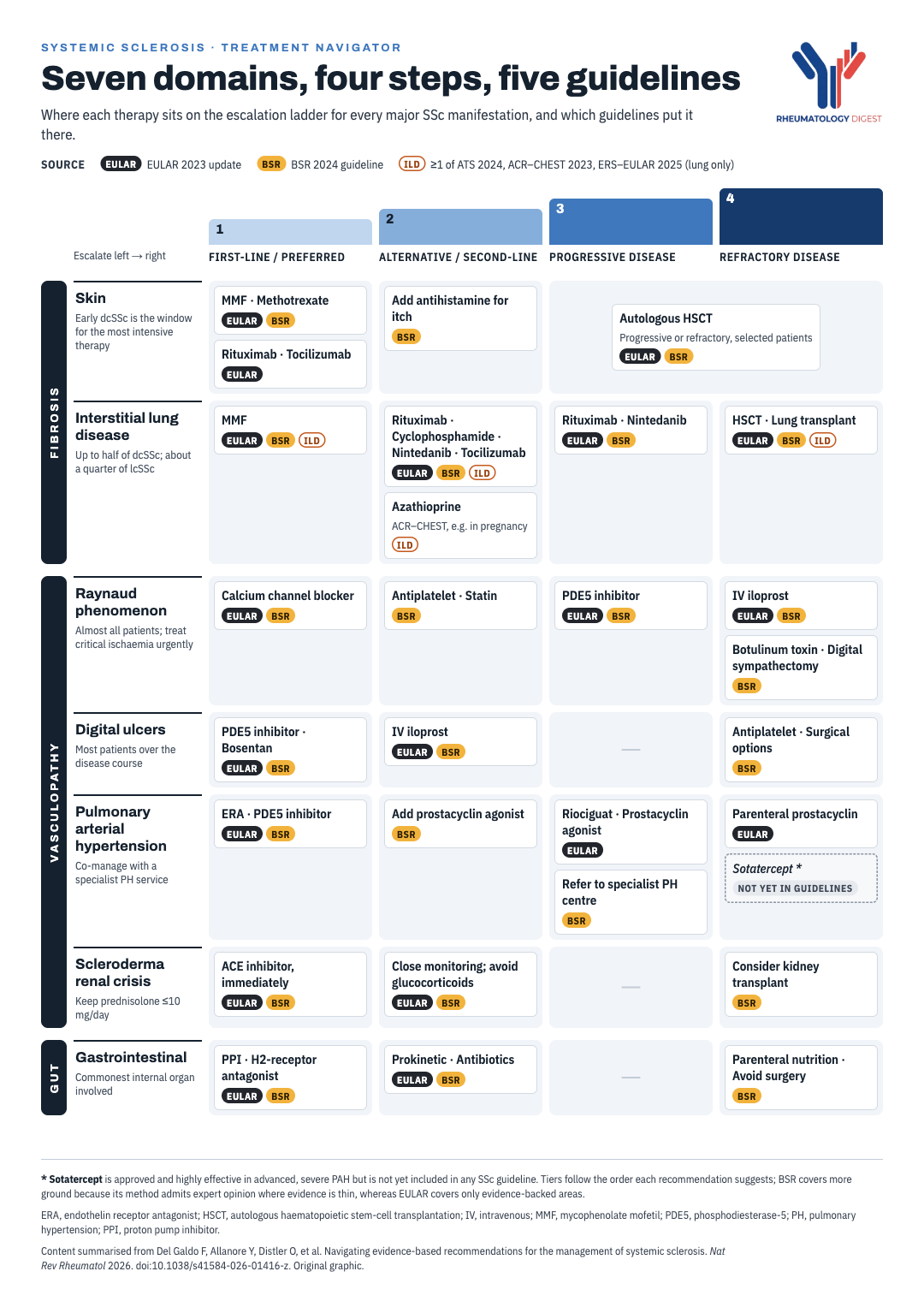
TL;DR: The five recent SSc guidelines agree on the essentials — mycophenolate as the backbone, nintedanib and tocilizumab as additions, glucocorticoids avoided — and differ mainly in how they rank options, how they treat azathioprine and transplant, and how much of the disease they cover.
Systemic sclerosis is no longer regarded as untreatable, and the evidence base has grown fast enough that the guidance now comes from several directions at once. A clinician can reasonably be holding a EULAR recommendation, a British guideline and a North American lung guideline that are not worded alike. This review compares them, asks where they truly differ and where they only seem to, and notes what none of them covers.
Five documents, five scopes
Five sets of guidance have been published in about three years, and they are not interchangeable.
- EULAR updated its SSc recommendations (the third iteration, after 2009 and 2016). The scope is pharmacological treatment in adults, and the task force agreed 22 recommendations across eight clinical domains, most concerning skin fibrosis and ILD.
- BSR published a 2024 guideline updating its earlier treatment recommendations. The scope is much wider: overall disease management, organ-based complications, health service organisation, and the broader impact of the disease, with relevance to children and young people with juvenile-onset disease and to NHS service planning and audit. The working group agreed 89 recommendations from 20 PICO questions.
- ATS produced an SSc-ILD guideline, from a 24-member international committee that addressed eight questions and made eight recommendations.
- ACR–CHEST covers ILD across systemic autoimmune rheumatic diseases, generating 35 recommendations from 216 PICO questions, including two strong recommendations, on screening, monitoring, first-line treatment, progression and rapidly progressive disease.
- ERS–EULAR covers ILD across connective tissue diseases (RA, myositis, Sjögren’s, SLE, MCTD and SSc), with recommendations from 25 PICO and 28 narrative questions.
For the review’s purposes, only the content relevant to SSc is compared in the two multi-disease ILD guidelines. The practical consequence of the scope differences is that “the guidelines say nothing about X” often means only that X was outside that document’s remit.
Why the same evidence produces different wording
All of these documents reviewed essentially the same body of trial evidence, so the differences in output come from method rather than from different facts.
The two SSc-wide documents use the 2011 Oxford evidence grading. The EULAR approach is strictly evidence-dependent, so areas without strong, high-quality evidence go uncovered. The BSR protocol is more flexible, permitting expert opinion where the evidence is thin, which is why it can offer guidance on fatigue and calcinosis, for example, but its recommendations rest on weaker evidence in places. The review sees strengths in both: EULAR for rigour, BSR for comprehensiveness. The ILD guidelines describe their evidence assessment in GRADE terms.
Other factors the authors list as shaping the strength of a recommendation are how conflicts of interest were managed, how much patient values and preferences counted, geographic variation in risk tolerance, and the breadth of the sponsoring organisation (the respiratory societies cover many ILDs for which several effective treatments exist). They also stress that guidelines are regional in scope, reflecting North America and Europe, and that when the evidence is of low certainty, recommendations become more sensitive to values, cost, feasibility and equity.
Overall management and skin disease
Both EULAR and BSR treat diagnosis as the first consideration, including early diagnosis and the very early diagnosis of SSc (VEDOSS) concept. Both single out early diffuse cutaneous SSc as needing particular focus, because it carries early, substantial organ involvement (scleroderma renal crisis, progressive lung disease, cardiac involvement) and is the window for the most intensive treatment, including autologous haematopoietic stem cell transplantation.
For skin fibrosis in early disease, the two agree that mycophenolate mofetil and methotrexate can be considered first-line. EULAR adds broader recommendations for tocilizumab and rituximab on the strength of published evidence. Both guidelines also emphasise systematic or protocolised investigation at baseline and during follow-up, which the review counts as an important advance. BSR additionally addresses service delivery: what centres treating SSc should offer, and what could feed future audits.
Interstitial lung disease: broad agreement, specific differences
Lung complications are the most frequent cause of SSc mortality. Clinically relevant ILD occurs in up to half of patients with diffuse cutaneous SSc and about a quarter of those with limited cutaneous disease. Because this is where the trial evidence is, it is also where the documents align best, and where the review’s overall verdict is that the conclusions are “largely congruent”.
What all the guidelines recommend. Mycophenolate, rituximab, cyclophosphamide and tocilizumab are recommended across the documents for SSc-ILD, based on published evidence. Nintedanib, with regulatory approval in most countries and support from large randomised trials, is recommended in every output and can be used in combination with mycophenolate.
Mycophenolate. BSR recommends it as first-line therapy. EULAR says it should be considered. ATS recommends it, and suggests a combination of nintedanib with mycophenolate. ACR–CHEST conditionally recommends it for first-line treatment and for progression if it was not first-line. ERS–EULAR suggests it with a conditional recommendation and very low certainty of evidence.
Nintedanib. BSR recommends it as an addition for progressive pulmonary fibrosis despite immunosuppression, as first-line alongside mycophenolate for extensive disease, and as monotherapy if mycophenolate is not tolerated or appropriate. ERS–EULAR gives a conditional recommendation (moderate certainty) for nintedanib and a conditional recommendation (low certainty) for combining it with mycophenolate. ACR–CHEST conditionally recommends it as first-line “in some situations” and for progression.
Tocilizumab. ERS–EULAR gives it a strong recommendation (moderate certainty) for SSc-ILD with early dcSSc and increased inflammatory markers or evident progression of skin fibrosis. BSR recommends it for severe or progressive SSc-ILD despite mycophenolate, and for early dcSSc with anti-topoisomerase positivity and inflammatory markers. ACR–CHEST conditionally recommends it. The review points to this as an example of the same evidence being graded differently: moderate evidence in ERS–EULAR, but only low-certainty evidence in ACR–CHEST.
Rituximab and cyclophosphamide. BSR positions rituximab as an additional treatment for severe or progressive disease despite mycophenolate and says it can be used first-line; it says cyclophosphamide can be used first-line. ACR–CHEST conditionally recommends both. ERS–EULAR suggests rituximab (very low certainty) and cyclophosphamide (low certainty), and ATS suggests rituximab without specifically mentioning cyclophosphamide.
Where they genuinely differ
- Azathioprine. ACR–CHEST conditionally recommended it as an additional first-line option, reflecting very low-certainty evidence combined with expert panel experience; the review notes the paucity of published evidence of benefit, though expert opinion supports it. BSR mentions it only as a potentially safe immunosuppressant in pregnancy. The others do not mention it for SSc-ILD.
- Glucocorticoids. EULAR recommends against prednisolone use. ACR–CHEST strongly recommends against glucocorticoids as first-line ILD treatment and recommends against long-term glucocorticoids for progression. BSR makes no recommendation for SSc-ILD.
- Transplantation. EULAR recommends stem-cell transplantation for severe or refractory skin or lung fibrosis, and lung transplantation in certain instances. BSR recommends stem-cell transplantation for those with a poor prognosis who meet suitability criteria, and lung transplantation in certain instances of severe ILD. ACR–CHEST conditionally recommends optimal medical management over referral as first-line treatment, but conditionally recommends referral for stem-cell or lung transplantation when ILD progresses despite first-line therapy. ERS–EULAR did not assess either as a predefined question.
- How treatments are ranked. ACR–CHEST designates first-line and second-line treatments. ERS–EULAR takes a clinical-phenotype rather than a hierarchical approach. The review notes this is a real conceptual difference, not a wording difference.
Other complications
The EULAR and BSR documents cover the wider disease and largely agree. The BSR framework is broader, reflecting its flexible protocol.
Gastrointestinal disease. This is the commonest internal organ manifestation and has few effective treatments, a limitation shared by both documents because high-quality SSc-specific evidence is scarce. Evidence is therefore borrowed from routine gastroenterology: management of upper tract disease with proton pump inhibitors and prokinetics. BSR gives the more comprehensive framework, covering the tract from mouth to anus, including motility, nutrition, anorectal disease and incontinence. The review identifies this as an area of unmet need for both organisations.
Raynaud phenomenon. Almost all patients have it. Both documents support calcium channel blockers as first-line and PDE5 inhibitors, with prostacyclin analogues such as iloprost for severe disease refractory to oral therapy. BSR additionally covers antiplatelet therapy and statins (not in EULAR because of limited evidence) and surgical interventions including digital sympathectomy and botulinum toxin injection. The review notes the BSR recommendations here are conditional, since the evidence is of very low quality, and that BSR specifically highlights management of critical digital ischaemia.
Digital ulcers. Most patients develop them over the disease course and they have a major effect on hand function and quality of life. Both documents highlight PDE5 inhibitors, iloprost and bosentan, which is approved for reducing new ulcer formation. Antiplatelet and surgical recommendations mirror those for Raynaud. Comprehensive recommendations on pharmacological and local management of digital ulcers were published in 2025 by the World Scleroderma Foundation and will inform future practice.
Scleroderma renal crisis. Outcomes have improved markedly, which the review attributes to routine early treatment, awareness and risk stratification, and avoidance of high-dose glucocorticoids in those at risk. The two documents are very similar. EULAR makes a strong recommendation for ACE inhibitors at diagnosis and for close monitoring in patients on glucocorticoids, and both agree that daily glucocorticoid doses should not exceed 10 mg prednisolone or equivalent. BSR adds that other antihypertensives are often needed, advises avoiding haemodynamically challenging approaches (favouring haemofiltration or peritoneal dialysis over intermittent haemodialysis in the initial period), recommends renal biopsy only when the diagnosis is uncertain or substantial recovery does not occur, and advises urgent referral for transplantation.
Pulmonary hypertension. It is a major vascular complication. Most SSc-PH is group 1 pulmonary arterial hypertension, but about a third arises from associated ILD (group 3) or cardiac disease (group 2), which need different approaches. Management usually happens under a specialist PH service, so the EULAR and BSR documents largely follow the recommendations of other specialist organisations and the review does not detail it. The review does highlight one gap: sotatercept, an approved drug shown to be very effective in advanced, severe PAH, is in none of the published guidance, the EULAR and BSR documents included.
What none of them has solved
The authors list unmet needs that both EULAR and BSR identify for future recommendations:
- Calcinosis, a high priority for patients, where pathogenesis, assessment and treatment are poorly understood; the BSR calcinosis section is unmodified from the 2016 guideline
- Fatigue, with studies of exercise and other non-pharmacological interventions under way
- Gastrointestinal burden, with poorly understood pathogenesis and generally refractory disease
- Dental problems, a multi-level challenge combining sicca, connective tissue changes and reduced mouth opening
- Reproductive health and sexuality, previously under-appreciated, where better approaches now exist but remain a challenge
- Prevention of progression, which needs a clear definition of disease modification and evidence of unequivocal prevention or slowing of organ complications
Non-pharmacological approaches are a particular opening, including for fatigue, itching and the psychological and social impact of SSc, reflected in the 2024 EULAR recommendations on non-pharmacological management of SSc and SLE.
Some evidence has also emerged since the guidelines were written. Reviews of autologous stem-cell transplantation and analyses highlighting the benefit of early mycophenolate in dcSSc reinforce key recommendations. Trials of cellular therapies, biologics and small molecules are ongoing, and the authors expect translational work to support more stratified, precision approaches. They add a note of caution on artificial intelligence: large language models producing consensus guidance would need high-quality source data to learn from.
What this says about using guidelines
The review’s conclusion is that implementation, not content, is now the main difficulty. Guidance is regional, health systems differ, access to approved therapies varies, and many recommended drugs are used outside their approved indication on the basis of expert opinion and trial evidence. Where recommendations are congruent across guidelines, they cover the major SSc features and include all the drugs with regulatory approval in at least one region. Substantial progress is still needed in disease-modifying strategies, in limiting the risks of high-risk interventions such as autologous stem-cell transplantation and emerging cellular therapies, and in ensuring appropriate use of both targeted and generic drugs.
A few practical points follow from the comparison:
- When two guidelines seem to disagree, check what each was asked. A topic missing from EULAR may be covered by BSR purely because of scope.
- Different certainty ratings for the same drug do not mean different evidence. Tocilizumab is the clearest example.
- Azathioprine is the place where expert opinion, not trial data, is carrying the recommendation.
- The documents cannot tell you about the newest agents. Sotatercept is the stated example.
A reader should also know the review is written from inside the field. The reference list shows that the first and last authors led the EULAR and BSR documents compared, and several authors report consulting, research and speaking relationships with many pharmaceutical companies, listed in full in the paper. That does not weaken the comparison, but it means this is an insiders’ synthesis, not an independent audit.
Disclosures noted in the source: the authors report consulting, advisory, research and speaker relationships with multiple pharmaceutical companies, listed in the paper; one reports holding a patent on an SSc treatment and co-founding a company.