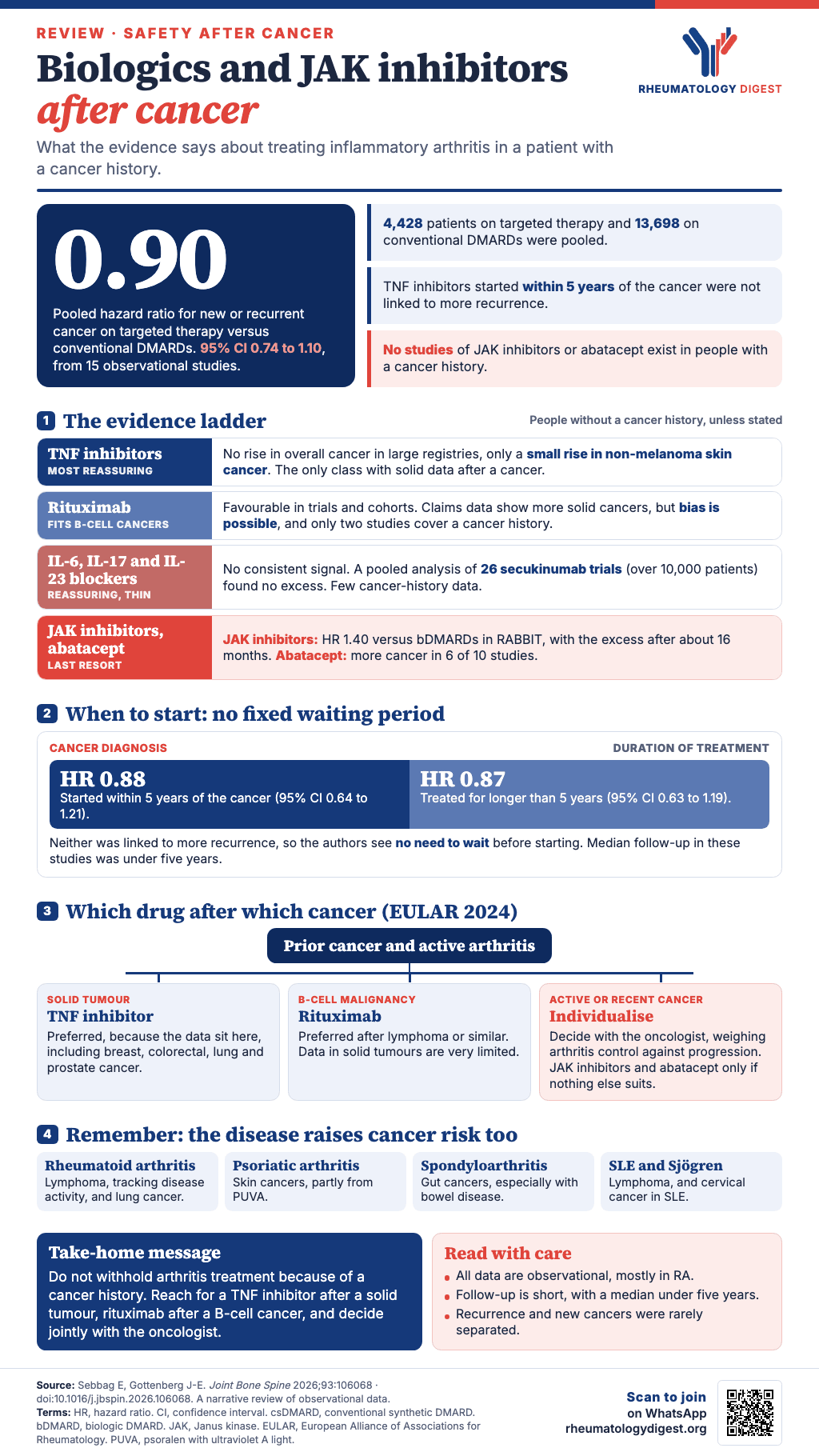
TL;DR: In inflammatory arthritis after cancer, observational data show no increase in new or recurrent cancer with targeted therapy compared with conventional DMARDs (pooled HR 0.90), including when a TNF inhibitor is started within five years of the cancer, so the 2024 EULAR Points to Consider prefer TNF inhibitors after a solid tumour and rituximab after a B-cell malignancy, and reserve JAK inhibitors and abatacept for when nothing else is suitable, on evidence that is almost all observational, mostly in RA and with short follow-up.
Biologic and targeted synthetic DMARDs (together “targeted therapies”, TTs) have changed the long-term outcome of inflammatory arthritis (IA). Their use after a cancer is an everyday worry, because immunity plays a part in tumour surveillance and because people with a cancer history are routinely excluded from randomised trials. Cancer survival is improving and the population is ageing, so more patients now have both a past malignancy and active arthritis. This review by Eden Sebbag and Jacques-Eric Gottenberg (Strasbourg) summarises recent data and the 2024 EULAR Points to Consider (PTC) on the topic. It is a narrative review, and the authors acknowledge there are no randomised trials in this population.
Inflammation and cancer are linked
Chronic inflammation is now regarded as a hallmark of cancer, and IA is a prototypical chronic inflammatory state. The review lists several mechanisms:
- Cell damage and immune escape. Reactive oxygen species damage DNA, inflammation promotes angiogenesis, and it helps tumours evade immune surveillance.
- Cytokines. TNF-α, IL-1β and IL-6 are high in IA and act through NF-κB and STAT3 to promote proliferation and block apoptosis. TNF has a dual role: it can kill tumour cells in some settings, while chronic exposure promotes angiogenesis, tissue remodelling and metastasis. IL-6 drives the JAK/STAT3 pathway, and high IL-6 is linked to poor prognosis in myeloma, breast and lung cancer.
- Local immunity. Regulatory T cells and tumour-associated macrophages, expanded in chronic inflammation, dampen anti-tumour responses. Tertiary lymphoid structures, seen in both autoimmune tissue and some tumours, have variable effects depending on their composition.
- Animal and trial evidence. Sustained inflammation can initiate tumours in mouse models, such as colitis-associated cancer. In the CANTOS cardiovascular trial, the IL-1β inhibitor canakinumab lowered lung cancer incidence and mortality, supporting a causal role for inflammation.
The authors conclude that controlling the disease is both a quality-of-life goal and a cancer-prevention strategy.
The disease carries its own cancer risk
- Rheumatoid arthritis. Lymphoma risk correlates with disease activity. Seropositive RA is a risk factor for lung cancer beyond smoking, and RA is also linked to cervical and bladder cancers. Part of the excess in smoking-related cancers reflects tobacco being a risk factor for both RA and cancer.
- Spondyloarthritis. Data are more limited, but gastrointestinal cancer risk may be raised, especially with inflammatory bowel disease, driven by persistent local inflammation.
- Psoriatic arthritis. Skin cancer risk is raised, related partly to psoriasis severity and partly to earlier treatments, notably PUVA, which causes precancerous lesions and squamous cell carcinoma.
- Connective tissue diseases. SLE is linked to lymphoma and cervical cancer. Dermatomyositis and the anti-synthetase syndrome are linked to lung, gynaecological and gastrointestinal cancers. In Sjögren’s disease, innate and adaptive immune activation can produce a clonal lymphocyte population that may progress to lymphoma, making it a prototype of the autoimmunity–cancer link.
Targeted therapies in patients without a cancer history
Large cohorts and registries show that overall cancer risk with bDMARDs does not seem significantly higher than with csDMARDs or the general population. Concerns centre on non-melanoma skin cancer (NMSC), especially with long exposure and in older adults.
| Drug class | What the review reports |
|---|---|
| TNF inhibitors (most studied) | No increase in overall cancer in large registries, but a small rise in NMSC, mainly squamous cell carcinoma |
| Rituximab | Favourable in large observational cohorts and trials. Some claims-data studies report more solid cancers than in the general population or than with anti-TNF, but claims data carry bias, and B-cell depletion may in theory affect immunosurveillance |
| Abatacept (anti-CTLA-4) | Mixed. Six of ten observational studies found more cancer than with other targeted therapies or the general population, with a small but significant rise in several cancer types. Two found no difference from other bDMARDs or methotrexate. Channelling bias is possible |
| JAK inhibitors | ORAL Surveillance reported more malignancy, including lung cancer and lymphoma, with tofacitinib than with TNF inhibitors in high-risk patients (age 50 or over with cardiovascular risk factors), which led to regulatory warnings. The RABBIT registry (2,285 JAK inhibitor and 4,259 bDMARD treatment episodes) found an adjusted HR of 1.40 (95% CI 1.09–1.80) for JAK inhibitors versus bDMARDs, with the excess seen in episodes lasting over 16 months (in ORAL Surveillance the rise appeared after about 18 months of tofacitinib). Age and smoking matter before starting |
| IL-6 inhibitors (tocilizumab, sarilumab) | No consistent signal in real-world studies. Danish registry data showed no increase compared with TNF inhibitors |
| IL-17 and IL-23 pathway inhibitors (secukinumab, ixekizumab, ustekinumab) | No consistent signal. A pooled analysis of 26 trials with more than 10,000 patients on secukinumab found no excess malignancy compared with expected rates |
Data for newer agents are limited and long-term monitoring is needed.
After a cancer: what the studies show
Systematic review. The authors’ own review (Sebbag et al.) pooled 15 observational studies: 4,428 patients on targeted therapy (over 15,000 patient-years) and 13,698 on csDMARDs (over 41,000 patient-years). The pooled hazard ratio for new or recurrent malignancy was 0.90 (95% CI 0.74–1.10), so no increase in recurrence.
TNF inhibitors are the best-studied agent, mostly in RA. They were not different from csDMARDs in any subgroup:
- By cancer type. Subgroups with breast, head and neck, and NMSC history showed no excess recurrence. For breast cancer, Raaschou and colleagues found a recurrence HR of 1.1 (95% CI 0.4–2.8).
- By timing. Starting a TNF inhibitor within five years of the cancer diagnosis was not associated with more recurrence (HR 0.88, 95% CI 0.64–1.21), nor was treatment lasting beyond five years (HR 0.87, 95% CI 0.63–1.19). The authors read this as countering the idea that a minimum waiting period is needed before starting.
- Consistency. Registries from the United States, UK, Finland, Sweden and Germany agree.
Other agents have little or no data.
- Rituximab was assessed in only two studies. A pooled HR for recurrence of 0.44 (95% CI 0.11–1.82) was reported, but the sample is small and the interval wide.
- IL-12/23 and IL-17 inhibitors: few studies.
- JAK inhibitors and abatacept: no data in people with a documented cancer history.
More recent real-world data.
- DANBIO (Denmark). Among 720 patients with RA and a solid cancer in remission, the HR for recurrence was 0.92 (95% CI 0.38–1.73) for any bDMARD, 1.10 (0.21–3.16) for TNF inhibitors and 0.94 (0.32–2.11) for rituximab, all non-significant against csDMARDs. The review gives 170 bDMARD initiators (81 TNF inhibitor and 99 rituximab) and 651 csDMARD initiators, and these subgroup counts do not add up (81 plus 99 is 180), so they should be treated as approximate.
- SEER-Medicare (US). Among 1,981 patients with RA and localised solid cancer (colorectal 514, lung 864, prostate 603), TNF inhibitor use in the first year after diagnosis was not associated with poorer overall or cancer-specific survival. Overall survival HRs against csDMARDs were 0.72 (0.43–1.21) for colorectal, 0.70 (0.49–1.00) for lung and 0.80 (0.44–1.44) for prostate cancer.
- Early breast cancer (US). Among 366 patients who received a TNF inhibitor in the first year, overall survival did not differ from csDMARD use at one year (HR 0.77, 0.42–1.40 and 0.84, 0.54–1.31 in two databases), with similar results at two years.
Limitations the authors stress.
- All studies are observational, with selection bias and confounding by indication.
- Cancer type, stage and cancer treatment details were often missing, and most studies did not separate new primary cancers from recurrences.
- Follow-up ran from under a year to nearly nine years, but the median stayed under five years, so long-term safety is unproven.
- Most data are from RA with solid tumours. Other targeted therapies, other inflammatory diseases (PsA, axial spondyloarthritis) and haematological malignancy need study.
The 2024 EULAR Points to Consider
A multidisciplinary task force of patient representatives, rheumatologists, oncologists and epidemiologists produced five overarching principles and eight Points to Consider. The central premise is that evidence on recurrence is limited and observational, but for many patients, especially those in remission, targeted therapies and notably anti-TNF do not substantially raise the risk of recurrence. The PTC are a framework for patient-centred decisions, not prescriptive guidelines.
- Individualise. Weigh the prior cancer (type, stage, histopathology), patient factors (smoking, comorbidity) and the activity and severity of the arthritis. Use shared decision-making, with rheumatologists, oncologists and primary care working together.
- Do not delay treatment because of a cancer history. Active arthritis treatment is itself linked to oncogenesis, particularly in RA with high disease activity and lymphoma, and the task force found no compelling evidence for waiting beyond a minimal period after remission.
- Choose by cancer type. Prefer a TNF inhibitor after a solid cancer, because that is where the data are, and rituximab after a B-cell malignancy.
- Use JAK inhibitors and abatacept with caution, only when other options are unsuitable, because of the lack of data and the signals seen elsewhere.
- Active or recently treated cancer. Decide case by case, weighing arthritis control against the risk of progression.
- Follow up. Monitor regularly and keep to national cancer screening programmes.
The authors add mechanistic reasoning that supports these choices, while noting it is speculative in places. TNF-α is both pro- and anti-tumoral depending on context. IL-6 inhibition might theoretically separate inflammation from tumour progression, and has been explored for immune-related adverse events during checkpoint-inhibitor cancer therapy. Abatacept targets CTLA-4, so it could in theory antagonise checkpoint function and compromise anti-tumour immunity. Rituximab depletes B cells, and B cells organised in tertiary lymphoid structures track with better prognosis in solid tumours, while melanoma data suggest B-cell depletion reduces tumour inflammation and T-cell infiltration, so preserving tumour B cells may matter for checkpoint-inhibitor efficacy. Because the data for solid cancers concern TNF inhibitors rather than rituximab, anti-TNF is preferred there.
What comes next
The research agenda is to widen guidance to targeted therapies other than anti-TNF, to all cancer types including melanoma, and to diseases beyond rheumatoid arthritis, with long-term prospective studies, longer follow-up, inclusion of PsA and axial spondyloarthritis, and personalised cancer-risk tools. Both authors disclose honoraria or consulting fees from pharmaceutical companies that make rheumatology drugs, and the article is open access under a CC BY licence.
What it adds up to
The review’s message is reassuring for TNF inhibitors, including soon after a cancer, and cautious for everything else. Rituximab fits B-cell malignancy and has limited data in solid tumours. JAK inhibitors and abatacept have signals in people without cancer and no data in people with it, so they are a last resort. The arthritis itself raises cancer risk, so leaving it untreated is not a neutral choice. All of this rests on observational evidence of short duration, which is why the EULAR points call for joint decisions with the oncologist.