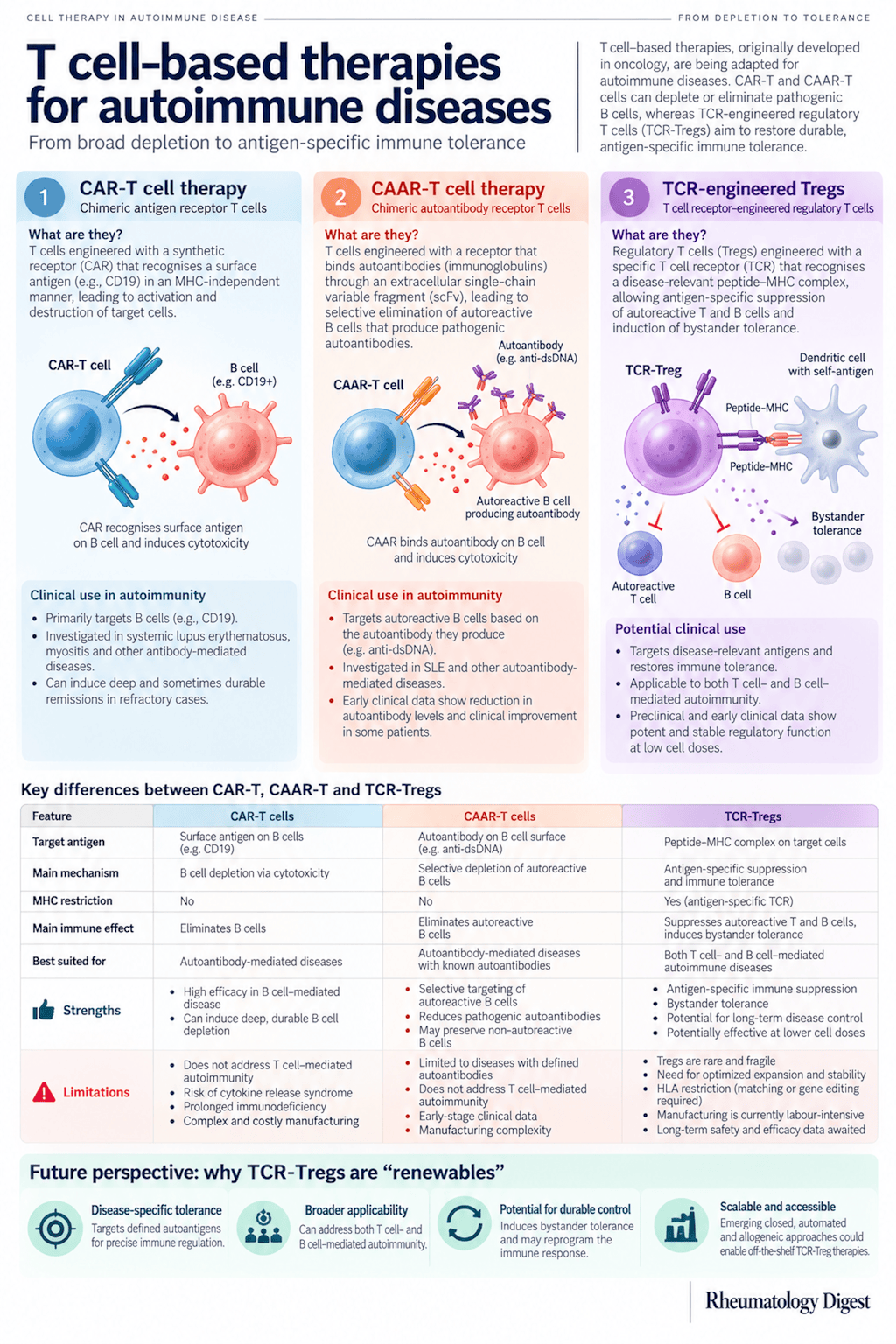
TL;DR: CAR-T cells delete B cells but do not restore tolerance in T cell-driven autoimmunity; antigen-specific regulatory T cells (TCR-Tregs) aim to, but they are preclinical, and making them is the barrier — the proposed answer is a banked, gene-edited stem-cell source.
CD19-directed CAR-T therapy has shown that a deep reset of the B cell compartment can produce drug-free remission in lupus. It has also made the limits of that approach clearer: it removes protective humoral immunity along with the pathogenic kind, and it does nothing directly about autoreactive T cells. This review, from Monash University, makes the case for a different class of cell therapy and spends as much time on how to make it as on what it does. It is a perspective on a field at an early stage, and its most specific proposal is, by the authors’ own description, hypothetical.
Why the existing options leave a gap
Conventional and targeted DMARDs control autoimmune disease through broad, chronic immunosuppression, and a subset of patients still has refractory disease or recurrent relapse. Rheumatoid arthritis often fails to reach sustained drug-free remission, lupus is characterised by flares and steroid dependence, and treatments for multiple sclerosis may not prevent long-term progression. Autologous haematopoietic stem cell transplantation can produce durable remission in severe systemic sclerosis by resetting and re-diversifying the immune repertoire, but it carries risks of severe cytopenia, sepsis, infertility and treatment-related mortality.
Regulatory T cells (Tregs) are central to self-tolerance, acting through IL-2 consumption, IL-10 and TGF-β, CTLA-4-mediated modulation of antigen-presenting cells, and metabolic disruption of effector T cells. Defects in Treg development or function, as in FOXP3 mutations, contribute to autoimmune disease. Attempts to enhance Tregs in vivo, such as low-dose IL-2 or IL-2/TGF-β agonists, have shown variable and often modest benefit and lack antigen specificity. That has pushed attention toward cell-based strategies that supply or replace Tregs directly.
What non-engineered cell therapies have shown
More than 120 clinical trials have tested non-engineered cell therapies in autoimmune disease, most of them using mesenchymal stem cells (MSCs). The review treats these as proof of principle and a source of logistical lessons.
Mesenchymal stem cells. They are immunomodulatory and low in immunogenicity, and about 61% of MSC trials use allogeneic cells, which are “off-the-shelf”. In a 6-year observational study of refractory SLE treated with umbilical cord MSCs, about 60–70% achieved remission or substantial reduction in disease activity with no treatment-related serious adverse events, though not all patients stayed in remission. In RA, roughly half of treated patients showed improvement across completed trials, but most intravenously infused MSCs are trapped in the lungs and cleared, with under 1% persisting beyond one week, so few cells reach the joints. A 2023 RA meta-analysis found only a trend toward clinical efficacy, and a 2025 meta-analysis of randomised trials confirmed good safety but only moderate, sometimes non-significant, improvement against controls. The consensus the review describes is that MSCs are safe and mechanistically interesting but have not demonstrated consistent or curative efficacy.
Polyclonal Tregs and in vivo induction. Ex vivo expanded polyclonal Tregs are usually autologous, isolated from peripheral blood and reinfused intravenously. In a phase 1 trial in type 1 diabetes, C-peptide was maintained in some patients but disease progression was not clearly halted. Low-dose IL-2 reproducibly raises Treg numbers with a favourable safety profile, but clinical responses were modest and not uniformly durable. In the TILT trial, combining Tregs with low-dose IL-2 improved Treg expansion and survival, with infused cells detectable for up to a year, but C-peptide still declined in most participants, with only 2 of 9 stabilising or improving slightly. These studies show Treg therapy is safe and feasible but that global, non-specific Treg expansion yields only modest disease modification.
Tolerogenic dendritic cells (tolDCs). These are the only non-engineered antigen-specific cell therapy in clinical trials: monocyte-derived DCs “tolerised” ex vivo and loaded with disease-relevant autoantigens. Trials in multiple sclerosis, type 1 diabetes, RA and Crohn’s disease have tested doses of 10⁶ to 10⁷ cells. The results are signals rather than efficacy: stimulated C-peptide was detectable in some type 1 diabetes patients, DAS28 fell modestly in an RA study that was not powered for efficacy, and in Crohn’s 3 of 9 evaluable patients achieved a clinical response at week 12. The review concludes that tolDCs show antigen-specific tolerance is clinically feasible, but their size and design do not allow conclusions on efficacy. Their manufacture is also constrained, because monocytes do not proliferate, so the yield depends on how many can be collected from a patient.
What engineered cell therapies add, and where they stop
CD19 CAR-T and CAR-NK. CD19-directed cells deplete B cells broadly. The review cites the phase 1/2a CASTLE study, in which a single infusion in 24 patients (10 SLE, 9 systemic sclerosis, 5 inflammatory myopathy) met the predefined 6-month efficacy endpoint in 22 (87.5%): 9 of 10 SLE patients reached DORIS remission, all nine systemic sclerosis patients had no progression, and 4 of 5 myositis patients had major or moderate ACR responses. Across early cohorts, most lupus patients achieved drug-free remission with deep but reversible B cell depletion and repopulation by naïve B cells. An allogeneic CD19 CAR-T in refractory SLE was safe, with deep B cell depletion lasting through 12 months of monitoring. Allogeneic CAR-NK products (such as NKX019) are earlier but are attractive because NK cells need not be HLA-matched and do not cause graft-versus-host disease.
The authors’ point about limits is the hinge of the review. Because CD19 is on most B cells, these therapies remove protective humoral immunity as well as the pathogenic arm, with risks of prolonged B cell aplasia, hypogammaglobulinaemia, impaired vaccine and infection responses, and a need for immunoglobulin replacement. They also do not directly address autoreactive T cells or restore tolerance, which remain drivers of many autoimmune diseases.
CAAR-T and CAAR-NK. These carry the autoantigen as the extracellular domain, so they kill only the B cell clones that bind it. Examples are desmoglein-3 CAAR-T cells in pemphigus vulgaris and an anti-La/SSB CAAR-NK concept for Sjögren’s. This is more selective than CD19 depletion, but it remains limited to antibody-mediated disease, since the effector T cells that drive tissue damage are left untouched.
What Tregs add, and the two ways to engineer them
Tregs act by suppression, not cytotoxicity, so engineering them is a different logic. The review distinguishes two platforms:
- CAR-Tregs recognise surface antigens through a synthetic receptor, independent of HLA. They have reached early trials mostly in transplantation. The one autoimmune result is REGULATE-RA, a phase 1 trial in refractory RA using citrullinated-protein-specific CAR-Tregs (SBT777101), in which 67% of patients had at least a 50% drop in swollen and tender joint counts by week 4. The authors note that finding suitable surface targets has been hard, that CAR-Tregs risk being activated in healthy sites, and that they suit diseases with defined, tissue-restricted antigens.
- TCR-Tregs use a physiological T cell receptor that recognises a peptide presented on MHC. That lets them respond to processed intracellular autoantigens, through the same antigen-presentation pathways that drive pathogenic T cells. When the TCR engages its peptide-MHC, the Treg is activated and suppresses locally, through IL-10, TGF-β, CTLA-4, IL-2 consumption and metabolic disruption, and also suppresses bystander T cells in the vicinity, so it need not match every pathogenic specificity.
In preclinical models of Goodpasture’s disease and lupus, antigen-specific TCR-Tregs outperformed polyclonal Tregs at similar or lower doses. A myelin-reactive TCR-Treg programme for multiple sclerosis (NCT06566261, Abata Therapeutics) is entering early human testing. There are no clinical efficacy data for TCR-Tregs in autoimmune disease, and the review says so: most of the early evidence comes from CAR-Tregs and from polyclonal Treg trials, and it proves principle for engineered antigen-specific Tregs without establishing the efficacy or safety of TCR-Tregs themselves.
The obstacles the authors name
Choosing the antigen. This is simpler in organ-specific disease, where the dominant antigen is known, such as the NC1 domain of type IV collagen in Goodpasture’s disease or myelin proteins in multiple sclerosis. In systemic disease it is hard: lupus produces anti-dsDNA, anti-Sm, anti-RNP and others, with any one present in only a subset of patients, and systemic sclerosis is stratified by anti-topoisomerase I, anticentromere and anti-RNA polymerase III.
Epitope spreading. A TCR-Treg built against one epitope may not control later-arising specificities. The review cites myelin epitope spreading in multiple sclerosis, widening autoantibody profiles in lupus, and intramolecular and intermolecular spreading in pemphigus vulgaris. A TCR-Treg may need to be combined with others or rely on bystander suppression.
HLA restriction. Each TCR-Treg works only in patients carrying the right HLA allele, so a single product will rarely be universal, and a disease may need a panel of HLA-restricted products.
Stability and safety. FOXP3+ Tregs can lose their phenotype under inflammation (“ex-Tregs”), but this has not yet emerged as a clear problem in early trials. Gene editing that places the transgene at the endogenous FOXP3 locus has stabilised the phenotype in preclinical work. Cross-reactivity of high-affinity TCRs is a known danger: affinity-enhanced MAGE-A3-specific TCRs in cytotoxic T cells cross-reacted with titin and caused fatal cardiac toxicity. For Tregs, the likely consequence is excess tissue-specific tolerance, not destruction, but it needs screening. Potency assays are not standardised.
Disease stage. Early disease may allow a finite course to re-educate the system, while established disease with fibrosis and ectopic lymphoid structures may need Tregs after other therapy has cleared the inflammatory drivers.
The access problem
The manufacturing cost of autologous CAR-T is estimated at about US$95,780 per dose, with some sources suggesting it could fall to $20,000–35,000 with well-automated systems. List prices in the review’s table range from $373,000–475,000 (Kymriah) to about $30,000–50,000 for an Indian product (NexCAR19). TCR-Tregs add their own difficulty: Tregs are only 1–4% of peripheral blood mononuclear cells and lack a unique surface marker, so isolation needs high-resolution sorting on a composite phenotype (CD4+CD25+CD127low), with a risk of contamination by effector T cells and loss of FOXP3 during expansion. The authors expect TCR-Treg manufacturing to cost as much as or more than CAR-T.
Two responses are described. Decentralised manufacturing uses closed automated systems, such as platforms from Thermo Fisher and Miltenyi Biotec, to cut labour, which is around half of manufacturing cost, and could place production in regional hubs, with India given as an emerging example, though quality control, regulation and intellectual property are real concerns when outsourcing. Allogeneic products use donor cell banks, with HLA-matching (for example Kyoto University’s iPS cell stock of HLA-homozygous lines, in more than 10 clinical trials since 2015) or gene editing to reduce immunogenicity. Allogeneic CAR-T and CAR-NK products have been delivered safely with efficacy signals, with edits such as knockout of the TCR, B2M, CIITA, HLA-A/B and PD-1. A preclinical study used multiplex CRISPR editing to make hypoimmunogenic human Tregs that resisted T and NK cell rejection and prolonged skin graft survival in humanised mice. No study has yet evaluated allogeneic, off-the-shelf antigen-specific Tregs, and the evidence is entirely preclinical.
The proposal: ASTRIDs
The authors propose a hypothetical manufacturing route they call ASTRIDs (antigen-specific Treg-derived iPSC-derived Tregs). In outline: co-culture polyclonal T cells with dendritic cells loaded with the disease antigen, select the antigen-specific Tregs, reprogramme them into induced pluripotent stem cells that keep the rearranged TCR, edit out HLA class I and II and the endogenous TCR to make immunologically inert “bald” cells, expand these as a banked master cell line, and differentiate them back into Tregs on demand. A related modular design would take a universal bald Treg bank and knock in disease-specific TCRs plus protective surface molecules such as HLA-E or CD47, so one bank could be armed against different diseases. The advantages suggested are repeated doses from one renewable line, less donor variability, standardised potency and, potentially, lower per-dose cost. The authors state plainly that this is a hypothetical future strategy without direct experimental validation, and that the benefits remain to be demonstrated. Risks of the iPSC route include insertional mutagenesis, mispairing with endogenous TCRs and off-target responses.
What to hold loosely
- No clinical efficacy data exist for TCR-Tregs. The human evidence cited is for polyclonal Tregs (safe, modest effect), tolDCs (small trials, no efficacy conclusions), CAR-Tregs (one early RA signal) and CAR-T (strong, but a different mechanism).
- The most concrete numbers come from CD19 CAR-T, which the review uses as the benchmark, not evidence for TCR-Tregs.
- The central proposal is explicitly a hypothesis. The cost comparison is also an expectation: the authors anticipate TCR-Treg manufacturing will be at least as costly as CAR-T before any renewable approach is shown to work.
- It is a narrative review without a stated systematic search, and the authors declare no competing interests. Several of its strongest claims about superiority of TCR-Tregs over polyclonal Tregs rest on preclinical models.
What it adds up to
The review’s value to a clinician is a frame for reading what is coming. CAR-T has shown that resetting the immune system can work in lupus, systemic sclerosis and myositis. The next question is whether tolerance can be restored without removing B cells, and the candidate answer is antigen-specific regulatory cells that suppress where the antigen is. Whether TCR-Tregs can do that in people is unknown. If they can, the practical obstacle is the same one that limits CAR-T today: cost and access, which is why the authors devote half the paper to manufacturing, decentralisation and banked allogeneic cells.
Disclosures noted in the source: the authors declare no competing interests.