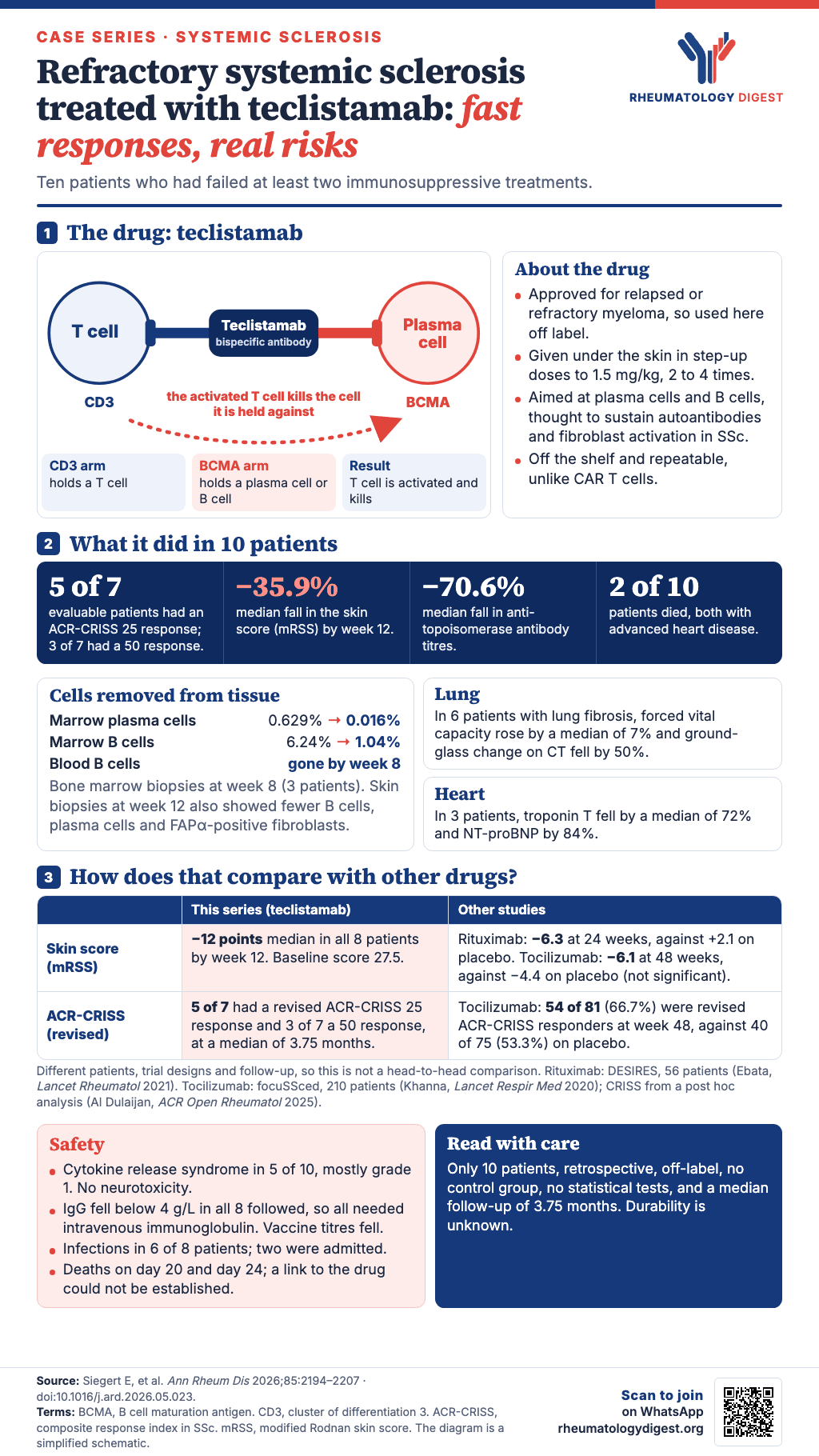
TL;DR: In 10 patients with refractory systemic sclerosis, the BCMA × CD3 T cell engager teclistamab removed B cells and plasma cells from blood, bone marrow and skin and was followed by rapid improvement in skin, lung and heart measures, but it also caused severe hypogammaglobulinaemia in everyone evaluated, frequent infections and two deaths in patients with advanced cardiac disease.
Systemic sclerosis (SSc) is still short of treatments that restore organ function. This multicentre case series from Berlin, Hamburg, Aarhus and Tübingen reports what happened when teclistamab, a drug approved for relapsed and refractory multiple myeloma, was given off label to patients whose disease had resisted at least two earlier immunosuppressive treatments. The paper is open access and the data are exploratory, so it is best read as a proof of concept for a new mechanism, not as evidence for a new treatment.
What teclistamab is and how it works
Teclistamab is a bispecific antibody that engages T cells. The paper describes it as a B cell maturation antigen (BCMA) × cluster of differentiation 3 (CD3) T-cell-engaging antibody: one arm recognises BCMA on the target cell, and the other recognises CD3 on T cells. The general principle of a bispecific T cell engager, as described in the Nature Reviews Rheumatology review on vaccination discussed in an earlier post on this site, is that binding CD3 on a T cell and a target antigen on the pathogenic cell at the same time activates the T cell, which then releases cytotoxic effectors and kills the target cell. In this series the target cells lost were plasma cells and B cells. The infographic draws this mechanism as a simplified schematic.
The authors place teclistamab in a wider shift towards treatments aimed at B cells and plasma cells, alongside anti-CD19 CAR T cells and anti-CD19/BCMA CAR natural killer cells. They cite the rationale that a B-cell-driven process, in which autoreactive B cells and plasma cells sustain autoantibody production, inflammation and fibroblast activation, is increasingly supported in SSc. Two practical features matter for how it was used here:
- It is given under the skin, and the step-up schedule was identical to the one approved for multiple myeloma. The target dose of 1.5 mg/kg was given 2 to 4 times in every patient, and the median cumulative dose was 6.36 mg/kg.
- Unlike cellular therapy, it requires repeat dosing from an off-the-shelf product. The authors list this as an advantage, together with easy scalability, and they note that its role compared with, or as a bridge to, stem cell transplantation or CAR T cells remains to be defined.
Why SSc needed something new
SSc is a rare autoimmune disease with immune dysregulation, microangiopathy and progressive fibrosis of the skin and internal organs. Treatments so far mostly dampen inflammation and slow progression. For SSc-related interstitial lung disease (ILD), a leading cause of death, the authors name nintedanib, mycophenolate mofetil, cyclophosphamide, tocilizumab and rituximab as options that show partial efficacy. These can slow progression but have not been shown to bring real recovery of organ function. Autologous stem cell transplantation can produce long remissions in selected patients, but its toxicity limits wide use. Recent guidelines call for approaches that go beyond transient immunosuppression, towards durable immune reprogramming.
The patients
Between June 2024 and September 2025, 10 patients who met the 2013 ACR/EULAR classification criteria received teclistamab as an off-label treatment after shared decision-making. The centres were Charité Berlin, Hamburg-Eppendorf, Aarhus and Tübingen. All patients gave written informed consent, and the analysis was approved by the Charité ethics committee.
- Seven were women, and the median age was 51 years. Median disease duration was 2 years, and the median number of earlier immunosuppressive treatments was 3.5.
- All had diffuse skin disease with a median modified Rodnan skin score (mRSS) of 27.5 out of 51, and a revised EUSTAR activity index of at least 2.5, which indicates highly active disease.
- Seven had ILD on high-resolution CT, with a median FVC of 66% of predicted and a median DLCO of 42%. Five had primary cardiac involvement, and one had pulmonary arterial hypertension.
- Six had anti-topoisomerase I (Scl-70) antibodies. One patient each had anti-RNA polymerase III, anti-RuvBL1/2, anti-PM/Scl-75/-100, and anti-U1-RNP antibodies.
- Refractoriness was defined by a revised ACR-CRISS score of 0 in response to earlier treatment, with failure of at least two earlier immunosuppressive treatments.
Baseline immunosuppression was stopped 2 weeks before teclistamab, apart from one patient who continued a prednisone taper. All patients received antiviral and antimicrobial prophylaxis (aciclovir and co-trimoxazole, or atovaquone), and intravenous immunoglobulin (IVIG) was started when IgG fell below 4 g/L. Patients were monitored for cytokine release syndrome (CRS), immune effector cell-associated neurotoxicity syndrome (ICANS), infections, cytopenias and hypogammaglobulinaemia. The efficacy analysis included only patients with at least 12 weeks of follow-up, which left 8. Median follow-up for the cohort was 3.75 months.
What happened to the cells and antibodies
B cells and plasma cells were almost completely removed from several compartments.
- In blood, CD19-positive B cells were depleted by week 8 in all 8 patients with data.
- In bone marrow (3 patients biopsied), plasma cells fell from a median of 0.629% of cells at baseline to 0.016% on biopsy, and from 0.870% to 0.000% of lymphocytes in aspirates. B cells fell from 6.240% to 1.036% on biopsy and from 3.150% to 1.110% in aspirates.
- In skin biopsies at week 12 (4 of 8 patients), plasma cells and B cells were also depleted.
- B cells returned in 3 of 10 patients after a median of 20 weeks (week 20 in two patients, week 36 in the third). In the patient with the longest follow-up, the returning B cells shifted from a mainly transitional to a mainly naive phenotype.
Disease-specific antibodies fell with them.
- Anti-topoisomerase antibody titres fell by a median of 70.6%.
- The patient with the longest follow-up (68 weeks) became seronegative for both antinuclear antibodies and anti-topoisomerase antibodies by week 28 and stayed that way.
- RNA polymerase III antibodies fell by 39% (RNA pol III 11) and 66% (RNA pol III 155). PM/Scl-100 antibodies fell by 71% and PM/Scl-75 antibodies by 93%. In the patient with anti-RuvBL1/2, the ANA titre fell by two dilution steps.
- Total IgG fell too, and so did vaccine-specific titres (for example rubella IgG). All 8 patients with at least 12 weeks of follow-up developed severe hypogammaglobulinaemia (IgG below 4 g/L).
Clinical response
Eight of 10 patients were evaluable at 12 weeks or later. All 8 had a revised ACR-CRISS of 0 at baseline.
- Composite response. According to the abstract, 71% and 43% of patients reached revised ACR-CRISS 25 and 50 responses, respectively. The results text describes improvement in 5 of 8 patients (62.5%), and the figure legend refers to 5 of 7, with 4 of 5 reaching a revised ACR-CRISS 50 by month 20. The difference seems to reflect patient 9, who had too little data to calculate a response after week 4.
- EUSTAR activity index. In 6 patients it fell by a median of 39.1% (2.29 points) within 12 weeks, and 2 of 6 reached inactive disease (below 2.5) at their last follow-up. Of the 5 patients with raised C-reactive protein at baseline, 4 normalised it.
- Patient-reported outcomes. The Scleroderma Impact of Disease questionnaire improved by a median of 32.2% in all 5 patients tested. The HAQ score fell from a median of 1.53 to 1.07 at last follow-up, with marked improvement in 5 of 8 patients and minimal change in 3.
- Digital ulcers and calcinosis. Digital ulcers resolved in the two patients with ulcers who completed follow-up, allowing tadalafil to be tapered. Calcinosis improved over time, and no severe infections were observed.
- PET imaging (exploratory). In patient 1, a fibroblast activation protein inhibitor (FAPI) PET scan showed widespread fibroblast activation at baseline and a global fall in signal across several organs by week 12.
Three patients did not reach ACR-CRISS 25 within 12 weeks but still improved. Patient 5 recovered from congestive heart failure and her mRSS fell from 32 to 16. Patient 8 had a clear symptomatic improvement by week 6, though an influenza infection around week 8 probably lowered pulmonary function tests and confounded assessment. Patient 9 lacked data for scoring.
Skin
Skin disease was present in all 10 patients, and all 8 evaluable patients improved. The median mRSS fell by 35.9% (12 points) within 12 weeks, with further reductions in all patients during longer follow-up, and improvement across all anatomical regions. In skin biopsies from 4 patients, fibroblast activation protein-alpha (FAPα)-positive and LGR5-positive fibroblasts fell markedly.
Lung
ILD was present in 7 patients, and 6 completed 12 weeks. At 3 months, median FVC rose by 7% and median DLCO by 12%. Patient 1, followed for the longest, kept improving through week 66. On high-resolution CT in 4 patients with paired scans, ground-glass opacities fell by a median of 50% by week 12, and patient 1 also showed regression of fibrotic reticulation. Dyspnoea scores improved by a median of 75% in the 4 of 6 patients who reported them. The text and the figure legend give slightly different FVC figures (a median rise of 7% in the text and abstract, against 6% in the legend), so the exact size of the gain should be read with caution.
Heart
Five patients had SSc heart disease, with raised troponin T and NT-proBNP, pericardial effusion, clinically relevant arrhythmias or congestive heart failure, and 3 of them completed 12 weeks. In those 3, troponin T fell by a median of 72% and NT-proBNP by 84% by week 12. Echocardiography showed regression of cardiac disease in patient 5, with no clinically relevant worsening in the other two, and cardiac MRI showed improvement in late gadolinium enhancement and T1 and T2 times in all 3.
How the results compare with other treatments
The case series itself does not compare teclistamab with other drugs, so this section draws on three other publications and is not part of the paper. It is meant only to give a sense of scale, and the comparison is indirect: the patients, trial designs and follow-up differ, and none of these studies is a head-to-head trial.
| Measure | This series (teclistamab) | Other published studies |
|---|---|---|
| Skin score (mRSS) | Median fall of 12 points (35.9%) in all 8 evaluable patients within 12 weeks. Baseline median score 27.5 | Rituximab, DESIRES trial (56 patients): change of −6.30 at 24 weeks against +2.14 on placebo. Tocilizumab, focuSSced trial (210 patients): change of −6.14 at 48 weeks against −4.41 on placebo, a difference that was not statistically significant |
| Revised ACR-CRISS | 5 of 7 evaluable patients had a revised ACR-CRISS 25 response and 3 of 7 a 50 response, at a median follow-up of 3.75 months | Tocilizumab, post hoc analysis of focuSSced: 54 of 81 patients (66.7%) were revised CRISS responders at week 48, against 40 of 75 (53.3%) on placebo |
Two things stand out. First, the skin improvement in this series was larger and faster than the changes reported in those trials, but it came from 8 patients without a control group, and the patients began with high skin scores, which leaves more room to fall. Second, the placebo arm of focuSSced also showed a large fall in skin score and a high rate of CRISS responders, a reminder of how much of the improvement in SSc skin disease can occur without active treatment, and why an uncontrolled series cannot say how much of the response belongs to the drug.
Sources for this section: Ebata S, et al. Lancet Rheumatol 2021;3:e489–e497 (DESIRES, doi 10.1016/S2665-9913(21)00107-7). Khanna D, et al. Lancet Respir Med 2020;8:963–974 (focuSSced). Al Dulaijan N, et al. ACR Open Rheumatol 2025 (post hoc CRISS analysis, doi 10.1002/acr2.11782).
Safety
Safety is where this series is most sobering.
- Cytokine release syndrome occurred in 5 of 10 patients and was mostly mild: 4 of the 5 had a maximum grade of 1 and 1 had grade 2. It was managed with paracetamol (and fluids in one patient), without tocilizumab or glucocorticoids, and no ICANS occurred.
- Infections were common and varied, with respiratory tract infections in 6 patients, skin in 2, and tonsils, sinuses and urinary tract in 1 each. Two patients were admitted (patient 6 with an upper respiratory tract infection and patient 8 with bronchitis), and all infections resolved after treatment.
- Severe hypogammaglobulinaemia (IgG below 4 g/L) developed in all 8 patients followed for at least 12 weeks. They needed regular IVIG, 20–70 g in the first 12 weeks, and vaccine titres fell and were only partly protected by IVIG. The need for IVIG slowed over time. IVIG may have contributed to some benefit, but responses were generally seen before it started, and the authors cite limited evidence of IVIG efficacy in SSc.
- Colitis. Patient 6 developed severe non-bloody diarrhoea at week 6 with raised faecal calprotectin. Biopsies showed collagenous microscopic colitis changes compatible with an inflammatory bowel disease-like picture with proctitis. It settled with budesonide and mesalamine, and endoscopy at week 13 confirmed complete healing. The authors raise the possibility of gut-specific immunological effects of BCMA targeting, noting a previous report of Crohn’s-like disease after teclistamab in a patient with lupus.
- Two deaths occurred, both in patients with advanced primary cardiac disease. Patient 4 (anti-Scl-70, severe myocarditis with recurrent ventricular tachycardia, pulmonary hypertension and renal dysfunction, with an LVEF of 35%) improved in his skin but developed multiorgan complications and died on day 20 of diffuse alveolar haemorrhage and heart failure, consistent with a pulmonary-renal syndrome previously described in SSc. Patient 10 (long-standing PAH and cardiac involvement) died suddenly of presumed cardiac death on day 24, 12 days after her last dose, with no sign of CRS or infection. The authors state that a treatment-related contribution cannot be excluded in the first case and that a causal relationship could not be established in either. Both patients would have met exclusion criteria in recent risk-stratification frameworks for cellular therapies, whereas the remaining patients would not.
How the authors interpret it
They conclude that teclistamab showed substantial efficacy across organ systems, with a generally manageable safety profile but clinically relevant adverse events in a high-risk population. They draw several points from the data:
- Reversal of established damage. Improvement was most marked in ILD, where actual reversal of established pathology has rarely been documented. Skin, tendon friction rubs, myocardial oedema and fibrosis on cardiac MRI and digital ulcers also improved quickly, which suggests that organ involvement in SSc may be more reversible than is usually assumed. Their cohort resembled an early, inflammatory SSc phenotype, with raised CRP and short disease duration, and earlier trials suggest such patients respond well to immunosuppression. Many patients had previously received tocilizumab or rituximab without meaningful benefit, which supports the claim of refractoriness.
- Tissue-level evidence. Unlike established therapies, teclistamab achieves deep depletion of autoreactive B cells and plasma cells in lymphatic organs and in affected tissues, with a fall in FAPα expression, a marker of activated fibroblasts. Fibroblast activation is complex, though, and a single marker cannot capture it.
- A hypothesis about the disease. The authors suggest that autoantibody-secreting cells may drive perivascular inflammation and endothelial dysfunction. Deep depletion of these cells might break that circle, improve microvascular perfusion and oxygenation, and suppress profibrotic fibroblast activation, allowing tissue remodelling instead of continued scarring. They stress that this remains speculative.
- Speed and comparison with other therapies. The clinical effect appeared quickly, in several patients earlier than has been reported with CD19-directed CAR T cells, which might mean that plasma cell-directed T cell engagement disrupts pathogenic circuits faster. Direct comparison is not possible because the targets, mechanisms and treatment regimens differ. A recent study of the CD19-directed T cell engager blinatumomab in SSc had smaller falls in autoantibody titres, smaller clinical responses and less effect on IgG and vaccine titres. The authors also note that the milder CRS and absence of neurotoxicity might favour T cell engagers over CAR T cells, though comparative data are limited.
- Cardiac risk. Careful patient selection, based on a full cardiac assessment and exclusion of patients with advanced cardiac involvement, may be critical, by analogy with stem cell transplantation and CAR T cell approaches. Patients with less advanced heart disease responded well, which supports studying BCMA-directed therapy at earlier stages and under controlled conditions.
Limits
The authors list the limitations clearly:
- The cohort is small and clinically heterogeneous, with only 8 patients evaluable at 12 weeks. The design is retrospective and multicentre, and use was off label in a highly selected group, which limits causal inference and makes the findings susceptible to selection and survivorship bias.
- Outcome assessments were not standardised across centres, and data availability varied. This affected pulmonary assessment most (imaging protocols and functional testing), and cardiac assessments rested on a limited number of patients. No formal statistical tests were performed.
- Several analyses, including bone marrow studies and FAPI-PET, covered only small subsets and are exploratory.
- Follow-up is short, which precludes conclusions on immune reconstitution, durability of response and late safety signals.
What it adds up to
The study provides a proof of concept that BCMA-directed T cell engagement can deplete B cells and plasma cells in tissue in SSc and is followed by rapid, multi-organ improvement in patients who had run out of options, with direct tissue evidence for the mechanism. The cost is nearly universal immunoglobulin deficiency needing replacement, frequent infections and two deaths in patients with advanced heart disease. The authors consider the benefit–risk balance justified in this high-risk population given the lack of effective alternatives, and they call for prospective trials with strict patient selection, standardised safety monitoring and assessment of durability. Key open questions are whether the effect lasts, whether BCMA targeting is as durable as CD19 CAR T cell therapy or works as a potent but time-limited treatment, and where it fits next to or before transplantation and cellular therapy.
Disclosures noted in the source: many of the authors report fees, board memberships, travel support or research funding from pharmaceutical companies, as listed in the paper’s competing-interests statement. The paper is open access under a CC BY licence.