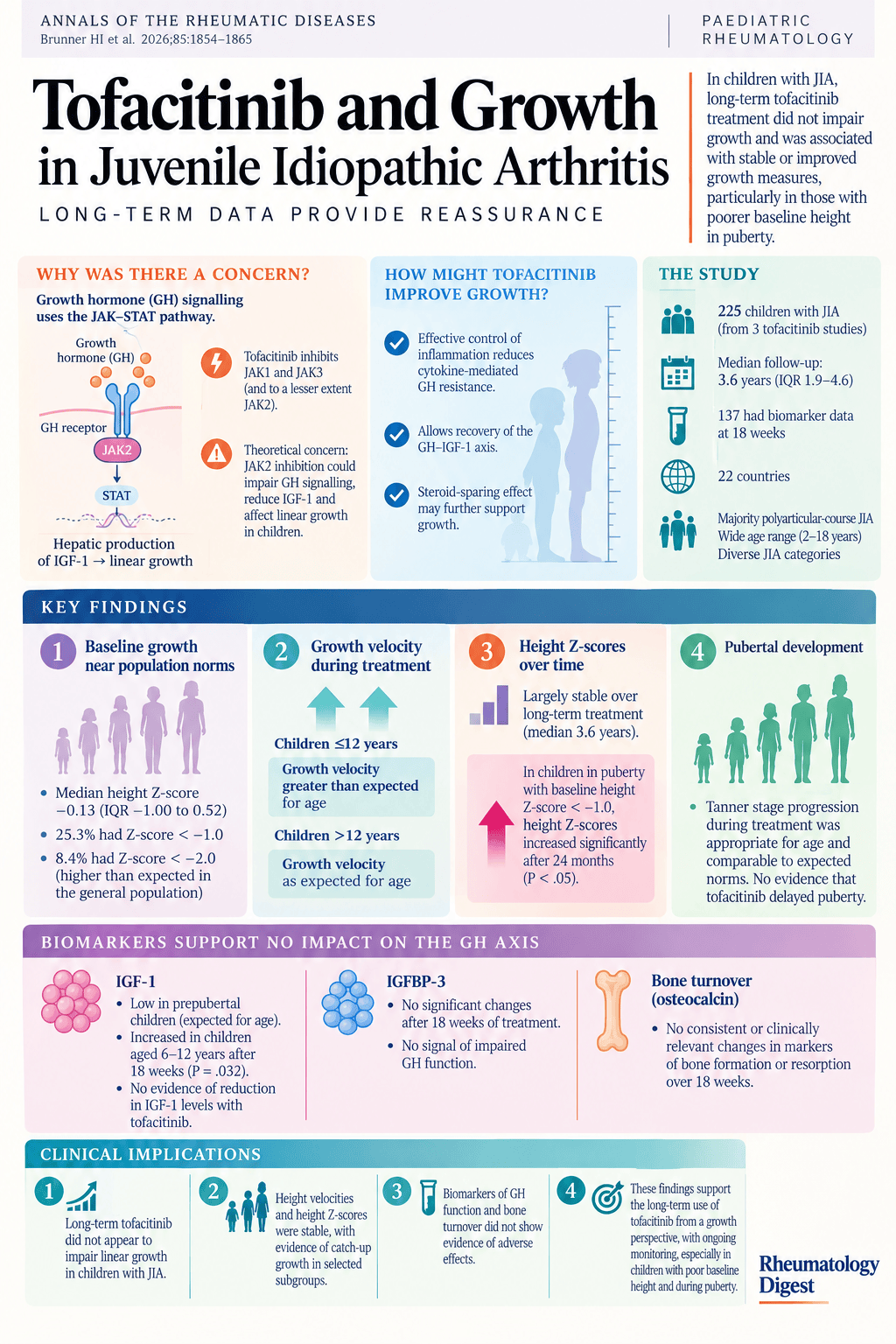
TL;DR: In children with JIA on long-term tofacitinib, growth stayed normal and younger patients grew faster than the WHO reference, with no fall in growth hormone biomarkers — reassuring, but from a post hoc analysis with no untreated control arm.
Any drug that inhibits Janus kinases in a growing child raises the same question, and it is a mechanistic one: growth hormone signals through a JAK2 homodimer. This paper asks whether tofacitinib, given to children with JIA for years rather than weeks, shows up in their height and in the biomarkers of the growth hormone axis. The answer is reassuring. The way the question was asked limits how much weight it can carry.
Why growth is a real concern in JIA
Growth failure is a recognised complication of chronic inflammatory conditions in childhood, including JIA, childhood-onset SLE, juvenile dermatomyositis and inflammatory bowel disease. The proposed drivers are uncontrolled disease activity, active systemic and local inflammation, and prolonged glucocorticoid use, and a common final pathway is a negative effect on the growth hormone–IGF axis and directly on the growth plate. IGF-1, IGF binding protein 3 (IGFBP3) and osteocalcin are all produced in response to growth hormone, peak at the adolescent growth spurt, and are low when growth hormone production or activity is impaired.
Tofacitinib acts mainly through JAK1 and JAK3. It can inhibit JAK2 to a much lesser extent, but at approved doses — 5 mg twice daily, or the weight-based equivalent in patients under 40 kg — that JAK2 inhibition is thought to be minimal. That matters because JAK2 is part of the growth hormone receptor mechanism. There is a countervailing argument too: growth hormone resistance in JIA is driven by inflammation, with IL-6 a central mediator, and tofacitinib has been shown to reduce IL-6 in rheumatoid arthritis, so controlling disease could in principle relieve growth restriction rather than cause it. Preclinical studies in juvenile rats found no direct effect of tofacitinib on bone growth and development.
The data source and the patients
This was a post hoc analysis of the tofacitinib JIA development programme, which comprised a phase 1 pharmacokinetic study, a phase 3 placebo-controlled withdrawal study, and an open-label long-term extension. The analysis included patients aged 2 to under 18 years who received continuous tofacitinib (unless temporarily withheld) across those studies, enrolled at 22 centres in the PRINTO and PRCSG networks, with a data cut-off of July 2022. Patients from the separate phase 3 study in systemic JIA were not included. For patients randomised to placebo in the phase 3 study, tofacitinib start was defined as entry into the extension.
All patients received open-label tofacitinib at 5 mg twice daily or the equivalent lower weight-based dose. Background therapy was allowed within limits: methotrexate up to 25 mg/week (or 20 mg/m² per week, whichever was lower), leflunomide at weight-based doses, and oral glucocorticoids up to 0.2 mg/kg/day or 10 mg/day, again whichever was lower.
225 patients were analysed. Most had polyarticular-course JIA (185: extended oligoarthritis 27, RF-positive polyarthritis 36, RF-negative polyarthritis 111), plus 11 with systemic JIA without active systemic features in the preceding six months, 19 with juvenile psoriatic arthritis, and 21 with enthesitis-related arthritis. The median age was 13 years (IQR 9–16), 75.1% were female, and median disease duration was 3.0 years. Disease activity was high — 89.3% had high disease activity by JADAS-27 and 44.9% had elevated CRP — and 88.4% had previously used a csDMARD and 30.7% a biologic DMARD. At baseline, 65.8% were taking methotrexate and 44.9% oral glucocorticoids.
By pubertal status at entry (Tanner stage), 57 patients (25.3%) were prepubertal, 95 (42.2%) were in puberty (stages 2–4), 41 (18.2%) were postpubertal (stage 5), and stage was unknown in 32 (14.2%). Median tofacitinib exposure was 3.6 years (IQR 1.9–4.6); 72.4% were treated for more than two years, 15.6% for one to two years and 12.0% for under one year.
Height was measured at baseline, at months 1 and 3, and then every third month. Height velocity was calculated in cm/year, and height Z-scores were derived against the 2007 WHO age- and sex-matched reference. Missing measurements were imputed by last observation carried forward. For biomarkers, IGF-1, IGFBP3 and osteocalcin were measured in fasting serum from 137 patients who completed 18 weeks of open-label treatment in the phase 3 study.
These children were not short at baseline
The starting point was better than the historical picture of JIA would predict. Median baseline height Z-score was −0.13 (IQR −1.0 to 0.52), close to the general population. Short stature (Z-score below −2) was nonetheless present in 8.4% (19/225) compared with about 2.5% expected in a normal distribution, and 25.3% (57/225) had a Z-score below −1.
The baseline associations were modest. There was no association between height Z-score and age group, sex or race. Longer disease duration trended toward lower Z-scores (P = .06), with patients at six years or more having the lowest values. Systemic JIA without active features had the lowest median Z-score of any category, but the difference across categories was not significant (P = .09). Across Tanner stages there was no association, though the numerically lowest Z-scores were in postpubertal patients. Baseline glucocorticoid use was associated with lower height Z-scores (P < .01). The authors suggest the near-normal baseline distribution may reflect improved treatment of JIA compared with the past, and note that the mix of categories matters: polyarticular, psoriatic and enthesitis-related disease carry a lower risk of growth failure than systemic JIA with active systemic features.
Height velocity: normal or better
Growth was assessed against the WHO norms for age. Among patients in Tanner stages 1–4 at baseline with two years of data, 66.3% (63/95) had a two-year height velocity at or above the WHO norm.
The split by age is what matters:
- Age 12 or younger: 86.0% (43/50) at or above the WHO norm, with 14.0% (7/50) below
- Older than 12 years: 44.4% (20/45) at or above, with 55.6% (25/45) below
The authors read this as greater than expected velocity in younger patients and the expected rate in older patients. Results were similar for boys and girls, and similar when velocity was assessed over one year instead of two.
Glucocorticoids modified the picture in younger children. Among those aged 12 or under, 32 were on glucocorticoids at baseline and 18 were not. 6 of 32 (18.8%) on glucocorticoids had a velocity below the WHO norm, compared with 1 of 18 (5.6%) not on them. The numbers are small, and no association was apparent by JIA category, but the direction fits the known effect of steroids on growth. It also matters for interpretation: the analysis did not account for total glucocorticoid exposure, and nearly half the population (44.9%) was receiving steroids, which may have reduced the precision with which tofacitinib’s own effect on growth could be isolated.
Height Z-scores: stable, with catch-up in those who were behind
If velocity were persistently below normal, height Z-scores would fall over time. Overall they were largely stable.
Some subgroups moved in a favourable direction:
- Prepubertal patients showed an increase in mean height Z-score after 42 months of treatment (P < .05)
- Pubertal patients were stable overall
- Postpubertal patients were stable, as expected
- Patients at Tanner stage 3 at baseline showed a minor but statistically significant reduction in Z-scores from month 6, reported in the supplementary figures
The catch-up signal is concentrated in children who began with a low Z-score. Among pubertal patients with a baseline Z-score below −1, height Z-scores increased after 24 months of treatment (P < .05), most prominently in those at Tanner stage 2. Grouping by age gave a similar result: in children aged 6 to 12 years at baseline, Z-scores tended to rise during treatment, including in those with baseline Z-scores below −1. The authors note that 69% (36/52) of patients with a baseline Z-score below −1 had residual growth potential, and that catch-up appeared after roughly 1.5 to 2 years of treatment in the pubertal group and in those aged 6 to 12 at inclusion. Six single time-point height measurements in five patients were excluded as biologically implausible.
The growth hormone axis: no adverse signal
IGF-1. At baseline, IGF-1 was low in children under 10 years and peaked at about 14 years, following the expected pubertal pattern. Lower baseline IGF-1 was associated with younger age, disease duration between 2 and under 6 years, a lower Tanner stage and CRP above normal (all P < .05). After 18 weeks of tofacitinib, IGF-1 did not change in the overall population. In the subgroup aged 6 to 12 years, IGF-1 increased from baseline (P = .032), whereas there was no difference in children under 6 or over 12 (P = .42 and P = .36).
IGFBP3. No change was seen after 18 weeks, overall or in any age subgroup.
Osteocalcin. Also unchanged, overall and by age group; baseline levels were lowest in patients over 12 years.
The authors point out why IGF-1 is the most informative of the three: it is the most commonly used biomarker of growth hormone activity and a direct target of growth hormone through JAK2. The absence of a fall in IGF-1 is therefore the biologically relevant result, and the rise in the 6–12 year group is consistent with the height velocity and catch-up findings in that same age band.
How the authors read it — and how the results might fit the wider picture
The interpretation is that patients grew normally, or at higher than expected velocity in younger children, and that there was no concerning change in growth hormone–related biomarkers over 18 weeks. The catch-up finding in children with low baseline Z-scores echoes what has been reported with tocilizumab in systemic JIA and polyarticular-course JIA, and with TNF inhibitors in polyarticular and systemic JIA. The authors also note that these velocities are consistent with a two-year growth analysis from a phase 3 tocilizumab study in polyarticular-course JIA. They stress that a formal comparison of the growth impact of approved medications — accounting for Tanner stage, inflammation and background therapy — was beyond the scope of this analysis, so no drug-versus-drug conclusion should be drawn.
Two mechanistic points sit alongside the data. The absence of a change in IGF-1 is what would be expected if tofacitinib’s clinically relevant inhibition is confined to JAK1 and JAK3 rather than the JAK2 pathway used by growth hormone. And the catch-up growth is compatible with the idea, which the authors raise, that controlling inflammation and the growth hormone resistance it drives may itself improve growth.
Limitations that matter
The authors are direct about these, and they are substantial:
- It is post hoc and the numbers are small, particularly in the subgroups where the catch-up finding sits. The figures show numbers of patients contributing to the long-term estimates falling considerably at later time points.
- There was no untreated or comparator group. Growth was compared against WHO population norms, not against similar children not on tofacitinib. WHO standards do not account for individual determinants such as parental height, nutrition or genetics.
- Height measurement was not standardised. The protocol preferred a Harpenden stadiometer but did not require it, which could have lowered accuracy.
- Pubertal development was not assessed as an outcome, and only baseline Tanner stage was used — patients moving through puberty during follow-up were not reclassified.
- Total glucocorticoid exposure was not analysed, despite 44.9% of the cohort receiving steroids.
- Patients with systemic JIA with active systemic features were excluded, and this is the group at highest risk of growth failure; few patients had low baseline Z-scores, so catch-up could not be examined in the most affected subgroups.
- The biomarker assays were validated for precision but not against a reference population, and biomarker follow-up was limited to 18 weeks.
- No adjustment was made for multiple comparisons, and missing data were handled by last observation carried forward.
The study was sponsored by Pfizer, which was responsible for study management and data analysis; the design was jointly developed with the PRINTO/PRCSG investigators, and several authors are Pfizer employees or shareholders. The publication was not contingent on Pfizer’s approval.
What it means for practice
The reasonable reading is that, in a population of children with JIA that was close to normal height at entry, long-term tofacitinib was not associated with growth impairment and showed no adverse signal on IGF-1, IGFBP3 or osteocalcin. That supports the safety of long-term use in this respect and answers the theoretical JAK2 concern with real data rather than reasoning.
What it does not do is show that tofacitinib causes catch-up growth. Without a control group, this design cannot separate a drug effect from the benefit of better disease control or reduced steroid use, which the authors note have improved growth with other advanced therapies too. The honest summary is the one the authors reach: growth appeared normal on treatment, and in younger children and those with low baseline Z-scores, better than expected. For a family worried about growth, that is a genuinely useful thing to be able to say — with the caveat that it has been observed rather than tested against a comparator.
Disclosures noted in the source: the study was sponsored by Pfizer; several authors are Pfizer employees or stockholders, and others report grants, consulting fees or speaker fees from multiple companies, listed in full in the paper. Written informed consent or assent was obtained from all participants’ parents, guardians or the patients themselves.