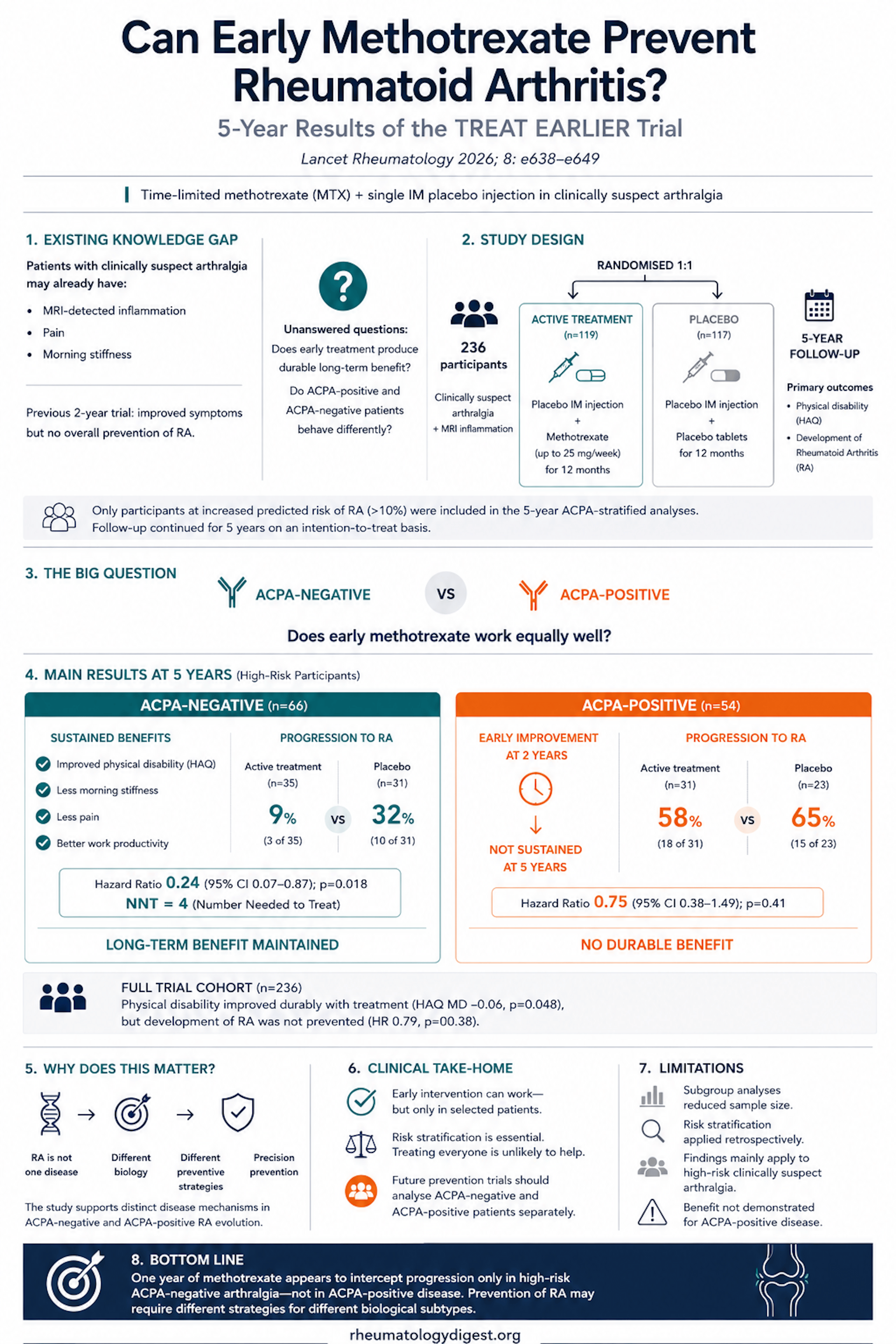
TL;DR: ACPA status splits the at-risk phase into two different diseases with two different answers — one year of methotrexate plus a single glucocorticoid injection gave durable 5-year benefit in ACPA-negative individuals at increased predicted risk (RA in 9% vs 32%, HR 0.24, NNT 4), and nothing lasting in ACPA-positive individuals; crucially, risk stratification is what made the signal visible at all.
The Clinical Problem
Rheumatoid arthritis is diagnosed only once clinically apparent arthritis exists — by which point the inflammatory process is already chronic and treatment can suppress but not cure. The logical response is to intervene earlier, in the symptomatic at-risk phase: clinically suspect arthralgia (CSA) with MRI-detected subclinical joint inflammation. This window precedes both ACPA-positive and ACPA-negative RA, already carries symptoms, disability and work productivity loss, and is conceptually a stage where autoimmunity is not yet fully entrenched.
The original TREAT EARLIER trial (Lancet 2022) tested exactly this and produced a mixed verdict: one year of methotrexate plus a single glucocorticoid injection did not prevent RA at 2 years, but did reduce inflammatory burden and physical disability. That result left two unresolved problems:
- Durability. Prevention or disease modification implies benefit that persists long after the drug is stopped. All prior secondary-prevention trials, TREAT EARLIER included, followed patients only ~1 year past treatment cessation.
- Heterogeneity. The at-risk population is not one population. ACPA-positive and ACPA-negative RA differ in genetics, environmental risk and pathophysiology — including during the symptomatic pre-arthritis phase. Furthermore, risk stratification tools did not exist when the trial was designed in 2014. A 2024 interim analysis revealed that a large slice of the ACPA-negative arm was, retrospectively, at low risk (<10% predicted) — individuals who by definition cannot benefit from prevention, and whose inclusion dilutes any true signal.
Precision prevention therefore requires homogeneity in both pathophysiological subtype and actual disease risk. The 2-year analysis had neither.
The Research Question
Over 5 years, does a time-limited intervention (single IM glucocorticoid injection plus 12 months of methotrexate) delivered in the CSA/subclinical-inflammation risk phase produce durable reductions in disease burden and RA development — and does this differ between ACPA-positive and ACPA-negative individuals at increased predicted risk?
How the Study Was Designed
Trial framework
- Double-blind, randomised, placebo-controlled; recruitment from 13 rheumatology outpatient clinics in southwest Netherlands, with study visits at Leiden UMC. Enrolment April 2015 – September 2019; final visit October 2024.
- Follow-up extended from 2 to 5 years by protocol amendment.
Two-level entry definition (the trial’s quality control)
- Clinically suspect arthralgia: recent-onset arthralgia (<1 year) that the treating rheumatologist suspected would progress to RA. Explicitly not requiring autoantibodies — both ACPA-positive and ACPA-negative individuals were eligible. Excluded if clinically apparent arthritis was present or a more probable alternative existed (OA, fibromyalgia, psoriasis).
- Subclinical joint inflammation: contrast-enhanced 1.5T MRI of MCP, wrist and MTP joints; at least one joint with synovitis, tenosynovitis or osteitis by two independent readers, at a level present in <5% of age-matched symptom-free volunteers at the same location. Reader reliability was strong (intra-reader ICC 0.92–0.99; inter-reader 0.91–0.98).
Randomisation and masking: 1:1 by pharmacist-led computer-generated block randomisation; identical active/placebo injections and tablets. Participants, rheumatologists, assessors and analysts masked for a minimum of 2 years; MRI readers masked to clinical data. Unmasking followed the 2-year database lock.
Intervention
- Active: single IM methylprednisolone 120 mg, then oral methotrexate escalated over 4 weeks to 25 mg/week (or highest tolerated) for 12 months.
- Placebo: matching injection plus tablets for 12 months.
- Folic acid 5 mg/week in both arms. Four further years off trial medication. All DMARDs and glucocorticoids prohibited throughout.
The defining analytical choice — prespecified risk stratification. Only participants with predicted RA risk >10% were analysed at 5 years. The risk model (developed and validated in an independent CSA population) weighs four variables: rheumatoid factor, ACPA, and two measures of subclinical inflammation severity. This was written into the statistical analysis plan, published on Zenodo and submitted to the ethics committee before the last patient completed follow-up.
Endpoints
- Co-primary: physical disability (HAQ, 0–3) and development of RA (clinically apparent inflammatory arthritis plus clinical RA diagnosis). Both chosen with patient research partners, who insisted that sustained reduction of symptoms and functional limitation is as legitimate a treatment goal as preventing progression.
- Secondary: pain and morning stiffness (VAS 0–100); work productivity (WPAI).
- Exploratory: resolution of CSA; DAS28-ESR remission 12 months after RA diagnosis; DMARD-free remission.
Statistics: ITT; constrained longitudinal data analysis for disability with a time-dependent term allowing the effect to differ ≤2 years vs >2 years; Kaplan–Meier/Cox for RA development; α 0.025 for the two primary endpoints; gate-keeping with the ACPA-negative group tested first (justified on an outcome-agnostic basis — larger n, hence greater power). Patient research partners deliberately kept follow-up low-burden to protect against attrition.
The Results
Flow and population
- 901 assessed → 763 MRI-screened → 384 with subclinical inflammation → 236 randomised (119 active, 117 placebo). Retention: 97% at 2 years, 91% at 5 years.
- Of the 236: 54 ACPA-positive (all at increased predicted risk) and 182 ACPA-negative, of whom only 66 were at increased predicted risk. The 5-year ITT population was therefore 120: ACPA-negative 66 (35 active / 31 placebo), ACPA-positive 54 (31 active / 23 placebo).
- Mean age 48 (SD 12); 60% women.
- An important and easily missed detail: because ACPA is itself a predictor in the risk model, the ACPA-negative participants who qualified as “increased risk” carried more subclinical inflammation than the ACPA-positive ones (MRI total inflammation score ~9–11 vs ~5–7). The subgroups are therefore not matched on baseline inflammation — addressed with a dedicated sensitivity analysis.
ACPA-negative at increased risk — a durable, clinically meaningful effect
- Physical disability: mean HAQ difference −0.16 (95% CI −0.29 to −0.04), p=0.0082, sustained across 5 years. This exceeds the 0.09 clinical relevance threshold. Post hoc, the benefit was driven by those who did not progress to RA.
- RA development: 13 (20%) of 66 progressed — 3 (9%) of 35 active vs 10 (32%) of 31 placebo; HR 0.24 (0.07–0.87), p=0.018. NNT = 4.
- The timing is the striking part: a few active-arm participants developed RA during the treatment year, but no new RA events occurred in the subsequent 4 years in that arm — while placebo participants continued to convert, including into year 5.
- Morning stiffness: −20.6 (−27.8 to −13.5), p<0.0001. Pain: −8.7 (−15.2 to −2.1), p=0.0093.
- Work: presenteeism improved (−8.8, p=0.039); absenteeism did not (p=0.65).
- Resolution of CSA: 14 (40%) of 35 active vs 5 (16%) of 31 placebo, p=0.047.
- Course after RA onset: all 3 (100%) active-arm converters reached DAS28-ESR <2.6, vs 4 of 10 (40%) placebo converters; DMARD-free remission also more frequent. Numbers too small for testing, but directionally consistent.
ACPA-positive at increased risk — the early benefit evaporates
- Physical disability: −0.12 (−0.26 to 0.03), p=0.12 — the 2-year benefit was not sustained.
- RA development: 33 (61%) of 54 progressed — 18 (58%) of 31 active vs 15 (65%) of 23 placebo; HR 0.75 (0.38–1.49), p=0.41. No prevention.
- Morning stiffness: −7.6, p=0.061 — not significant.
- Pain: −11.6 (−19.5 to −3.8), p=0.0038 — significant at the nominal 5% level, but the authors explicitly caution against over-reading it: the difference narrowed in later years and no primary, other secondary or exploratory endpoint supported it.
- Resolution of CSA: 26% vs 13%, p=0.40. No numerical benefit in DAS or DMARD-free remission after RA onset.
Sensitivity analyses — the robustness case
- Stricter RA definition (plus 1987/2010 classification criteria), ACPA-negative: 2 (6%) vs 9 (31%); HR 0.18 (0.04–0.81), p=0.012 — effect strengthens.
- Baseline imbalance: morning stiffness was the only variable differing between arms (p=0.021). Adjusting: disability −0.13 (−0.26 to −0.01); RA HR 0.28 (0.07–1.02) — direction preserved, RA estimate loses significance at the margin.
- Autoantibody-negative subset (ACPA- and RF-negative): similar results. Per-protocol: consistent with ITT.
- 2025 EULAR/ACR risk stratification criteria applied instead of the original model: similar treatment effects for both primary endpoints.
- Matched-inflammation analysis: restricting ACPA-positive participants to those with comparable baseline inflammation showed a numerical delay in the first 2 years but no 5-year reduction (HR 0.59, 0.21–1.63, p=0.31) — arguing the ACPA difference is not merely an artefact of differing inflammatory load.
- Unmasking: roughly half were unmasked at the year-5 questionnaire; adjusted and still-masked analyses gave similar results.
The whole trial cohort (n=236) — for context
- Disability improved durably (−0.06, p=0.048) — statistically present but below the clinical relevance threshold.
- RA was not prevented: 22% vs 27%; HR 0.79 (0.47–1.34), p=0.38.
- In the low-risk ACPA-negative subgroup: no effect on disability (p=0.51) and none on RA (HR 0.99). Exactly as predicted — and this is the group whose inclusion diluted the original headline result.
Study Limitations
- Not powered for ACPA-stratified subgroups. Sample size was fixed in 2014. The pivotal ACPA-negative comparison rests on 35 vs 31 participants and 13 events; the HR of 0.24 spans 0.07–0.87. Credible and internally consistent, but a subgroup result requiring independent confirmation.
- The intervention cannot be deconstructed. Injection and methotrexate were given together, with the first measurement at 4 months — whether the durable effect belongs to the glucocorticoid, the methotrexate, or the combination is unanswerable from this design.
- Sparse patient-reported data between years 3 and 5 — a deliberate trade-off recommended by patient research partners to protect retention (91% completion suggests it worked), but it limits granularity.
- Partial unmasking from year 2 onward, mitigated but not eliminated by sensitivity analyses.
- Risk stratification applied retrospectively to a trial not designed around it, though re-analysis with the 2025 criteria was concordant.
- Restricted applicability within ACPA-negative RA. These findings apply only to ACPA-negative disease passing through a symptomatic pre-arthritis phase. A 2024 study identified a smaller ACPA-negative subgroup with acute onset and no such phase, never captured by this approach.
- Prevention versus delay is unresolved. The authors draw an instructive parallel with tamoxifen: in adjuvant early breast cancer the benefit faded at 10–14 years, whereas in primary prevention the benefit grew with time (NNT 59 at 10 years, 22 at 20 years). Initial and long-term prevention results can diverge in either direction.
- Three protocol violations in the ACPA-negative arm; single-region Dutch population.
How This Study Adds to Practice
- It rehabilitates a “negative” trial by dissecting it. The 2022 null result was, on this reading, a composite of three different populations averaged into invisibility: low-risk ACPA-negative individuals with nothing to prevent, ACPA-positive individuals who did not durably respond, and increased-risk ACPA-negative individuals in whom the intervention worked well. A methodological lesson as much as a clinical one.
- It provides the first long-term efficacy data for methotrexate as secondary prevention stratified simultaneously by pathophysiological subtype and measured risk.
- It identifies a concrete, actionable target group: ACPA-negative CSA with substantial subclinical inflammation and predicted risk >10%. NNT of 4, with a cheap, familiar, widely available drug.
- It defines the limits just as clearly. For ACPA-positive at-risk disease, this regimen is not the answer — alongside the wider literature: rituximab (PRAIRI) gave no sustained benefit; abatacept (ARIAA, APIPPRA/ALTO) produced the best results to date (22% difference at 18 months, 12% at 24 months, delay up to ~4 years) but no sustained separation beyond 5 years.
- Mechanistic hypotheses worth teaching: methotrexate may suppress inflammation without permanently altering ACPA-positive chronification; the relevant mechanisms may not be methotrexate-sensitive; or chronicity may already be established by the CSA stage in ACPA-positive disease (autoimmunity matures ~5 years before diagnosis, in the asymptomatic phase — implying the ACPA-positive window may lie even earlier).
- It legitimises disease burden as a prevention endpoint, driven by patient research partners.
- It supplies biological support for the ACPA dichotomy — differential response to an identical intervention is arguably stronger evidence of aetiopathological separation than association studies alone.
Final Take-Aways
- ACPA status splits the at-risk phase into two different diseases with two different answers. Durable 5-year benefit in ACPA-negative individuals at increased risk; nothing lasting in ACPA-positive individuals.
- In the right ACPA-negative patient, the effect size is large. RA in 9% vs 32% (HR 0.24), NNT 4; disability improved 0.16 HAQ points (above the clinical threshold); morning stiffness fell ~21 points; CSA resolved in 40% vs 16%. The stricter definition strengthened the effect (HR 0.18).
- The event timing suggests genuine interception, not just suppression. After the treatment year, no further RA events over four years in the ACPA-negative active arm, while placebo participants kept converting into year 5.
- Risk stratification is not optional — it is what makes the signal visible. Low-risk (<10%) ACPA-negative individuals showed no benefit on any endpoint, and their presence obscured the true effect. Future trials and protocols must select on measured risk, not the loose label “at risk.”
- For ACPA-positive at-risk disease, we still have no durable strategy. Methotrexate fails; abatacept delays but does not prevent beyond ~5 years; rituximab does not sustain. A different agent, mechanism, or a considerably earlier window will be needed.
- Interpret with appropriate humility. A prespecified but underpowered subgroup analysis with 13 events driving the headline hazard ratio, an intervention mixing two drugs, and a prevention-versus-delay question only longer follow-up can settle. Strong enough to reshape trial design and inform shared decision-making with a well-selected patient; not yet guideline-level standard of care.