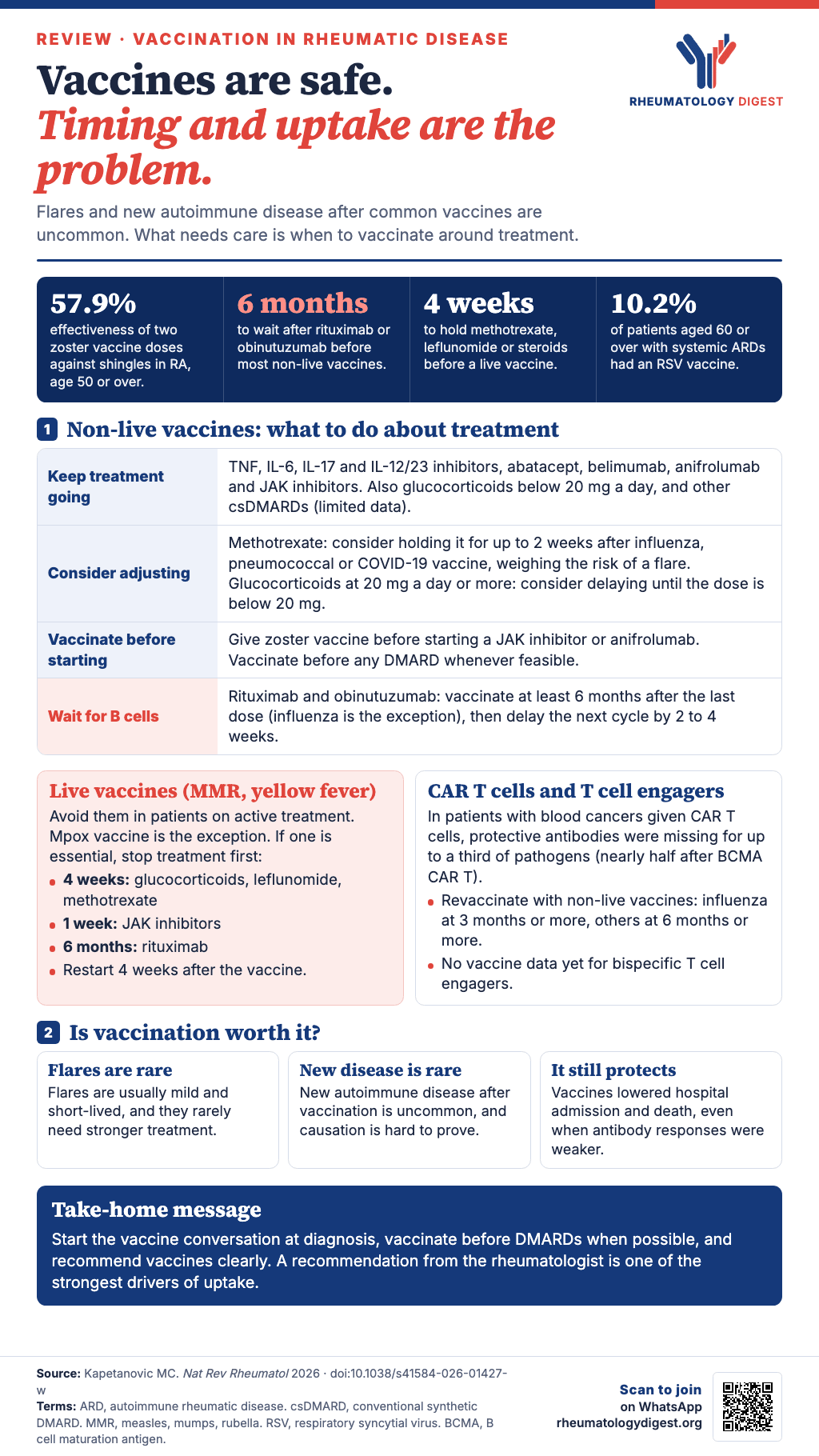
TL;DR: Commonly used vaccines are safe in autoimmune rheumatic diseases and flares are uncommon, so the real problems are timing around B-cell-depleting and other advanced therapies, avoiding live vaccines in most treated patients, and the poor uptake that follows weak recommendations and hesitancy.
Vaccination is one of the most cost-effective ways to prevent infection, and adults with autoimmune rheumatic diseases (ARDs) have more to gain from it than most. This review, written by a rheumatologist from Lund University, covers what is known about safety, response to vaccines, the timing of vaccination around treatment, how long protection lasts, how well the vaccines work in real life, and the ethical questions that surround vaccination. It also deals with newer therapies, such as CAR T cells and bispecific T cell engagers, and newer vaccines, such as those for respiratory syncytial virus (RSV) and mpox.
Why patients with ARDs need vaccines
Adults with ARDs are at increased risk of many vaccine-preventable infections. Three things add up to this risk: disease-related immune dysregulation, immunomodulatory treatment (glucocorticoids included), and the burden of other illnesses. Immune ageing adds to it in older patients, as it does in the general population. The COVID-19 pandemic and recent outbreaks of measles and polio have shown how important high vaccination coverage is for vulnerable groups.
Vaccination lowers the risk of severe infection and its complications, but it does not remove the extra risk. A population-based study from Manitoba, Canada, compared patients with immune-related inflammatory diseases with age- and sex-matched people from the general population. COVID-19 vaccination reduced hospitalisation and all-cause death in both groups. Patients were vaccinated more often than the general population, yet they remained at higher risk of both outcomes. The factors linked to those outcomes were older age, immunomodulatory treatment, higher disease activity, more comorbidity and lower socioeconomic status. The lesson the author draws is that good control of the underlying disease and good adherence to preventive measures, including vaccination, matter most for patients with many comorbidities and for those from disadvantaged backgrounds.
Safety
Most vaccines cause only mild or moderate effects, such as pain at the injection site, muscle aches and headache. Some vaccines contain adjuvants, which strengthen the immune response. Because vaccines are meant to stimulate the immune system, the possibility that they trigger autoimmunity in susceptible people has been studied extensively.
New autoimmune disease or phenomena after vaccination
New autoimmune phenomena and diseases have been reported after several vaccines. The mechanisms are not fully understood. Molecular mimicry, epitope spreading, bystander activation and cross-reactivity have all been proposed. Autoimmune disease generally develops in genetically susceptible people, with environmental triggers (infections in particular) thought to start the process, and the mechanisms behind a vaccine-triggered event are probably similar to those behind the infection the vaccine is meant to prevent. Most of the evidence comes from case reports, case series and small observational studies, and large randomised trials that would establish causation are lacking.
The review gives several examples:
- Vaccine-induced immune thrombotic thrombocytopenia (VITT). This syndrome of widespread thrombosis with low platelets was described after adenovirus-based COVID-19 vaccines. The data suggest molecular mimicry between platelet factor 4 and an adenoviral core protein in genetically susceptible people.
- Myocarditis. This was reported most often after mRNA COVID-19 vaccination in young men, including patients with ARDs. A systematic review found it to be rare, typically mild and self-limiting.
- Guillain–Barré syndrome (GBS). GBS was seen more often after the influenza A/NJ/76 vaccine in the 1976–1977 US programme. A five-country European case–control study did not confirm an association with the adjuvanted 2009 pandemic H1N1 vaccine. An increased risk, estimated at about 3 cases per 1,000,000 vaccinated people, has been reported after recombinant zoster vaccine among Medicare beneficiaries in the USA.
- Systemic ARDs. An Italian analysis of 680,000 adverse-event reports found no disproportionate increase in reports of any systemic ARD after COVID-19 vaccination. By contrast, a meta-analysis of 17 cohort studies found that COVID-19 infection was associated with a higher risk of several new autoimmune diseases, especially after severe infection.
The overall conclusion is that new autoimmune phenomena or diseases might occur after vaccination but are rare, and causality is hard to establish because a temporal association is not the same as disease induction. The infections that vaccines prevent can also cause similar complications. The benefits of vaccination therefore greatly outweigh the risks of these uncommon events.
Flares of the underlying disease
Flares have been reported after most vaccines in patients with ARDs, but the overall evidence does not support an increased risk of flare or worsening after commonly used vaccines.
- UK Clinical Practice Research Datalink data found no link between COVID-19 vaccination and flares, whatever the vaccine type or the underlying ARD.
- A review of studies found no increase in overall flare risk after COVID-19 vaccination, although vaccination might occasionally trigger a flare, particularly in people with high baseline disease activity. Other reviews found severe flares to be uncommon across ARDs.
- The same UK database showed no association between influenza or pneumococcal vaccination and primary-care consultations for symptoms suggestive of a flare.
- For recombinant zoster vaccine, a double-blind, placebo-controlled phase IV study showed an acceptable safety profile and no increase in flare rates compared with placebo. A double-blind placebo-controlled study in lupus in South Korea reported a favourable safety profile, and a pilot trial in rheumatoid arthritis (RA) patients on abatacept found comparable flare rates between vaccinated and placebo groups. Real-world US data, including patients on immunosuppression, confirmed the trial safety profile.
Taken together, vaccination might occasionally trigger a flare, particularly when baseline disease activity is high, but such flares are generally mild and short-lived, and they rarely need treatment escalation.
Which vaccines to consider
The review lists vaccines recommended or considered for adults with ARDs, based on current ACR and EULAR guidance. Some are meant for everyone with an ARD, and others only for particular risk groups, travel or circumstances. The article presents them in a table. This post groups them by how they are used.
Non-live vaccines given routinely
- Influenza: an annual dose. High-dose or adjuvanted vaccine can be considered in patients taking conventional synthetic, targeted synthetic or biologic DMARDs (csDMARDs, tsDMARDs, bDMARDs).
- Pneumococcal: recommended for all patients taking csDMARDs, tsDMARDs or bDMARDs. The suggested schedule is a single dose of a conjugate vaccine covering at least 20 serotypes (for example PCV20). If that is unavailable, a lower-valency conjugate vaccine followed by PPSV23 might be used.
- COVID-19: an annual dose, with additional doses possibly needed in selected immunosuppressed patients.
- Herpes zoster (recombinant): two doses given 2–6 months apart, preferably before DMARDs are started, especially JAK inhibitors.
- Tetanus–diphtheria (Td) or Tdap: a booster every 10 years.
- RSV (recombinant prefusion F protein): recommended for eligible patients according to national guidance, with a specific recommendation for patients aged 60 or older taking csDMARDs, tsDMARDs or bDMARDs. Eligibility varies by country.
Non-live vaccines for patients at higher risk, or after shared decisions
- Hepatitis A: can be considered in patients at increased risk of infection, as two doses. A combined hepatitis A and B vaccine is usually given as three doses at months 0, 1 and 6.
- Hepatitis B: can be considered in patients at increased risk. Most often three doses (0, 1, 6 months); depending on the treatment, a four-dose schedule can be considered.
- HPV (9-valent): two doses if started before age 15 and three doses from age 15. Catch-up is recommended to age 26, and in some countries up to 45. There is a conditional recommendation, based on shared decision-making, for previously unvaccinated patients aged 26–45 on immunomodulatory treatment.
- Meningococcal ACWY: a two-dose schedule for adults at high risk. Meningococcal B is not generally recommended but could be considered after shared decision-making.
- Tick-borne encephalitis: three doses for people living in endemic areas, with a booster at least 3 years after the primary series.
Live-attenuated vaccines
- Measles, mumps and rubella (MMR): two doses at least 4 weeks apart if the patient has never had MMR, and one dose if only one has been given. It is contraindicated in patients taking csDMARDs, tsDMARDs or bDMARDs. Temporary interruption of treatment before vaccination might be required, and treatment should generally be withheld for 4 weeks afterwards.
- Yellow fever: a single dose, mandatory for travel to certain countries. The same contraindication and treatment-interruption advice as for MMR applies.
- Mpox: two doses 28 days apart for people at risk of exposure, by the subcutaneous or intramuscular route. This is an exception, because the vaccine contains modified vaccinia Ankara virus that cannot replicate in human cells, and it can be given to immunosuppressed people.
What shapes the response to a vaccine
Immunogenicity means the ability of a vaccine to produce antigen-specific immune responses, both antibodies and T cell activation. It depends on vaccine-related factors, such as vaccine type, adjuvants, antigen dose and how well the vaccine matches circulating pathogens. Live-attenuated vaccines generally produce stronger and longer-lasting responses than non-live vaccines. Host factors matter too. Older age is linked with a gradual decline in immune function, and genetic background, sex, existing immunity, comorbidities, smoking and alcohol also play a part. Women generally respond more strongly than men.
In ARDs, both the disease and its treatment can reduce humoral and cellular responses. The review stresses a point that is easy to forget: immunogenicity results do not translate directly into clinical protection, and a partly reduced antibody or T cell response does not necessarily mean reduced protection against infection.
Timing vaccination around treatment
Both ACR and EULAR recommend that, whenever feasible, vaccination should be done before DMARD therapy begins. In general, commonly used non-live vaccines are considered safe and can be given during ongoing treatment. An update of the EULAR recommendations is under way.
The review sets out guidance on non-live vaccines in a box. This post arranges the same advice by the action to take:
| Action around a non-live vaccine | Treatments it applies to |
|---|---|
| No interruption of treatment is recommended | TNF inhibitors; IL-6, IL-17 and IL-12/23 inhibitors; abatacept (limited data); belimumab; anifrolumab; JAK inhibitors; other csDMARDs (limited data, no interruption generally recommended); glucocorticoids below 20 mg/day |
| Consider adjusting | Glucocorticoids at 20 mg/day or more: consider delaying vaccination until the dose is below 20 mg/day. Methotrexate: consider withholding for up to 2 weeks after pneumococcal, influenza or COVID-19 vaccination, weighing the risk of a flare |
| Vaccinate before treatment starts | Herpes zoster vaccination is advised before starting anifrolumab or a JAK inhibitor |
| Wait for B-cell recovery | Rituximab and obinutuzumab: vaccinate at least 6 months after the last treatment for every vaccine except influenza, and delay the next cycle by 2–4 weeks after vaccination |
Methotrexate is the best-studied example
Methotrexate is the best-studied example of how treatment interruption can improve vaccine responses. Holding it for a short period around vaccination has been shown to improve antibody responses to influenza and pneumococcal vaccines. In the VACIMRA study, postponing the start of methotrexate by 1 month in early RA improved the antibody response to pneumococcal conjugate vaccine without harming disease activity over 1 year of follow-up. In the VROOM study, a 2-week pause of methotrexate straight after a COVID-19 booster improved antibody responses, but with a temporary increase in flares, most of which patients managed themselves.
For other csDMARDs, tsDMARDs and bDMARDs, evidence on temporary interruption is limited. It might improve immunogenicity, but studies are needed to show whether this is useful across different drugs and what it does to disease control. Whether a better antibody response from interruption means better protection against infection is not yet known.
B-cell depletion, CAR T cells and bispecific T cell engagers
Rituximab and obinutuzumab deplete B cells and can markedly weaken antibody responses to vaccines, so a long gap between treatment and vaccination is often needed. The recommendation to vaccinate at least 6 months after the last dose of a B-cell-depleting drug is based on data about how peripheral B cells return.
CAR T cell therapy has shown promising results in treatment-resistant lupus, Sjögren’s disease, systemic sclerosis, inflammatory myopathy and RA. CD19-directed CAR T cells cause profound B-cell depletion, including depletion of long-lived plasma cells in the bone marrow, and in patients with haematological malignancies CAR T therapy has been linked to low immunoglobulin levels lasting up to 4 years and a higher risk of severe infection.
- Vaccine-response data are so far limited to patients with haematological malignancies. In a study of 12 vaccine-preventable pathogens, seroprotective antibody levels were missing for nearly half of the pathogens in recipients of BCMA-directed CAR T cells, and for up to a third in those who received CD19- or CD20-directed CAR T cells.
- A phase I–II trial of CD19-directed CAR T cells in refractory autoimmune disease (lupus, systemic sclerosis, inflammatory myopathy) found that antibody titres against earlier vaccines were preserved: measles, mumps, rubella, varicella-zoster and tetanus. Antibody levels against SARS-CoV-2 were moderately reduced.
- On limited evidence from haematological malignancy and expert consensus, current guidance advises revaccination with routine non-live vaccines after CAR T therapy, starting with influenza vaccine at least 3 months after treatment and other non-live vaccines at least 6 months after.
Bispecific T cell engagers bind CD3 on T cells and a target antigen on the pathogenic cell, which triggers T cell activation and killing of the target. Unlike CAR T cells, they require repeated administration. No data on vaccine responses in ARDs exist yet. CAR T and bispecific T cell engagers are mainly used in severe, treatment-refractory ARDs, either in trials or under compassionate use. Guidance has been borrowed from haematological malignancy and developed as expert consensus by the Autoimmune Diseases Working Party of the European Society for Blood and Marrow Transplantation. The author notes that patients with ARDs differ from those with cancers, for instance in how seldom they receive myeloablative treatment, so dedicated studies are needed.
Live vaccines in an immunosuppressed patient
Live-attenuated vaccines have generally been avoided in patients on immunomodulatory treatment because of the risk of infection with the vaccine strain, but the evidence behind this caution is thin. Several studies of yellow fever vaccination in selected patients with ARDs reported good immunogenicity, mostly mild adverse effects and no rise in flares. A systematic review of live vaccines (MMR, varicella, live zoster and yellow fever) in patients on biologic or small-molecule treatment for skin disease found no reported cases of vaccine-strain infection. Even so, given the limited evidence, live vaccines should be used only in carefully selected patients after an individual risk–benefit assessment and shared decision-making.
The mpox vaccine is the exception, because its virus does not cause human infection.
Viraemia after a live-attenuated vaccine lasts about 2 weeks but might persist for up to 4 weeks in immunosuppressed people. Live vaccination should ideally therefore take place at least 4 weeks before immunosuppression starts. When a live vaccine is considered during DMARD therapy, the 2022 ACR guideline recommends the following temporary stops:
| Treatment | Stop before the live vaccine |
|---|---|
| Glucocorticoids, leflunomide, methotrexate | 4 weeks |
| JAK inhibitors | 1 week |
| Other biologics | One dosing interval |
| Rituximab | 6 months |
| Intravenous immunoglobulin | 8 months (300–400 mg/kg), 10 months (1 g/kg) or 11 months (2 g/kg) |
Antirheumatic treatment can generally be restarted 4 weeks after the live vaccine. In practice, apart from the mpox vaccine, live vaccines should be avoided in patients on active immunomodulatory treatment. When one is required, temporary treatment interruption can be considered after a careful risk–benefit assessment and shared decision-making.
How long protection lasts, and extra doses
After vaccination, long-lived memory plasma cells maintain protective antibody levels for long periods and, for some diseases, may give lifelong protection. Data on durability in patients on immunomodulatory treatment are limited, and the available studies suggest it depends on both the vaccine and the treatment.
- Around 16 years after diphtheria and tetanus vaccination, adults with rheumatic disease had lower antibody levels and were less likely to stay above the protective threshold than healthy people.
- After H1N1 influenza vaccination, protective antibody levels were found for up to 22 months in patients with RA or spondyloarthropathy taking methotrexate or TNF inhibitors, but not in those taking rituximab. An extra dose raised antibody levels in the TNF inhibitor group but not in the methotrexate or rituximab groups.
- In established arthritis, antibody levels after pneumococcal conjugate vaccine had fallen below pre-vaccination levels 1.5 years later.
- Early in the COVID-19 pandemic, a small study showed a steeper fall in antibody response 6 months after the second dose in patients on TNF inhibitors than in healthy people. Patients with RA on rituximab had reduced antibody levels after vaccination, although T cell responses persisted for up to 18 months after the last dose.
Extra doses might partly overcome weak responses. In an open-label, multicentre randomised trial, additional COVID-19 vaccine doses in patients on drugs known to impair humoral responses (methotrexate, mycophenolate mofetil and B-cell-depleting treatment) raised antibody levels whether or not treatment was paused. Levels in the B-cell-depleted group stayed lower than in patients on other DMARDs. One-third of participants had COVID-19 after these doses, but most breakthrough infections were mild, which suggests continued protection against severe disease. Outside ARDs, people over 67 years of age who received recombinant zoster vaccine still had antibody and T cell responses up to 10 years later. These data do not prove clinical protection, but they suggest vaccine-induced immunity can last even in older adults. Equivalent data in ARDs are lacking.
Do the vaccines work in real life?
Most studies in ARDs measure immunogenicity, but a growing body of real-world evidence supports effectiveness. Protection might remain lower than in the general population.
- Influenza. In more than 30,000 patients with ARDs on DMARDs in UK primary-care data, influenza vaccination was linked to lower risks of influenza-like illness, of hospitalisation for pneumonia or COPD exacerbation, and of death from pneumonia.
- Pneumococcal. Data from the same database showed protection against hospitalisation and death from pneumonia in common ARDs.
- COVID-19. A fourth dose reduced the risk of COVID-19 and of severe disease in patients with systemic ARDs on DMARDs. In the Manitoba population study (more than 10,000 patients with RA, more than 5,000 with systemic ARDs and 243,490 people from the general population), vaccination lowered hospitalisation and death in all groups, although the patients stayed at higher risk.
- Recombinant zoster vaccine. A US claims study in lupus found that it prevented most cases of zoster and did not raise the risk of a severe lupus flare compared with no vaccination. Another study reported less zoster reactivation in a mixed group of ARD patients on immunomodulatory therapy. In a retrospective matched cohort of RA patients aged 50 or over, two doses had an estimated effectiveness of 57.9% against herpes zoster and 88.7% against postherpetic neuralgia. A small Japanese retrospective study of RA patients on JAK inhibitors found similar results.
- HPV and tick-borne encephalitis. Patients with ARDs, especially lupus and RA, are at higher risk of persistent HPV infection and cervical dysplasia, probably because of immunosuppression, but real-world HPV vaccine data in ARDs are lacking. Tick-borne encephalitis vaccine is highly effective in the general population, yet there is no information on effectiveness in ARDs.
The author concludes that common vaccines reduce severe infection-related outcomes even in patients with impaired responses, because the response that remains is often enough for meaningful protection. This supports routine vaccination for most patients on these treatments. Larger randomised trials across different immunomodulatory treatments are still needed.
Ethics, herd immunity and hesitancy
In most countries, adult vaccination is not mandatory but depends on shared decision-making between patient and clinician and on public health programmes. Some European countries, including Italy, Austria and Greece, introduced time-limited or age-targeted mandates during the COVID-19 pandemic. Yellow fever is the only vaccine mandated under the WHO International Health Regulations for travel, although individual countries may require others in specific circumstances, such as meningococcal vaccination for Hajj pilgrims.
Vaccination protects the individual, but high uptake also limits transmission and strengthens community protection. Herd immunity is the indirect protection of susceptible people when enough of the population is immune. It matters most for immunosuppressed patients and others who cannot be vaccinated or who do not respond well. The herd immunity threshold for measles is about 95%, and falling uptake among children has contributed to outbreaks.
Even so, vaccine hesitancy is common among patients with ARDs, and uptake of routine vaccines is lower than in the general population.
- A recommendation from a health professional is among the strongest determinants of uptake. In surveys, discussion with a rheumatologist was linked to higher uptake, and in RA and lupus patients the absence of a recommendation was a major barrier.
- A German interview study stressed comprehensive information and clearly defined responsibilities between providers, including a central role for general practitioners.
- After zoster vaccine recommendations were extended to immunosuppressed adults aged 19 or over, uptake rose modestly but stayed at 10.4%, and lowest in those under 50. Rheumatologists named insufficient education and awareness as major barriers.
- In a cohort of patients with systemic ARDs aged 60 or over, only 10.2% received RSV vaccine, although breakthrough infections were few (0.8%). RSV vaccine coverage in the general US population aged 60 or over was 16.4% in the 2023–2025 seasons.
Hesitancy and patients’ autonomy to decline should be addressed with evidence-based information tailored to the person’s level of understanding, covering both personal protection and community benefit. Misinformation spreads on social media, so rheumatologists have a responsibility to correct misconceptions clearly. All patients should be told that they are more susceptible to infection and how vaccination helps. Vaccination strategies should begin at diagnosis and be reviewed regularly, with vaccination before immunomodulatory therapy actively encouraged.
Unmet needs and what the review concludes
The author lists the gaps. Studies should show whether temporarily withholding specific csDMARDs, tsDMARDs or bDMARDs improves vaccine responses and for how long the break should last, how durable vaccine-induced immunity is in patients on treatment, and when extra doses are indicated. Large collaborative and register-based studies should evaluate effectiveness. New vaccine platforms need safety evaluation, including vaccine-associated autoimmune phenomena. Patients on CAR T and bispecific T cell engagers should be included systematically in vaccine studies.
The conclusion is that vaccination is a highly cost-effective way to prevent infection and should be part of routine rheumatology care. Adverse events, including rare autoimmune phenomena, new-onset autoimmune disease and flares, cannot be avoided completely, but the evidence supports the overall safety of commonly recommended vaccines. Rheumatology teams should begin vaccination discussions at diagnosis and return to them regularly. Optimal timing in relation to treatment, temporary treatment interruption where evidence supports it, and extra or booster doses in selected immunosuppressed patients can all improve responses.
Disclosures noted in the source: the author reports research grants from GSK, Pfizer and Roche.